
In a previous article, we crushed that idea that the Universe is perfect for life. It’s not. Almost the entire Universe is a horrible and hostile place, apart from a fraction of a mostly harmless planet in a backwater corner of the Milky Way.
While living here on Earth takes about 80 years to kill you, there are other places in the Universe at the very other end of the spectrum. Places that would kill you in a fraction of a fraction of a second. And nothing is more lethal than supernovae and remnants they leave behind: neutron stars.
We’ve done a few articles about neutron stars and their different flavours, so there should be some familiar terrain here.
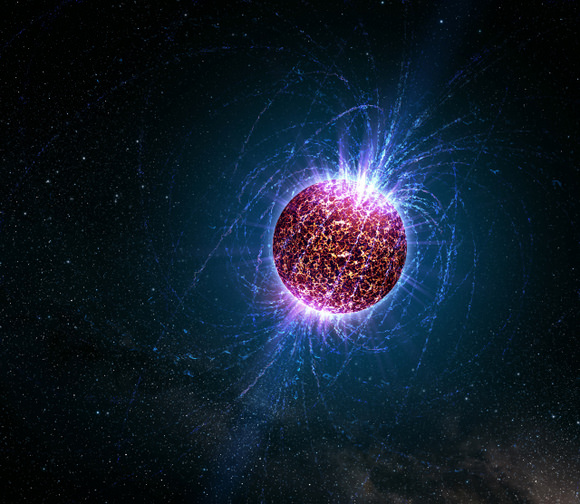
As you know, neutron stars are formed when stars more massive than our Sun explode as supernovae. When these stars die, they no longer have the light pressure pushing outward to counteract the massive gravity pulling inward.
This enormous inward force is so strong that it overcomes the repulsive force that keeps atoms from collapsing. Protons and electrons are forced into the same space, becoming neutrons. The whole thing is just made of neutrons. Did the star have hydrogen, helium, carbon and iron before? That’s too bad, because now it’s all neutrons.
You get pulsars when neutron stars first form. When all that former star is compressed into a teeny tiny package. The conservation of angular motion spins the star up to tremendous velocities, sometimes hundreds of times a second.
But when neutron stars form, about one in ten does something really really strange, becoming one of the most mysterious and terrifying objects in the Universe. They become magnetars. You’ve probably heard the name, but what are they?
As I said, magnetars are neutron stars, formed from supernovae. But something unusual happens as they form, spinning up their magnetic field to an intense level. In fact, astronomers aren’t exactly sure what happens to make them so strong.
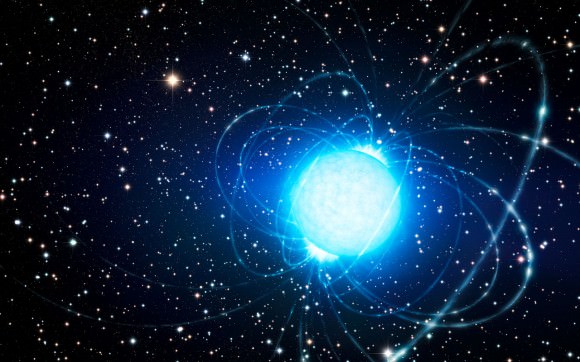
One idea is that if you get the spin, temperature and magnetic field of a neutron star into a perfect sweet spot, it sets off a dynamo mechanism that amplifies the magnetic field by a factor of a thousand.
But a more recent discovery gives a tantalizing clue for how they form. Astronomers discovered a rogue magnetar on an escape trajectory out of the Milky Way. We’ve seen stars like this, and they’re ejected when one star in a binary system detonates as a supernova. In other words, this magnetar used to be part of a binary pair.
And while they were partners, the two stars orbited one another closer than the Earth orbits the Sun. This close, they could transfer material back and forth. The larger star began to die first, puffing out and transferring material to the smaller star. This increased mass spun the smaller star up to the point that it grew larger and spewed material back at the first star.
The initially smaller star detonated as a supernova first, ejecting the other star into this escape trajectory, and then the second went off, but instead of forming a regular neutron star, all these binary interactions turned it into a magnetar. There you go, mystery maybe solved?
The strength of the magnetic field around a magnetar completely boggles the imagination. The magnetic field of the Earth’s core is about 25 gauss, and here on the surface, we experience less than half a gauss. A regular bar magnet is about 100 gauss. Just a regular neutron star has a magnetic field of a trillion gauss. Magnetars are 1,000 times more powerful than that, with a magnetic field of a quadrillion gauss.
What if you could get close to a magnetar? Well, within about 1,000 kilometers of a magnetar, the magnetic field is so strong it messes with the electrons in your atoms. You would literally be torn apart at an atomic level. Even the atoms themselves are deformed into rod-like shapes, no longer usable by your precious life’s chemistry.
But you wouldn’t notice because you’d already be dead from the intense radiation streaming from the magnetar, and all the lethal particles orbiting the star and trapped in its magnetic field.
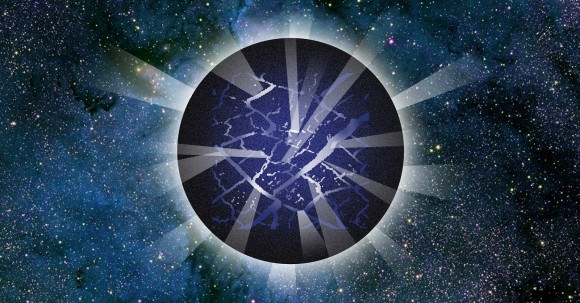
One of the most fascinating aspects of magnetars is how they can have starquakes. You know, earthquakes, but on stars… starquakes. When neutron stars form, they can have a delicious murder crust on the outside, surrounding the degenerate death matter inside. This crust of neutrons can crack, like the tectonic plates on Earth. As this happens, the magnetar releases a blast of radiation that we can see clear across the Milky Way.
In fact, the most powerful starquake ever recorded came from a magnetar called SGR 1806-20, located about 50,000 light years away. In a tenth of a second, one of these starquakes released more energy than the Sun gives off in 100,000 years. And this wasn’t even a supernova, it was merely a crack on the magnetar’s surface.
Magnetars are awesome, and provide the absolute opposite end of the spectrum for a safe and habitable Universe. Fortunately, they’re really far away and you won’t have to worry about them ever getting close.
So cool.., a type of star named after a super hero!
http://i.annihil.us/u/prod/marvel//universe3zx/images/9/90/Magneto_430.jpg