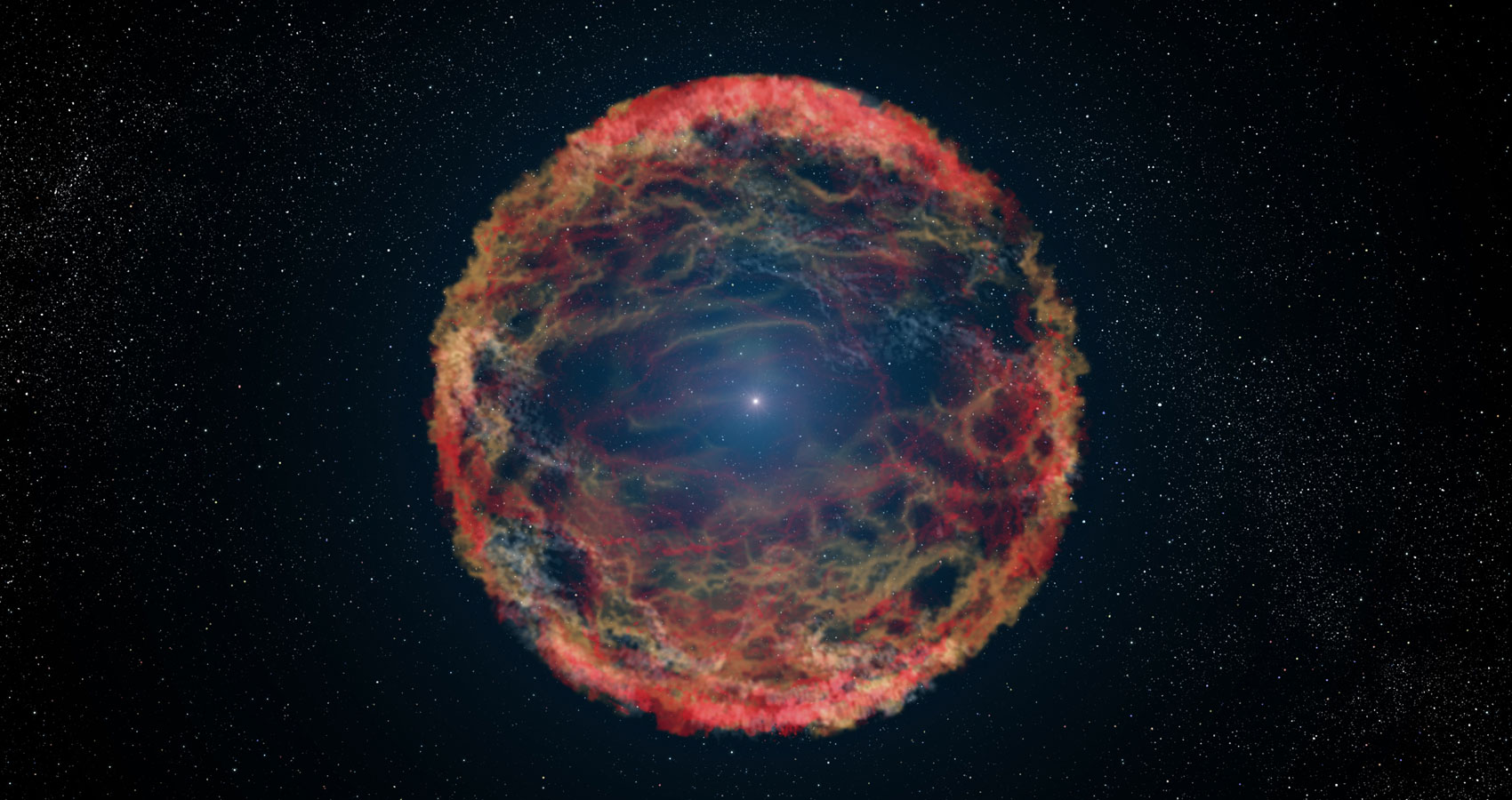
Artist's impression of a supernova remnant. Credit: ESA/Hubble
Supernovae are relatively rare. It might not seem like it, but that’s because they’re so bright we can see them in other galaxies a great distance away. In fact, in 2022, astronomers spotted a supernova over 10 billion light-years away.
Any time astronomers spot a supernova, it’s an opportunity to learn more about these rare, cataclysmic explosions. It’s especially valuable if astronomers can get a good look at the progenitor star before it explodes.
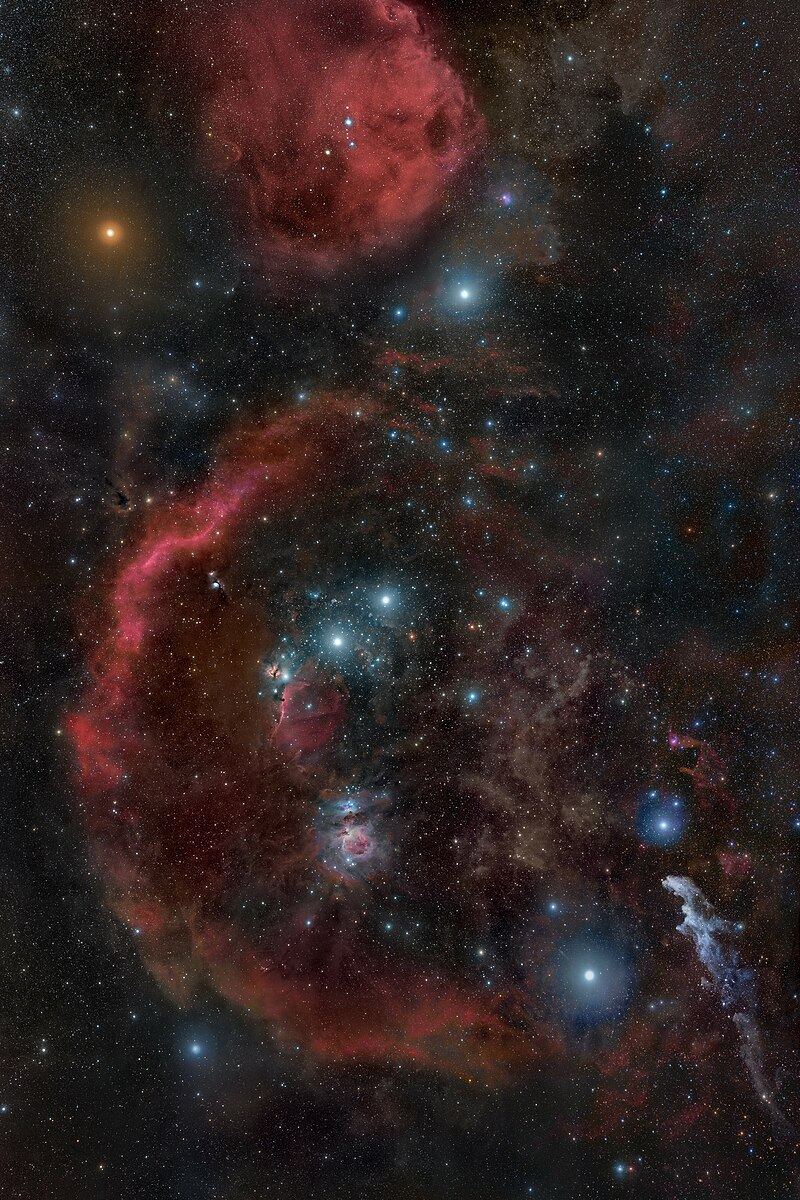
Orion and the molecular cloud covering the region. Betelgeuse is the red star in the upper left. (Credit : Rogelio Bernal Andreo)
When a prominent star in the night sky suddenly dims, it generates a lot of interest. That’s what happened with the red supergiant star Betelgeuse between November 2019 and May 2020. Betelgeuse will eventually explode as a supernova. Was the dimming a signal that the explosion was imminent?
The interior structure of the Sun. Credit: Wikipedia Commons/kelvinsong
From here on Earth, the Sun like a smooth ball of light. And prior to Galileo’s discovery of sunposts, astronomers even thought it was a perfect orb with no imperfections. However, thanks to improved instruments and many centuries of study, we know that the Sun is much like the planets of our Solar System.
In addition to imperfections on its surface, the Sun is also made up of several layers, each of which serves its own purpose. It’s this structure of the Sun that powers this massive engine that provides the planets with all the light and heat they receive. And here on Earth, it is what provides all life forms with the energy they need to thrive and survive.
Composition:
If you could take the Sun apart, and stack up its various elements, you would find that the Sun is made of hydrogen (74%) and helium (about 24%). Astronomers consider anything heavier than helium to be a metal. The remaining amount of the Sun is made of iron, nickel, oxygen, silicon, sulfur, magnesium, carbon, neon, calcium and chromium. In fact, the Sun is 1% oxygen; and everything else comes out of that last 1%.
Where did these elements come from? The hydrogen and helium came from the Big Bang. In the early moments of the Universe, the first element, hydrogen, formed from the soup of elementary particles. The pressure and temperatures were still so intense that the entire Universe had the same conditions as the core of a star.
Hydrogen was fused into helium until the Universe cooled down enough that this reaction couldn’t happen any more. The ratios of hydrogen and helium that we see in the Universe today were created in those first few moments after the Big Bang. The other elements were created in other stars. Stars are constantly fusing hydrogen into helium in their cores.
Once the hydrogen in the core runs out, they switch to fusing heavier and heavier elements, like helium, lithium, oxygen. Most of the heavier metals we see in the Sun were formed in other stars at the end of their lives. The heaviest elements, like gold and uranium, were formed when stars many times more massive that our Sun detonated in supernova explosions.
In a fraction of a second, as a black hole was forming, elements were crushed together in the intense heat and pressure to form the heaviest elements. The explosion scattered these elements across the region, where they could contribute to the formation of new stars.
Our Sun is made up of elements left over from the Big Bang, elements formed from dying stars, and elements created in supernovae. That’s pretty amazing.
Structure:
Although the Sun is mostly just a ball of hydrogen and helium, it’s actually broken up into distinct layers. The layers of the Sun are created because the temperatures and pressures increase as you move towards the center of the Sun. The hydrogen and helium behave differently under the changing conditions.
The Core: Let’s start at the innermost layer of the Sun, the core of the Sun. This is the very center of the Sun, where temperatures and pressures are so high that fusion can happen. The Sun is combining hydrogen into helium atoms, and this reaction gives off the light and heat that we see here on Earth. The density of the core is 150 times the density of water, and the temperatures are thought to be 13,600,000 degrees Kelvin.
Astronomers believe that the core of the Sun extends from the center out to about 0.2 solar radius. And within this region, temperatures and pressures are so high that hydrogen atoms are torn apart to form separate protons, neutrons and electrons. With all of these free floating particles, the Sun is able to reform them into atoms of helium.
This reaction is exothermic. That means that the reaction gives off a tremendous amount of heat – 3.89 x 1033 ergs of energy every second. The light pressure of all this energy streaming from the core of the Sun is what stops it from collapsing inward on itself.
Radiative Zone: The radiative zone of the Sun starts at the edge of the core of the Sun (0.2 solar radii), and extends up to about 0.7 radii. Within the radiative zone, the solar material is hot and dense enough that thermal radiation transfers the heat of the core outward through the Sun.
The core of the Sun is where nuclear fusion reactions are happening – protons are merged together to create atoms of helium. This reaction produces a tremendous amount of gamma radiation. These photons of energy are emitted, absorbed, and then emitted again by various particles in the radiative zone.
The path that photons take is called the “random walk”. Instead of going in a straight beam of light, they travel in a zigzag direction, eventually reaching the surface of the Sun. In fact, it can take a single photon upwards of 200,000 years to make the journey through the radiative zone of the Sun.
As they transfer from particle to particle, the photons lose energy. That’s a good thing, since we wouldn’t want only gamma radiation streaming from the Sun. Once these photons reach space, they take a mere 8 minutes to get to Earth.
Most stars will have radiative zones, but their size depends on the star’s size. Small stars will have much smaller radiative zones, and the convective zone will take up a larger portion of the star’s interior. The smallest stars might not have a radiative zone at all, with the convective zone reaching all the way down to the core. The largest stars would have the opposite situation, where the radiative zone reaches all the way up to the surface.
Convective Zone: Outside the radiative zone is another layer, called the convective zone, where heat from inside the Sun is carried up by columns of hot gas. Most stars have a convective zone. In the case of the Sun, it starts at around 70% of the Sun’s radius and goes to the outer surface (the photosphere).
Gas deeper inside the star is heated up so that it rises, like globs of wax in a lava lamp. As it gets to the surface, the gas loses some of its heat, cools down, and sinks back towards the center to pick up more heat. Another example would be a pot of boiling water on the stove.
The surface of the Sun looks granulated. These granules are the columns of hot gas that carry heat to the surface. They can be more than 1,000 km across, and typically last about 8 to 20 minutes before dissipating. Astronomers think that low mass stars, like red dwarfs, have a convective zone that goes all the way down to the core. Unlike the Sun, they don’t have a radiative zone at all.
Photosphere: The layer of the Sun that we can see from Earth is called the photosphere. Below the photosphere, the Sun becomes opaque to visible light, and astronomers have to use other methods to probe its interior. The temperature of the photosphere is about 6,000 Kelvin, and gives off the yellow-white light that we see.
Above the photosphere is the atmosphere of the Sun. Perhaps the most dramatic of these is the corona, which is visible during a total solar eclipse.
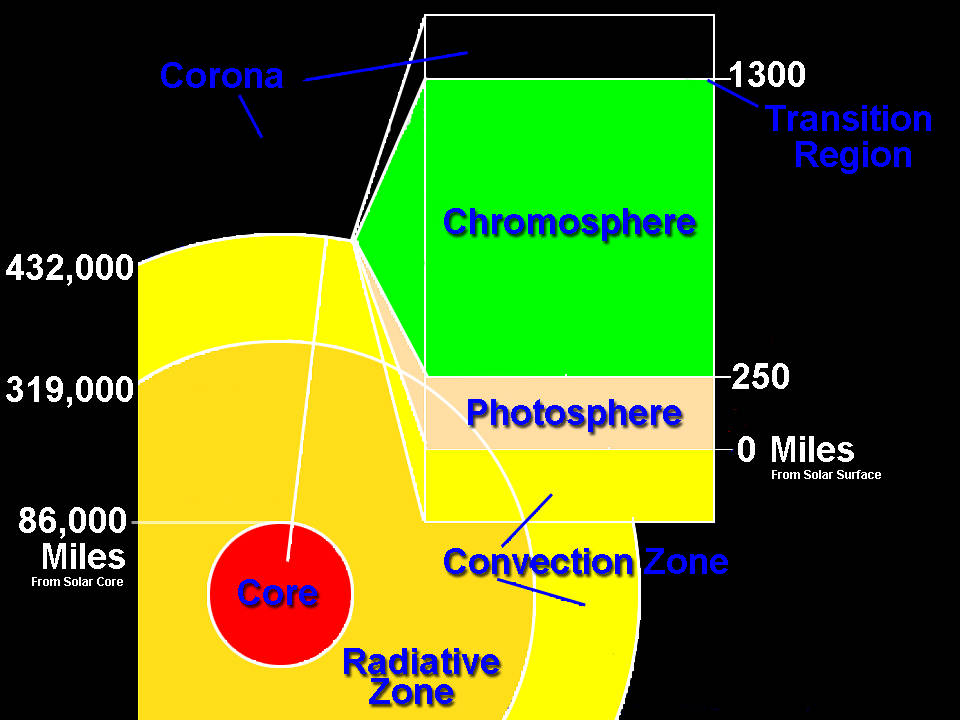
Graphic showing a model of the layers of the Sun, with approximate mileage ranges for each layer. Credit: NASA
Diagram:
Below is a diagram of the Sun, originally developed by NASA for educational purposes.
Visible, IR and UV radiation – The light that we see coming from the Sun is visible, but if you close your eyes and just feel the warmth, that’s IR, or infrared radiation. And the light that gives you a sunburn is ultraviolet (UV) radiation. The Sun produces all of these wavelengths at the same time.
Photosphere 6000 K – The photosphere is the surface of the Sun. This is the region where light from the interior finally reaches space. The temperature is 6000 K, which is the same as 5,700 degrees C.
Photosphere 6000 K – The photosphere is the surface of the Sun. This is the region where light from the interior finally reaches space. The temperature is 6000 K, which is the same as 5,700 degrees C.
Radio emissions – In addition to visible, IR and UV, the Sun also gives off radio emissions, which can be detected by a radio telescope. These emissions rise and fall depending on the number of sunspots on the surface of the Sun.
Coronal Hole – These are regions on the Sun where the corona is cooler, darker and has less dense plasma.
2100000 – This is the temperature of the Sun’s radiative zone.
Convective zone/Turbulent convection – This is the region of the Sun where heat from the core is transferred through convection. Warm columns of plasma rise to the surface in columns, release their heat and then fall back down to heat up again.
Coronal loops – These are loops of plasma in the Sun’s atmosphere that follows magnetic flux lines. They look like big arches, stretching up from the surface of the Sun for hundreds of thousands of kilometers.
Core – The is the heart of the Sun, where the temperatures and pressures are so high that nuclear fusion reactions can happen. All of the energy coming from the Sun originates from the core.
14500000 K – The temperature of the core of the Sun.
Radiative Zone – The region of the Sun where energy can only be transferred through radiation. It can take a single photon 200,000 years to get from the core, through the radiative zone, out to the surface and into space.
Neutrinos – Neutrinos are nearly mass-less particles blasted out from the Sun as part of the fusion reactions. There are millions of neutrinos passing through your body every second, but they don’t interact, so you can’t feel them.
Chromospheric Flare – The Sun’s magnetic field can get twisted up and then snap into a different configuration. When this happens, there can be powerful X-ray flares emanating from the surface of the Sun.
Magnetic Field Loop – The Sun’s magnetic field extends out above its surface, and can be seen because hot plasma in the atmosphere follows the field lines.
Spot – A sunspot. These are areas on the Sun’s surface where the magnetic field lines pierce the surface of the Sun, and they’re relatively cooler than the surrounding areas.
Prominence – A bright feature that extends above the surface of the Sun, often in the shape of a loop.
Energetic particles – There can be energetic particles blasting off the surface of the Sun to create the solar wind. In solar storms, energetic protons can be accelerated to nearly the speed of light.
X-rays – In addition to the wavelengths we can see, there are invisible X-rays coming from the Sun, especially during flares. The Earth’s atmosphere protects us from this radiation.
Bright spots and short-lived magnetic regions – The surface of the Sun has many brighter and dimmer spots caused by changing temperature. The temperature changes from the constantly shifting magnetic field.
Yes, the Sun is like an onion. Peel back one layer and you’ll find many more. But in this case, each layers is responsible for a different function. And what they add to is a giant furnace and light source that keeps us living beings here on Earth warm and illuminated!
And be sure to enjoy this video from the NASA Goddard Center, titled “Snapshots from the Edge of the Sun”:
The Sun provides energy for life here on Earth through light and heat. Credit: NASA Goddard Space Flight Center
There is a reason life that Earth is the only place in the Solar System where life is known to be able to live and thrive. Granted, scientists believe that there may be microbial or even aquatic life forms living beneath the icy surfaces of Europa and Enceladus, or in the methane lakes on Titan. But for the time being, Earth remains the only place that we know of that has all the right conditions for life to exist.
One of the reasons for this is because the Earth lies within our Sun’s Habitable Zone (aka. “Goldilocks Zone”). This means that it is in right spot (neither too close nor too far) to receive the Sun’s abundant energy, which includes the light and heat that is essential for chemical reactions. But how exactly does our Sun go about producing this energy? What steps are involved, and how does it get to us here on planet Earth?
An innovative solar observatory is adding a key piece to the puzzle of the enigma that is our Sun.
Its two of key questions in heliophysics: why does our Sun have a corona? And why is the temperature of the corona actually higher than the surface of the Sun?
This week, researchers released results from the preliminary first six months of data from NASA’s Interface Region Imaging Spectrograph, known as IRIS. The findings were presented at the Fall American Geophysical Union Meeting this past Monday.
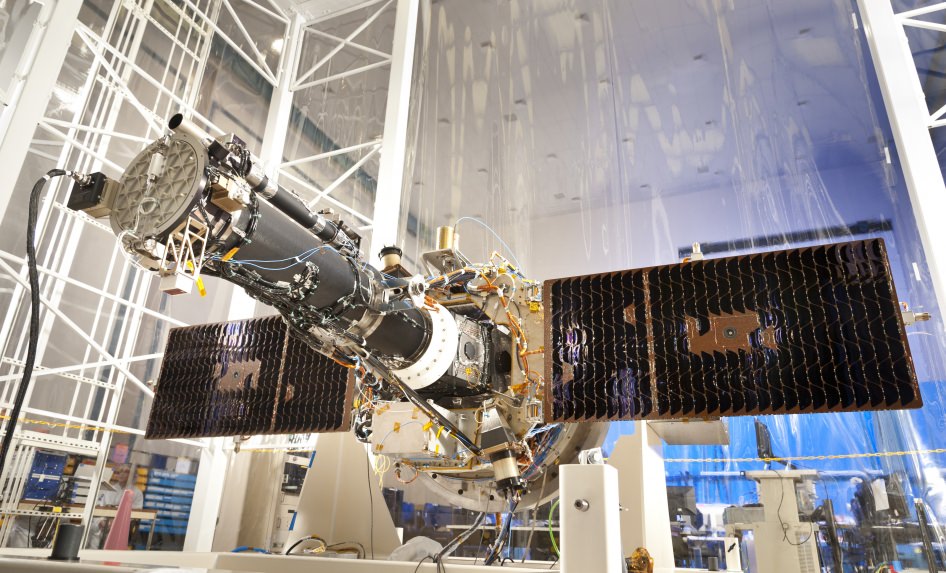
IRIS was launched on June 27th of this year on a Pegasus-XL rocket deployed from the belly of a Lockheed L-1011 aircraft flying out of Vandenberg Air Force Base. IRIS can focus in on a very specific interface region of the Sun sandwiched between the dazzling solar photosphere and the transition to the corona. To accomplish this, IRIS employs an ultraviolet slit spectrograph looking at ionized gas spectra.
IRIS in the clean room. The spacecraft is only about 2 metres in length, about the height of a person. (Credit: Lockheed Martin).
“The quality of images and spectra we are receiving is amazing,” IRIS Principal Investigator Alan Title said in a recent press release from the NASA Goddard Space Flight Center. While other missions may take over a decade to go from the drawing board to the launch pad, IRIS was developed and deployed into Low Earth Orbit in just 44 months.
IRIS offers scientists a new tool to probe the Sun and a complimentary instrument to platforms such as Hinode, the Solar Heliospheric Observatory (SOHO) and NASA’s Solar Dynamics Observatory. In fact, IRIS has a better resolution than SDO’s AIA imagers or Hinode when it comes to this key solar interface region. IRIS has a 20x greater resolution in time, and 25x the spatial resolution of any former space-based UV spectrometer deployed.
“We are seeing rich and unprecedented images of violent events in which gases are accelerated to very high velocities while being rapidly heated to hundreds of thousands of degrees,” said Lockheed Martin science lead on the IRIS mission Bart De Pontieu. These observations are key to backing up theoretical models of solar dynamics as well as testing and formulating new ones of how our Sun works.
IRIS bridges this crucial gap between the photosphere and the lower chromosphere of the Sun. While the solar surface roils at relatively placid 6,000 degrees Celsius, temperatures rise into the range of 2-3 million degrees Celsius as you move up through the transition region and into the corona.
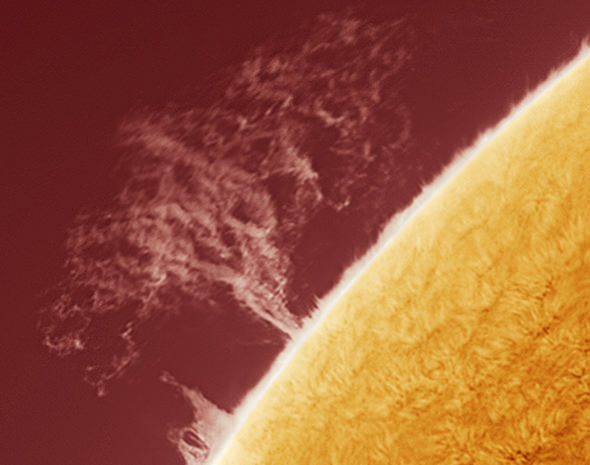
Two key solar phenomena that are of concern to solar researchers can be examined by IRIS in detail. One is the formation of prominences, which show up as long looping swirls of solar material rising up from the surface of the Sun. Prominences can be seen from backyard telescopes at hydrogen alpha wavelengths. IRIS can catch and track their early modeling with unprecedented resolution. Images released from IRIS show the fine structure of targeted prominences as they evolve and rise off the surface of the Sun. When a prominence and accompanying coronal mass ejection is launched in our direction, disruption of our local space environment caused by massive solar storm can result.
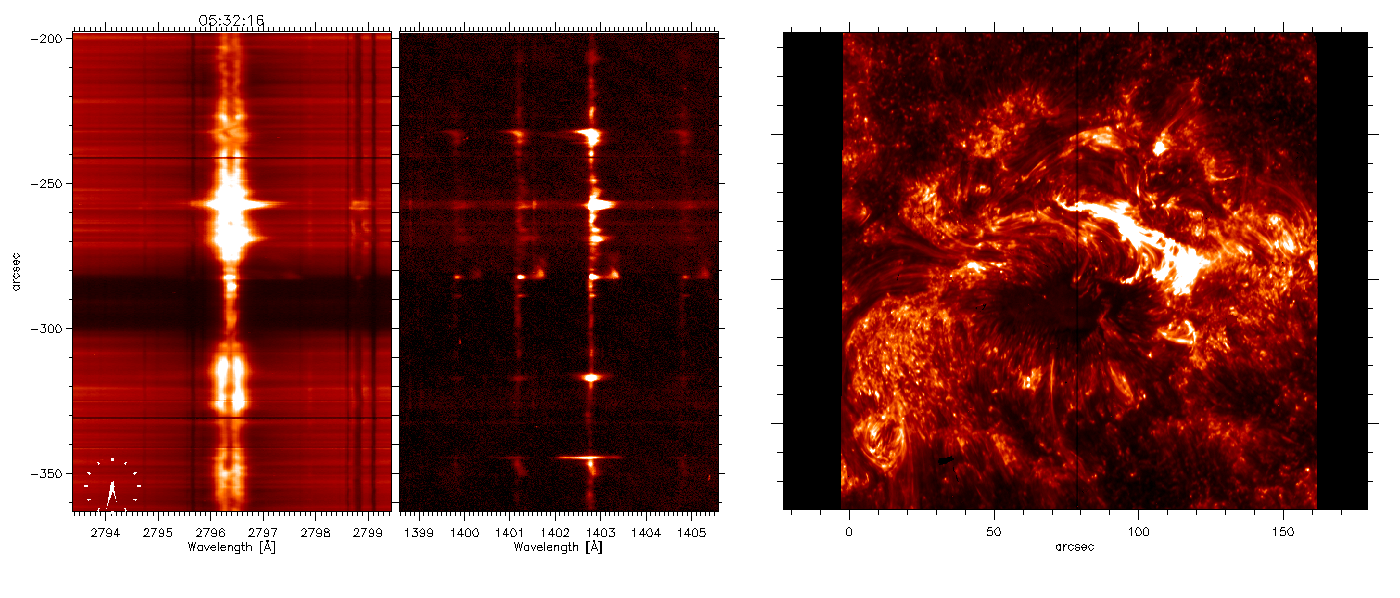
Slit jaw spectra images (the two strips to the left) and imaging of spicules (to the right) as seen by IRIS. (Credit: NASA/IRIS).
The second phenomenon targeted by IRIS is the formation of spicules, which are giant columns of gas rising from the photosphere. Although the spicules look like hair-fine structures through Earth-based solar telescopes, they can be several hundred kilometres wide and as long as the Earth. Short-lived, spicules race up from the surface of the Sun at up to 240,000 kilometres per hour and seem to play a key role in energy and heat transfer from the solar surface up through the atmosphere. IRIS is giving us a view of the evolution of spicules for the first time, and they’re proving to be even more complex than theory previously suggested.
“We see discrepancies between these observations and the models, and that is great news for advancing knowledge. By seeing something we don’t understand, we have a chance of learning something new,” Said University of Oslo astrophysicist Mats Carlsson.
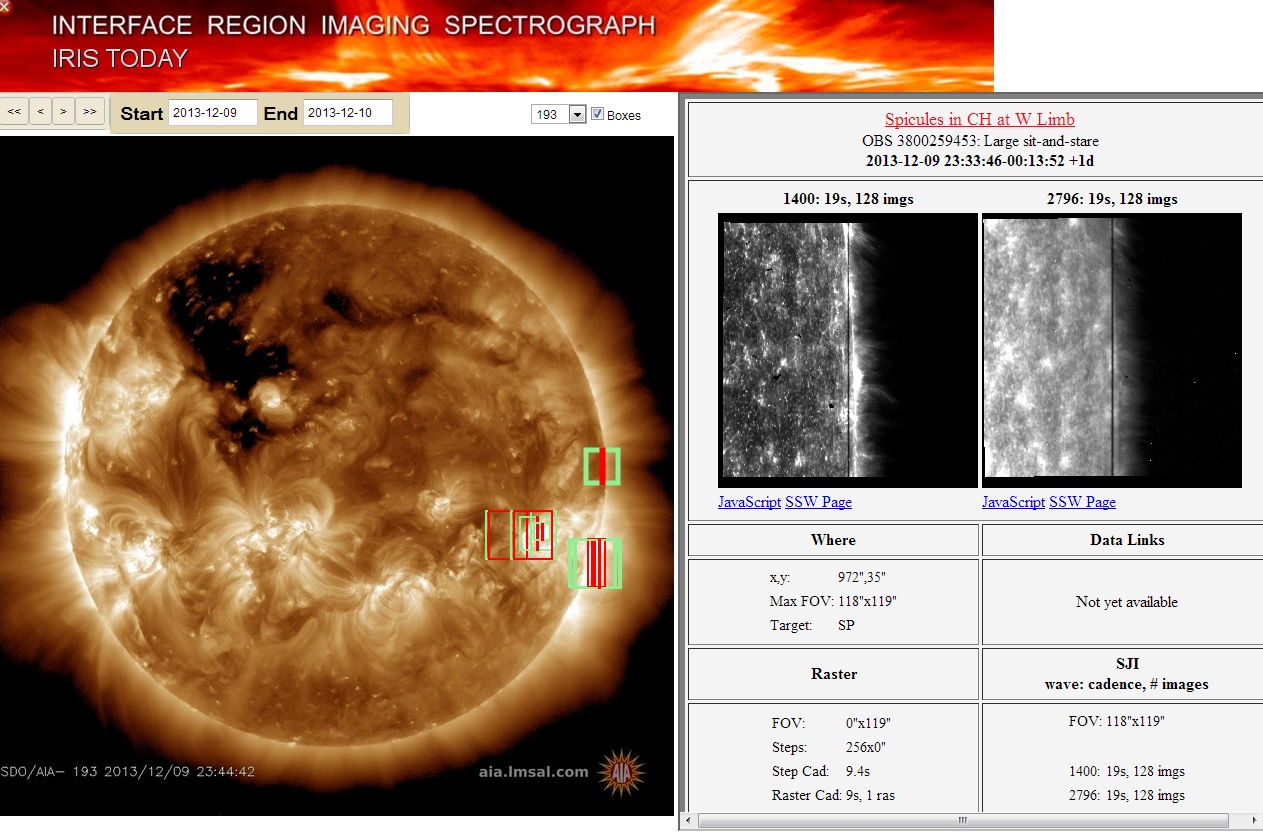
Like SDO and SOHO, data and images from IRIS are free for the public to access online. Though the field of view for IRIS is a narrow 2’ to 4’ arc minutes on a side – the solar disk spans about 30’ as seen from the Earth – IRIS gives us a refined view of “where the action is.”
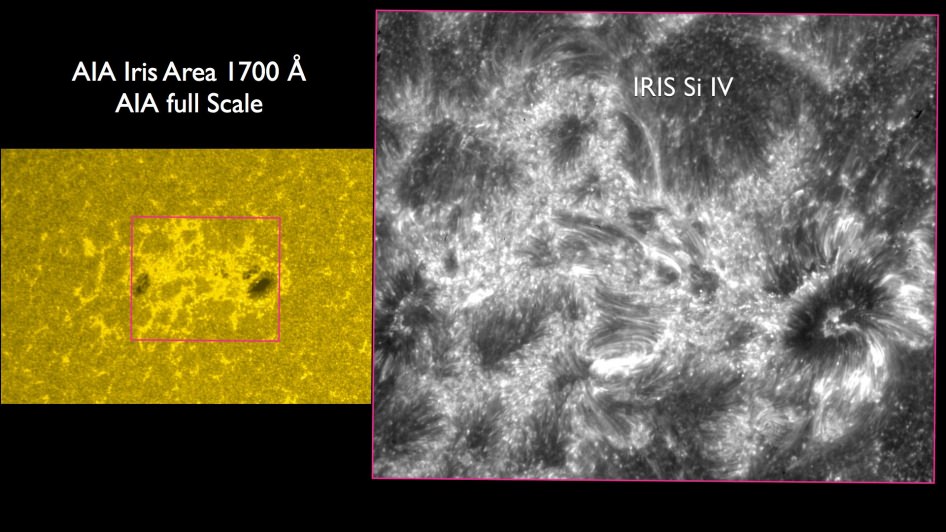
Where is IRIS looking? This snapshot gives some context of the IRIS field of view (green and red boxes) and black and white insets versus SDO’s AIA full disk view of the Sun. (Credit: NASA/SDO/IRIS).
And this all comes at an interesting time, as our nearest star crosses the sputtering solar maximum for Cycle #24.
The equivalent of 50 million CPU hours were utilized in constructing and modeling what IRIS sees. The reconstruction was an international effort, spanning the Partnership for Advanced Computing in Europe, the Norwegian supercomputing collaboration, and NASA’s Ames Research Center.
IRIS also faced the additional challenge of weathering a 2.5 week period of inactivity due to the U.S. government shutdown this fall. Potential impacts due to sequestration remain an issue, though small explorer missions such as IRIS demonstrate how we can do more with less.
“We’ve made a giant step forward in characterizing the heat transfer properties of this region between the visible surface and the corona, which is key to understanding how the outer atmosphere of the Sun exists, and is key to understanding the outer atmosphere that the Earth lies in,” said Alan Title, referring to the tenuous heliosphere of the Sun extending out through the solar system.
Understanding the inner working of our Sun is vital: no other astronomical body has as big an impact on life here on Earth.
IRIS is slated for a two-year mission, though as is the case with most space-based platforms, researchers will work to get every bit of usefulness out of the spacecraft that they can. And it’s already returning some first-rate science at a relatively low production cost. This is all knowledge that will help us as a civilization live with and understand our often tempestuous star.
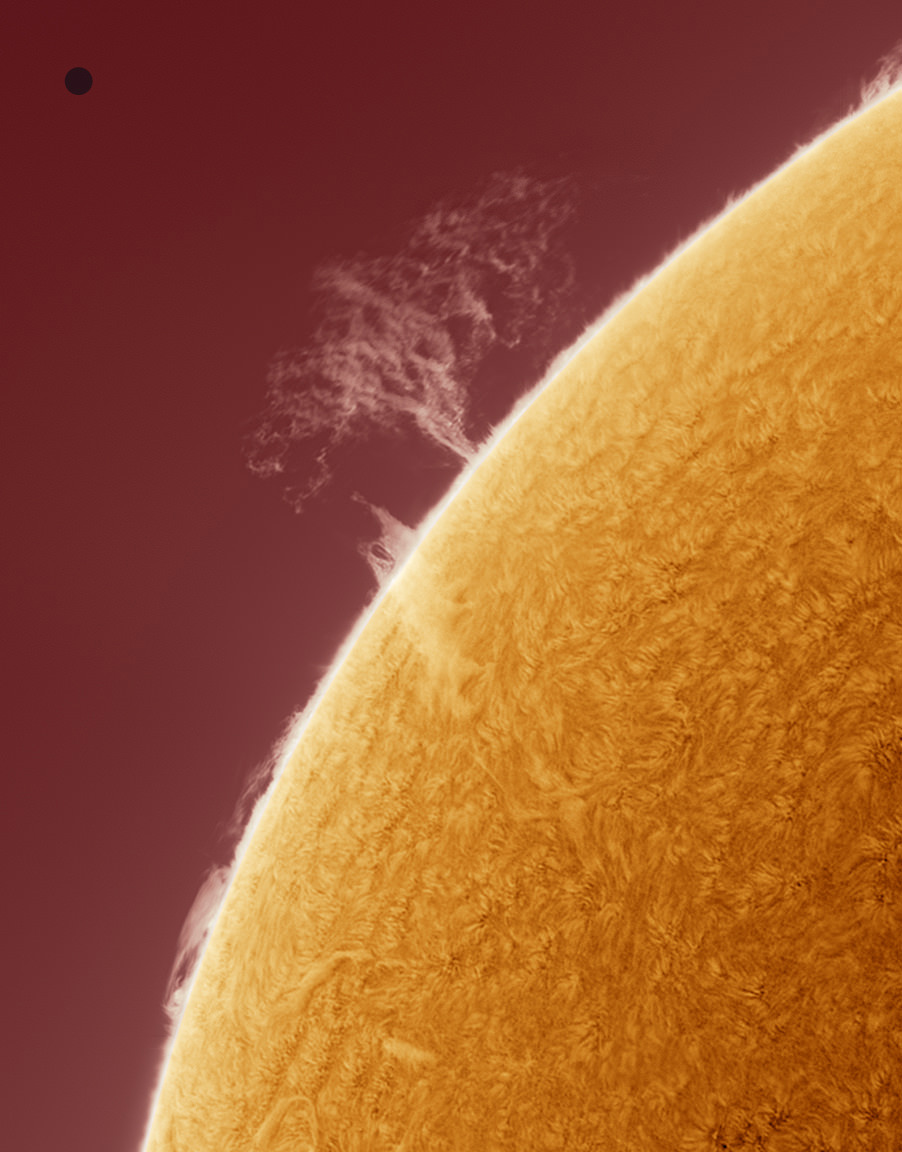
An enormous tree-shaped prominence spreads its “branches” tens of thousands of miles above the Sun’s photosphere in this image, a section of a photo acquired in hydrogen alpha (Ha) by Alan Friedman last week from his backyard in Buffalo, NY.
Writes Alan on his blog, “gotta love a sunny day in November!”
Check out the full image — along with an idea of just how big this “tree” is — after the jump:
Taken through a special solar telescope and a Grasshopper CCD camera, Alan’s gorgeous solar photos show the Sun in a wavelength absorbed by atomic hydrogen — most present in the photosphere and chromosphere — thus revealing the complex and dynamic activity of the Sun’s “surface”.
Here’s the full image:
The dark circle at upper left (added by me) shows approximately the scale size of Earth (12,756 km, or about 7,926 miles diameter.) As you can see, that particular prominence is easily six times that in altitude, and spreads out many more times wider… and this isn’t even a particularly large prominence! As far as solar activity goes, this is a non-event. (Not like what was seen by SDO on Nov. 16!)
Regardless, it makes for an impressive backyard photo.
Check out more of Alan’s photos on his blog and on his website, AvertedImagination.com. Many of his photos, some of which have been shown at galleries across the U.S., are available as limited-edition prints. (Alan also runs a greeting card print studio.) I’ve found that he usually shares at least a couple of fantastic solar shots every month, if not more.
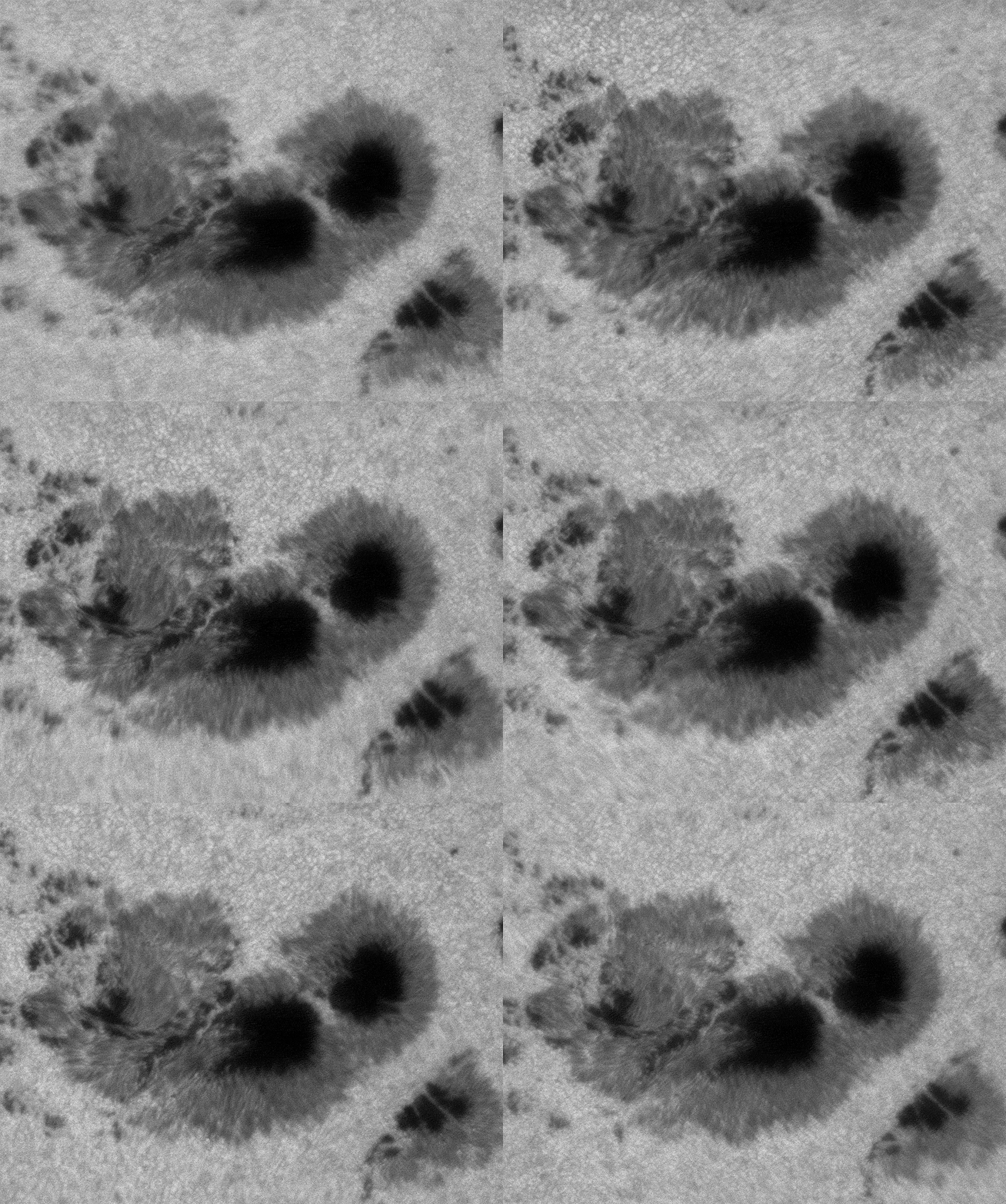
This quick animation made by astrophotographer Alan Friedman shows a 30-minute view of sunspot 1520, a large region of magnetic activity on the Sun that’s currently aimed directly at Earth. Although 1520 has been quiet for the past couple of days, it’s loaded with a delta-class magnetic field — just right for launching powerful X-class flares our way. There’s no guarantee that it will, but then there’s no guarantee that it won’t either.
(Click the image to play the animation.)
Alan captured the images from his location in upstate New York using a 10″ Astro-Physics scope and PGR Grasshopper CCD. A master at solar photography — several of his hydrogen alpha images have been featured here on Universe Today as well as other popular astronomy news sites — Alan’s work never fails to impress.
A static, color version of sunspot 1520 can be seen here… what Alan calls “a magnetic beauty.”
Although the sunspots don’t change much over the course of the animation, the surrounding texture on the Sun’s photosphere can be seen to shift and move rapidly. These bright kernels are called granules, and are created by convective currents on the Sun. An individual granule typically lasts anywhere from 8 to 20 minutes and can be over 600 miles (1000 km) across.
The overall wavering effect is caused by distortion from Earth’s atmosphere.
While 1520 is facing Earth we’re subject to any flares or CMEs that may erupt from it, potentially sending a solar storm our way. In another week or so it will have rotated safely around the Sun’s limb and eventually dissipate altogether… but then, it is solar maximum and so there’s likely to be more active regions just like it (or even larger!) coming around the bend.
When they do come, there’s a good chance that Alan will grab some pics of those too.
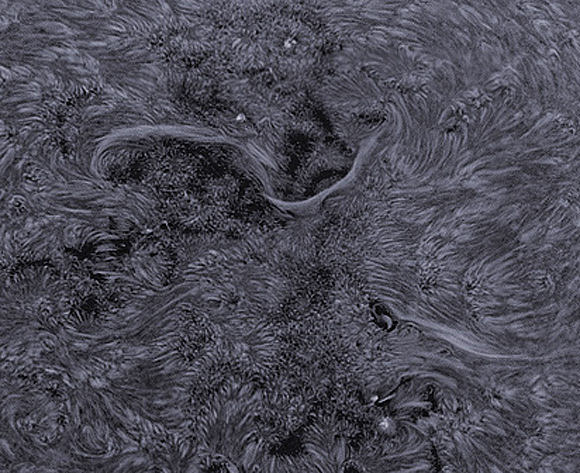
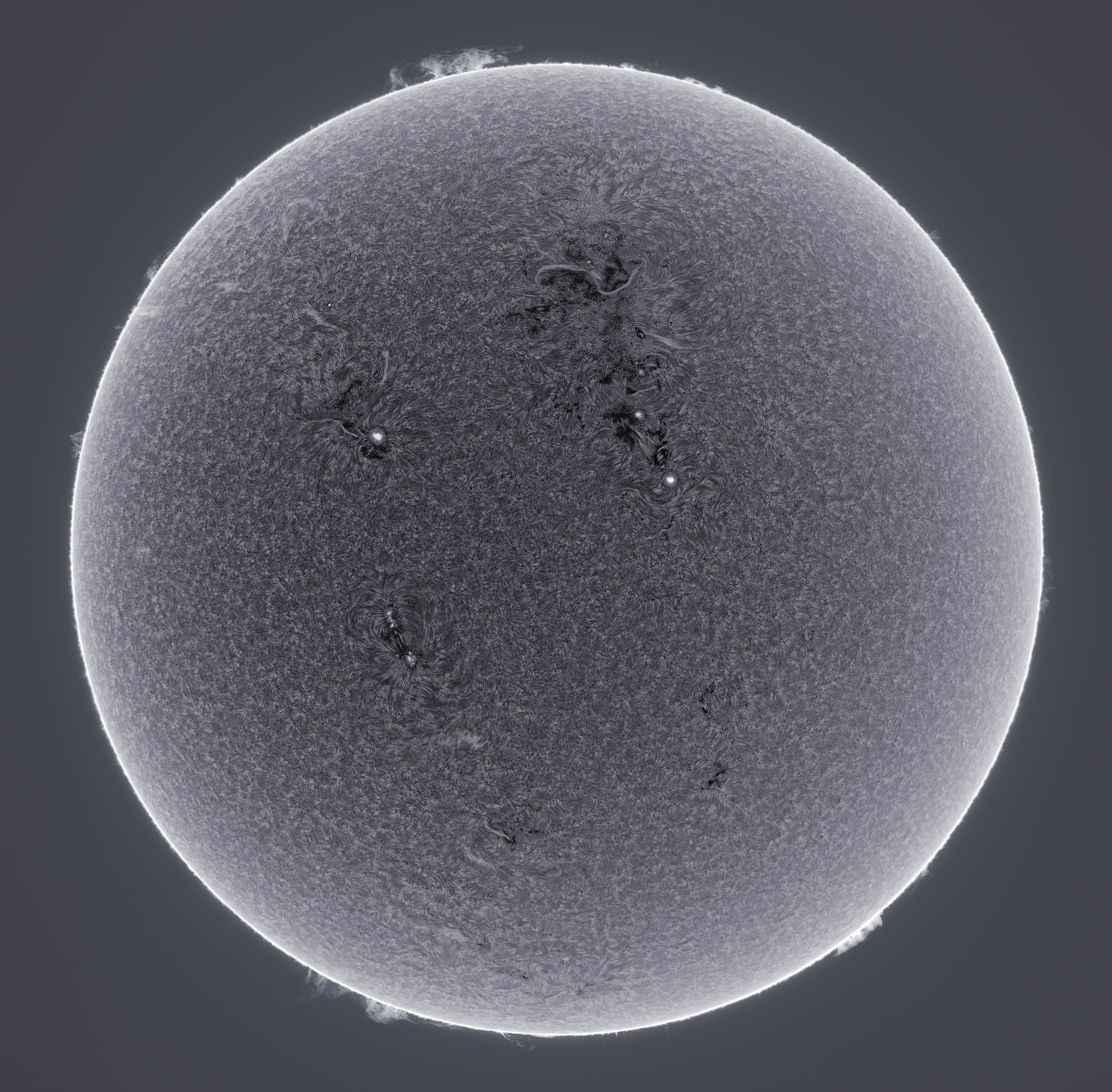
Looking like an intricate pen-and-ink illustration, the complex and beautiful structures of the Sun’s surface come to life in yet another stunning photo by Alan Freidman, captured from the historic Mount Wilson Observatory near Los Angeles, California.
Click below for the full-size image in all its hydrogen alpha glory.
An oft-demonstrated master of solar photography, Alan took the image above while preparing for the transit of Venus on June 5 — which he also skillfully captured on camera (see a video below).
Hydrogen is the most abundant element found on the sun. The sun’s “surface” and the layer just above it — the photosphere and chromosphere, respectively — are regions where atomic hydrogen exists profusely in upper-state form. It’s these absorption layers that hydrogen alpha imaging reveals in detail.
The images above are “negatives”… check out a “positive” version of the same image here.
” The seeing was superb… definitely the best of the visit and among the best solar conditions I’ve ever experienced,” Alan writes on his blog.
The video below was made by Alan on June 5, showing Venus transiting the Sun while both passed behind a tower visible from the Observatory.
Alan’s work is always a treat… see more of his astrophotography on his website AvertedImagination.com.