
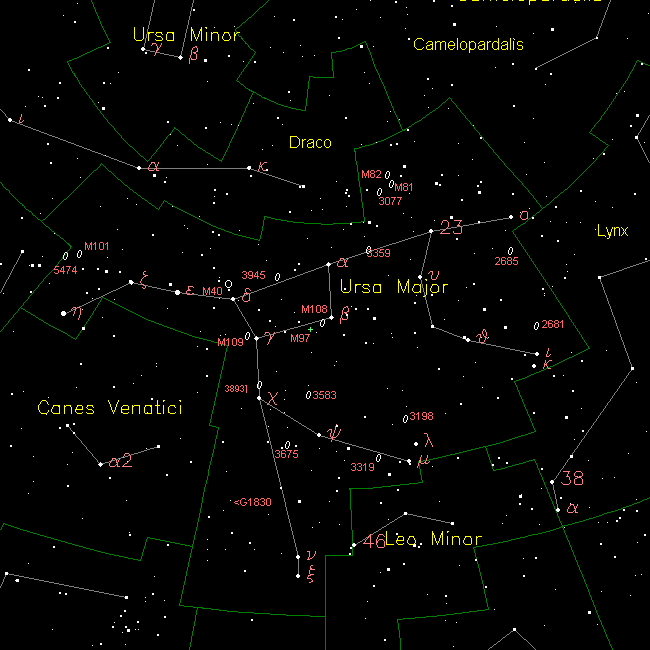
[/caption]
The northern circumpolar constellation of Ursa Major is perhaps one of the oldest and most recognized of all. Listed by Ptolemy as one of the original 48 constellations, it has played a role in all cultures and civilizations – even recorded in historic literature, such as the works of Homer, Spenser, Shakespeare and Tennyson. Ursa Major has been depicted by Vincent Van Gogh and mentioned in the Bible. Its primary asterism is formed by anywhere from 7 to 20 stars (depending on how many you wish to include) and it contains 93 Bayer Flamsteed designated stars within its borders. It covers an expansive 1280 degrees of sky, ranking third in size. Ursa Major is bordered by the constellations of Draco, Camelopardalis, Lynx, Leo Minor, Leo, Coma Berenices, Canes Venatici and Bootes. It is visible to all observers located at latitudes between +90° and ?30° and is best seen at culmination during the month of April.
According to Greek mythology, the god Zeus once desired a woman named Kallisto. Quite understandably, his wife Hera became jealous and turned Kallisto into a bear. In the meantime, Kallisto’s son, Artemis, almost shoots his mother by accident while hunting. In order to avert tragedy, Zeus turns them both into stars and sets them in the sky. Despite the Greek tale, a resounding amount of cultures also recognized this constellation as being a bear – including many native American Indian tribes, the Jewish culture and more. No matter if you can “see” the bear in the stars or not, the seven brightest stars of Ursa Major form the well-known asterism known as the “Big Dipper” (as it is called in the United States) or the Plough (as it is referred to in the United Kingdom and Ireland). The Big Dipper constellation also played a very important role in the Underground Railroad which helped slaves escape from the South before the Civil War. By connecting the stellar patterns, escapees could easily follow the stars north and there were songs quietly passed among the slave population which told of the “Drinking Gourd” and how to follow its light.
Before we begin our binocular tour, let’s start first with a visual tour – because this asterism of stars is very significant in its own right. With the exception of Alpha (Dubhe) and Eta (Alkaid), these bright stars are all part of a stellar association known as the Ursa Major Moving Group. This means all of these stars share the same proper motion – heading towards a common point in Sagittarius. As a collective – along with several other stars – the group is known as Collinder 285 and is roughly 80 light years away from Earth. The Ursa Major Moving Group was discovered in 1869 by Richard A. Proctor, and may once have been a part of a much larger open star cluster.
Now, turn your attention towards the star in the center of the handle of the Dipper – Zeta – the squiggle on our chart. If you can resolve this close set of stars with just your unaided vision, then you’d be riding a horse in the Arab army! Collectively this pair is known as Mizar and Alcor, the “Horse and Rider”… and splitting them visually was once used as an eyesight test. Take a look in binoculars to easily split this optical double star – and then take a closer look in a telescope! Mizar, the brighter of the two, is true binary star system. Both the primary star – and the 4th magnitude secondary star are also spectroscopic binary stars, too… making it a four star system located about 78 light-years away. While Mizar and Alcor aren’t gravitationally bound to each other, they still share common ground. Separated by only about 3 light years, this pair also shares proper motion and belongs to the Ursa Major Moving Group!
Before we move on to fainter objects, aim your binoculars between Epsilon and Delta to pick up Messier 40 (RA 12 : 22.4 Dec +58 : 05). This faint double star was found by Charles Messier while looking for a nebula that was incorrectly reported by Johann Hevelius. While we can never be quite sure of why Messier included this optical double star in his catalog, we can always include it on our observing list!
Next up? Another binocular object (and spectacular in any telescope!) as we head for M81 (RA 9 : 55.6 Dec +69 : 04) and M82 (RA 9 : 55.8 Dec +69 : 41). Discovered in December, 1774 by JE Bode at Berlin, these two deep sky favourites hold secrets between themselves. Photographed as early as March, 1899, this pair is central to a group of galaxies encompassing the northern circumpolar constellations of Ursa Major and Camelopardalis. Modern photos show the superb spiral structure of the M81. At some 36,000 light years in diameter, it is one of the densest known galaxies. One third of the mass is concentrated at the core! Its’ glow is the combined luminosity of twenty billion suns… Often mistaken in the small telescope for an edge-on spiral, M81’s neighbor – M82 – shows no sign of “swirling”. A true space “oddity”! The light from M82 journeying back to our eyes, is polarized. This galaxy probably contains a super-massive magnetic field. Not only is M82 polarized visually, it is also a powerful radio source. Within its’ broken structure lay huge masses of dust accompanied by the radiance of stars possessing unusual spectral qualities. These facts lead scientists to believe that a violent outburst may have occurred within the galaxy as recently as 1.5 million years ago… About the time when our own adventurous ancestral species, Homo Erectus, began seeking pattern in the Night Sky!
It is estimated M82’s defining event released the energy equivalent of several million exploding suns! “Shock waves” emanating from the galaxy greatly resemble synchrotron radiation. This phenomenon was first discovered in association with planetary nebula M1 – but within the M82, on an enormous scale! Can you image a super nova remnant the size of an entire galactic core region? Roughly every one hundred million years, M81 and M82 make a “pass” at one another. Immensely powerful gravitation arms reach out and intertwine to produce a spectacular embrace. It is theorized that during the last go-round, M82 raised rippling density waves which circulated throughout M81. The result? Possibly the most perfectly formed spiral galaxy in all of space! But M81’s influence left M82 a broken galaxy. Filled with exploded stars and colliding gas, a galaxy so violent it emits X-rays. Reactions induced by colliding dust and gas caused the birth of numerous brilliant stars. Stars capable of creating extremely dense atoms… Some of which are now excited by the kind of extreme motion that induces immense magnetic fields. The end may already be envisioned. Scientists speculate within a few billion years, out of the two, there shall be one. Two Cosmic Lovers locked in full embrace. Indistinguishable but for the welter of radiation only such an embrace can foment. It is known this same Danse Galactic awaits our own galaxy. Billions of years hence, our own galaxy and its’ largest neighbor – the Great Spiral in Andromeda – shall swoop together in consummation of their own Cosmic Courtship.
Let us not speak only of this fascinating galactic duet however. For the M81 and M82 also have some very unusual playmates! Neighboring galaxy NGC3077 displays some of the same “peculiarities” as its’ larger companion, M82. At 6,000 light years in diameter, NGC3077 is little more than a third the size of its protoype. Southwest of Spiral M81, is yet another “odd ball”. Like NGC3077, NGC2976 is a dwarf. At less than 1/5th the size of M81, NGC2976 is some 7,000 light years across. A value only thrice the distance between our own Sun and the nearby, spectacular Great Nebula in Orion! Three faint, irregular galaxies are also associated with our galactic pair. The NGC2366 jumps the border into Camelopardalis. IC2574 is found just a bit southeast of the M81 and is a real “toughie”! A smaller system known as Ho II was discovered in 1950 by astronomer E. Holmberg. Even farther into Camelopardis is the large spiral NGC2403, also thought to be a member of the M81/82 “family” of galaxies. As one of the two galaxy groups closest to our own “Milky Way” system (the other lies in Sculptor), this region presents a fascinating opportunity for study by the backyard astronomer. Why, the main pair can even be seen through 6x35mm binoculars!
Now it’s time to go to the telescope and head for Messier 97 (RA 11 : 14.8 Dec +55 : 01). Best known as the “Owl Nebula”, this 11th magnitude customer isn’t always the easiest thing to spot. Many observers cite M97 as one of the most difficult of the Messier studies to detect – especially through the kind of contrast-robbing skies found near larger cities. Pollution! The “Owl Nebula” gets its name for the vague gray-greenness of its light, and the two curious voids visible through larger scopes. These voids are thought to be the result of looking at a globe of nebulosity whose lowest-density poles lie at an oblique angle to our line of sight. The material making up planetary nebula M97 and the light causing it to glow are associated with a high surface temperature central star in the last stages of life. At the center of M97 is a faint 16th magnitude white dwarf star.
More? Then try Messier 109 (RA 11 : 57.6 Dec +53 : 23). At near magnitude 10, this barred spiral galaxy isn’t particularly easy for a small telescope, either. In the field with Gamma, M109 will show its faded central bar and prominent nucleus to the small scope, but requires large aperture and high magnification to make out structure. This object was observed by Pierre Mechain on March 12, 1781, and by Charles Messier on March 24, 1781 – but little did they know it is part of the Ursa Major Cloud – a huge group of galaxies in this area which our chart barely begins to list. M109 is about 55 million light years away from our solar system – but only as far as your backyard.
Ready for Messier 101 (RA 14 : 03.2 Dec +54 : 21)? While its apparent magnitude is brighter and it is larger, it is low surface brightness and less magnification is best. Located about three fingerwidths northeast of Mizar and Alcor, this near 8th magnitude galaxy was added as one of the last on the Messier list, but it ranks as one of the first to be identified as a spiral. While M101 is huge and bright, binoculars will only spot the bright central region – yet the average beginner’s scope (114mm) will begin to reveal arm structure with aversion. As aperture increases, so does detail, and some areas are so bright that Herschel assigned them their own catalog numbers. Even Halton Arp noted this one’s lopsided core as number 26 (“Spiral with One Heavy Arm”) on his peculiar galaxies list. At a distance of 27 million light-years, M101 might be somewhat disappointing to smaller scopes, but photographs show it as one of the most fantastic spirals in the Cosmos. Dubbed the “Pinwheel,” it heads up its own galactic group consisting of NGC 5474 to the south-southeast and NGC 5585 to the northeast, which are visible to larger scopes. It is estimated there may be as many as six more members as well! Be sure to take the time to really study this galaxy. The act of sketching often brings out hidden details and will enrich your observing experience.
Ready to try your hand at a few more obscure galaxy challenges? Then let’s rock! Our first will be 10th magnitude NGC 3945 (RA 11 : 53.2 Dec +60 : 41). This double barred spiral galaxy is bright and contains a terrific core region which just glows to large telescopes. No wonder it’s a Herschel 400 challenge! Now go for NGC 3359 (RA 10 : 46.6 Dec +63 : 13). Also 10th magnitude, beautiful barred spiral galaxy this is located 49 million light years away and recent studies have shown that the central bar has only formed within the the last 500 million years. Put in a high power eyepiece, this particular object shows great spiral galaxy structure! Ready for NGC 2685 (RA 8 : 55.6 Dec +58 : 44)? It’s a little fainter at magnitude 11, but it’s worth the hunt because it’s an is an unusual lenticular galaxy. It would make a great astrophotography expedition because it displays two axes of symmetry as well as an encircling ring composed of stars and interstellar matter. Leftovers from a tremendous galaxy interaction!
Ready to head into no man’s land for NGC 3583 (RA 11 : 14.2 Dec +48 : 19)? For a large telescope, you’ll find this 12th magnitude spiral galaxy oddly distorted despite what should be regular form. It is very low luminosity with an active galactic nucleus and a black hole! Now go to NGC 3675 (RA 11 : 26.1 Dec +43 : 35). At magnitude 11, this one makes a much better presentation with its bright core and even spiral galaxy structure. Look for a great oval that almost appears like an elliptical galaxy. More? Then try NGC 3319 (RA 10 : 39.2 Dec +41 : 41). Also magnitude 11, this 32 million light year distant spiral is going to look pencil-slim… edge-on! While it truly isn’t seen on the oblique, what we are witnessing is a very, very strong central bar and very, very faint spiral arms. Enjoy!As you can see from our chart, there are a HUGE amount of galaxies waiting to be discovered in Ursa Major! The area just northwest of Delta (the “8” symbol on our chart) is where the Hubble Space Telescope took its deep field image spanning an area 2.5 arc minutes across. To give yourself just a slight idea of how many galaxies there are in something that size, take a look at that image and then hold a grain of salt between your fingers at arm’s length against the starry backdrop near Delta. Can you see where no chart can even begin to list how many are there? Can you imagine how long an observing article would be even if you just told about the ones you could see with an average telescope?! Be sure to explore…
But, before we leave? Don’t forget about a very special star called Groombridge 1830. I’ve marked it on the chart as G1830 with an arrow. While it’s nothing more than a pretty ordinary yellowish class G8 subdwarf star, it’s what it is doing that’s extraordinary. Located just shy of 30 light years from us, Groombridge 1830 is a halo star – very old and metal-poor. Out of all the stars near our Sun, only 1 in every 10,000 can be like this one. Why? Because the daggone thing is standing still! When it was first discovered, it was believed to be THE star of the time with the highest proper motion. Reality check? Groombridge 1830 stands still while the rest of the Milky Way Galaxy rotates right on by.
Don’t let the “Bear” pass you by! Get your paws on a detailed star chart and enjoy everything is has to offer…
Sources:
Wikipedia
SEDS
Chandra Observatory
Chart Courtesy of Your Sky.