
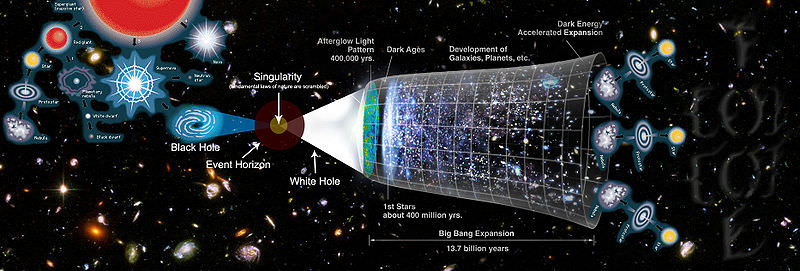
[/caption]
Theoretical physics has brought us the notion that our single universe is not necessarily the only game in town. Satellite data from WMAP, along with string theory and its 11- dimensional hyperspace idea has produced the concept of the multiverse, where the Big Bang could have produced many different universes instead of a single uniform universe. The idea has gained popularity recently, so it was only a matter of time until someone asked the question of how many multiverses could possibly exist. The number, according to two physicists, could be “humongous.”
Andrei Linde and Vitaly Vanchurin at Stanford University in California, did a few back-of- the- envelope calculations, starting with the idea that the Big Bang was essentially a quantum process which generated quantum fluctuations in the state of the early universe. The universe then underwent a period of rapid growth called inflation during which these perturbations were “frozen,” creating different initial classical conditions in different parts of the cosmos. Since each of these regions would have a different set of laws of low energy physics, they can be thought of as different universes.
Linde and Vanchurin then estimated how many different universes could have appeared as a result of this effect. Their answer is that this number must be proportional to the effect that caused the perturbations in the first place, a process called slow roll inflation, — the solution Linde came up with previously to answer the problem of the bubbles of universes colliding in the early inflation period. In this model, inflation occurred from a scalar field rolling down a potential energy hill. When the field rolls very slowly compared to the expansion of the universe, inflation occurs and collisions end up being rare.
Using all of this (and more – see their paper here) Linde and Vanchurin calculate that the number of universes in the multiverse and could be at least 10^10^10^7, a number which is definitely “humungous,” as they described it.
The next question, then, is how many universes could we actually see? Linde and Vanchurin say they had to invoke the Bekenstein limit, where the properties of the observer become an important factor because of a limit to the amount of information that can be contained within any given volume of space, and by the limits of the human brain.
The total amount of information that can be absorbed by one individual during a lifetime is about 10^16 bits. So a typical human brain can have 10^10^16 configurations and so could never distinguish more than that number of different universes.
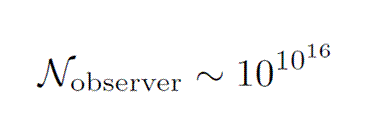
“So, the total number of possibilities accessible to any given observer is limited not only by the entropy of perturbations of metric produced by inflation and by the size of the cosmological horizon, but also by the number of degrees of freedom of an observer,” the physicists write.
“We have found that the strongest limit on the number of different locally distinguishable geometries is determined mostly by our abilities to distinguish between different universes and to remember our results,” wrote Linde and Vanchurin. “Potentially it may become very important that when we analyze the probability of existencse of a universe of a given type, we should be talking about a consistent pair: the universe and an observer who makes the rest of the universe “alive” and the wave function of the rest of the universe time-dependant.”
So their conclusion is that the limit does not depend on the properties of the multiverse itself, but on the properties of the observer.
They hope to further study this concept to see if this probability if proportional to the observable entropy of inflation.
Sources: ArXiv, Technology Review Blog
You’re on a loser there, Lawrence. I doubt the word universe will ever come to encompass anything more than our classical “universe,” even if multiverses are proven to exist 🙂
This sort of “news” is tiresome. It is NOT science, it is science imaginagion or fiction. People read this sort of stuff and think that scientist KNOW there are multiuniverses. They do not know anything about the existence of multiuniverses. This is just a hypothesis and most likely completely untestable. If it is untestable it will NEVER be science and is only a belief or wish.
Put this stuff in the fantasy forum. And stop misleading the readers.
Thanks for posting the occasional article from the theoretical extremes. The multiverse is speculative science based on rather reasonable physical assumptions which may explain some rather surprising properties of our universe, like fine tuning. Definitely a topic worth watching (with health skepticism, of course).
Mason, I’d avise you to take a tranquilizer and think about the following for a while:
Strange ideas are not science? Well, I beg to differ. You see, provided a given idea does not contradict any data, i.e., provided you don’t need to use “selectively” the available data to find a way to support your theory, like crackpots like to do, any idea that may be put forward IS science. Why? Because one person may come up with an idea but be unable to imagine a way to test it, while someone else, despite not being imaginative enough to come up with the idea in the first place, can look at the original work and expand on it to the point of making it testable.
Cosmological models are way too complicated to allow any one person to study in depth all their implications, including their potential for testability. So, the work of these theorists is not only fully scientific, but also fundamental, no matter how abstract it may seem at first sight. Only by exploring the models to their fullest extent science can find eventual logical errors or come up with novel approaches to the data that may one day lead to actual experimental or observational breakthroughs.
And there’s nothing more scientific than that.
I say one cheer for the multiverse, but not three and I doubt even two. There are some reasons to raise questions with this idea. Maybe I should say these ideas. On top if it I really dislike the term multiverse. I prefer the term multi-cosmologies, which exist in a universe — the universe consisting of everything which exists, including other spacetime cosmologies. There are four basic levels or versions of the multiverse, each one having a different level of characterization. I will try to outline each of these levels.
The first level is the so called pocket universe. These occur because the inflaton field, a Higgs-like field which induces inflationary cosmology, assumes different values in different regions of the earliest spatial surface of the spacetime universe. This then segments the universe into distinct regions where local physical properties may differ. These regions are vastly inflated away from each other, or they are separated by regions where there exists a collection of physically distinct pockets of spacetime (i.e. a “universe”) where the energy density is substantially below the threshold at which the motion of the scalar field is dominated by its quantum or stochastic evolution. These pockets are topologically disconnected according to the S-matrix. Any path which connects “low density” regions in different pockets necessarily traverses a “high density” region between the pockets. Each pocket has quantum fields with S-matrix domains of causality which are not connected to each other. One hands-on model is with a ferromagnetic material which has different domains of magnetization. Each domain is analogous to a pocket.
The second model level is the D-brane multiverse. Our spacetime cosmology is associated with a D3-brane which is evolving in the so called M-theory bulk. This spacetime may contain all the various pockets and so forth in it. The D-brane for our universe exists in a dynamical system with other D-brane, where these are all connected by open string. An open string on a D-brane may have both of its endpoints connected to a single D-brane. It may also connect two D-branes together. So the D-brane associated with our spacetime cosmology exists in a huge multiple sandwich composed of an a vast number of other D-branes. Each of these D-branes have target maps to spaces or spacetime. This structure has interesting analogues with quantum chromodynamics of quarks and gluons, and indicates that these structures have anti-de Sitter structure. Maldacena illustrated how AdS spacetime structure is dual to conformal field theory, and further work by Susskind and Vafa have shown that these structures with black holes preserve quantum information. It was over this that Hawking surrendered his bet on information preservation advanced by Preskill and Susskind.
There is the level three version of the multiverse, which involves the many worlds interpretation (MWI) of quantum mechanics. I am not a big upholder of any interpretation of quantum mechanics, so I don’t take this multiverse idea with great seriousness. This interpretation states that upon the reduction of a wave function by some decoherent process, such as a measurement or thermal noise, the universe splits off into multiple copies for each of the possible outcomes. So on top of the two versions above the whole gemish might split off into a vast number of branches of possible elementary outcomes when ever there is some quantum demolition or decoherence. I fail to see how MWI or any quantum interpretation can ever be empirically verified, so I don’t treat this idea with much weight.
Then finally there is the fourth level, advanced by Max Tegmark. Tegmark has this idea that all which exists is mathematically determined. In other words the totality of “existence” is equivalent to all possible mathematical structures which satisfy certain requirements. Now this is an extreme speculation. It might end up being the case, but honestly this is just so far “out there” that I don’t see how it can be seriously considered.
When it comes to the first two there are prospects for some indicators. With the first of these the structure of the observable universe should give some indicator on whether the inflaton field engaged in the sort of stochastic “hopping” with the outcome we observe locally. When it comes to the second level, again it is possible that aspects of this will appear in high energy physics. This would be particularly the case for so called large extra dimensions. This predicts at the TeV range of energy small amplitudes which have black hole-like characteristics. There are some indicators of this from the RHIC experiments, where quark-gluon plasmas do have some of these signatures. If these experiments bear fruit I will change my thinking to two cheers for the multi-verse, or if restricted to the first two versions 3-cheers. The other two versions I fail to see how we can support with experimentation or observations.
So that is my take on the multi-verse. I could of course have engaged in some theory mongering here, but I did not. These ideas are pretty much in line with general papers being published.
Cheers LC
“To the Universe and Beyond!”: suddenly takes a new meaning…
I totally agree that we need theoretical, speculative physics. As long anyone is clear about the speculative part.
It’s necessary to pave the way for future observations.
When Lemaitre invented the Big-Bang and black holes, I doubt he very much believed in their testability.
Don’t knock MWI!!
At least not until I have written and published my killer scifi trilogy set in a world where the technology to open wormholes between realities is not only possible but dangerously easy…
Well, if I don’t get it written in this reality — perhaps there’s a parallel me whose already raking in the big bucks after selling the movie rights…!
Jorge – you lost me when I skimmed and saw ‘crack pots’ in your response.
That kind of thinking reminds me of the idiots that thought the earth was flat and not round and fought the idea.
That kind of ‘holier than thou – too smart to engage in discussion of possibilities’ attitude.
I say – hey it’s plausible – since we actually know so little about what’s really going on. Our observations will ALWAYS be confined to what our human senses can detect.
I find the possible explanation in Elegant Universe to be interesting, giant particles stretched out into branes colliding and creating big bangs on a regular basis.
Just keeping an open mind.
Try not skimming and actually reading what’s written for a change. You haven’t the slightest idea of what’s “that kind of thinking” unless you actually read what’s written, see?
@Jorge: I couldn’t have responded to Mason’s criticism any better. It always amazes me how incensed some of these commenters get when something doesn’t conform to their known universe ideas. If these theories are so bothersome, then DON”T READ THEM. I’d rather keep an open mind, as I was taught that this is the basis for learning.
Untestable? Possibly, and certainly if it remains untestable for all time, then yes, it can only ever be philosophy. But never doubt the ingenuity of the human mind when it comes to devising methods to test hypotheses – even hypotheses than are supposedly ‘theoretically’ untestable.
At the moment though, it will just remain an idea – a possible explanation for our situation. I say cudos to Andre Linde for staking his entire career on such ideas, because there’s better than even chance they’ll turn out to be incorrect…
Tacitus: Sure the term multi-verse is here to stay. I still don’t like the term.
A caveat I do have on these multi-verse ideas is that I prefer to think according to systematics that explain our observable universe with a minimal referece to the physical state of other universes. We might be able to measure their influence on physics in our universe. Detecting black hole-like amplitudes at high energy are a sort of Casimir detection of the vacuum state influenced by D-branes tied to other cosmologies (universes). Yet the one problem with fine-tuning arguments is that these involve incomputable and unobservable aspects of the internal states of these universes. Computing the conditions for fine tuning based on landscape arguments is likely an NP-complete problem. Given the vast configuration space available we will never theoretically compute these problems.
At the risk of “theory mongering” I have some people reading a paper of mine on how these parameters (gauge coupling constants & masses etc) are heavily determined by quantum critical points or phase transitions. This takes some weight off the need for characterizing the landscape for a vast number of universes in the multiverse. They might exist, but we can’t observe them internally, and it would be best if such detail were less important for understanding the observable universe.
Lawrence B. Crowell
Mr. Crowell, you beat me to the punch with MWI. Man, my head STILL hurts from trying to wrap it around that one!
Dr. Max Tagmark has a wonderful page with discussion of different kinds of multiuniverse.
As for pocket universes, I KNEW Sailor Moon had some place to hide her magic wand!!!
….oh, yeah, on testability, that is where the MWI really loses. It postulates that there can never be any information transfer between the separate universes after the split.
A circular argument, common in mental hospitals, I think.
Yeah, when it comes to MWI I “don’t get it.” The idea is not really that hard to understand, and the mathematics for it is not hard either. But when it comes to the “why MWI?” I don’t get it. There are people who go googoo over Bohm’s interpretation as well — again I don’t get it. You can’t test these ideas! They are not effective. It is not that they are wrong, but that these things are metaphysical notions that are wrapped around quantum physics to make it look pretty.
BTW, people all wound up about the strangeness of quantum physics have the question upside down. Quantum mechanics involves nice linear wave equations, they are perfectly deterministic — I mean sheesh, what could be simpler? What is odd is the existence of the macroscopic or thermal and classical physical world we ordinarily experience. Why or by what means does that come about? Those pictures of dunes on Mars, or the dynamics of galaxy collisions, that stuff is nonlinear and bat-s**t crazy compared to nice integral wave motion of quantum fields.
Max Tegmark is pretty much the MWI cosmology guy out there. On the US program NOVA on PBS there is feature which has Hugh Everett’s son, a lead singer and guitarist in a rock band, explore the life of his father. Tegmark has an appearance in it.
LC
“BTW, people all wound up about the strangeness of quantum physics have the question upside down. Quantum mechanics involves nice linear wave equations, they are perfectly deterministic — I mean sheesh, what could be simpler? What is odd is the existence of the macroscopic or thermal and classical physical world we ordinarily experience. Why or by what means does that come about? Those pictures of dunes on Mars, or the dynamics of galaxy collisions, that stuff is nonlinear and bat-s**t crazy compared to nice integral wave motion of quantum fields.”
Beautifully put.
It’s incredible that this kind of gobledygook gets serious attention in astronomy. And it’s prima facie evidence that astronomy is in crisis.
It is not just theoretically untestable. It is physically untestable and never will be testable by the authors own admission.
This is navel gazing, not star gazing.
Is Max Tegmark the guy who hypothesizes that every conceivable universe that is not logically inconsistent is objectively real?
Anyways, I don’t like the idea of postulating a gajillion universes that can never be observed, even in principle, just to explain ours. If you’re going to do that, why not just say “Because God made it that way” and be done with it?
Doesn’t matter how many universes there are (although it’s a shame we’ll never know or visit!). We are still faced with those all important questions of where they came from, why, and what existed before. I know the physicists tell us there was nothing before the Big Bang but that concept is impossible for us humans to get our heads round.
It’s not as crazy or fantasy as you think….we have known about this for over 3000 years….
Kabbalists have known about many different universes or dimensions or other worlds since the giving of the Torah on Mt Sinai.
Not to mention Black Arts and sorcery doesn’t just pull stuff from this universe, but it invokes different dimensions…
You can’t be just one sided and only look at the field through one perspective, it takes a multi-faceted integration of theories to try to understand the whole puzzle…not just physics but biology, metaphysics, etc…
These are all metaphysical and almost philosophical questions, and don’t relate to anything that can be tested physically in the future. At least, this is my opinion.
IIRC there was a cold spot in the WMAP data which some people interpreted as a sign of a parallel universe. There was a story here on UT recently that showed that it was a statistical artifact due to the analyses process. Changing that process and the cold spot disappeared, and so was the parallel universe.
It is just a matter of human imagination: What is easier to understand? A universe stretching from and to infinity in time or a universe that had a day with no yesterday and will face the Judgement Day (or all the possibilities in between)?
@ LBC
Beautiful put, indeed.
What is easier here:
= int_{-infty}^{infty} Psi* H Psi dr
or
dH/dq = -dp/dt
(I just wanted to quote some formulae 😉 )
I fail to see the relevance of counting the number of configurations of the human brain.
Whether typical human brains exist or not, the Universe is still there, with as many parallel histories as it happens to have.
And besides, M-theory multiverse should NOT be confused with quantum multiverse (Many-worlds interpretation)!
Don’t be confused by the word in common. They are as different as lemonade and lemon cars.
M-theory speculations include surfaces containing separate spacetimes called branes which can interact.
The Many-worlds interpretation of quantum mechanics describes objective reality as a wave function which doesn’t collapse.
I skimmed is paper the other day when it appeared on an arxiv aggregator, and I must say I have difficulties with it. (Well, aside from the technical ones, obviously! :-D)
The authors go through a lot of possible ways of calculating the number of universes in eternal inflation, but all along from the perspective of an observer having access to worldlines that are boundedly related by an initial condition. [I should say “chaotic inflation” since it’s Linde’s paper but I prefer the more general term.]
Now, IIRC it is Linde himself who has pointed out that one can push infimum of worldlines unboundedly back, making the process physically “eternal” in both directions. Or, while it is highly improbable, it is possible the process started off close to its fixed point. In either case you wouldn’t pose the restrictions Linde et al does.
It is but in the end of the paper that the authors insert an argument based on the wavefunction of the universe to cut off the putatively massive set of backwards eternal multiverses (if you imagine an ensemble of them) and confine their observers to the asymmetric case.
And there they partly lost me, because I don’t think this additional assumption is useful for full falsifiability. That is, if they derive the wished for proportionality for testing and the test fails, they haven’t eliminated the possibility of the symmetric case.
But at least it’s a test, so I applaud their efforts.
[Personally (IANA Cosmologist) I think the symmetric case is the more likely one, because one can then understand cosmological time as the over all broken symmetry of volume expansion/contraction.
Hmm, I haven’t studied Noether’s work, but I have a feeling that a global (broken) symmetry doesn’t imply a charge. (Heh! A “time charge”?! The energy of the universe is zero – or at least that is what Linde et al claim when they use the wavefunction of the universe.)
So it would work, I think. But I dunno how you would understand the origin of the asymmetry of the other case in a similar manner.]
One nitpick on the timely and excellent article though.
The illustration is probably of Smolin’s “fecund universe” (it’s not really legible), which is a rather different idea. And a failed one at that I believe, I don’t think black holes are considered “white hole” originators today, nor do I think “white holes” as such are considered likely.
I realize that it is hard to find nice illustrations, but maybe it is time to whip up one of eternal inflation instead of the joke (AFAIU) Smolin’s ideas?
As a side note, I find it hilarious that so many people in general and here protest and/or claim that these ensembles of solutions for cosmologies of inflationary universes are untestable. It is likely because they are about universes instead of, say, ensembles of solutions for potentials of charged bodies.
Especially when the authors present potential tests.
Well, the paper beg to differ if you had made the effort to read it, as they present a pathway to a test. It may or may not be possible. And you would also have seen that if you had actually read the post above, as it sums up the proposed test.
But it would be science anyway, as Jorge so eloquently describes. It is only if you can derive and test the possibility that no test is derivable from any of the inflationary cosmologies that you can say that it will never be science. And to date no one has been able to do that.
@ Lawrence B. Cromwell:
I would say the same as for multiverse cosmologies, you have yet to derive and test that prediction (of untestability) from the theory. A tall order, I’m sure.
As for “why MWI” I would say that one reason is that it is the most parsimonious theory (two less assumptions), another is that it takes contrafactual definiteness seriously and makes it explicit AFAIU (as opposed to, say, the classical Copenhagen interpretation), and yet another is that it relies on decoherence.
As decoherence has been successfully tested for, it has passed one test. Of course, so has the other similar theories. But the field has narrowed and in the spirit of testability we are obliged to take the remaining theories more seriously.
If MWI would turn out to be the wrong theory I wouldn’t loose any sleep over it, any more than other theories. But I think it is a serious mistake to dismiss it as a mere “interpretation”, especially after decoherence was observed. We don’t speak of “interpretation” elsewhere, it is a parochial and non-scientific description.
On another note, I think the description of MWI as that it “splits off” copies is parochial as well, especially considering your personal definition of “universe”. AFAIU what happens is that parts of the same universe decompose into parts which may or may not be interfering with each other. (But often into mutually entangled states, which won’t interfere.) These “worlds” are analogous to bubble universes embedded in an eternal inflation multiverse structure.
why should there be a limit on the number of universes any more than there is no limit on prime numbers or no end to pi.
The paper “How many universes are in the multiverse?” by Andrei Linde, Vitaly Vanchurin:
http://arxiv.org/PS_cache/arxiv/pdf/0910/0910.1589v1.pdf
involves pocket universe logic. The paper discusses the number of local FRW regions which are determined by the value of the scalar field of inflation in local regions. The estimate given here involves counting of modes for N e-folds. An e-fold is the number of volume increases due to de Sitter exponential expansion. So the estimate is somewhat reasonable.
The pocket universe model is a bit odd, for it proposes there are regions of high scalar field density on a space which topologically (causally) disconnects regions by S-matrix domains of support. I might as well consider a toy model to make a point about the pocket universe. The universe may well have emerged from some sort of quantum fluctuation. An easy model for this is a virtual wormhole. Inside the regions which connect up there exists a three-ball of space, and the wormhole junction results in a topological suturing of these two 3-balls into a three sphere. Now assume that inflation takes place by puncturing a hole in the three ball. This point or the boundary is removed “to infinity” from the perspective of the antipodal point and the space is converted to R^3 plus pt. If we consider the “reciprocal” of this space with r –> 1/r the point that is removed is a singularity or in complex variables (complexified coordinates) a pole. An integration around this point of field propagators might then result in a branch point which connects this R^3 to other R^3 surfaces — similar to Riemann sheets. For various reasons I find this to be a more aesthetic picture of what might be called the multi-verse.
So this would I think clean up some of the issues with pocket universes. This preserves the basic idea of e-fold statistics on how inflaton fields “hop,” but might prevent what I see as offensive boundary issues. The statistics have some bearing on the cosmological constant and the entropy of the universe. In fact if you are at all savy on matters of cosmology, there are relationships between the cosmological constant and the vacuum energy of the universe and its entropy. So there may be some observational support which could be given to this type of cosmology.
LC
Oh, and a final correction. I know that you probably didn’t mean it, but Bohm’s theory is both falsifiable and falsified. It is a non-local theory, so it fails at relativity (i.e. Lorentz invariance).
Or it should, if it hadn’t been non-relativistic in the first place…
Bohm’s quantum interpretation or “theory” works in relativity, or at least you can work up a Bohmian Klein-Gordon theory or even Dirac theory. If works in a free field case. Where it has trouble is with the coupling of particles in a relativistic setting and the production of particles, and even worse if there is a mass-gap. It does not have a ladder structure where the a and a-dagger operators generate discrete states of photons or other particles.
MWI can be dispensed with, as frankly can all so called quantum interpretations. I would say that the best approach to these matters is Zurek’s decoherence and einselection work, which has a minimum of the sorts of metaphysics that other interpretations invoke.
LC
I agree with Mason Kelsey this article while very interesting, is pure speculation. While I think that it is important to keep an open mind we should take articles such as this with a grain of salt. The entire concept of Multiverses at this point relies Quantum Theory which relies on probability for the basis of its arguments. I think people are beginning to tire of hearing about the possibility of this and the possibility of that. After awhile according to QM everything that anyone can concieve of is possible. This is NOT the way the Universe works in the observable macroscopic world. That is why I suggest an alternative to Quantum Mechanics. Someone has got to to do it else we will be stuck in this fundametally flawed paradigm indefinitely.
Einstein was right about the shortcomings of Quantum Mechanics and so therefore String Theory is also the incorrect approach. As an alternative to Quantum Theory there is a new theory that describes and explains the mysteries of physical reality. While not disrespecting the value of Quantum Mechanics as a tool to explain the role
of quanta in our universe. This theory states that there is also a classical explanation for the paradoxes such as EPR and the Wave-Particle Duality. The Theory is called the Theory of Super Relativity.
This theory is a philosophical attempt to reconnect the physical universe to realism and deterministic concepts. It explains the mysterious.
@ mmfiore:
No physicist in the whole world will abandon quantum mechanics due to philosophical reasons. It’s predictions have come true with an unheard-of precision. It is the newest of the “big” physical theories but it is the one theory that is checked and tested best. Even better than GR, which is also tested rather well.
Quantum mechanics describe the reality – no doubt about that.
There are many people who are convinced of this as well. So far quantum mechanics has resisted these efforts, from Bell’s inequalities and Kochen-Specker theorem, to the Aspect experiments. Quantum nonlocality and the existence of entanglements simply appear to exist on their own with no “realism” substratum.
It might be worth my pointing out that 20 years ago I worked out and wrote on how general relativity when worked as a Schild’s ladder and the spin entanglement system of quantum mechanics has the same Galois algebraic representation GF(4), which is also the root space for the SO(8) group. So quantum mechanics and general relativity at least within this “partial functor” are equivalent, and might ultimately prove to be two aspects of an identical system. The system for GF(4) is the hexacode error correction code C_6, and it is possible that extended quantum error correction codes might embed both gravitation and quantum mechanics as different aspects of a single structure.
Cheers LC
I second Dr Flimmer’s post here. My post above we directed at mmfiore. Quantum physics is a highly robust theory of particles and fields, and attempts to reduce it to “rational mechanics” so that nonlocality is some derived result of locality have failed. Bell’s theorem and other related results give a negative verdict on any possibility of doing so.
LC
Yes.
mmfiore, get your facts right.
EPR is not a paradox (although originally conceived as one), it’s a reproducible experimental fact.
Wave-Particle Duality has been abandoned as a concept for 50 years. Think quantum fields.
“This theory is a philosophical attempt …”
say what?! How does that work?
@ Jorge – Who’s an idiot? ME! I have to apologize to you – I am so used to seeing small remarks and then being led down that path of ‘let’s discredit this method of thinking things through in this manner’, it’s tiresome.
My bad 100%. You have taught me a lesson, not to allow myself to assume, which is something I try to avoid and have obviously failed here.
I’m really sorry man. Please forgive me.
@ Dr Flimmer:
Dr Flimmer wrote: What is easier to understand? A universe stretching from and to infinity in time or a universe that had a day with no yesterday and will face the Judgement Day (or all the possibilities in between)?”
How about simply saying Man is not privileged to know how the Universe started or how it will end, or how far it stretches.
There are some things Man will never know — pretending otherwise is a disservice to Science and potentially dangerous if elements of Science get locked into a serious defense of this kind of gobbledygook.
‘
Anaconda offers up a council of despair.
LC
No, just a sober realization of Man’s limitation.
Crowel, are locked into a serious defense of this gobbledygook?
Judging from the length of your responses, I would say you are.
Professional back scratching…
“No, just a sober realization of Man’s limitation.”
Great opening to make fun of Anaconda. Just sayin’ 🙂
We are limited, but not blind and incapable. Astronomy illustrates aspects of the large scale structure of the universe, such as the Hubble relationship v = Hd, the big bang and so forth. The mechanism for the big bang, or at least one phase of it, is inflation. Predictions from inflation include small anisotropes in the microwave cosmic background in a certain distribution, which have been found. There are also predictions of B-modes from gravitational decoupling. The Planck probe is currently suveying the cosmic background for signatures of these.
So the quest continues, and the next big issue is to understand how the cosmological constant, which drives the accelerated expansion of the universe, has the comparatively small value it has.
LC
It is always good for everyone to know his/her limits. I think I have an idea about my limits.
Still: Not imaginable is NOT not knowing. I can’t imagine the four dimensions of space-time, but I know that they exist. And there are many more examples….
@ Anacond:
“There are some things Man will never know”.
I couldn’t agree more. But please, lets not decide right away which ones these things are going to be.
We’ll write down the score the day the last human dies.
I’d like a bigger picture so I can read/see everything what’s in it. 🙁
Also, what’s white hole???
@HeadAroundU
Some info on white holes can be found here: http://en.wikipedia.org/wiki/White_holes .
“There are some things Man will never know”.
Will women know them?
I’d just like to say that this could be the thread with the most impenetrable posts ever! But I like that, it tells me there are people out there specialising in amazing fields, with detailed knowledge and exploratory minds.
“Gobbledygook” it is not.
BeckyWS:
I most heartedly concur with your post. I find it fascinating that theorists are vigorously pursing these questions, wherever it leads. Definitely, “gobbledygook” it is not.
I had always thought that the multiverse referred to many bubble universes within The Universe whereas the Multi World Interpretation resulted in parallel universes. This would where you existed having made a decision ‘now’ to do this rather than that, the universe split, and one version of you went on to do ‘this’ and another version did ‘that’. Gregory Benford wrote a novel based on this idea – ‘Timeslip’- I think.