
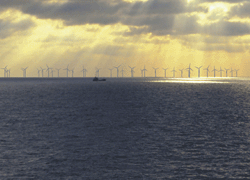
I drive regularly through Iowa and southern Minnesota in the US, and over the past few years wind farms have been popping up in that region up almost faster than corn grows. These massive wind turbines are awesome to see. But there may be an even better location for future wind farms than the breezy plains of the central United States: our oceans. Experts say ocean winds blow harder and with more reliable consistency than wind on land, which more than offsets the greater cost of building windmills offshore. Efforts to harness the energy potential of Earth’s ocean winds could soon gain an important new tool: global satellite maps from NASA. Scientists have been creating maps using nearly a decade of data from NASA’s QuikSCAT satellite that reveal ocean areas where winds could produce wind energy.
“Wind energy is environmentally friendly. After the initial energy investment to build and install wind turbines, you don’t burn fossil fuels that emit carbon,” said study lead author Tim Liu, a senior research scientist and QuikSCAT science team leader at NASA’s Jet Propulsion Laboratory in Pasadena, Calif. “Like solar power, wind energy is green energy.”
The new maps created by QuickSCAT have many potential uses including planning the location of offshore wind farms to convert wind energy into electric energy. Ocean wind farms have less environmental impact than onshore wind farms, whose noise tends to disturb sensitive wildlife in their immediate area.
QuikSCAT, launched in 1999, tracks the speed, direction and power of winds near the ocean surface. Data from QuikSCAT, collected continuously by a specialized microwave radar instrument named SeaWinds, also are used to predict storms and enhance the accuracy of weather forecasts.
Wind energy has the potential to provide 10 to 15 percent of future world energy requirements, according to Paul Dimotakis, chief technologist at JPL. If ocean areas with high winds were tapped for wind energy, they could potentially generate 500 to 800 watts of energy per square meter, according to Liu’s research. Dimotakis notes that while this is slightly less than solar energy (which generates about one kilowatt of energy per square meter), wind power can be converted to electricity more efficiently than solar energy and at a lower cost per watt of electricity produced.
The new QuikSCAT maps, which add to previous generations of QuikSCAT wind atlases, also will be beneficial to the shipping industry by highlighting areas of the ocean where high winds could be hazardous to ships, allowing them to steer clear of these areas.
Scientists use the QuikSCAT data to examine how ocean winds affect weather and climate, by driving ocean currents, mixing ocean waters, and affecting the carbon, heat and water interaction between the ocean and the atmosphere.
News Source: NASA
I hope the research into harvesting wave power benefits from this.
When the mills are in place suddenly we have the whole infrastructure to bring energy onshore anyway. So anchoring wave-shavers between the mills will be a relatively small investment.
Here in Lackawanna, a suburb of Buffalo, NY, we have the first “urban windfarm”. There’s a set of 8 turbines on the shore of Lake Erie about 4 miles south of downtown Buffalo. There are plans to put up additional turbines on land that used to be occupied by the former Bethlehem Steel Corporation. The project itself and the turbines are being called “Steel Winds”. I wish they’d fill up the whole parcel of land with those turbines. If they were to do that, I think there would be a total of about 100 turbines, maybe more. Of course, you’ll have environmentalists screaming about the dangers to birds, which has already happened with the current set of 8 wind mills.
hi
go suck big dick
hi alejandro
hi amy wats up
wats up im waiting
say nun
nun
im going to write u a long pararaph on how to suck big dick if u are a gurl u would be smart to listen so u do it right the first time. 1st u get a bf or a man thats wants u to suk him up.2nd u take off all your clothes.3rd if u want him to do the same to u all u have to do is lay down where ur head is near his dick and his head is near ur pussy and just go at it!!!!!!!!! good luck!!!!!
im a dude but im going to do wat alejandro says im going to suk big dick
dont laugh just cuz im gay i like big dick i look at that on google
hahaha some one comment