

Our nearest star has exhibited some schizophrenic behavior thus far for 2013.
By all rights, we should be in the throes of a solar maximum, an 11-year peak where the Sun is at its most active and dappled with sunspots.
Thus far though, Solar Cycle #24 has been off to a sputtering start, and researchers that attended the meeting of the American Astronomical Society’s Solar Physics Division earlier this month are divided as to why.“Not only is this the smallest cycle we’ve seen in the space age, it’s the smallest cycle in 100 years,” NASA/Marshall Space Flight Center research scientist David Hathaway said during a recent press teleconference conducted by the Marshall Space Flight Center.
Cycle #23 gave way to a profound minimum that saw a spotless Sol on 260 out of 365 days (71%!) in 2009. Then, #Cycle 24 got off to a late start, about a full year overdue — we should have seen a solar maximum in 2012, and now that’s on track for the late 2013 to early 2014 time frame. For solar observers, both amateur, professional and automated, it seems as if the Sun exhibits a “split-personality” this year, displaying its active Cycle #24-self one week, only to sink back into a blank despondency the next.
This new cycle has also been asymmetrical as well. One hallmark heralding the start of a new cycle is the appearance of sunspots at higher solar latitudes on the disk of the Sun. These move progressively toward the Sun’s equatorial regions as the cycle progresses, and can be mapped out in what’s known as a Spörer’s Law.

But the northern hemisphere of the Sun has been much more active since 2006, with the southern hemisphere experiencing a lag in activity. “Usually this asymmetry lasts a year or so, and then the hemispheres synchronize,” said Giuliana de Toma of the High Altitude Observatory.
So far, several theories have been put forth as to why our tempestuous star seems to be straying from its usual self. Along with the standard 11-year cycle, it’s thought that there may be a longer, 100 year trend of activity and subsidence known as the Gleissberg Cycle.
The Sun is a giant ball of gas, rotating faster (25 days) at the equator than at the poles, which rotate once every 34.5 days. This dissonance sets up a massive amount of torsion, causing the magnetic field lines to stretch and snap, releasing massive amounts of energy. The Sun also changes polarity with every sunspot cycle, another indication that a new cycle is underway.
But predictions have run the gamut for Cycle #24. Recently, solar scientists have projected a twin peaked solar maximum for later this year, and thus far, Sol seems to be following this modified trend. Initial predictions by scientists at the start of Cycle #24 was for the sunspot number to have reached 90 by August 2013; but here it is the end of July, and we’re sitting at 68, and it seems that we’ll round out the northern hemisphere Summer at a sunspot number of 70 or so.
Some researchers predict that the following sunspot Cycle #25 may even be absent all together.
“If this trend continues, there will be almost no spots in Cycle 25,” Noted Matthew Penn of the National Solar Observatory, hinting that we may be on the edge of another Maunder Minimum.
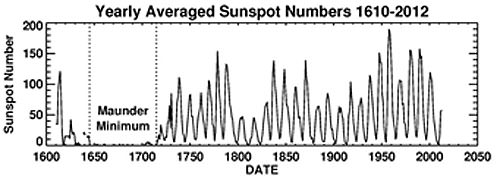
The Maunder Minimum was a period from 1645 to 1715 where almost no sunspots were seen. This span of time corresponded to a medieval period known as the Little Ice Age. During this era, the Thames River in London froze, making Christmas “Frost Fairs” possible on the ice covered river. Several villages in the Swiss Alps were also consumed by encroaching glaciers, and the Viking colony established in Greenland perished. The name for the period comes from Edward Maunder, who first noted the minimum in papers published in the 1890s. The term came into modern vogue after John Eddy published a paper on the subject in the journal of Science in 1976. Keep in mind, the data from the period covered by the Maunder Minimum is far from complete— Galileo had only started sketching sunspots via projection only a few decades prior to the start of the Maunder Minimum. But tellingly, there was a span of time in the early 18th century when many researchers supposed that sunspots were a myth! They were really THAT infrequent…
Just what role a pause in the solar cycle might play in the climate change debate remains to be seen. Perhaps, humanity is getting a brief (and lucky) reprieve, a chance to get serious about controlling our own destiny and doing something about anthropogenic climate-forcing. On a more ominous note, however, an extended cooling phase may give us reason to stall on preparing for the inevitable while giving ammunition to deniers, who like to cite natural trends exclusively.
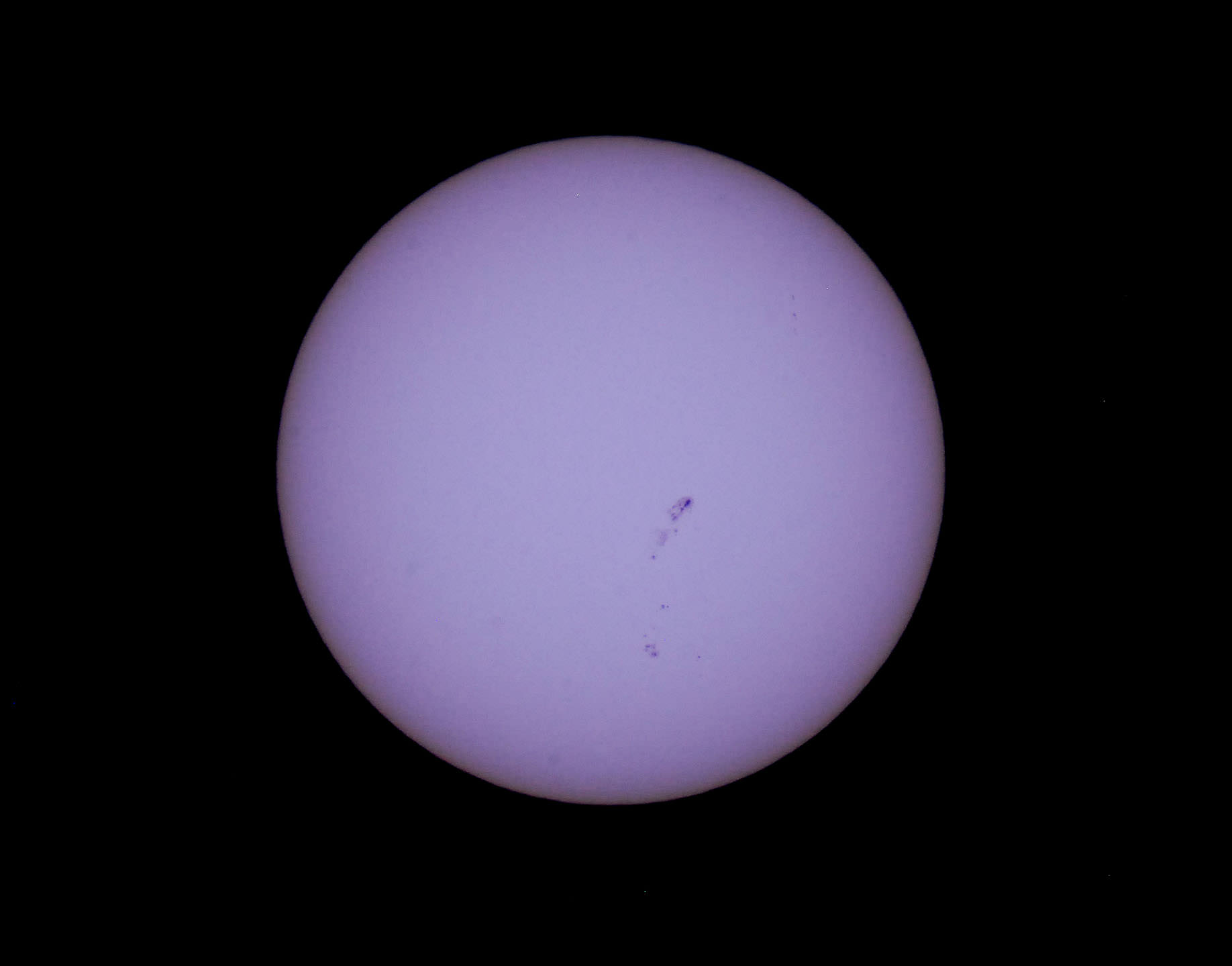
Whatever occurs, we now have an unprecedented fleet of solar monitoring spacecraft on hand to watch the solar drama unfold. STEREO A & B afford us a 360 degree view of the Sun. SOHO has now monitored the Sun for the equivalent of more than one solar cycle, and NASA’s Solar Dynamics Observatory has joined it in its scrutiny. NASA’s Interface Region Imaging Spectrograph (IRIS) just launched earlier this year, and has already begun returning views of the solar atmosphere in unprecedented detail. Even spacecraft such as MESSENGER orbiting Mercury can give us vital data from other vantage points in the solar system.
Cycle #24 may be a lackluster performer, but I’ll bet the Sun has a few surprises in store. You can always get a freak cloud burst, even in the middle of a drought. Plus, we’re headed towards northern hemisphere Fall, a time when aurora activity traditionally picks up.
Be sure to keep a (safely filtered) eye on ol’ Sol— it may be the case over these next few years that “no news is big news!”
How many amateur astronomers does it take to screw in a lightbulb …
Sorry, just joking, not turning on the light …
But Joking aside, what’s up with this cycle. Afaik, it was drumrolled to be a significant maximum, and now a soft drumroll prediction for cycle 25 … Based on what were these predictions? someone left the light on?
The Mayan predictions of course.
Quick – pass a global warming tax before it’s too late. We all know that extra taxes on people will fix the climate!
No, I disagree. A global warming tax would only serve to benefit the filthy rich and a select few privileged people, by digging out a huge underground bunker (or several interconnected smaller bunkers) were they all could live comfortably, regardless of all the hellish climates and flooding on earth’s outer surface and it’s insignificant suffering population.
The bias of the author shows when he calls those who don’t agree with the majority ‘deniers’. Shouldn’t he then call those who subscribe to the majority opinion ‘warmists’?
Here’s hoping Mr. Sol is just saving his punches for Comet ISON!
The sunspots don’t burn my eyes quite as much as some of the grammar in this article. Interesting.
Thanks… sorry if I get on the florid side occasionally, anthropomorphizing stars and what not. Prose writing is my first love.
I continually find myself laughing my battoookus off with every 5000lb piece of hard evidence is stacked against the AGW worshipers.
Those that promote AGW will be seen in the centuries to come as true fanatics instead of objective scientists.
To ASSUME based on 100yr observations to know what will occur in 20-30 yrs is preposterous in the extreme….And to try to convince society and change humanity based on conjecture is nothing but idiocy.
The fact is that it would take a concerted multi100 generational study with people dedicated to just that occupation in order to gain a glimpse into the whims of the various variables that decide our climate.And to think you can do such in just a quarter century is beyond the pale.
Jump off the bandwagon fellers, ya look silly.
Can you explain the lake that surrounds the geophysical North Pole, icebergs the size of Pennsylvania, or the newly formed “Northwest passage” big enough for a ship to pass through? Perhaps you could say that Santa is desiring lake front property.
Ya knoowwww I can’t leave well enough alone.
You’d think that ‘scientists’ would realize that there is a hell ov alot they don’t know. That should be Tenet #1
But no.
They think that because they’ve observed something continually for 15 years that they know all.They forget that even their own estimates of the age of the universe puts it into the 100’s of millions of years of age.
That means that the overwhelming average of any natural subjects behavior can not be determined by studying a sliver of time that would be 100 or 1000 or 10000 yrs.long.
1% of 100 million is 1 million, my elementary friends. So in order to gain even a slight perspective on the behavior of something so old and complex, it must be reasonably studied for an extended time before ANY data, decisions, rulings or hypothesis is offered as proof of Law.
But no…. not these guys.
Oh, I didn’t know that you’re a Republican. Sorry.
Brenda…your slip is showing…
Can u explain the glaciers that engulfed whole villages the last time the sun went to sleep?
The proof is in the ebb and flow of the Sun.
GREENLAND used to be Green.
I see you shoved out the whole political thingy while I was merely stating that todays scientists aren’t objective…again thanks for proving my point.
I love it when emotions run amok among the ‘objective open minded ones’….
I liked your article, and thank you for taking the time to write it. I have to admit that I also read “deniers’ and thought sounds like no room for skepticism or my experience with religion as if global anything can be measured with a calibrated caliper.
Maybe I’m a flat earther, but it seems like the sun might be the main impact on the temperature of the earth. What I have found on the web seems like an experiment in a fish tank being extrapolated to the entire earth.
Maybe you can point me to a good site that will make the impact on human activity on the earth clear. I have yet to find one. I was hoping to find one with a discussion of the solid angle of the sun that the earth sees and the net energy transferred, some thermal dynamics including radiation of the earth to space being a relationship of the difference in the earths temperature and space to the fourth power to demonstrate the the relative energy gain from the CO2 increase is detectable and significant, and some discussion of the impact of the relative density of CO2 to the rest of the atmosphere to account for the distribution of the CO2 in the atmosphere. Maybe some data demonstrating that algae and other plant life does not, time lagged, compensate for the increased CO2. I don’t want to be a denier, I’m just uninformed. Please show me the math.
Thanks… this post just touched on climate change as it relates to the main topic of the solar cycle. NOAA, NASA, the EPA and Universe Today have numerous articles out there on the reality of climate change. These are good sources in what is, unfortunately, a polarizing subject. I’ve noticed over the last decade that voices claiming “climate change is a myth” are, for the most part, backing their stance up a bit to “climate change is happening, but natural causes are exclusively to blame,” so I guess that’s progress somewhat… we just need to take accountability for our role in the outcome.
With regards to the Sun’s role, Bob Berman points out in his book The Sun’s Heartbeat that a lackluster solar cycle should be cooling our planet right now… greenhouse gas emissions are working against this trend.
Some will argue that your gage is malfunctioning, but mostly I think that what they are denying is that human induced CO2 emissions have been proven to be the main cause of climate change, and instead point to the sun. It is much larger than the earth with all kinds of emissions visible and invisible that are clearly changing in the same time frame as climate change.
So I haven’t been following your posts on climate change but this one seems to implicitly acknowledge a link between solar activity and global temperatures. How can you do that and then tar those who make that claim as “deniers”? Isn’t the question really just one of degree and relative importance of the causes? The “consensus” camp has maintained that the solar component is insignificant – often restricting the discussion to variation of insolation and ignoring the impact on cloud formation. Does that make them “deniers”?
On a less combative note, I have often wondered about variations in measurement. I assume that we can detect far smaller sunspots today than in 1900 or even 1950. Does that mean we are understating previous cycles? Or is there a minimum size to qualify as a sunspot which we have been able to detect since the 19th century?
Cycle is screw-up because of ohbama, he’s screwed-up America. Now he’s messing with that Sun.