Universe Today
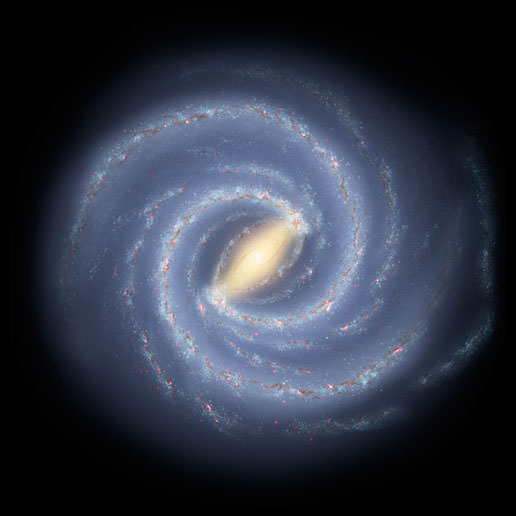
Here are some
beautiful pics
of the Milky Way Galaxy. It's important to remember that we live inside the Milky Way Galaxy, so there's no way to show a true photograph of what the Milky Way looks like. We can see pictures of the Milky Way from inside it, or see artist illustrations of what the Milky Way might look like from outside.
[/caption]
This Milky Way Galaxy picture shows what our galaxy would look like from above. You can see its spiral arms, dense core and the thin halo. The Milky Way is a common barred spiral galaxy. There are billions more just like it in the Universe.
[caption id="attachment_38054" align="alignleft" width="580" caption="Milky Way in infrared. Image credit: COBE"]

[/caption]
This picture of the Milky Way was captured by NASA's COBE satellite. This photograph was taken using the infrared spectrum, which allows astronomers to peer through the gas and dust that normally obscures the center of the Milky Way.
[caption id="attachment_30401" align="alignleft" width="580" caption="The plane of the Milky Way, recorded with the Chandra satellite in three colours: Photons with energies between 0.5 and 1keV appear red, those between 1 and 3keV green, and those between 3 and 7keV blue. Discrete sources are indicated by circles. Image: Mikhail Revnivtsev"]

[/caption]
This image of the Milky Way Galaxy was taken with the Chandra X-Ray Observatory, which can see in the X-Ray spectrum. In this view, only high energy emissions are visible, such as the radiation emitted from black holes and other high energy objects.
[caption id="attachment_23119" align="alignleft" width="580" caption="Artist's concept shows young, blue stars encircling a supermassive black hole at the core of a spiral galaxy like the Milky Way.Credit: NASA, ESA, and A. Schaller (for STScI) "]

[/caption]
Here's an artist's impression of what a galaxy like the Milky Way might have looked like early in its history. This image shows a supermassive black hole with young blue stars circling it.
[caption id="attachment_14689" align="alignleft" width="580" caption="Milky_Way_infrared_mosaic. Credit: Spitzer Space Telescope"]

[/caption]
This is a mosaic image of the Milky Way captured by NASA's Spitzer Space Telescope. It was built up by several photographs taken by Spitzer, which sees in the infrared spectrum, and can peer through obscuring dust.