
The 1908 explosion over the Tunguska region in Siberia has always been an enigma. While the leading theories of what caused the mid-air explosion are that an asteroid or comet shattered in an airburst event, no reliable trace of such a body has ever been found. But a newly published paper reveals three different potential meteorite fragments found in the sandbars in a body of water in the area, the Khushmo River. While the fragments have all the earmarks of being meteorites from the event – which could potentially solve the 100-year old mystery — the only oddity is that the researcher actually found the fragments 25 years ago, and only recently has published his findings.
Like the recent Chelyabinsk airburst event, the Tunguska event likely also produced a shower of fragments from the exploding parent body, scientists have thought. But no convincing evidence has ever been found from the June 30, 1908 explosion that occurred over the Tunguska region. The explosion flattened trees in a 2,000 square kilometer area. Luckily, that region was largely uninhabited, but reportedly one person was killed and there were very few people that reported the explosion. Forensic-like research has determined the blast was 1,000 times more powerful than a nuclear bomb explosion, and it registered 5 on the Richter scale.
Previous expeditions to the region turned up empty as far as finding meteorites; however one expedition in 1939 by Russian mineralogist Leonid Kulik found a sample of melted glassy rock containing bubbles, which was considered evidence of an impact event. But the sample was somehow lost and has never undergone modern analysis.
The expedition in 1998 by Andrei Zlobin from the Russian Academy of Sciences was initially unsuccessful in finding meteorites or evidence of impacts. He made several drill holes in the peat bogs in the area and while he found evidence of the explosion, he didn’t find any meteorites. He then decided to look in the nearby river shoal.
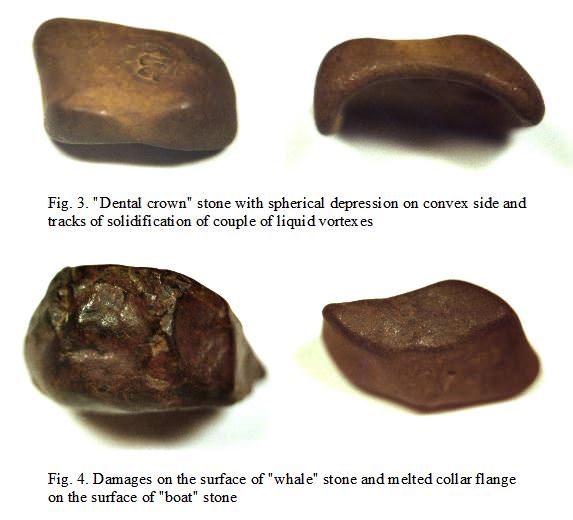
Zlobin gathered about 100 samples of rocks that had features of potential meteorites, but further examination produced just three rocks with tell-tale features like melting and regmalypts – the , thumblike impressions found on the surface of meteorites which are caused by ablation as the hot rock falls through the atmosphere at high speed.
Zlobin writes that “After the expedition the author focused his efforts on experimental investigation of thermal processes and mathematical modeling of the Tunguska impact [Zlobin, 2007],” and he used tree ring evidence to estimate the temperatures from the event, and concluded that rocks already on the ground would not have been changed or melted from the blast, and therefore any rocks having evidence of melting should be from the impactor itself.
Zlobin says he has not yet carried out a detailed chemical analysis of the rocks, which would reveal their chemical and isotopic composition. But he does say the stony fragments do not rule out a comet since the nucleus could easily contain rock fragments. However, he has calculated the density of the impactor must have been about 0.6 grams per cubic centimeter, which is about the same as nucleus of Halley’s comet. Zlobin says that initially, the evidence seems “excellent confirmation of cometary origin of the Tunguska impact.”
While there is nothing definitive yet from Zlobin’s new paper – and there is the question of why he waited so long to conduct his study – his work provides hope for a better explanation of the Tunguska event as opposed to some rather off-the-wall ideas that have been proposed, such as a Tesla death-ray or an explosion of methane gas from the bogs.
The Technology Review blog writes that “clearly there is more work to be done here, particularly the chemical analysis perhaps with international cooperation and corroboration.”
Read Zlobin’s paper, Discovery of probably Tunguska meteorites at the bottom of Khushmo river’s shoal
Source: MIT Technology Review
Some time back I saw a documentary on the Tunguska event where the researchers were finding dust-sized meteorite material embedded in some of the trees in the area. Wouldn’t something like that be useful for authenticating this ‘new’ find of pieces of the Tunguska bolide?
How would such material help? I don’t think there is any material that has been tied to the Tunguska event, even less identified as dated meteorite material.
Tunguska would of leveled ‘any’ city in the world. In fact, those astro’scientists said it was a 1 in 100 yr. event. Damn, they were so correct! Great call/bet! 1908 to 2013 is 105 yrs.. I have to bring those colleagues w/me to the track!… :-)… .
The recent blast over Russia a few months back pales in comparison to Tunguska. If that recent event would of been 90% an iron asteroid. I shutter to think of the realities. Anyways, …the more research we do will bring more concrete factual developments in the comet/asteroid discipline(s). ..PEACE!
If the comet underwent thermal decomposition, the prediction would be that we shouldn’t find any remains at all.
Zlobin need a test of composition, else it is just pattern search. I don’t think it adds anything to the mass of similar literature on this, claiming material being from the event.
“Leonid Kulik found a sample of melted glassy rock containing bubbles..But the sample was somehow lost….” BUMMER! Who’s nose though… maybe the samples will show up some day when someone stumbles across a mislabeled collection?
I really don’t want to sound like a complete jerk, but the expression is “Who knows?”, not “Who’s nose?”
Hmm well perhaps the sample being “somehow lost” after the 1939 discovery might just have something to do with Nazi invaders making their way to Leningrad, Moscow and Stalingrad while destroying, killing and looting everything in sight?
Maybe. I doubt the Nazis would have had much use for rocks from space, regardless of what we may have been told in movies. But when there’s a big distraction like an invading army, things can get packed away and forgotten.
Hi Nancy,
I enjoy your articles. Thanks.
Two things: If he found the pieces in 1998, then it has been only 15 years, not 25 — not especially mysterious or sinister given that he appears to have been trying to be very thorough before announcing.
And, re “1000 times more powerful than a nuclear bomb explosion,” since nuclear explosion can range from small to very large you might want to be more specific in order to give a useful sense of scale.
Regards
Ken
“Previous expeditions to the region turned up empty as far as finding
meteorites; however one expedition in 1939 by Russian mineralogist
Leonid Kulik found a sample of melted glassy rock containing bubbles,
which was considered evidence of an impact event.”
The Kulik expedition was in 1927, where the heck did you get 1939 from?