

When we think of space travel, we tend to picture a massive rocket blasting off from Earth, with huge blast streams of fire and smoke coming out the bottom, as the enormous machine struggles to escape Earth’s gravity. Rockets are our only option for escaping Earth’s gravity well—for now. But once a spacecraft has broken its gravitational bond with Earth, we have other options for powering them. Ion propulsion, long dreamed of in science fiction, is now used to send probes and spacecraft on long journeys through space.
NASA first began researching ion propulsion in the 1950’s. In 1998, ion propulsion was successfully used as the main propulsion system on a spacecraft, powering the Deep Space 1 (DS1) on its mission to the asteroid 9969 Braille and Comet Borrelly. DS1 was designed not only to visit an asteroid and a comet, but to test twelve advanced, high-risk technologies, chief among them the ion propulsion system itself.
Ion propulsion systems generate a tiny amount of thrust. Hold nine quarters in your hand, feel Earth’s gravity pull on them, and you have an idea how little thrust they generate. They can’t be used for launching spacecraft from bodies with strong gravity. Their strength lies in continuing to generate thrust over time. This means that they can achieve very high top speeds. Ion thrusters can propel spacecraft to speeds over 320,000 kp/h (200,000 mph), but they must be in operation for a long time to achieve that speed.
An ion is an atom or a molecule that has either lost or gained an electron, and therefore has an electrical charge. So ionization is the process of giving a charge to an atom or a molecule, by adding or removing electrons. Once charged, an ion will want to move in relation to a magnetic field. That’s at the heart of ion drives. But certain atoms are better suited for this. NASA’s ion drives typically use xenon, an inert gas, because there’s no risk of explosion.
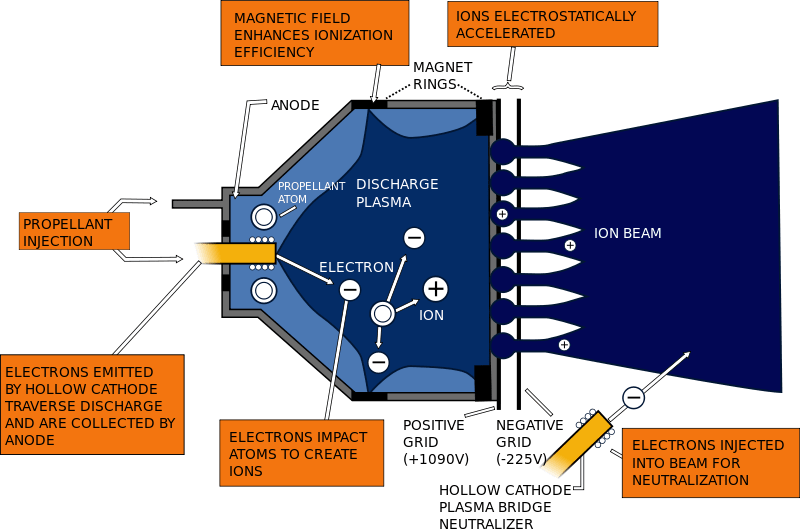
In an ion drive, the xenon isn’t a fuel. It isn’t combusted, and it has no inherent properties that make it useful as a fuel. The energy source for an ion drive has to come from somewhere else. This source can be electricity from solar cells, or electricity generated from decay heat from a nuclear material.
Ions are created by bombarding the xenon gas with high energy electrons. Once charged, these ions are drawn through a pair of electrostatic grids—called lenses—by their charges, and are expelled out of the chamber, producing thrust. This discharge is called the ion beam, and it is again injected with electrons, to neutralize its charge. Here’s a short video showing how ion drives work:
Unlike a traditional chemical rocket, where its thrust is limited by how much fuel it can carry and burn, the thrust generated by an ion drive is only limited by the strength of its electrical source. The amount of propellant a craft can carry, in this case xenon, is a secondary concern. NASA’s Dawn spacecraft used only 10 ounces of xenon propellant—that’s less than a soda can—for 27 hours of operation.
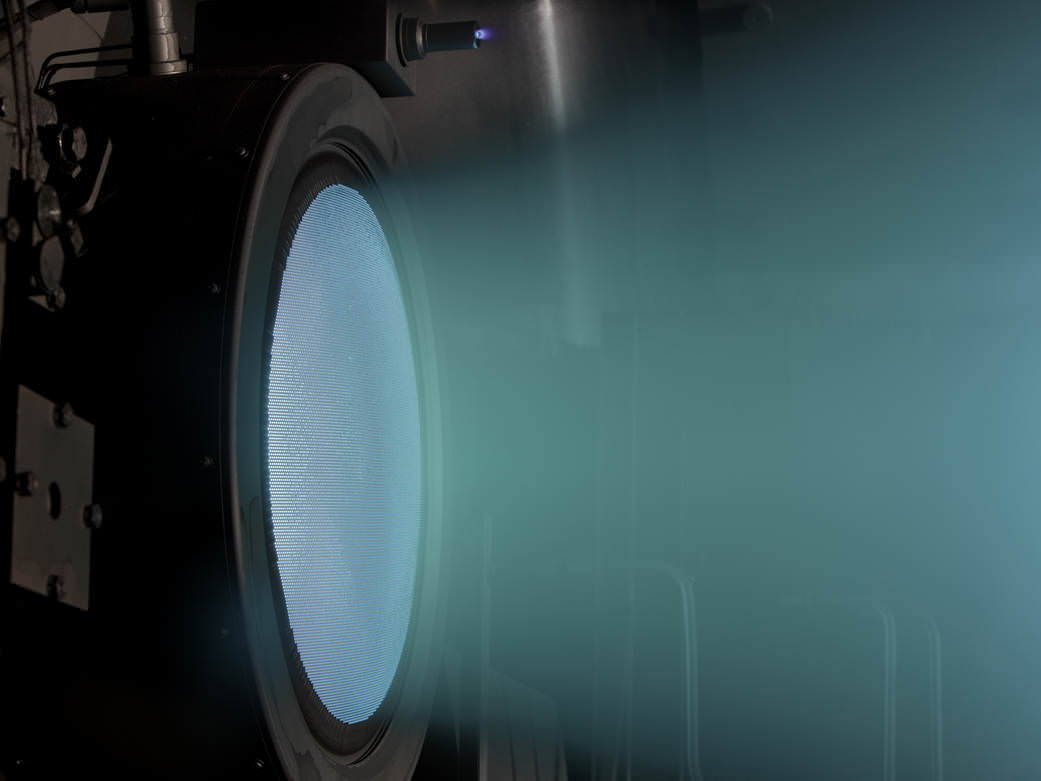
In theory, there is no limit to the strength of the electrical source powering the drive, and work is being done to develop even more powerful ion thrusters than we currently have. In 2012, NASA’s Evolutionary Xenon Thruster (NEXT) operated at 7000w for over 43,000 hours, in comparison to the ion drive on DS1 that used only 2100w. NEXT, and designs that will surpass it in the future, will allow spacecraft to go on extended missions to multiple asteroids, comets, the outer planets, and their moons.
Missions using ion propulsion include NASA’s Dawn mission, the Japanese Hayabusa mission to asteroid 25143 Itokawa, and the upcoming ESA missions Bepicolombo, which will head to Mercury in 2017, and LISA Pathfinder, which will study low frequency gravitational waves.
With the constant improvement in ion propulsion systems, this list will only grow.
This is the warp drive which is being used here and now, matured since decades. It gets way too little attention and appreciation in the public space nerd community.
According to the logarithm of the rocket equation, tenfolded speed change requires 20,000 times more fuel, or 10 times higher exhaust velocity. Ion thrusters are already at 30 if not even 50 times higher exhaust velocities. Thanks to this magic, which is really happening, the sky is no longer the limit.
So it is slow and boring. Chemical explosions emit energy much more rapidly than any solar or nuclear power plant. Human space travel needs to be more rapid than what ion thrusters can provide. However, ion thrusters can be used to pre-deploy equipment, and chemical fuel to be used for fast travel when needed. Humans could be transferred quickly chemically in low-mass capsules between Earth, a Mars cycler and a Mars surface base which all have been pre-deployed by ion propulsion.
Oopsters.. I deleted my post.. dang.
The current sticking point for getting more powerful thrusters is a good enough power source. It’s very hard to get permission to launch lumps of Pu-238 out of the gravity well using a controlled explosion, let alone U-235 or Pu239 but hopefully the commercial drivers for electric cars and some of the recent breakthroughs with capacitor efficiency will allow us to accumulate enough power from solar collectors to run megawatt ion drives and open up the Solar System. Relayed charging points might even be feasible out to the orbit of Mars, dock the craft at the collector, and grab the accumulated charge by whatever clever means possible
Boeing seems to be working on a 1 MWe photovoltaic array for spacecrafts (at 1 AU, in ten years). The space station has about a tenth of that at 100 kWe, and is in the shadow about half of the time. So I think that solar electric power can go a long way even for human spaceflight to Mars. Not a long way from the Sun, though, Jupiter could be the limit.
Capacitors allowing a substantial storage of electric power would be super nice. Nuclear would be great, but solar power does well for the small scale local space flight we’ll see in our lifetime. The electric power generated by the plutonium RTG of Curiosity corresponds to only one sixth (1/6) of a horsepower! It mostly generates heat, which is also valuable up to some small scale above which the heat instead becomes a problem.
See slide 3.
I’m not sure it was mentioned bu when the two atoms collide and an ion is released and ejected isn’t it hot/cold? And how does it know where to exit? How is sufficient electricity supplied when the unit is out of range from the Sun or a Star or radiation?
Answers to your last two questions.
“Once charged, an ion will want to move in relation to a magnetic field. ”
Outer planets are possible targets. Jupiter, Saturn, Uranus, Neptune are our outer planets.
Hello, Ponce.
“I’m not sure it was mentioned bu when the two atoms collide and an ion is released and ejected isn’t it hot/cold?”
The ionized xenon (or other fuel) particle WILL be more energetic (a.k.a. “hotter”) after its collision with the ionizing electron. That heat doesn’t contribute very much to the thrust achieved however.
“And how does it know where to exit?”
From the article: “Once charged, these ions are drawn through a pair of electrostatic grids—called lenses—by their charges, and are expelled out of the chamber, producing thrust.” In other words, the positively charged ions are drawn magnetically to the exit by the negatively charged grids.
Ordinarily, these ions would be accelerated through the grid… and then be drawn right back to it by their charge, which would reduce or eliminate thrust altogether. However the neutralizing beam adds an electron back to the ions, which cancels out the positive charge before this can occur.
“How is sufficient electricity supplied when the unit is out of range from the Sun or a Star or radiation?”
This is the $Zillion Question. The engine itself doesn’t care where it gets the electricity from, only that it gets it. Therefore, options such as large capacity batteries, capacitors, RTGs and even full-blown fission (or someday, fusion) reactors are potential energy sources once an ion-drive-equipped craft reaches areas where solar arrays are no longer effective.
“Unlike a traditional chemical rocket, where its thrust is limited by how much fuel it can carry and burn, the thrust generated by an ion drive is only limited by the strength of its electrical source. The amount of propellant a craft can carry, in this case xenon, is a secondary concern. NASA’s Dawn spacecraft used only 10 ounces of xenon propellant—that’s less than a soda can—for 27 hours of operation.”
This almost makes it sound like “As long as you have SOME fuel, the amount doesn’t actually matter,” which of course is not the case. The distinction between an ion engine & a chemical rocket is that an ion engine uses its fuel by the atom; a chemical rocket uses its fuel by the pound (not to say “by the TON”).
Eventually, even an ion engine will run out of fuel, and the more energy one applies to the reaction, the more quickly one will run out of fuel.
Pardon me please for a couple of things: The first is for being older than methuselah and the second is for having a memory afflicted by that age – but – I remember a kid’s comic strip from some time around the years of 1938-1942 in which the characters were traveling in space either from planet to planet or star to star using “a new system” called ION PROPULSION.
I can’t imagine how one might find that strip today but I swear to you that it did mention ion propulsion. It also referred to the “click sound made when each ion was expelled from the engine”.
This is an honest memory and an honest query:
How do we go back to find that comic strip?