Ejected Black Holes Drag Clusters of Stars With Them

by Nancy Atkinson on July 15, 2009

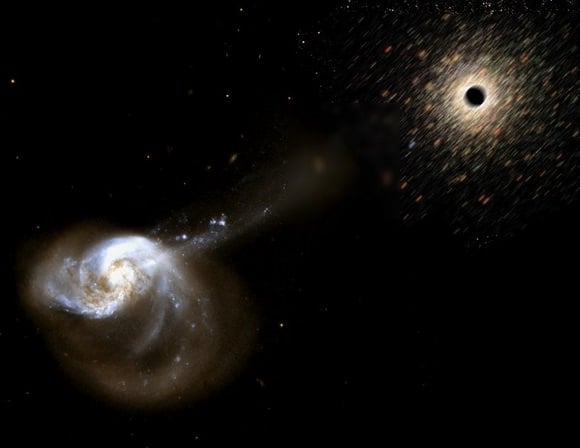
This artist’s conception shows a rogue black hole that has been kicked out from the center of two merging galaxies. The black hole is surrounded by a cluster of stars that were ripped from the galaxies.  Credit: Space Telescope Science Institute

This artist’s conception shows a rogue black hole that has been kicked out from the center of two merging galaxies. The black hole is surrounded by a cluster of stars that were ripped from the galaxies. Credit: Space Telescope Science Institute


The tight cluster of stars surrounding a supermassive black hole after it has been violently kicked out of a galaxy represents a new kind of astronomical object which may provide telltale clues to how the ejection event occurred. “Hypercompact stellar systems” result when a supermassive black hole is violently ejected from a galaxy, following a merger with another supermassive black hole. The evicted black hole rips stars from the galaxy as it is thrown out. The stars closest to the black hole move in tandem with the massive object and become a permanent record of the velocity at which the kick occurred.

“You can measure how big the kick was by measuring how fast the stars are moving around the black hole,” said David Merritt, professor of physics at the Rochester Institute of Technolyg. “Only stars orbiting faster than the kick velocity remain attached to the black hole after the kick. These stars carry with them a kind of fossil record of the kick, even after the black hole has slowed down. In principle, you can reconstruct the properties of the kick, which is nice because there would be no other way to do it.”

In a paper published in the July 10 issue of The Astrophysical Journal, Merritt and his colleagues discusses the theoretical properties of these objects and suggests that hundreds of these faint star clusters might be detected at optical wavelengths in our immediate cosmic environment. Some of these objects may already have been picked up in astronomical surveys. .

“Finding these objects would be like discovering DNA from a long-extinct species,” said team member Stefanie Komossa, from the Max-Planck-Institut for Extraterrestrial Physics in Germany.

The astronomers say the best place to find hypercompact stellar systems is in cluster of galaxies like the nearby Coma and Virgo clusters. These dense regions of space contain thousands of galaxies that have been merging for a long time. Merging galaxies result in merging black holes, which is a prerequisite for the kicks.

“Even if the black hole gets kicked out of one galaxy, it’s still going to be gravitationally bound to the whole cluster of galaxies,” Merritt says. “The total gravity of all the galaxies is acting on that black hole. If it was ever produced, it’s still going to be there somewhere in that cluster.”

Merritt and his co-authors think that scientists may have already seen hypercompact stellar systems and not realized it. These objects would be easy to mistake for common star systems like globular clusters. The key signature making hypercompact stellar systems unique is a high internal velocity. This is detectable only by measuring the velocities of stars moving around the black hole, a difficult measurement that would require a long time exposure on a large telescope.

From time to time, a hypercompact stellar system will make its presence known in a much more dramatic way, when one of the stars is tidally disrupted by the supermassive black hole. In this case, gravity stretches the star and sucks it into the black hole. The star is torn apart, causing a beacon-like flare that signals a black hole. The possibility of detecting one of these “recoil flares” was first discussed in an August 2008 paper by co-authors Merritt and Komossa.

“The only contact of these floating black holes with the rest of the universe is through their armada of stars,” Merritt says, “with an occasional display of stellar fireworks to signal ‘here we are.’”

Source: Rochester Institute of Technology

  • IVAN3MAN
  • Nereid

    The words ‘hypocritical’, ‘disingenuous’, ‘inconsistent’, and ‘hopelessly confused’ spring to mind wrt Anaconda’s comments.

    Consider (these are all Anaconda comments, unless otherwise noted):

    “There is a rather large, if somewhat subtle, flaw in this approach … “observation & measurement”, in contemporary astronomy, is intricately associated with “a priori theoretical constructs”! ”

    Yes, exactly and that’s why it’s on a sterile dead-end path to nowhere.

    No, there are observation & measurement that substantiates those detection instruments. It worked in a laboratory first, then it was trained on the sky or sent into space.

    “On what basis should any decisions to allocate that money be made?”

    On the basis of what is known already as a result of observation & measurement.

    (Nereid is being quoted)

    You can delude yourself if you want, but I’ll follow the scientific evidence where it leads.

    (bold added)

    Magnetized plasma bends light much as water bends light, so when looking at light as it passes past the Sun, the bending of light doesn’t come from the curvature of space due to gravity, but from magnetized plasma bending the light.

    As for GPS, the time is measured using atomic clocks no spings and wheels, but it is known that magnetic fields and their supporting electric currents will effect the rate of atomic clocks.

    This GPS assertion is one of the biggest canard out there.

    Also, the difference is taken up with the fact that there is variance with GPS positioning. The accuracy is within 3 meters which is very good but cancels out supposed GR time variances.

    [...]

    Light bends, different electromagnetic environments effects radioactive decay, behavior, and vibration patterns.

    The small variances of light are far less likely to have to do with the alleged curvature of space due to gravity, but rather to material effects on light and other frequencies on the electromagnetic wave spectrum from physical influences from material substances.

    [...]

    Scientists have been doing everything to CONFIRM General Relativity and have been conflicted with ‘confirmational bias’

    (All from this UT story thread, timestamps July 21st, 2009 at 3:30 pm, July 20th, 2009 at 4:23 pm, and July 22nd, 2009 at 2:04 pm, respectively).

    AFAIK, every single one of the weak field tests of GR, either in labs or within the solar system, meet every aspect of Anaconda’s “a result of observation & measurement” criterion.

    Further, and again AFAIK, not a single one of his ‘alternative possibilities’ (that I am quoting) has been shown to account for all the relevant observations and measurements, to within the stated uncertainties. Of course, as usual, I could be wrong, so if you can cite material which does show this please do so Anaconda (but please, no more obviously falsehoods such as ‘there are published papers which propose that plasmoids can account for all relevant observations of the M87 nucleus’).

    I’ll follow the scientific evidence where it leads” rings rather hollow in light of this, doesn’t it?

    To complete Anaconda’s education, one of the elisions in the last quote is this: “Gravitational waves, still looking for those which falsifies GR since it predicted their reality.“. At the very short sentence level, no Anaconda, the non-detection of GWR to date does NOT falsify GR. However, a more detailed summary is certainly in order (*why* isn’t GR falsified by this non-detection?!?), which I will provide later (it’s yet another fascinating aspect of physics).

  • ND

    I said that I wasn’t going to respond to Anaconda but I can’t help it. I have to say something.

    Anaconda has demonstrated that he has no interest in an honest discourse. He lectures about “observation & measurement” and how science is supposed to be done. Yet he has demonstrated dishonesty simply and most clearly with the following statement of his:

    “Magnetized plasma bends light much as water bends light, so when looking at light as it passes past the Sun, the bending of light doesn’t come from the curvature of space due to gravity, but from magnetized plasma bending the light.”

    He was presented with observational evidence to a prediction made by Einstein’s theories. Observations and measurements, to a very high degree, showed that the Sun’s gravity influences electromagnetic radiation. Not only observational evidence but a controlled experiment using the Cassini probe, to a very high degree leaving no doubt that one of the predictions of Relativity is proven to be true.

    And yet Anaconda rejects these observations & measurements because it does not fit his view of the universe (and accuse others of the very things he himself is guilty of).

    Who is he trying to fool?

  • IVAN3MAN

    If sophism and sophistry were an Olympic sport, Anaconda would definitely be a gold medal contender!

  • DrFlimmer

    Thanks, Ivan. Interesting stuff!
    Also thanks for mentioning the Faraday effect. I was about to say that magnetic fields do not have an effect on light at all, which would’ve been wrong. Those little details that are easily forgotten…. ;)

    But btw: Refraction of light depends on the density of the material. The effect of refraction in the atmosphere is not that big (but significant for astronomical observations!). And the density of the atmosphere is about 10^23 particles per ccm.
    Now compare it to the density of the corona: It has a mass density of about 10^-16 g/ccm. A proton has a mass of about 10^-23 g. Assuming that the corona contains mainly protons it would have a particle density of 10^7 particles per ccm. I consider the effect or refraction being at a minimum. It should be almost undetctable.

    But still: Anaconda, you can do your experiment and show that GR is wrong as I described it above. As long as you haven’t done this (or someone else) we must consider your idea to be a “theoretical construct with no experimental confirmation”….

  • IVAN3MAN

    Anaconda:

    Knock on my door when you want to start exploring the real world…

    *Knock Knock*
    Who’s there?
    G.R.
    G.R. who?
    Gee… are you still on the bloody toilet?!

  • Nereid

    Gravitational wave radiation (GWR) is a firm prediction of GR.

    In 1993, Hulse and Taylor got a free return trip to Stockholm, for their observations and analyses of a pulsar (PSR 1913+16 if you really want to know). The pulsar is in a binary system, and the system is decaying (the distance between the two objects is decreasing, the orbital period decreasing), and the rate of decay matches that expected from a loss, to the system, of energy, due to GWR … exactly as predicted by GR (to within the observational uncertainties).

    AFAIK, the only binary systems which have been observed to be decaying in this way are those in which at least one component is a neutron star (NS), so the only indirect observations of GWR involve ~stellar mass objects in binary systems.

    The final stage of decay of such a system should produce a highly distinctive GWR signal, an ‘inspiral’.

    As the sensitivity of GWR detectors such as LIGO and VIRGO has improved, the volume of space within which such an inspiral event should be detectable has increased (it goes up as the cube of sensitivity – why?).

    So null GWR detection results to date imply that

    a) no NS-NS or NS-BH or BH-BH binaries have coalesced within the search volume while the GWR detectors have been ‘live’; or

    b) such events have happened within the ‘up time’ and detectable volume, but as GR is ‘wrong’ in some sense there have been no detections; or

    c) GWR detection calibrations/data pipelines/etc/etc/etc contain errors; or

    d) {insert your own alternative here}.

    Now the decay of an NS-NS binary (or NS-BH or BH-BH, ~stellar mass BH in each case) should produce some real electromagnetic fireworks – at least one intense burst of gammas+x-rays, for example. During the time the GWR detectors have been ‘up’, no such fireworks were observed within the detection volume (AFAIK), so the non-detection of an inspiral event is not surprising.

    Further, estimates of the rate of inspiral events, from the known space density of NS-NS (etc) systems, indicate that the GWR searches to date would have been pretty lucky to catch one.

    So, at this level, for these types of events, there is no conflict between (GWR) theory and observation (pace Anaconda).

    (to be continued)

  • ND

    Nereid,

    The indirect evidence of GW through the HT pulsar has been pointed out to Anaconda numerous times and he has ignored it and remained silent. He has also, always, ignored the sensitivity issue regarding the GW experiments and always tried to twist the current lack of positive results to mean no GW. Yet he continues on to lecture about how science is done.

    Dishonesty.

  • Nereid

    @ND: to your knowledge, has Anaconda ever acknowledged this dishonesty?

    On several occasions Anaconda has acknowledged that the material he has cited does not support the claim he made earlier; that’s good. However, AFAIK he has never been able to cite material in support of his original claims (there are some examples of him changing the claims – without actually saying so – and presenting material to support the modified claim); that is bad (do you know of any counter-examples?).

  • Nereid

    Gravitational wave radiation (GWR) – continued

    While it is relatively straight-forward to think of how GWR could be generated, other than in an inspiral, AFAIK no such possible source is both a) well-constrained, and b) estimated to be detectable with current GWR detectors (LIGO, VIRGO, etc).

    Perhaps an analogy might help.

    With our eyes we can detect light, and on dark, moonless nights, with well-adapted vision, most of us can see magnitude 5.5 to 6 stars.

    However, our eyes cannot detect x-rays or radio (except when such radiation is so intense as to cause serious cell damage).

    Like electromagnetic radiation, GWR is expected to have frequencies that range over dozens of decades; like our eyes, current GWR detectors have a very limited frequency response.

    So there may very well be intense sources of GWR of frequencies way outside the GWR equivalent of the visual … but no current detector could ever detect them.

    Similarly, there may be millions of sources of GWR with frequencies LIGO is sensitive to … but they may be the equivalent of magnitude 10 or 15 stars (i.e. too faint to detect).

    One more: transients.

    Novae and supernovae were observed well before the invention of the telescope, but GRBs and flare stars were not (AFAIK). Yet in both cases there certainly have been events which would have been visible, to the unaided eye, even if only for a few seconds to minutes (even today these are rarely detected in real time, in the visual waveband first).

    Contemporary GWR detectors are far better than historical eyes in this respect: good records of all data from the instruments is kept, so transients can be discovered through off-line, painstaking analysis. However, this doesn’t help if our GWR eyes were not looking at the sky when a transient occurred.

    To sum up: the ‘GWR night sky’ is expected to be totally dark to the eyes we have today, except for ~seconds-long transients which should reach peak brightness of somewhere between 5th and 8th magnitude, and happen about once a year to once a decade.

  • ND

    Nereid,

    I don’t remember him acknowledge it. I’m not even sure he realizes his behavior. One may be deliberately dishonest (like a con-man, as a means to an end), or one may be shifty and react and act hypocritically when they are met with strong challenges and even hard evidence against a strongly held belief. I think Anaconda is more the latter. I’m torn between just ignoring him and correcting the incorrect “facts” he pushes around the net.

  • ND

    The conclusion on the livingreview site that Nereid provided outlining the experimental and observational evidence supporting GR, i think, is very well written and summarizes the spirit of scientific investigation:

    “We find that general relativity has held up under extensive experimental scrutiny. The question then arises, why bother to continue to test it? One reason is that gravity is a fundamental interaction of nature, and as such requires the most solid empirical underpinning we can provide. Another is that all attempts to quantize gravity and to unify it with the other forces suggest that the standard general relativity of Einstein is not likely to be the last word. Furthermore, the predictions of general relativity are fixed; the theory contains no adjustable constants so nothing can be changed. Thus every test of the theory is either a potentially deadly test or a possible probe for new physics. Although it is remarkable that this theory, born 90 years ago out of almost pure thought, has managed to survive every test, the possibility of finding a discrepancy will continue to drive experiments for years to come. ”

    I hope Anaconda and others understand that this is how their interlocuters feel. This is the attitude we take.

    “the possibility of finding a discrepancy will continue to drive experiments for years to come. ”

    The discovery that a theory with strong evidence behind it, a theory that fits much of what we see in nature, actually diverges from that reality, is exciting. And scientists look for this.

  • IVAN3MAN

    Nereid, and ND,

    This extract from an article on “The Psychology of Crankery” summarizes Anaconda’s mentality to a tee:

    A suspicious person is a person who has something on his mind. He looks at the world with fixed and preoccupying expectation, and he searches repetitively, and only, for confirmation of it. He will not be persuaded to abandon his suspicion of some plan of action based on it. On the contrary, he will pay no attention to rational arguments except to find in them some aspect or feature that actually confirms his original view. Anyone who tries to influence or persuade a suspicious person will not only fail, but also, unless he is sensible enough to abandon his efforts early will, himself, become an object of the original suspicious idea.

    :D

  • ND

    I know DrFlimmer enjoys the exchanges but it may be time to just ignore Anaconda.

    Nereid, nice post on the reality of GW detection today. Unfortunately Anaconda will ignore it because he needs to discredit GR in order to undermine BHs. He will instead keep saying “millions spent, still no detection”.

  • DrFlimmer

    Well, ND, you’re maybe not that wrong at all ;) . I think I will decide from time to time. Enjoyment, well, not in the usual sense, but still…. ;)

    I wonder right now, if he will show up in this thread again in a few days and will happily scream about “cats and mice” as he has done several times before.

    As I see Anaconda, he just want to oppose. Being against the mainstream. This is an advantage since you don’t need to feel responsible for anything.
    I think this matches with Ivan’s description.

Previous post:

Next post: