
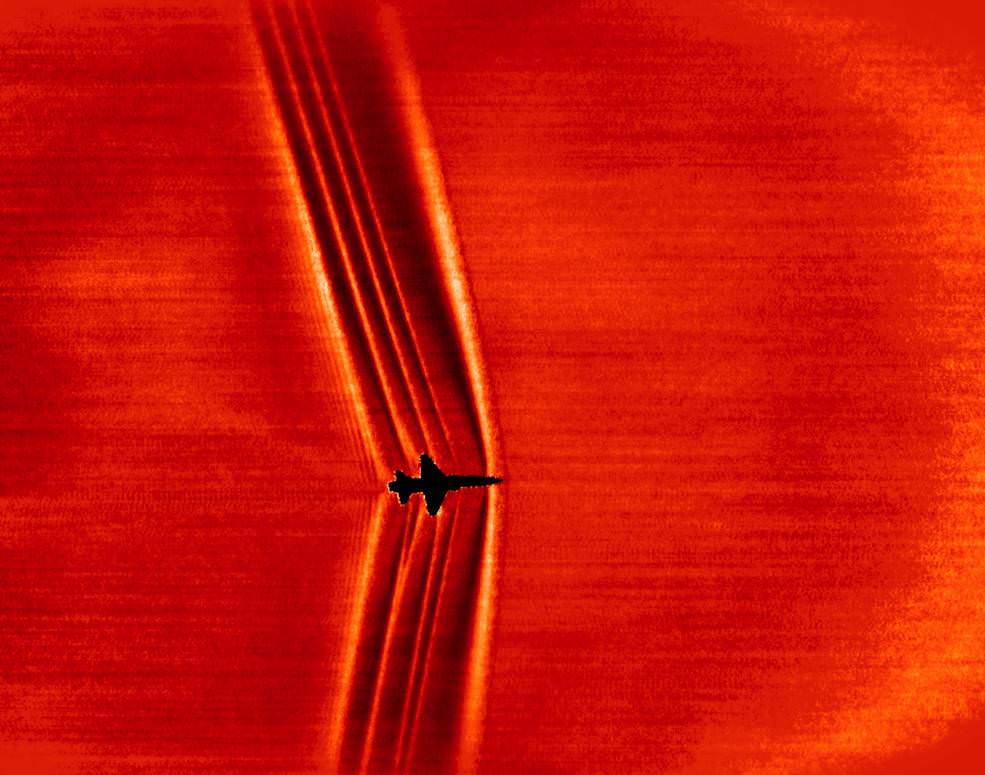
NASA is using a 150-year-old photographic technique with a few 21st century tweaks to capture unique and stunning images of the shockwaves created by supersonic aircraft.
Called schlieren imagery, the technique can be used to visualize supersonic airflow with full-scale aircraft in flight. Usually, this can only be done in wind tunnels using scale models, but being able to study real-sized aircraft flying through Earth’s atmosphere provides better results, and can help engineers design better and quieter supersonic planes.
And a side benefit is that the images are amazing and dramatic, creating a little “shock” and awe.

Credit: NASA.
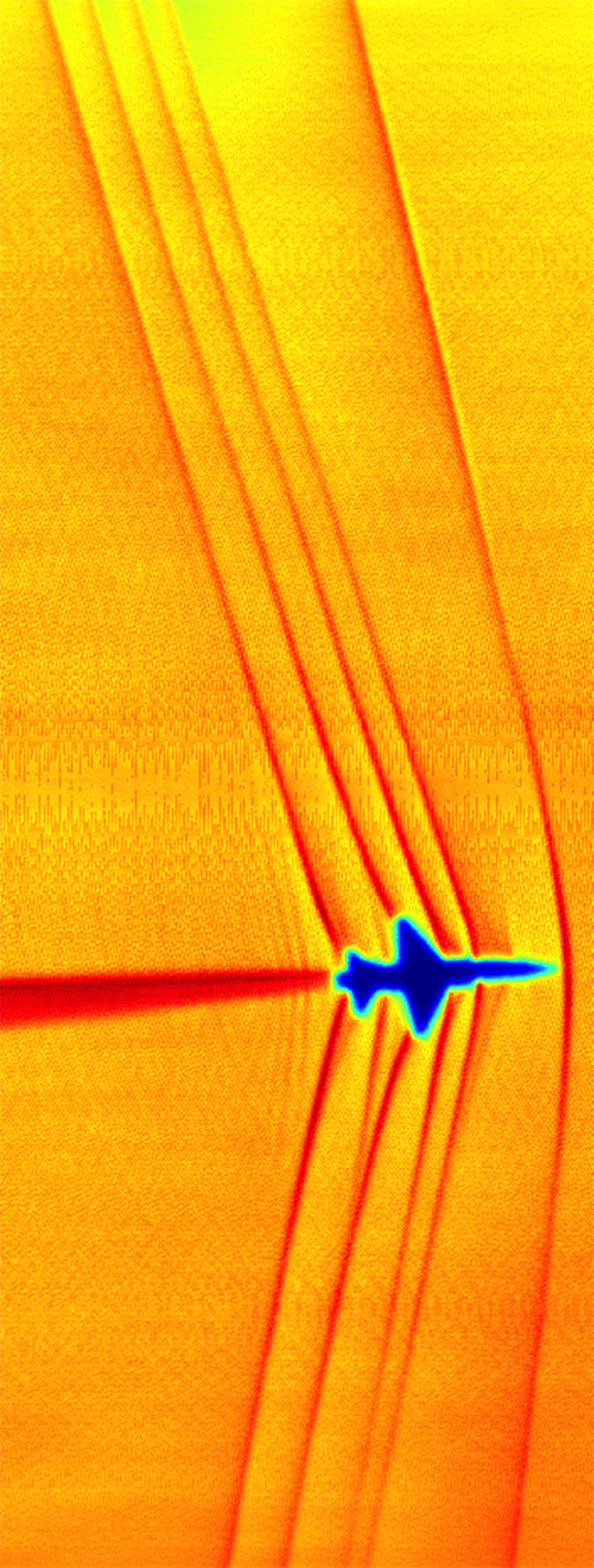
Earlier this year, NASA released some schlieren imagery taken with a high-speed camera mounted on the underside of a NASA Beechcraft B200 King Air, which captured images at 109 frames per second while a supersonic aircraft passed several thousand feet underneath over a speckled dessert floor. Special image processing software was used to remove the desert background, then combine and average multiple frames, which produces a clear picture of the shock waves. This is called air-to-air schlieren.
“Air-to-air schlieren is an important flight-test technique for locating and characterizing, with high spatial resolution, shock waves emanating from supersonic vehicles,” said Dan Banks, the principal investigator on the project, being done at NASA’s Armstrong Flight Research Center at Edwards Air Force Base. “It allows us to see the shock wave geometry in the real atmosphere as the target aircraft flies through temperature and humidity gradients that cannot be duplicated in wind tunnels.”
But now they’ve started using a technique that might provide better results: using the Sun and Moon as a lit background. This backlit method is called Background-Oriented Schlieren using Celestial Objects, or BOSCO.
The speckled background or a bright light source is used for visualizing aerodynamic flow phenomena generated by aircraft or other objects passing between the camera and the backdrop.
Credit: NASA.
NASA explains the technique:
“Flow visualization is one of the fundamental tools of aeronautics research, and schlieren photography has been used for many years to visualize air density gradients caused by aerodynamic flow. Traditionally, this method has required complex and precisely aligned optics as well as a bright light source. Refracted light rays revealed the intensity of air density gradients around the test object, usually a model in a wind tunnel. Capturing schlieren images of a full-scale aircraft in flight was even more challenging due to the need for precise alignment of the plane with the camera and the sun.”
Then, there are variations on this technique. One recent demonstration used Calcium-K Eclipse Background Oriented Schlieren (CaKEBOS). According to Armstrong principal investigator Michael Hill, CaKEBOS was a proof of concept test to see how effectively the Sun could be used for background oriented schlieren photography.

Credit: NASA.
“Using a celestial object like the sun for a background has a lot of advantages when photographing a flying aircraft,” Hill said. “With the imaging system on the ground, the target aircraft can be at any altitude as long as it is far enough away to be in focus.”
Researchers found the ground-based method to be significantly more economical than air-to-air methods, since you don’t have to have a second aircraft carrying specially mounted camera equipment. The team said they can use off-the-shelf equipment.
Schlieren imagery was originally invented in 1864 by German physicist August Toepler.
Find out more about the air-to-air technique here and the BOSCO techniques here.
High wow-factor, especially the stunning images.
If was invented in 1864 what was he taking pictures of?