
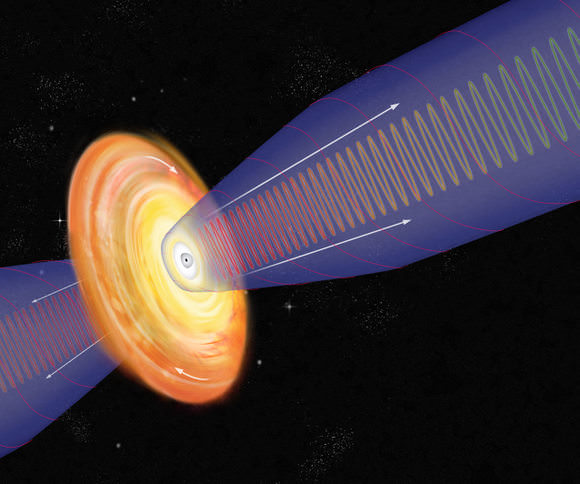
[/caption]
When the giant radio galaxy Messier 87 (M 87) unleashed a torrent of gamma radiation and radio flux, an international collaboration of 390 scientists happened to be watching. They’re reporting the discovery in this week’s issue of Science Express.
The results give first experimental evidence that particles are accelerated to extremely high energies in the immediate vicinity of a supermassive black hole and then emit the observed gamma rays. The gamma rays have energies a trillion times higher than the energy of visible light.
Matthias Beilicke and Henric Krawczynski, both physicists at Washington University in St. Louis, coordinated the project using the Very Energetic Radiation Imaging Telescope Array System (VERITAS) collaboration. The effort involved three arrays of 12-meter (39-foot) to 17-meter (56-foot) telescopes, which detect very high-energy gamma rays, and the Very Long Baseline Array (VLBA) that detects radio waves with high spatial precision.
“We had scheduled gamma-ray observations of M 87 in a close cooperative effort with the three major gamma-ray observatories VERITAS, H.E.S.S. and MAGIC, and we were lucky that an extraordinary gamma-ray flare happened just when the source was observed with the VLBA and its impressive spatial resolving power,” Beilicke said.
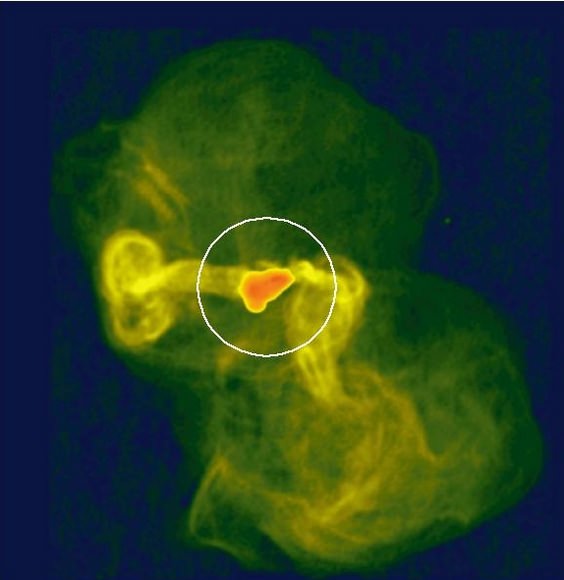
“Only combining the high-resolution radio observations with the VHE gamma-ray observations allowed us to locate the site of the gamma-ray production,” added R. Craig Walker, a staff scientist at the National Radio Astronomy Observatory in Socorro, New Mexico.

M 87 is located at a distance of 50 million light years from Earth in the Virgo cluster of galaxies. The black hole in the center of M 87 is six billion times more massive than the Sun.
The size of a non-rotating black hole is given by the Schwarzschild radius. Everything — matter or radiation — that comes within one Schwarzschild radius of the center of the black hole will be swallowed by it. The Schwarzschild radius of the supermassive black hole in M 87 is comparable to the radius of our Solar System.
In the case of some supermassive black holes — as in M 87 — matter orbiting and approaching the black hole powers highly relativistic outflows, called jets. The matter in the jets travels away from the black hole, escaping its deadly gravitational force. The jets are some of the largest objects in the Universe, and they can reach out many thousands of light years from the vicinity of the black hole into the intergalactic medium.
Very high-energy gamma-ray emission from M 87 was first discovered in 1998 with the HEGRA Cherenkov telescopes. “But even today, M 87 is one of only about 25 sources outside our galaxy known to emit [very high energy] gamma rays,” says Beilicke.
The new observations now show that the particle acceleration, and the subsequent emission of gamma rays, can happen in the very “inner jet,” less than about 100 Schwarzschild radii away from the black hole, which is an extremely narrow space as compared with the total extent of the jet or the galaxy.
In addition to VERITAS and the VLBA, the High Energy Stereoscopic System (H.E.S.S.) and the Major Atmospheric Gamma-Ray Imaging Cherenkov (MAGIC) gamma-ray observatories were involved in these observations.
Lead image caption: Artists’s Conception of M87’s inner core: Black hole, accretion disk, and inner jets. Credit: Bill Saxton, NRAO/AUI/NSF
Second image: Large-scale VLA image of M87: White circle indicates the area within which the gamma-ray telescopes could tell the very energetic gamma rays were being emitted. To narrow down the location further required the VLBA. CREDIT: NRAO/AUI/NSF
Collage: At top left, a VLA image of the galaxy shows the radio-emitting jets at a scale of about 200,000 light-years. Subsequent zooms progress closer into the galaxy’s core, where the supermassive black hole resides. In the artist’s conception (background). the black hole illustrated at the center is about twice the size of our Solar System, a tiny fraction of the size of the galaxy, but holding some six billion times the mass of the Sun. Credit: Bill Saxton, NRAO/AUI/NSF
Sources: Science and the National Radio Astronomy Observatory, via Eurekalert.
Whoa! Beautiful object, and beautiful observation.
And I can even imagine I see the whirlpool structure in the VLBA closeup, wonder if it’s so?
Do I detect a hint of a z-pinched plasmoid in that last image?! Jokes, jokes…
Happy days. Gotta love those serendipitous observations.
@ Torbjorn Larsson OM
At least it is obvious that you have a very bright source in the center! And this probably a hint to the whirlpool structure. I don’t think that we can really “see” it, this would be hard, even for a nearer whirlpool. A spectrum could reveal what’s going on in there.
@ Astrofriend
This was a terrible joke 😀
I believe its important to remember the scale here, the black hole is itself totally invisible (sub-pixel size), so is the closer part of any accretion disk
But the surroundings shows a strong rotational pattern, i wonder if this is mostly dust or star clusters orbiting outside of the accretion zone. Anyone knows?
but… what is the radius of our system?
Do we count the Kuiper Belt?
Do we count the Oort Cloud? hardly, I’d say… but if so…
what do we consider the radius of it?
The Schwarschild radius is
r = GM/c^2,
which for the sun would be about 1km, and the radius scales linearly with mass, so for a 6 billion solar mass BH that would be 6 billion km radius. This would encompass the orbit of Pluto.
Of course this radius is a coordinate radius and is not to be taken as anything set in stone, such as the radius of the Earth. One has to integrate the Schwarzschild factor according to the proper interval. The result is the “tortoise radius.” This is strikingly different from the above coordinate measure.
General relativity is just that way — our usual notions of space and time don’t apply.
“don’t think that we can really “see” it, this would be hard, even for a nearer whirlpool.”
“… (sub-pixel size), so is the closer part of any accretion disk … mostly dust or star clusters orbiting outside of the accretion zone.”
DrFlimmer, Excalibur: Thanks, I didn’t realize that the BH accretion zone would be so small.
I assume the process that makes the accretion happen must dissipate rotational energy as the matter “goes down the drain”. OK, if that mechanism participates in what powers the jet at a guess it should be narrowly confined indeed.
Then the question is how the orbiting mass ended up so close to the BH and feeding the accretion zone, if there is no such dissipation going on. Surely there are other means of dissipating momentum here, say magnetic fields acting on light induced charges. So perhaps there is a slow accretion zone outside the high power one, “lining the drain up” and feeding the monster?
@ Torbjorn Larsson OM
Compared to galactic scales such accretion disks are incredibly small, probably of the order of magnitude of 100 Schwarzschild radii, which could be as big as 100 times the solar systems. That sounds rather big, but compared to a whole galaxy or even space between the stars it is quite small.
How can matter be pumped in to a black hole?
Even though you have to get rid of the angular momentum there are ways to push matter in the currect direction in the beginning. Shock waves of Supernovae could send matter down to the black hole. Matter that just happens to be there or to flow close by could be forced to come even closer. Stars thet got ejected out of many-star-systems could happen to be send to doom.
And as we can see in our own galaxy, the SMBH in the center can be silent (and I say that is good for us, but this is my point of view). The poor biest is lacking food, no gas nearby to suck in.
With regards to the *apparent* size of the accretion disk surrounding a SMBH, IIRC the largest seen from Earth would be Sgr A*, followed by M 87 with Cen A (NGC 5128) at third place. Hence the emphasis by current research teams on Sgr A* and its’ accretion disk. @Dr Flimmer, be glad for our starving central beast, Sgr A*. At the very least, if Sgr A* did turn active, we might lose our (remaining) dark night sky! 🙂
@Lawrence B Crowell, thanks for the clarification of the measured value of the Schwarschild radius and it not to be taken as a literal ‘set in stone’ radius. Some readers may not have realized this or taken it into account. @Astrofiend, I ralphed up ambiplasma on that last joke. What a mess. It didn’t even form a torus 🙂
A recent preprint of MAGIC VHE gamma-ray observations of the VHE flaring of M 87 can be found here: http://arxiv.org/PS_cache/arxiv/pdf/0907/0907.0460v1.pdf . The researchers in this paper have detected gamma-ray variability of one day! at energies over 350 GeV, thus making a good case for this radiation coming from the immediate vicinity of the SMBH in the nucleus and ruling out emission from HST-1, the nearest & brightest knot in the jet in M 87.
Matter in orbit around a black hole can only enter the BH if there is some dissipative process. The accretion disk has its internal friction and charge separation of superheated gas that produces currents and magnetic fields.
There is of course some limit to the rate any black hole can absorbe matter. As thought experiment we might imagine a black hole in empty space with a thick shell of matter surrounding that empty space and the BH. The matter has to angular momentum so it falls directly inwards. Tidal accelerations will set up turbulent flow in the material as it rushes inwards. This will result in heating, which for a large enough a shell of material might result in shock heating or even runaway fusion. So while some of the material will enter the BH some of it will also explode outwards.
A black hole can only absorb matter at a rate under some upper limit. I am not familiar with the astrophysics of this, but an active galactic nucleus is really an energetic demonstration of this.
@ Lawrence B. Crowell
You are referring to the “Eddington limit”, aren’t you?
This also important for simple stars. It combines the radiative pressure with the gravity of an object, i.e. it defines the limit when radiation can push matter out of the gravitational well.
Or in a third version: An object exceeding the Eddingtion limit blows itself (or it’s outer layers) up.
If a black hole accretes to fast the radiation will also increase and will finally reach a point when it is able to blow away the disk. Thus the black hole wouldn’t eat anymore, the radiation would stop and the material could be sucked back in. This is some kind of a self-regulating mechanism.
Yes this limit I refer to is related to that.
Galactic black holes seem to go through quiet periods, and some hypotheses state these quite period follow very violent ones where the BH blows the center clear of material.
Very much enjoying the sensible discussion here.
Note: solrey and Anaconda say they won’t be returning… Thank goodness! Perhaps there is a Anaconda Limit, but at least this time he may of learnt something for once! 🙂
This is a microcosm for creationist activity. It comes forth and retreats in response to trouble. It is frustrating to have people who are wrong about things and refusse to accept error.
Solrey and Anaconda may be gone for now, but there is a good chance they’ll be back.
Btw, anyone else noticed the hints of a helical corkscrew pattern in the VLBI image?
@ Excalibur
Are you referring to the jet? Yeah, looks something alike, could be a sign of gyration and relativistic particles. But I don’t want to speculate here 😉 . To be really in a position to tell what it is, I think one needs more data (or papers).
Lawrence B. Crowell Says:
July 6th, 2009 at 7:50 am
He said on Thinsderbolts in the thread “Re: What degrees does Wal Thornhill have ?” on Thu Jul 02, 2009 1:28 pm
“I enjoy good debate, but those twits at UT are nothing but rude, arrogant and hostile. After one too many personal insults, I’m done with UT altogether.”
As to Anaconda might come back, but with the tail between his legs. Sadly, his responses on Universe Today bloggers was so rude, he would survive.
All I say is good riddance…
I meant; “As to Anaconda, he might come back, but with the tail between his legs. Sadly, his responses on Universe Today bloggers was so rude, he wouldn’t survive.”
DrFlimmer: Yes, sorry, i was referring to the jet.
Why not specualte some ? I mean its not like i expect any of the normal people here to start claiming its a plasmoid…
@ Excalibur
😀 indeed!
The “group think” dynamic seems to be in control, just follow the leader…
I wouldn’t worry too much about creativity, anything is allowed as long as it’s…”Yadda yadda yadda black hole”, then you can say just about anything you like.
“Yadda yadda yadda black hole.”
Interesting… 🙂
———————————————–
by Anaconda on Sun Jun 14, 2009 6:48 am
Dave,
I’ve debated Bridgman, and certainly he will lie his ass off :), or if he’s that ignorant, there’s no helping him. But I made him pay the price Bridgman took his blog to “moderation” and then couldn’t admit he didn’t like the comments coming his way, instead he offered a lame excuse that he was “busy” and he knew his blog would draw a lot of comments and he wanted to be able to answer them.
No, he was getting his butt kicked and he couldn’t take it any more. 🙂
Now, I was hard on him, yes, but considering his posts and comments, I thought he needed a complete “education”
Not everybody feels comfortable pointing out hard truths that are unpleasant for the other.
I understand that.
But “pigs” need to be put in their place.
I aim to do that 😀
——————————————————
1. Admitting harassment
2. Being proud of it
3. Taking on the role of being the harasser
4. Justifying his actions
5. Promising to keep doing it
Anaconda, was it you who got banned from Wikipedia for harassment ?
I told you he’d be back. Van Helsing said something to the effect that no amount of nails will keep the undead in their coffin.
A closely related paper entitled ‘ The Black Hole Mass, Stellar Mass-to-Light, and Dark Halo in M 87 ‘ was posted 6-17-09 on the arXiv preprint server here: http://de.arxiv.org/PS_cache/arxiv/pdf/0906/0906.1492v2.pdf . This 12 page paper covers some of the same specific physics as mentioned in the article above 🙂
@ Excalibur:
It would be informative if you linked the posts at Bridgman’s blog, to provide context. If you did that would be more informative to readers.
http://dealingwithcreationisminastronomy.blogspot.com/2009/03/theory-vs-experiment-i.html
There…, readers can read my comment in the comments section for themselves. There are some comments to Bridgman’s earlier posts as well.
Full context is infomative.
But getting back to the topic at hand:
M87 has been studied a lot because of its unique “jet” that extends for some 5,000 light years away from the Active Galactic Nucleus, which consists of magnetic fields and various forms of electromagnetic waves from X-ray to visible light and it also gives of synchrotron radiation which is emitted when electrons spiral around a magnetic field (strongly suggesting the presence of an electric current).
Some other readers, here, would even say, “So what? Most astronomers don’t dispute that black holes emit electric currents in focussed beams from their accretion disks.”
But is the conclusion in “modern” astronomy that one can plainly read from the post to the comments of a so-called ‘black hole” justified?
Are there any alternative possibilities?
The first level of analysis is, “Are there any other objects that emit “jet” that are not ‘black holes’?”
And the answer is, yes.
Herbig Haro objects, or “jetted stars” also emit “jets” and are known to not be “black holes”.
Herbig Haro objects, or “jetted stars” are generally stars in the early part of their formation or evolution. The Herbig Haro object is the “jet” that emits from the star. (See APOD, February 3, 2006 linked below)
http://antwrp.gsfc.nasa.gov/apod/ap060203.html
The APOD calls it a “cosmic tornado”, which is similar to the “magnetic tornado” described as impinging on Mercury and Earth by the way, but at a much larger scale.
The APOD goes on further: “Though such energetic outflows are well known to be associated with the formation of young stars, the exact cause of the spiraling structures apparent in this case is still mysterious. The embryonic star responsible for the 100-kilometer per second jet is located just off the top of the picture…”
Rule number one in Science: Explain the unknown by reference with the known, or at least better understood object.
Do not recourse to abstract constructs when physical objects can be compared.
As far as I can tell, Herbig Haro objects are not associated with “black holes” and it is fairly secure that they emit from young stars.
There seems to be some analogous structures between M87 “jet” and the “jets” on Herbig Haro objects.
Could it be that rather than “black holes” at the Active Galactic Nucleus, an object more like a “birthing” star is present?
And what causes a star to have a “jet”?
Could it be that the star acts a “lense” or focus of electrical energy, which concentrates a diffused electrical current and also stores it, until some unknown critical threshold is reached and then discharges the electrical energy in the form of a collimated beam of electrical energy, electrons and ions causing a magnetic field that then serves to maintain the “jet” and even causes it to “knot” and “kink” something similar to the M87 “jet”?
No “black hole” required, and it allows Science to use a “known” phenomena (or at least better understood) to explain an “unknown” phenomena without jumping to a collective “group” conclusion.
One very big difference between the way science is actually done, by scientists, and the way some people think it’s done can be traced to the supreme importance of *quantification*.
To take an example where the contrast is turned way up, think of trees and nebulae such as the Orion nebula or Hanny’s Voorwerp: they are both ‘green’. Does their common ‘greenness’ imply something profound about why they are green (other than how the human eye works)?
At this extremely high level of analysis, Anaconda, there are very likely similarities in the physical mechanism(s) that result in the observed jets in these two classes of objects (and such similarities can be demonstrated *quantitatively*), but how these jets are powered shows how different they are.
Once a fairly well-constrained estimate of distance is at hand, the integrated energy output (actually power – energy per unit of time) of an object follows by a simple turn of the handle (anisotropies can be constrained fairly easily, and well) … and *that* shows very clearly that HH objects *cannot* be powered the same way as AGNs are.
None have yet been proposed.
If you think you have such a viable alternative, Anaconda, by all means write up your idea, and submit to to a relevant peer-reviewed journal.
It really is that simple …
…. except, of course, that doing the relevant quantitative calculations requires familiarity with the relevant parts of physics (BTW, you do realise, don’t you Anaconda, that almost every astrophysicist has more training in electromagnetism – both classical and quantum mechanics – that you?).
@ Nereid:
Nereid wrote: “One very big difference between the way science is actually done, by scientists, and the way some people think it’s done can be traced to the supreme importance of *quantification*.”
Well, we’ve had our looong discussion and while I know you firmly disagree, but the fact remains that so-called “black holes” are not rigorously quantified to begin with.
So, the suggestion that my hypothesis is nothing but “qualitative” and “black holes” are rigorously quantified is false, as much as you and others may sqirm and whine to the contrary.
And if you don’t have quantification, which only happens AFTER observation & measurement, and not before, which is what “black hole” theory attempts to do, you are left with qualitative comparison.
Nereid wrote: “but how these jets are powered shows how different they are.”
Of course, your statement presupposes that they are powered differently. That’s called an assumption.
But what are we actually comparing?
The physical qualities of the resulting “jets”.
And as electromagnetic phenonenon are scale-indepedent the size of the “jet” does not rule out an electromangetic mechanism or process.
Nereid presents my [Anaconda’s] comment: “Are there any alternative possibilities?
And Nereid responds: “None have yet been proposed.”
Or what she really means is: “I got my hands over my ears and I can’t hear you.”
Because Nereid knows that plasmoids have been proposed in published journals — maybe not to her liking — but published never the less:
http://www.plasma-universe.com/index.php/Galaxy_formation
Scroll down to the bottom of the linked webpage and note the published papers supporting the Active Galactic nucleus as plasmoid.
And note the laboratory work by Bostwick.
My point in the comment was that we have Harbig Haro objects that have “jets” that are not alledged to be “black holes”, yet the physical properties of the “jets” that can be observed and measured have multiple similarities.
Trees and nebulae don’t have MEANINGFUL similarities, that you would offer such as a analogous comparison just shows you aren’t serious, and are simply acting as a “blocker”.
But you offered a miserable “block” and the quarterback just got sacked for a 10 yard loss.
And as a parting comment:
It always seems that a theshold question raised in these debates is whether “electric currents exist in space”? Or maybe I should call it an opening gambit to end meaningful debate.
And just to get over that hump and move the debate forward, I’ll present these quotes:
In example, Tim Thompson, an objector of some note to the ‘Electric Sun’ hypothesis had this to say about ‘Electric Currents in Space’:
Tim Thompson was challenged by an interlocutor: “…somehow you’ve managed to convince yourself that electricity does not play a vital role in events in space.”
(Nereid can vouch-safe that Tim Thompson is no friend of Plasma Cosmology. Thompson is an astrophysicist recently retired from the JPL.)
And Tim Thompson responded:
“Wrong. I believe no such thing and neither does anyone else I know. Electric currents certainly do play a vital role in events in space, on every spatial scale from the smallest to the largest. They are incorporated into standard physical models of the solar system and cosmology. There are whole books and reams of papers on the topic. Electric currents do play a vital role in events in space without question.”
So can we lay to rest that opening gambit once and for all?
I think when Anaconda reads and fully comprehends the “whole books and reams of papers on the topic” can we lay to rest that opening gambit. But that’s not gonna happen anytime soon. As Thompson and many other people posting at UT have pointed out numerous times “electric currents play a vital role in space”. The gambit that needs to be retired is this ‘gravity only’ notion of astrophysics that Anaconda and others bring up when convenient. Does anyone have a link to a peer-reviewed paper that establishes or even posits gravity as the only force in the universe?
@ Jon Hanford:
Thanks for the back-handed acknowledgment.
Of course, when I first began commenting at the Universe Today website several months ago, there were plenty of people who denied “electric currents in space”, claiming there was no ‘charge seperation’ in space or space was ‘neutral’.
So, we have progress…
The point was that people “in the know” would obfiscate the issue and rarely turned to their followers and forthrightly corrected them that “electric currents do exist in space”.
How many times did we see Nereid doing her best to cloud the issues instead of exploring the possibilities.
— that’s what good scientists do — they explore the possibilities.
Anybody who has followed this running discussion, with an once of objectivity, would readily agree that everything ‘electric’ was disputed and admissions were grudging at best.
Anyhow, Jon Hanford does open the door to some mutual acknowledgment and possible terms of discussion.
I’ll acknowledge that gravity does play a role in space.
And the interlocutors also acknowledge electricity plays a role in space.
The question then becomes what “Fundamental Force” plays a role for any given object, process, or situation…based on the scientific evidence at hand?
And with any discussion looking to come to agreement…the devil is in the details…
Good faith discussion acknowledges disagreements, but doesn’t disagree purely for the sake of being disagreeable.
I hope we have come to that point in the discussion — time will tell…
We did, indeed, have an exchange of comments on “quantification” Anaconda, but I don’t think it could be called a discussion.
You see, every time I tried to address the very obvious, and very deep, gulf that exists between your understanding of math and the math that is actually used in contemporary physics (yes, including in plasma physics and the study of electromagnetism), you either disengaged or repeated gross over-simplifications you seem to have remembered from your school days.
I also tried, unsuccessfully, to get you to start a dialogue on ‘observation’ as the term applies to astronomy (as in, ‘remote observing’), but with the same result.
Anaconda, do you not see that unless and until we are on the same page wrt fundamental concepts that are at the heart of science we will be forever talking past each other?
Leaving aside the fact that you mis-read what I wrote (and so misquoted it), it’s not an assumption if you do the simple energetics calculations.
In the case of HH objects, the physical size of the ‘engine’ can be fairly well estimated, and the energy output likewise. At a ‘back of the envelope’ level of calculation, quite a few different possible energy sources are available to power the jets.
In the case of AGNs, there is only one possible energy source; namely black holes.
But of course, I could be wrong … so why not provide a simple, ‘back of the envelope’ calculation which shows that another energy source could be responsible for the observed energy outputs of AGNs, within the observed physical sizes of such objects?
Ah ha! Bostick (without a ‘w’).
I checked out the sources Anaconda, and there is no proposal therein that AGNs are ‘plasmoids’.
But I could have missed it … would you be so kind as to quote the text, in the primary source(s), which presents that proposal?
This is actually a rather neat summary of why we need to have a decent discussion on observations, math, electromagnetism, and other fundamentals in astrophysics.
I do not doubt that to you HH jets and AGN jets have sufficient similarities as to lead you to wonder if what powers them may also be similar.
I also do not doubt that you are profoundly ignorant of the relevant physics, that which is at the heart of any models, or explanations, of either set of objects (worse, and depressing, is the fact that you have repeatedly said how proud you are of that ignorance, and have no desire to do anything about it).
What puzzled me, and puzzles me still, is why – given your own, self-admitted ignorance – you refuse to even consider the possibility that the similarities you perceive would disappear if you would only take the time and trouble to study?
I’ve read a great many of your comments, Anaconda, and found – by direct experience – that statements like these need to be taken with a large grain of salt.
Your cynical, disingenuous intentions perhaps should be quoted back to you here …
Leaving aside, for now, the interpretation which says that this is, once again, a cynical debating tactic …
… what I have done, many times, is point to the objective evidence of a profound gulf: you use many key words with highly idiosyncratic meanings (and do not take the opportunity to explain them; example “electromagnetism”, “infinity”), and you are, by your own admission, profoundly ignorant of the relevant physics.
If you genuinely wish to engage in a discussion, how about taking the time and trouble to ensure that we are on the same page wrt understanding of the fundamentals?
My offer again: let’s start with ‘astronomical observations’, and for avoidance of doubt, restrict these to ‘remote observing’?
Of course.
And as a great many UT comments show, I am but one of many willing to explore possibilities.
What – in terms of what I have actually written – lead you to conclude that I am unwilling to do that?
(bold added)
Once again, the question that must be asked if the intention is to have a discussion involving you, Anaconda, is what do you mean by “electricity”?
And, once again, astronomy would be impossible without the electromagnetic force … it is, by far, the dominant source of all our data (not to mention that it is what holds us, as people, together as objects, as well as what holds our instruments together, how our detectors work, etc, etc, etc).
I haven’t read all the comments. And since I am (once again) lacking time, I will not search for references, now. Maybe on weekend, when the “Tour de France” is not running on TV and I am not learning for my math examination in 1,5 weeks, maybe then I will look for some.
What I actually want to talk about is the universality of the jet model.
The “standard” model for jets is that they are a by-porduct of accretion. Whenever there is accretion going on you will have a jet (like the simulation suggests that we discussed recently).
But there is a difference between jets from different “sources”.
A Herbig-Haro-jet is rather weak. They tend to be rather short compared to galactic scales and the doppler-shifts indicate that the velocities of the particles in the jets are not too high.
On the other hand a jet coming out of galactic centers tends to be quite long compared to galactic scales, is indeed very powerful and the particles are highly relativistic (the radiation is more powerful and higher-energetic than from Herbig-Haro-objects).
What we see is a little difference, here. Jets emerging “from” new-born stars are rather weak. Jets from black holes are pretty strong!
The jet of M87’s core cannot be produced by a star. There is no “Herbig-Haro” object that produces even a small fraction of the power of M87’s jet. It must be an extream object, with extream forces and exream power. A black hole is such a candidate!
@ Nereid:
The above missive only serves to illustrate my proceeding comment:
“How many times did we see Nereid doing her best to cloud the issues instead of exploring the possibilities — that’s what good scientists do — they explore the possibilities.”
Does Nereid’s comment explore the possibilities?
Nereid wrote: “[Anaconda,] you refuse to even consider the possibility that the similarities you perceive would disappear…”
Instead of discussing those similarities, Nereid simply proclaims the “similarities…would disappear…”
Take my original comment expressing the Herbig Haro objects as a possible analogous object/process to M87’s “jet”:
“The APOD calls it a “cosmic tornado”, which is similar to the “magnetic tornado” described as impinging on Mercury and Earth by the way, but at a much larger scale.
The APOD goes on further: “Though such energetic outflows are well known to be associated with the formation of young stars, the exact cause of the spiraling structures apparent in this case is still mysterious. The embryonic star responsible for the 100-kilometer per second jet is located just off the top of the picture…”
And: “[Herbig Haro object] then discharges the electrical energy in the form of a collimated beam of electrical energy, electrons and ions causing a magnetic field that then serves to maintain the “jet” and even causes it to “knot” and “kink” something similar to the M87 “jet”?
Did readers actually see Nereid wrestle with the “similarities” I listed, discussing the physical characteristics by name?
No, instead readers saw this opening:
— A complaint that my listed physical properties were not “quantitative”.
— A meaningless attempt to make equivalent a comparison of trees to nebulae with my comparison of the Herbig Haro objects’ “jets” to M87’s “jet”.
— And an assumption laden assertion that, “how these jets are powered shows how different they are.”
But no listing or discussion of the actual physical properties of the similarities I provided.
Which is how Nereid generally proceeds: Abstract objections without ever getting to the actual physical characteristics, themselves.
Nereid wrote: “In the case of AGNs, there is only one possible energy source; namely black holes.”
And with Nereid’s unstated goal: End of discussion.
Sorry, it isn’t the end of discussion for the reasons cited above.
Nereid asked: “I checked out the sources Anaconda, and there is no proposal therein that AGNs are ‘plasmoids’.
But I could have missed it … would you be so kind as to quote the text, in the primary source(s), which presents that proposal?”
Here it is, titled: Experimental Study of Plasmoids by H. W. Bostick:
http://articles.adsabs.harvard.edu/full/1958IAUS….6…87B
Quote from Abstract:
“By firing several sources simultaneously, it is possible to simulate the production of spiral galaxies and barred spirals. The paper presented here forms an extension of earlier experiments performed by the author on plasmoids.”
Nereid, read the entire paper and it’s all very clear.
Yes, you missed it — but it’s apparent you didn’t try very hard. Why am I not surprised?
Nereid brings up her desire to discuss definitions of observations & measurements, whether they are direct, indirect, inferences or just assumptions.
But Nereid wants to enage in this discussion in an abstract way, dissociated from a set of physical exhibits, the scientific evidence, if you will.
In my opinion, the most productive method in terms of discussing definitions and what weight to give various pieces of scientific evidence is in the context of a specific set of exhibits, or specific observations & measurements.
I presented my exhibits as quoted above: The physical similarities between Herbig Haro objects’ “jets” and M87’s “jets”.
And when given the opportunity to engage in a discussion of the various exhibits of physical characteristics or “similarities”, what did Nereid do?
She avoided the discussion.
No, Nereid isn’t serious about “exploring the possibilties”…what she is serious about is “blocking” the discussion with abstract objections, so the “horse never gets out of the gate” and the discussion never reaches the actual physical characteristics.
Tim Thompson stated:
“Wrong. I believe no such thing and neither does anyone else I know. Electric currents certainly do play a vital role in events in space, on every spatial scale from the smallest to the largest. They are incorporated into standard physical models of the solar system and cosmology. There are whole books and reams of papers on the topic. Electric currents do play a vital role in events in space without question.”
Apparently, Nereid never got the memo 🙂
@ DrFlimmer:
First, at least DrFlimmer attempts to wrestle with the physical characteristics — that’s an improvement over Nereid’s “blocking”.
There is no question a Herbig Haro object is at a smaller scale, but as we know electromagnetism is scale-independent and has been demstrated in the laboratory to be scale-independent to 14 orders of magnitude.
So, it no surprise the Herbig Haro objects’ jet is “weaker”, but still plenty powerful by human standards:
“‘Herbig Haro 111”’ displaying a jet 12 light-years long with charged particles accelerated to speeds approaching 500 kilometers per second. The finely filamentary and knotted jet spans three times the distance from the Sun to our nearest star.”
Still, as H. W. Bostick’s published paper shows, electromagnetic phenomenon, such as plasmoids can act on a variety of different scales.
DrFlimmer wrote: “The “standard” model for jets is that they are a by-product of accretion. Whenever there is accretion going on you will have a jet.”
Oh really? Initially, astronomers expressed surprise at such objects. Gravitational models featured in twentieth century astronomy never envisioned narrow jets of anything streaming away from stellar bodies. Neither gravity nor standard gas laws would allow it.
But atronomers have slightly recovered from their initial surprise:
“Jets originate from the star and the inner parts of the disk and become confined to a narrow beam within a few billion miles of their source. It’s not known how the jets are focused, or collimated. One theory is that magnetic fields, generated by the star or disk, might constrain the jets.”
(Those “magnetic fields” generated by electric currents keep cropping up… 🙂 )
(See HubbleSite link below.)
http://hubblesite.org/newscenter/archive/releases/1995/24/text/
But still astronomers acknowledge there is much they don’t understand.
DrFlimmer, I’m not saying there is a “star” at the center of M87, rather, what I am suggesting as a possibility is that the “jets” are generated by similar plasmoid processes, but on different scales.
It certainly isn’t “quantified” as Nereid demands. So much for Nereid’s opening gambit.
Sigh.
This is all your own words Anaconda, no one is forcing you to make such a fool of yourself.
You do realise, don’t you, Anaconda that what Tim Thompson is referring to is the same as what I pointed out to you, at least twice?
The comments in question were quite early on, and were an attempt by me to relate what’s astronomically observable (remote observing, remember?) to the state of a plasma being observed, by application of Maxwell’s equations.
IIRC, you completely misunderstood what I wrote (the first time), and completely ignored what I wrote in trying to dumb it down for you.
Again, IIRC, it was about then that I first realised just how grossly ignorant you were, concerning physics in general and electromagnetism in particular, and that lead to my – so far futile – attempts to reach out to you, to find common ground on which to build to (hopefully) have a meaningful discussion.
Thanks to your honesty on another website, we all know, now, why my well-meant efforts were in vain.
(I see that my earlier long reply is in moderation … I’ll re-write it, sans URLs).
The missing comment:
Let’s refresh our memories, shall we, of Anaconda’s bouncing ball …
… we’ll begin with this comment of his:
Leave aside the fact that M87’s jet is far from unique (there are thousands of observed AGN jets).
Too, leave aside for now what “which consists of magnetic fields and various forms of electromagnetic waves from X-ray to visible light and it also gives of synchrotron radiation” is supposed to mean.
So, the topic is M87’s jet, and its relationship with M87’s AGN; more generally, AGNs and their associated jets.
Anaconda asks the key question a little later in the same comment:
Again, let’s leave aside the (deliberate?) mis-statement (Anaconda has been told, many times, by many people, that black holes do NOT emit jets).
So, the question concerns galactic nuclei; specifically, active galactic nuclei.
I quote Anaconda’s question, and answer it thus:
Pretty simple, easy to follow, no room for ambiguity, right?
Here’s Anaconda’s reply:
(bold added)
Me:
Anaconda:
The W. H. Bostick document is there for everyone to read Anaconda (this time you spelt his name correctly, even if you reversed his initials), and there is no mention of AGNs, or jets, in it.
But perhaps, in your gross ignorance, you conflated ‘galaxy’ with ‘galactic nucleus’?
Of course, you won’t find the term AGN in the Bostick document, because, AFAIK, it wasn’t first used until many years after 1958. Nor ‘quasar’ or ‘QSO’ or similar (ditto).
In fact, AFAIK, the only objects which we today class as one kind of AGN that were known in 1958 are the nuclei of Seyfert galaxies. Of course, galaxies with AGNs were known then – synchrotron radiation had been detected from M87 by then, for example – but the nature of AGNs, as a general class of object, was not explored systematically until well after 1958.
So, it would have been remarkable indeed if Bostick, in 1958, has come up with a model for a class of astronomical objects which had not yet been identified!
But perhaps that’s what you read into his work, Anaconda? If so, why not write it up and submit it to, say, ApJ? It would be a most remarkable (re-)discovery, and you’ll receive high praise indeed (and rightly so).
You missed the memo on the limitations of plasma scaling, did you Anaconda?
I went through your sources, did some calculations, and showed that 14 orders of magnitude are far too few to begin to address astronomical phenomena such as YSO and AGN jets.
Would you like me to repeat (or just copy) my analysis for you Anaconda?
For this next one, Anaconda, I’ll give you a while to reconsider … if you continue to want to display gross ignorance, fine; if not, then please at least re-write this …
@other readers: in case you haven’t already twigged to it, Anaconda is in full ‘strawman’ flight; in this case, his characterisation of 20th century astrophysics is both grotesque and profoundly ignorant.
If anyone is interested in the actual findings of the study at hand, it is that the gamma-ray variability has been identified as originating from very near the SMBH and NOT in any part of the jet in M 87. The authors of the paper state that this is the first identification of VHE extragalactic gamma-rays from a non-blazar. In other words, the jet is irrelevant wrt this observation.
@ Anaconda:
Your big point is the “scale-independence” of plasmas. I have a few questions which I hope you can answer (and present some sources; I will search for my comment above later).
Has there been produced a plasmoid in the lab with a jet?
How much power did the jet have?
How fast were the particles the plasmoid accelerated (in the jet)?
What kind of radiation was detected from the accelearted particles?
If you wonder why I ask these questions, here is my answer:
If plasmas are indeed scaleable as high as you claim, then how big must a plasmoid be to account for the detection of VHE in M81 close to the center?
Is it bigger or smaller than 100 Schwarzschild radii?
If it’s smaller it has a chance.
If it’s bigger it is ruled out, since the story above says that the radiation (and thus the acceleration of particles) took place in a region no bigger than 100 R_S.
So, the answer to the questions above is also of interest to you!
@DrFlimmer: I think you meant to write “M87” (not “M81”).
I too look forward to reading Anaconda’s answers (not least because I have read the ‘plasmoid’ materials he has cited).
@ Nereid
Yes, indeed. M87, not M81 ;). (Btw: If you want to post links and just post the address here, then drop the “http://www.” prefix. Then you’ll pass the moderation filter.)
@ Anaconda
I have searched for a few sources and will post the links here. Some are probably more useful than others, but just the overview how many different sources can be found and the times of publication are interesting.
arxiv.org/PS_cache/astro-ph/pdf/9902/9902062v1.pdf
(about jets from black holes in the Milky Way, from 1999)
adsabs.harvard.edu/abs/1982MNRAS.199..883B
(a jet model from 1982)
adsabs.harvard.edu/abs/1992ApJ…397L…5M
(a blazar model from 1992)
http://adsabs.harvard.edu/abs/1996ApJ…473..437B
(particularly interesting, since it is about a Herbig Haro object, from 1996)
springerlink.com/content/66778664156q0uup/fulltext.pdf
(about M87, from 2007)
arxiv.org/PS_cache/arxiv/pdf/0904/0904.3925v1.pdf
(about M87, from 2009)
arxiv.org/PS_cache/arxiv/pdf/0810/0810.0562v2.pdf
(a theoretical work about jets with discussions about its application to M87, from 2009)
I give DrFlimmer credit — he deals with the specific physycal characteristics.
I don’t give much credit to Nereid, her multiple comments are mostly attacks devoid of substance conerning the physical characteristics at hand.
There she goes again, abstract objections without addressing the pertinent issues — the actual physical characteristics.
Quotes must be used sparingly, but sometimes they are appropriate:
“There is a principle which is a bar against all information, which is proof against all argument, and which cannot fail to keep man in everlasting ignorance. That principle is condemnation without investigation.” –William Paley (1743-1805).
Nereid, do you ever investigate the possibilities?
Since I don’t see Nereid disagreeing with Tim Thompson statement:
“Wrong. I believe no such thing and neither does anyone else I know. Electric currents certainly do play a vital role in events in space, on every spatial scale from the smallest to the largest. They are incorporated into standard physical models of the solar system and cosmology. There are whole books and reams of papers on the topic. Electric currents do play a vital role in events in space without question.”
And Thompson states there “are whole books and reams of papers on the topic [electric currents in space],” how come Nereid never presents (links) some of these papers so she can present and discuss her positive view of “electric currents in space”, instead of always trying to tear down somebody elses view of “electric currents in space…hmmm?
Now that would be a refreshing change of pace, wouldn’t it?
The rest of the Tim Thompson quote may be of interest …
(source: http://forums.randi.org/showthread.php?t=144752&page=5 scroll down to post#174; google is your friend)
(bold added)
The whole JREF Forum thread is interesting, in a sick fascination kinda way …
Uh huh …
… like the analysis of the 14 orders of magnitude (plasma scaling relationships), and the Ej vs Bv comment (plus links), and the identification of the two separate sets of Fitzpatrick lecture notes, the groundwork I laid for you Anaconda wrt synchrototron radiation from GMCs, etc, etc, etc.
So, without further ado, here goes Nereid’s attempt to give Anaconda an insight into the nature of astronomy (part 1).
With lots of time, a location where the night sky is sufficiently free of clouds, something like an astrolabe, and a clock, one can observe, with one’s unaided eyes (assuming something close to normal vision) the following:
* the Sun, Moon, Mercury, Venus, Mars, Jupiter, and Saturn move relative to the stars
* these objects’ positions – over many days, months, and years – can be succinctly summarised in a few relatively simple equations which include a small number of (apparently arbitrary) constants
* the equations also predict the future positions of these objects, to within the accuracy of your vision, astrolabe, and clock
* add an estimate of your position on the Earth relative to anyone else’s, and a few more equations (and constants) and you can account for all recorded observations of these objects, at any time in the past.
(I’ll say a few words about ‘equations’ in a later comment).
Notice, Anaconda, that I have said nothing about any forces of nature, nor have I built any models, such as the Moon going round the Earth, or the planets going round the Sun.
(to be continued)
Nereid’s attempt to give Anaconda an insight into the nature of astronomy (part 2): mathematics.
As with everything else one is taught in school, especially if one does not take an upper level stream in senior high school, there is a lot more to all parts of math.
Here is one aspect that you may not have been taught Anaconda: maths is rigorously consistent, and its foundations in logic sound. While Gödel and others proved some rather surprising results concerning the limitations of maths, for our purposes in astronomy, cosmology, and astrophysics, these limitations are irrelevant.
One of the many things that follows from this: any statement that you, Anaconda, make concerning math can be checked, objectively, and shown to be true, false, indeterminate (e.g. insufficiently precisely stated), or unprovable. In this regard maths is utterly unforgiving … if you make stuff up, like infinity and quantification, you’ll come a cropper.
A little over a century ago, David Hilbert proposed some 20+ deep problems in maths, all unsolved in his day. Number 6 on this list is “axiomatize all of physics”, and it remains unresolved. It may be one of the few remaining problems that cannot be resolved, for reasons that Hilbert cannot have even guessed. However, with two notable exceptions (see below), the physics that we need to do astronomy (etc) is rigorously grounded in maths.
The two exceptions? They are two of the seven Clay Mathematics Institute’s Millennium Problems, namely the Navier-Stokes Equations and Yang-Mills Theory (source: http://www.claymath.org/millennium/).
Note what is not unresolved Anaconda: the maths that underpins the theory of General Relativity (GR). Of course, GR may be shown to be an inaccurate representation of the behaviour of the universe (or, if you prefer, inconsistent with a non-null subset of good experimental or observational results), but to tilt at it for its lack of mathematical rigor is exceedingly foolish.
Oh, and I should add that if you are genuinely interested in learning more about anything I mention, I’d be only too happy to provide suggestions on how you can do so, and point you to online resources (the same applies for any other reader too, of course).
Nereid’s attempt to give Anaconda an insight into the nature of astronomy (part 3): heaven and earth.
The story has it that Newton was sitting under an apple tree, thinking deep thoughts, when an apple fell (on his head?), whereupon he looked up and noticed that the Moon was in the sky … and heaven and earth became one.
More prosaically: Newton realised that the very same thing which made the apple fall kept the Moon in the sky, gravity.
Further, with just one equation – Newton’s ‘universal law of gravitation’ – plus some ‘initial conditions’, the entire body of historical data on the positions of solar system bodies can be accounted for, from Newton’s day until ~a century ago.
Indeed, the single equation, when combined with relevant observations produced a prediction of the existence of a previously unseen planet (do you know which one, Anaconda?).
Were there any exceptions? Yes, two: many comets did not seem to follow exact Keplerian orbits, and Mercury’s orbit was just a teensy-weensy bit different than what it should have been, according to Newton’s law.
Oh, and Newton’s law of universal gravitation was not tested in the lab until well after his death (do you who did this test, and when, Anaconda?), an interesting facet of physics/astronomy/science which has been repeated many times since Newton unified heaven and earth.
(to be continued)
Interlude: an answer to Anaconda’s question.
Yes, Anaconda, I have investigated every single ‘possibility’ that you have presented, in UT story comments, since I got involved here.
In many cases the investigation was done well beforehand, in that you have often presented the same, tired old EU material (from thundercraps of the dogs, no doubt) that I investigated when it was first presented in the ATM section of BAUT forum.
How else do you think I was able to discover that you had conflated two separate sets of Fitzpatrick lecture notes, or that you had (apparently) confused the scope of Bostick’s (no ‘w’) plasmoid material (i.e. galaxies vs galactic nuclei), to give just two examples?
A preprint paper discussing the H.E.S.S., VERITAS, MAGIC and radio observations was recently published here: http://arxiv.org/PS_cache/arxiv/pdf/0907/0907.1465v1.pdf . Again, the authors find it most likely that the VHE gamma rays are being emitted close to the SMBH in M 87 itself, NOT, repeat, NOT in the jet. This finding is in itself quite remarkable, as it reveals insights into the origin of the BH jet and other phenomena near the AGN.
@Nereid, thanks for that link to Tim Thompson’s comments on that thread. I sure found it insightful!
Nereid’s attempt to give Anaconda an insight into the nature of astronomy (part 4): beyond your direct physical experience.
The only one of our physical senses that we use to do astronomy, directly, is sight. And we can do rather a lot of astronomy with nothing more than our unaided sight, together with an efficient means of taking notes (including drawings), devices such as astrolabes, and communicating and cooperating with other people (who also use nothing more than their unaided vision).
With telescopes we can do much more astronomy, but how do we know that what we see through a telescope is real? (If you ever have a chance to look through a faithful replica of one of the early astronomical telescopes (or, if you’re very lucky, an original), you’ll quickly see that this is not an idle question! In today’s words, the optics of those early ‘scopes is awful.)
One way to satisfy yourself that an optical telescope merely magnifies and/or amplifies is to run a series of tests; for example, using the telescope to look at distant objects, then physically getting closer, and comparing what you see (and if you’re pedantic, oops, I mean scientific, you’ll do this in a systematic way).
But what if the distant object is the Moon, or Mars? Until merely a few decades ago, you couldn’t get closer to them, to do these kinds of tests! (In the philosophy of science, I think this is a subset of the ‘problem of induction’; it’s also an example of extrapolation).
Now there is another method … apply theory.
How does a telescope work? Why does a telescope work? The most powerful answers to these questions have to do with ‘optics’, or ‘opticks’ as it was spelled in Newton’s day, which may be described as theories on the nature of light and sight. Why are such answers so powerful? One reason is that they explain so much with so little, the behaviour of all optical astronomical telescopes (at least up to a few decades ago), for example. Another reason is their predictive power; for example, you can design entirely new telescopes, using theories of optics, and expect them to work very well (and so they do).
Note this well, Anaconda: astronomical observations made using optical telescopes have a deeply embedded relationship with theory. For example, while it is possible, in principle, to objectively assess the astronomical observations of Galileo without using any theory of optics, no one does so.
This may seem rather trite, and almost certainly seems excessively pedantic, but it will become very important when I look at astronomy of the last century or so.
One last thing for this comment: to what extent does a theory of optics describe reality? Up until the early years of the 20th century, I think it’s safe to say that scientists acted as if their theories were ‘real’, in the sense that, for example, space and time were absolute, and that gravity ‘really’ was ‘an action at a distance’ (some philosophers, during this period, did not think this way, of course). This worldview was shattered in the early years of the 20th century, and one of the clues was contained in a set of simple equations, by James Clerk Maxwell.
Nereid’s attempt to give Anaconda an insight into the nature of astronomy (part 5): a revolution in physics.
From Galileo to Maxwell, astronomy was done entirely in the visual waveband (with modest extensions into the UV and IR). In terms of detection, the human eye totally dominated until a mere half century before the publication of what we today call the Maxwell equations (by Heaviside, in 1884). During that multi-century period ‘imaging’ also totally dominated astronomy, with astronomical photometry and spectroscopy both getting started only in the 1830s, at about the same time astrophotography began.
So astronomy was all about analysing ‘light from the heavens’ … but what is ‘light’?
In physics in undergrad university classes – and, possibly, in some advanced level physics in some senior high school ones too – students learn that there is a remarkable solution to Maxwell’s equations, involving mutually interacting electric and magnetic fields, travelling as waves … what are these ‘electromagnetic waves’?
It is remarkable enough that a few equations capture all the separate electric(al) and magnetic phenomena known at the time, but it is even more remarkable that these same few equations have a solution that seems to describe light as well (and predicted ‘radio’ or ‘wireless communication’ too)!
However, the most astonishing part is that these electromagnetic waves travel at c (in a vacuum) … no matter who does the measuring!!
It took a while for this clue’s penny to drop (there were other ones as well) … Einstein’s paper on special relativity was published in 1905.
So, at last the centuries-old debate about whether light was a particle or a wave was settled … light is a form of electromagnetic radiation, a wave.
Not so fast … in 1900 Max Planck ‘solved’ the problem of the blackbody spectrum, using ‘quanta’, which he thought was a mere mathematical convenience … until another of Einstein’s 1905 papers was published (on the photoelectric effect), which showed that light really does come in packets (‘quanta’) … and so the foundations of quantum mechanics were laid.
It’s now nearly a century since the quantum revolution, and in the last seven decades or so quantum mechanics (QM) has been studied intensively and subject to an astounding range of tests, some quite breath-taking in their creativity. And it has passed every test, with flying colours.
Yet the universe which QM describes so remarkably well is counter-intuitive, nay, mind-twisting, so much so that many, if not most, physicists who work in this field adhere to the David Mermin’s pithy summary, “shut up and calculate”.
QM has been most fertile; not only has it lead to an understanding of what powers stars (nuclear fusion), the keys to the nature of white dwarf and neutron stars (electron and neutron degeneracy, respectively), and a great deal more in astrophysics, but also the tools to design and build detectors and telescopes utterly unimaginable by any 19th century astronomer (or physicist).
The implications of the success of QM for how one understands the relationship between theory and reality are many and deep … but they usually don’t come up much in discussions of astronomy or astrophysics, because they have essentially zero practical impact. With one exception here: Anaconda’s “Science” and “Man”, as in “known to Science”.
There are many ways develop a logically consistent description of the roles (scope, domain) of science and their relationship(s) to ‘reality’, the behaviour of the universe, etc. However, it is all too easy create inconsistencies if you try to do this all by yourself, from scratch (and it is almost certain that you will fall flat on your face if you try to build on ‘intuition’ or ‘common sense’ to do this). And developing a logically consistent description that is also practical, wrt having discussions on astronomy etc, is far from trivial.
I’ll leave it at that, for now; next: what is gravity?
Nereid’s attempt to give Anaconda an insight into the nature of astronomy (part 6): gravity.
By the end of the 19th century, Newton’s universal law of gravitation had proven immensely successful in explaining the apparent positions of various solar system bodies in the sky, as a function of time. There were, then, only two exceptions: some comets, and Mercury.
That comets would have orbits which deviated from Keplerian ones is to be expected; all comets shed mass, and most do so asymmetrically.
To explain Mercury’s tiny deviations from its predicted orbit, calculated using Newtonian gravity, a new theory of gravity was proposed, an extension of the Special Theory of Relativity (SR), the General Theory of Relativity (GR), published in 1916. This new theory has been subject to a large number of tests, of many different kinds, and has passed all of them with flying colours.
In the last century or so the precision and accuracy of measurements of the positions and velocities of solar system bodies has improved dramatically. And many tens or hundreds of thousands of new bodies have been discovered, and thousands of man-made bodies have been put into orbit too. To account for all large (characteristic size >~100 m) bodies’ motions all you need is GR and some sort of ‘rocket effect’ for comets; for smaller bodies you also need the effects of radiation pressure (a form of electromagnetism, in the usual sense, but apparently not in Anaconda’s idiosyncratic one). AFAIK, the motion of only one solar system body is anomalous, one of the Pioneer spacecraft (or is it two?); the motion of the ‘spokes’ in Saturn’s rings may be another exception, but AFAIK too little is known of the nature of these things to yet say one way or the other if their motions are anomalous.
One example: there are a number of retroreflectors on the Moon, which have enabled several groups to make measurements of the distance to the Moon with an accuracy of ~1 cm (soon to be improved to ~1 mm), using laser ranging. AFAIK, the only force needed to account for the observed motion of the Moon is gravity, as described by GR. It is interesting to note that proponents of EU ideas, such as Anaconda, enthusiastically point out that ‘electromagnetism’ is 10^39 (or some other large number) times stronger than gravity. Yet, so far as the motion of the Moon is concerned, the effect of ‘electromagnetism’ is undetectable at a level of ~1 part per 10^10.
Now for some mind-twisting: is gravity a force? Newton’s law describes it as a force … but in GR it is geometry! I’m sure we could have many hours of interesting discussion on what gravity ‘really’ is … however, from the point of view of astrophysics, Newton’s law is good enough for most situations, and GR can handle the rest (some caveats to be covered later).
Next: stars.
My oh my…
Quite a response, in series, no less.
First, I’m happy that Nereid presents further comments of Tim Thompson. I highlight part of what Nereid presented:
Thompson: “You fail to realize the interplay between force in physics. Sometimes plasma & electric currents dominate, sometimes not. Sometimes it’s not easy to tell which dominates.”
That maybe true for some proponents of Plasma Cosmology theory, but I’ve primarily expressed an opinion that alternative theories be investigated and the various Fundamental Forces, primarily electromagnetism be considered, yet gravity should also, of course, be considered.
In reviewing the historical development of today’s “modern” astronomy, one can certainly conclude gravity has not been ignored, in fact, it is the primary fall back position of “modern” astronomy.
So, the danger, if any exists, of investigating other Fundamental Forces, to the undue exclusion of gravity does not seem likely.
On the other hand, it seems there is a danger that assumptions regarding gravity’s primacy in celestial objects, processes, mechanics has resulted in the lack of consideration of other Fundamental Forces, specifically electromagnetism.
So, let’s take Tim Thompson at his word and investigate all possible Fundamental Forces with reasonable scepticism and just as important, an open mind.
What should not happen is that one Fundamental Force be considered at the expense of the other.
Thompson: “You fail to realize the interplay between force in physics. Sometimes plasma & electric currents dominate, sometimes not. Sometimes it’s not easy to tell which dominates.”
If Nereid and others would faithfully follow Thompson’s injunction, scientific understanding of the cosmos will increase.
Getting back to Nereid’s series of comments, she seems to be intent on doing what I pointed out was her tendency: Abstract argument without referring to the physical evidence at hand.
Nereid wrote: “…maths is rigorously consistent, and its foundations in logic sound.”
Upon close examination, mathematics is not as consistent and its foundations in logic are not as rigorous as advertised.
But the point, here, in this post, relevant to these set of observations & measurements, is that “modern” astronomy, by its own admission doesn’t have a set of rigorous quantitative mathematical equations that describe or explain the idea that “accretion disks” by way of gravity generate the “jet” of M87 or the Herbig Haro objects.
And in the absence, considering qualitative physical characteristics is appropriate. In fact, it is absolutely necessary to consider qualitative physical characteristics, even if there were quantitative equations because the simple fact remains: Assumptions about physical processes, a priori, meaning before observation & measurement can often be wrong, including elegant mathematical equations designed to support those a priori assumptions.
Nereid fails to entertain the above as even a possibility and that ‘blind spot’ leaves her at a severe disadvantage.
I presented above this quotation:
“There is a principle which is a bar against all information, which is proof against all argument, and which cannot fail to keep man in everlasting ignorance. That principle is condemnation without investigation.” –William Paley (1743-1805).
Nereid’s series of comments ostensively to provide “insight”, in actuality seem designed to provide justification for “condemnation”.
And when I challenged Nereid: “Thompson states there ‘are whole books and reams of papers on the topic [electric currents in space],’ how come Nereid never presents (links) some of these papers so she can present and discuss her positive view of ‘electric currents in space’, instead of always trying to tear down somebody elses view of “electric currents in space…hmmm?
Now that would be a refreshing change of pace, wouldn’t it?”
What was Nereid’s reaction?
To ignore the challenge and make a series of comments that offer only “condemnation” and an abstract “wonder through the woods” while any substantive response to the specific physical “similarities” of Herbig Haro objects’ “jets” and M87’s “jet” go unanswered.
Indeed, Nereid’s series of comments are designed as a justification for why she doesn’t have to respond on the merits I raised and acts whether intentionally or not as a distraction.
Ask yourself this question: Who has repeatedly attempted to steer this discussion toward comparing specific physical “similarities” and who has repeatedly attempted to steer this discussion away from the specifics of this post into abstract challenges about who is entitled to offer comparisons of physical observations & measurements?
I say investigate the alternative possibilities!
What is Nereid’s want?
Most likely that I just keep my key board quiet.
And that says volumes about Nereid’s agenda: Protect the status quo at all costs.
Readers ask yourself this question: Do you think Nereid is really interested in investigating all the possiblities?
And if readers really think Nereid is open to all the possibilitiesso, then how come Nereid’s response to my challenge of presenting Nereid’s own “Electric Universe”, as however Nereid thinks fit and appropriate was summarily ignored without so much as a reason given.
Nereid’s agenda is obvious.
Perhaps, Nereid can more constructively use her time and energy.
According to Anaconda …
May readers know the details of the “close examination” you conducted, Anaconda, to arrive at this conclusion?
And, given your own words on your familiarity with, competence in, and understanding of mathematics, aren’t you in rather a weak position to be pontificating on this subject?
I wonder … does anyone other than Anaconda and Nereid actually *read* these exchanges of comments (can’t really be called a discussion, yet)? …
Not to get caught up in Nereid’s irrelevancies, but just one quick example: What is the mathematical definition of a “point”?
Review the what mathematicians state themselves when asked that question and you get different definitional answers.
Or in other words, inconsistencies.
But getting back to the post at hand: Nereid suggested, in one of her early rejoinders to my bringing up Herbig Haro objects as a comparison of astrophysical objects that didn’t rely on “black holes”, that my comparison was invalid.
Not everybody agrees with Nereid.
Consider the following quoted passage:
“Some of the most beautiful structures observed in the Universe are the intricate jets of supersonic material speeding away from accreting stars, such as young proto-stars and stellar mass black holes. These jets are composed of highly collimated gas, rapidly accelerated and ejected from circumstellar accretion disks. The in-falling gas from the disks, usually feeding the black hole or hungry young star, is somehow redirected and blown into the interstellar medium (ISM).”
Focus on, “…is somehow redirected and blown into the interstellar medium.”
In other words, astronomy doesn’t know.
And where did the, above, quoted passage come from?
None other than the Universe Today post: Stellar Jets are Born Knotted, February 11th, 2009, in the opening paragraph of the post, itself:
http://www.universetoday.com/2009/02/11/stellar-jets-are-born-knotted/
And note the source for the post at the bottom of the story: EurekAlert, and in that link it states: “Now, laboratory research detailed in the current issue of Astrophysical Review Letters shows how magnetic forces shape these stellar jets.”
And the plasma physics experiment in a laboratory was able to provide a possible physical process for Herbig Haro objects.
Electric currents generate the magnetic fields, as in the laboratory and so in space as well.
So, plasma physics in a laboratory was used to simulate a Herbig Haro object. And the noted beading is quite similar to the beading noted in the instant post on M87.
Nereid your seemingly absolute refusal to discuss the material in the instantant post is revealing.
Give Universe Today credit, this website has already reported on a plasma laboratory experiment reported in Astrophysical Review Letters that simulates Herbig Haro objects.
Seemingly, if Nereid had her druthers, no such reporting of this kind would be offered.
Fortunately, Universe Today has a more broad minded policy than Nereid’s attitude seemingly allows for.
I said this before, Anaconda, perhaps you didn’t see it?
So, let me say it again
Anaconda, I have investigated every ‘alternative possibility’ that you have proposed, here in the UT story comments (since I started writing here).
Let me repeat that: Anaconda, I have investigated every ‘alternative possibility’ that you have proposed, here in the UT story comments (since I started writing here).
Is there anything ambiguous in what I have written? Anything you do not understand?
You mean this as a joke, right Anaconda?
If you don’t intend it as a joke, then I guess there truly is no basis for any discussion.
For the record, here’s what I said:
Yes, I saw Nereid’s statement: “I have investigated every ‘alternative possibility’ that you have proposed…”
Sorry, Nereid, your statement rings singularly hollow.
As if your assurances are writ.
The EurekAlert backs up my suggestions regarding Herbig Haro objects:
http://www.eurekalert.org/pub_releases/2009-02/uor-fle020909.php
And, Nereid still hasn’t addressed the physical characteristics I’ve raised with respect to this post.
Apparently, Nereid assumes readers will accept whatever she says, but I’m not so sure about that…I think people are starting to see through Nereid’s “blocking” techniques.
AFACS, Anaconda’s first mention of “physical characteristics” comes in his very long comment on July 8th, 2009 at 3:55 pm.
The July 8th, 2009 at 3:55 pm comment is too long to copy, so I’ll just copy the questions in it:
(I’ve numbered these)
The answers, again, are:
1) No one has proposed any such, and it is very difficult to see how there could be any such, given that AGNs have a huge mass (millions to billions of sols) in a tiny volume (characteristic dimension ~hundreds of au, or smaller). I’ll be covering AGNs in more detail in a later “Nereid’s attempt to give Anaconda an insight into the nature of astronomy”.
2) This question is nonsense (black holes do not emit jets).
3) No; see 1) above.
4) A very interesting question, one that is well worth exploring (but one that has nothing to do with whether an AGN could be a star).
5) I don’t know, wrt the mechanism which gives rise to the jets observed in YSO (young stellar object; HH objects are one kind of YSO); for M87’s jet, no (see above).
What other “physical characteristics”-based proposal has Anaconda presented, so far, in this thread? Stay tuned.
In his comment on July 8th, 2009 at 11:59 pm Anaconda proposes that plasmoids might be the things which power the jets in YSOs and AGNs:
After a few exchanges, it became extremely clear that plasmoids, per Bostick (1958), were not proposed as an alternative possibility (although, in fairness, I should point out that Anaconda did not comment on my observation that Bostick refers to galaxies, not AGNs, in his 1958 paper).
There’s another long Anaconda comment on July 9th, 2009 at 12:03 pm; this seems to be the key part of it:
(bold added)
I really don’t know what to make of these comments Anaconda.
You see, in your first mention you seemed to focus on the question of whether the key component of AGNs could be something other than super-massive black holes (SMBHs), and in your second you proposed an alternative (plasmoids).
Yet in your third comment (the one I’m quoting from), you seem to have shifted your focus, to the question of what the similarities between YSO and AGN jets are.
And indeed a later Anaconda comment seems to hint at this (July 9th, 2009 at 1:47 pm):
Now if *this* is what you mean by “addressed the physical characteristics I’ve raised with respect to this post”, then I do seem to have missed it. If so, would you please say so, directly and explicitly, and I’d be happy to help you learn more about both the observations and the theories which describe jet processes.
(BTW, I see that DrFlimmer already commented on your ‘jet process’ proposals … but you didn’t reply).
Oops, some formatting lost in the parts of Anaconda’s comments that I quoted (in my last comment).
@ Nereid:
As you can see, I am still following 😉
@ Anaconda:
Would you mind answering my question? If you want to read them again:
universetoday.com/2009/07/02/messier-87-shows-off-for-hundreds-of-earth-bound-astronomers/comment-page-3/#comment-68426
If you are unable to answer them due to whatever reason, that would be no problem. Noone can answer all the questions. Just a short note would be nice.
I could write a lengthy post about mathematics and their proofs and what a mathematical proof means, but I think this would lead to nowhere.
If you (or someone else) are (is) interested in a nice and entertaining story which describes how mathematics work and why some people can’t live without it, I urge you (them) to read Simon Singh’s book “Fermat’s Last Theorem”. It is really entertaining and I really enjoyed it!
Let’s what will be going on here. Maybe when my math test is over next Tuesday I can answer more again.
@ DrFlimmer:
You asked a series of questions:
“@ Anaconda:
Your big point is the “scale-independence” of plasmas. I have a few questions which I hope you can answer (and present some sources; I will search for my comment above later).
Has there been produced a plasmoid in the lab with a jet?
How much power did the jet have?
How fast were the particles the plasmoid accelerated (in the jet)?
What kind of radiation was detected from the accelearted particles?
If you wonder why I ask these questions, here is my answer:
If plasmas are indeed scaleable as high as you claim, then how big must a plasmoid be to account for the detection of VHE in M81 close to the center?
Is it bigger or smaller than 100 Schwarzschild radii?
If it’s smaller it has a chance.
If it’s bigger it is ruled out, since the story above says that the radiation (and thus the acceleration of particles) took place in a region no bigger than 100 R_S.
So, the answer to the questions above is also of interest to you!”
Yes, your questions are reasonable, and I agree, the questions are of interest to me!
Has a plasmoid been created in the lab with a jet?
Not specifically identified as such. But the laboratory experiment I linked above has a “jet”, but the question unanswered was whether there was a plasmoid formed?
http://www.eurekalert.org/pub_releases/2009-02/uor-fle020909.php
The description in the link doesn’t give enough detail to determine if a plasmoid was at the heart of the magnetic field which generated the ‘jet”.
I don’t have specifics.
@ DrFlimmer:
Continued:
Here is another link for a “astrophysical jets” generated in a laboratory setting, but still it’s not clear if a plasmoid is responsible for the jet.
http://www.obspm.fr/actual/nouvelle/mar08/jet.en.shtml
Of course, the question is how large is “a region no bigger than 100 R_S.”
I don’t have an answer at present.
Good questions.
Thanks for now, Anaconda. I will check your last link tomorrow. Now, shortly before the launch of Endeavour, just one thing:
How big are 100 R_S?
Well, R_S is of course the Schwarzschild radius which is defined by:
R_S= 2*G*M/c^2
M87’s (supposed) black hole has a mass of about 6 billion solar masses. So we gain:
R_S= 2* 6,67*10^(-11)(m^3/(kg*s^2)) * 6*10^9*2*10^30(kg) / (3*10^8(m/s))^2 = 1.779*10^13(m)
The letters in the brackets are of course the units of the values. So, finally:
100 R_S = 1.779*10^15 (m)
According to Wikipedia a light-year is about:
1ly = 9.461*10^15 (m)
So, 100 R_S is about 10 times smaller than one light-year. Not terribly big I would say….
@Anaconda: did you read the paper behind the webpage? It can be found by clicking on the relevant link at the bottom of the page.
The objective of the reported research did not include an investigation of what might, or might not, be responsible for the jets; rather, it was about trying to account for the observed curving of (some) jets while also accounting for the observed properties such as shocks, speed, radiative output, and so on.
The researchers did both lab experiments and numerical simulations; the latter used the “three-dimensional resistive MHD code GORGON” – are you familiar with it?
Oh and no, no plasmoids in the research work, either by name or by implications (however, if you do find some, please let us know).
@Anaconda: as the Eureka article states, Sergey Lebedev’s team has been studying jets of astrophysical interest for several years, using a combined lab+simulation approach.
One result of that research is reported in the l’Observatoire de Paris webpage in your later post.
Here is another (you will have to add http://):
arxiv.org/abs/0811.2736
Abstract:
(to be continued)
(continued)
The number of papers from the Lebedev team, and citations thereto, are pretty good indications that this is both an active and fruitful line of research, conducted by modern astronomers.
I did find one paper presenting an “alternative possibility”, involving plasmoids, for YSO jets: “Hypersonic Buckshot: Astrophysical Jets as Heterogeneous Collimated Plasmoids” (arxiv.org/abs/0806.0038 add your own prefix to get the URL); abstract (special characters not displayed):
I will leave it to you, Anaconda, to determine whether the “plasmoid” in the title of this paper is the same sort of thing as Bostick’s, of the same name (inconsistent definitions and all that).
By doing a literature search, starting with the papers I have cited, you will quickly find what is already known about the similarities and differences between YSO jets and AGN ones.