

In the 1970s, astronomers became aware of a compact radio source at the center of the Milky Way Galaxy – which they named Sagittarius A. After many decades of observation and mounting evidence, it was theorized that the source of these radio emissions was in fact a supermassive black hole (SMBH). Since that time, astronomers have come to theorize that SMBHs at the heart of every large galaxy in the Universe.
Most of the time, these black holes are quiet and invisible, thus being impossible to observe directly. But during the times when material is falling into their massive maws, they blaze with radiation, putting out more light than the rest of the galaxy combined. These bright centers are what is known as Active Galactic Nuclei, and are the strongest proof for the existence of SMBHs.
Description:
It should be noted that the enormous bursts in luminosity observed from Active Galactic Nuclei (AGNs) are not coming from the supermassive black holes themselves. For some time, scientists have understood that nothing, not even light, can escape the Event Horizon of a black hole.
Instead, the massive burst of radiations – which includes emissions in the radio, microwave, infrared, optical, ultra-violet (UV), X-ray and gamma ray wavebands – are coming from cold matter (gas and dust) that surround the black holes. These form accretion disks that orbit the supermassive black holes, and gradually feeding them matter.
The incredible force of gravity in this region compresses the disk’s material until it reaches millions of degrees kelvin. This generates bright radiation, producing electromagnetic energy that peaks in the optical-UV waveband. A corona of hot material forms above the accretion disc as well, and can scatter photons up to X-ray energies.
A large fraction of the AGN’s radiation may be obscured by interstellar gas and dust close to the accretion disc, but this will likely be re-radiated at the infrared waveband. As such, most (if not all) of the electromagnetic spectrum is produced through the interaction of cold matter with SMBHs.
The interaction between the supermassive black hole’s rotating magnetic field and the accretion disk also creates powerful magnetic jets that fire material above and below the black hole at relativistic speeds (i.e. a significant fraction of the speed of light). These jets can extend for hundreds of thousands of light-years, and are a second potential source of observed radiation.
Types of AGN:
Typically, scientists divide AGN into two categories, which are referred to as “radio-quiet” and “radio-loud” nuclei. The radio-loud category corresponds to AGNs that have radio emissions produced by both the accretion disk and the jets. Radio-quiet AGNs are simpler, in that any jet or jet-related emission are negligible.
Carl Seyfert discovered the first class of AGN in 1943, which is why they now bear his name. “Seyfert galaxies” are a type of radio-quiet AGN that are known for their emission lines, and are subdivided into two categories based on them. Type 1 Seyfert galaxies have both narrow and broadened optical emissions lines, which imply the existence of clouds of high density gas, as well as gas velocities of between 1000 – 5000 km/s near the nucleus.
Type 2 Seyferts, in contrast, have narrow emissions lines only. These narrow lines are caused by low density gas clouds that are at greater distances from the nucleus, and gas velocities of about 500 to 1000 km/s. As well as Seyferts, other sub classes of radio-quiet galaxies include radio-quiet quasars and LINERs.
Low Ionisation Nuclear Emission-line Region galaxies (LINERs) are very similar to Seyfert 2 galaxies, except for their low ionization lines (as the name suggests), which are quite strong. They are the lowest-luminosity AGN in existence, and it is often wondered if they are in fact powered by accretion on to a supermassive black hole.

Radio-loud galaxies can also be subdivded into categories like radio galaxies, quasars, and blazars. As the name suggests, radio galaxies are elliptical galaxies that are strong emitters of radiowaves. Quasars are the most luminous type of AGN, which have spectra similar to Seyferts.
However, they are different in that their stellar absorption features are weak or absent (meaning they are likely less dense in terms of gas) and the narrow emission lines are weaker than the broad lines seen in Seyferts. Blazars are a highly variable class of AGN that are radio sources, but do not display emission lines in their spectra.
Detection:
Historically speaking, a number of features have been observed within the centers of galaxies that have allowed for them to be identified as AGNs. For instance, whenever the accretion disk can be seen directly, nuclear-optical emissions can be seen. Whenever the accretion disk is obscured by gas and dust close to the nucleus, an AGN can be detected by its infra-red emissions.
Then there are the broad and narrow optical emission lines that are associated with different types of AGN. In the former case, they are produced whenever cold material is close to the black hole, and are the result of the emitting material revolving around the black hole with high speeds (causing a range of Doppler shifts of the emitted photons). In the former case, more distant cold material is the culprit, resulting in narrower emission lines.
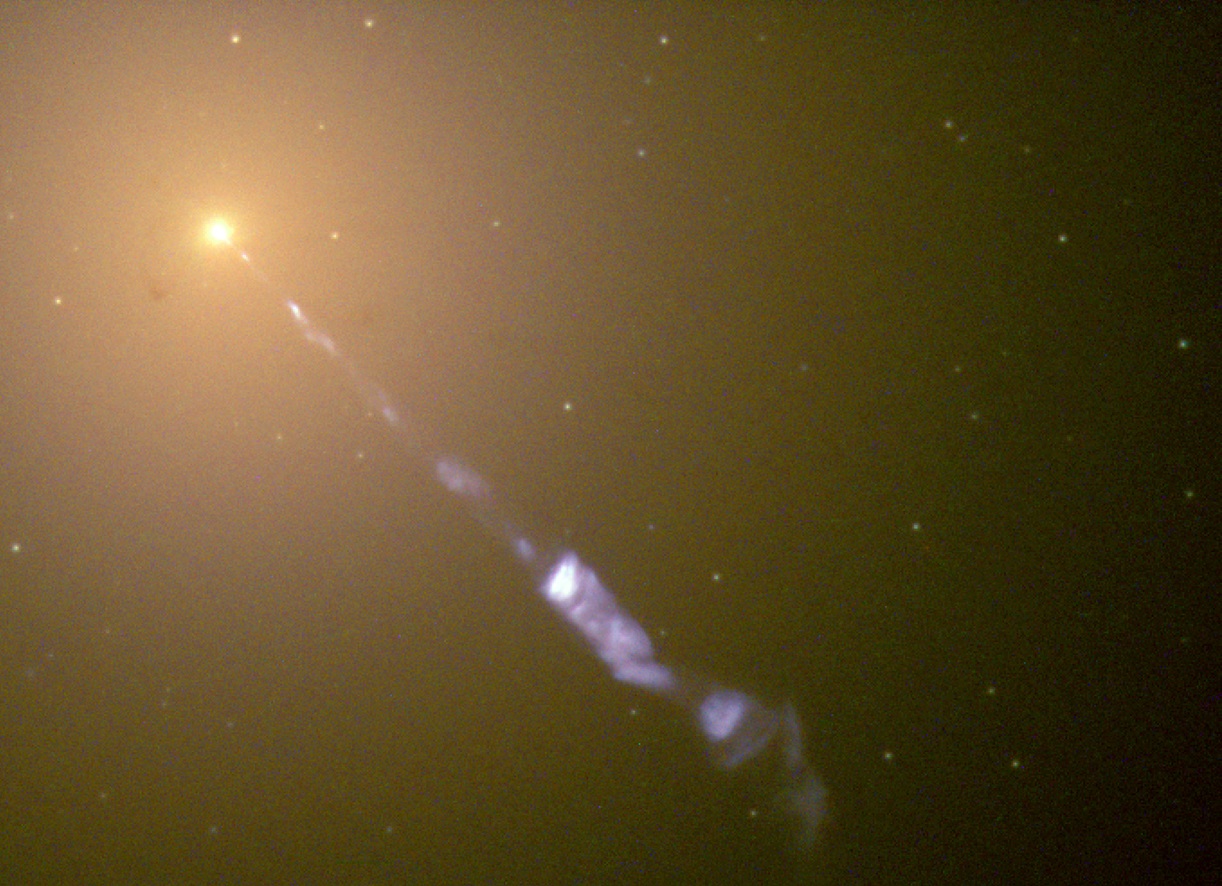
Next up, there are radio continuum and x-ray continuum emissions. Whereas radio emissions are always the result of the jet, x-ray emissions can arise from either the jet or the hot corona, where electromagnetic radiation is scattered. Last, there are x-ray line emissions, which occur when x-ray emissions illuminate the cold heavy material that lies between it and the nucleus.
These signs, alone or in combination, have led astronomers to make numerous detections at the center of galaxies, as well as to discern the different types of active nuclei out there.
The Milky Way Galaxy:
In the case of the Milky Way, ongoing observation has revealed that the amount of material accreted onto Sagitarrius A is consistent with an inactive galactic nucleus. It has been theorized that it had an active nucleus in the past, but has since transitioned into a radio-quiet phase. However, it has also been theorized that it might become active again in a few million (or billion) years.
When the Andromeda Galaxy merges with our own in a few billion years, the supermassive black hole that is at its center will merge with our own, producing a much more massive and powerful one. At this point, the nucleus of the resulting galaxy – the Milkdromeda (Andrilky) Galaxy, perhaps? – will certainly have enough material for it to be active.
The discovery of active galactic nuclei has allowed astronomers to group together several different classes of galaxies. It’s also allowed astronomers to understand how a galaxy’s size can be discerned by the behavior at its core. And last, it has also helped astronomers to understand which galaxies have undergone mergers in the past, and what could be coming for our own someday.
We have written many articles about galaxies for Universe Today. Here’s What Fuels the Engine of a Supermassive Black Hole?, Could the Milky Way Become a Black Hole?, What is a Supermassive Black Hole?, Turning on a Supermassive Black Hole, What Happens when Supermassive Black Holes Collide?.
For more information, check out Hubblesite’s News Releases on Galaxies, and here’s NASA’s Science Page on Galaxies.
Astronomy Cast also has episodes about galactic nuclei and supermassive black holes. Here’s Episode 97: Galaxies and Episode 213: Supermassive Black Holes.
Source: