
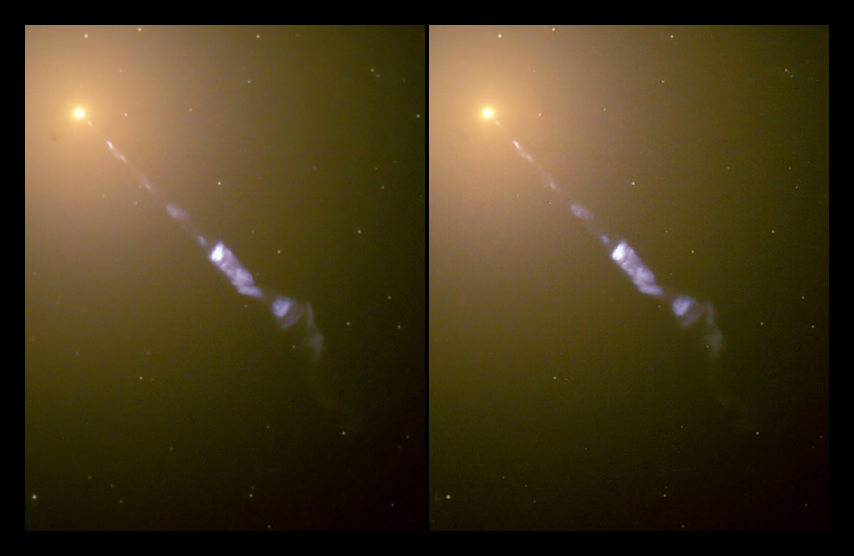
[/caption]
We’re all familiar with the photo of the jet of material emanating from the core of the Virgo A galaxy as imaged by the Hubble Space Telescope, but this 5,000 light year long streamer coming from the nucleus of M87 has never been more “in your eyes” than it is through the stereo magic visualizations produced by Jukka Metsavainio. Are you ready to take a closer look at this relativistic jet of extremely powerful plasma emerging from one of the best studied radio galaxies around? Then step inside…
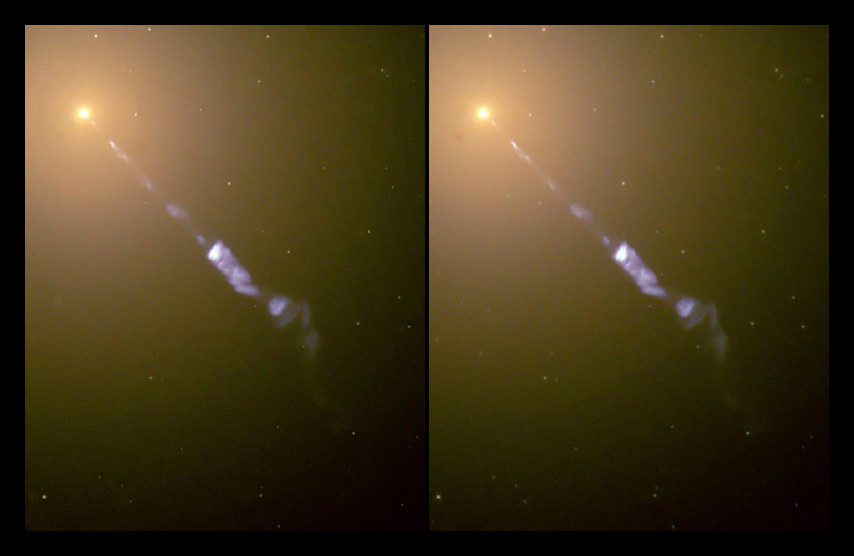
Whenever we present a dimensional visualization it is done in two fashions. The first is called “Parallel Vision” and it is much like a magic eye puzzle. When you open the full size image and your eyes are the correct distance from the screen, the images will seem to merge and create a 3D effect. However, for some folks, this doesn’t work well – so Jukka has also created the “Cross Version”, where you simply cross your eyes and the images will merge, creating a central image which appears 3D. As we learned with the last image, it might not always work for all people, but there are a few other tricks you can try. Now sit back and prepare to be blown away…
The year is 1918, and high on top of Mt. Hamilton at Lick Observatory an astronomer named Herbert Curtis is busy studying Messier Object 87. But, Mr. Curtis isn’t your ordinary garden-variety astronomer. In just two more years, he and a man named Harlow Shapely were going to have it out publicly about the nature of these “distant fuzzies” and Curtis was going to be eventually proved correct: Spiral “nebulae” were indeed galaxies just like our own. However, good old Herbert was noticing something about M87 that would take nearly 8 decades to discover its true nature… a “curious straight ray” coming straight from its heart. Now, you’ve got to give Herbert some very big credit for being an astute visual observer, because this was back in the day long before wide field imaging camera, infra-red technology, x-ray photography, radio studies and more. Heck, it would be 2 more years before Hubble began identifying Cepheid variables and 10 more years before interstellar absorption was discovered!
Are you ready to fast forward to 1977? Because it would be about that long before another noble name in galaxy studies would again reveal astonishing visual things about M87’s jet by resolving knots and clouds – Halton C. Arp of Mt. Palomar and J. Lorre of JPL. “The shred itself, however, is the object of most significance for establishing the reality of the ejection of the radio source. It is difficult to make a quantitative statement, but objects of this nature are not frequently seen. The inference is plain that the radio source has either left a wake behind it, (i.e. condensations along its track) or that this is some kind of jet or material associated with the ejection of the radio source form the parent peculiar galaxy.”
It wasn’t long until the discovery of a disk of rapidly rotating gas around the nucleus of M87 occurred and thanks to the Hubble Space telescope, we were taking closer than ever looks into the violent active nucleus of this galaxy. “We see almost a dozen clouds which appear to be moving out from the galaxy’s center at between four and six times the speed of light. These are all located in a narrow jet of gas streaming out from the region of the black hole at the galaxy’s center,” said Dr. John Biretta of the Space Telescope Science Institute. “We believe this apparent speed translates into an actual velocity just slightly below that of light itself.”
What we know now is the jet in M87 connects the innermost black hole to the outer parts of the source. It supplies the radio source and the surrounding region with energy and relativistic plasma. The speeds reported are two to three times faster than the fastest motions previously recorded in M87, the only nearby galaxy to show evidence for superluminal motion. “This discovery goes a long way towards confirming that radio galaxies, quasars and exotic BL Lac objects are basically the same beast, powered by super massive black holes, and differ only in orientation with respect to the observer,” Biretta said.
And this time the orientation is right in your eyes…
Many thanks to JP Metsavainio of Northern Galactic for his magic with Hubble Space Telescope images and allowing us this incredible look inside another mystery of space.
What? Stars in the backround? How strange! >:-0
What a fantastic sight, of the majestic jet in M 87 through the eyes of the Hubble Space Telescope! Recently on the arXiv.org site an interesting paper was posted concerning M 87, the jet & HST-1. It reported on the discovery of an Quasi Periodic Oscillation (QPO) discovered in HST-1 and and its’ HST-1 region of the jet as the source of high energy (~ 1 TeV) emissions. The paper can be found here: http://arxiv.org/PS_cache/arxiv/pdf/0904/0904.3925v1.pdf . What a wild corner of deep space to investigate!
“…the universe is 99.999% matter in the plasma state.” — Anthony L. Peratt, physicist, May 1995
P.S. Nice to see someone intelligent like Halton Arp being quoted.
@Total Science: do you have a source for the Peratt quote?
I’m curious to know whether this, like the 1947 Hubble one you posted earlier, omits something crucial (and to know its context too).
Oh, and do you mean, by your “Arp” comment, to imply that Herbert Curtis, Harlow Shapely, J. Lorre, Dr. John Biretta (and JP Metsavainio) are (were) not intelligent?
@Total Science: Google is my friend.
I found that the abstract of a document with Anthony L. Peratt as (sole) author uses the phrase you quote.
Here it is, in full:
“One of the earliest predictions about the morphology of the universe is that it be filamentary (Alfvén, 1950). This prediction followed from the fact that volumewise, the universe is 99.999% matter in the plasma state. When the plasma is energetic, it is generally inhomogeneous with constituent parts in motion. Plasmas in relative motion are coupled by the currents they drive in each other and nonequilibrium plasma often consists of current-conducting filaments.
In the laboratory and in the Solar System, filamentary and cellular morphology is a well-known property of plasma. As the properties of the plasma state of matter is believed not to change beyond the range of our space probes, plasma at astrophysical dimensions must also be filamentary.
During the 1980s a series of unexpected observations showed filamentary structure on the Galactic, intergalactic, and supergalactic scale. By this time, the analytical intractibility of complex filamentary geometries, intense self-fields, nonlinearities, and explicit time dependence had fostered the development of fully three-dimensional, fully electromagnetic, particle-in-cell simulations of plasmas having the dimensions of galaxies or systems of galaxies. It had been realized that the importance of applying electromagnetism and plasma physics to the problem of radiogalaxy and galaxy formation derived from the fact that the universe is largely aplasma universe. In plasma, electromagnetic forces exceed gravitational forces by a factor of 1036, and electromagnetism is 107 times stronger than gravity even in neutral hydrogen regions, where the degree of ionization is a miniscule 10–4.
The observational evidence for galactic-dimensioned Birkeland currents is given based on the direct comparison of the synchrotron radiation properties of simulated currents to those of extra-galactic sources including quasars and double radio galaxies.”
The document is entitled “Plasma and the Universe: Large Scale Dynamics, Filamentation, and Radiation”, and appears in Astrophysics and Space Science, Volume 227, Issue 1-2, pp. 97-107.
Curiously, Peratt does not ‘show his working’ wrt the 99.999% ‘fact’; I wonder why not?
Anyway, the “matter” Peratt refers to seems to be ordinary (‘baryonic’) matter; in fact, mass-wise, such matter is only a minor component (CDM comprises some 85% of all matter).
Beautiful. M87 is certainly one of my favourite objects in the sky, and hats off to Curtis for the fantastic visual observation of the jet before anyone knew there was one…
And you’ve got to love the Shapely v. Curtis debate – it isn’t called the great debate for nothing!
Nereid,
“I’m curious to know whether this, like the 1947 Hubble one you posted earlier, omits something crucial (and to know its context too).”
I provided the context for you and the words speak for themselves.
As for the Peratt quote, I’ll provide that context for you as well: http://www.youtube.com/watch?v=UEbatH0ssYE
“Oh, and do you mean, by your “Arp” comment, to imply that Herbert Curtis, Harlow Shapely, J. Lorre, Dr. John Biretta (and JP Metsavainio) are (were) not intelligent?”
Harlow Shapley thought that the Milky Way was the entire universe and thought that anyone who said otherwise was a Velikovskian crackpot. You can draw your own conclusions.
Total Science Says:
April 28th, 2009 at 7:40 pm
“Harlow Shapley thought that the Milky Way was the entire universe and thought that anyone who said otherwise was a Velikovskian crackpot. You can draw your own conclusions.”
He also happened to discover where the centre of the Milky Way lies, approximately how far we lie from it, how big the galaxy is to far better accuracy than anybody at the time, and became one of the most respected astronomers of his time, if not ever. I’d say that that cements his place in history as far beyond merely intelligent. It’s more than anyone of us has managed or likely will manage in our lifetimes.
If all of us weren’t wrong at least a great deal of the time, that would imply we know it all, and clearly we do not. He just happened to argue for the wrong resolution of a scientific problem, the correct resolution of which was far from obvious at the time. I don’t see how that diminishes him as a person or his previous outstanding achievements one iota.
@ Manu: could what looks like “stars” in the background be galaxies? Otherwise, this would be very strange, indeed…..
Great picture – it’s one of the easiest ones for me to “get” (the cross eye version) – thanks a lot, Tammy.
@Total Science: I think you have a rather selective, shall we say, take on history, at least wrt Shapley.
By the time Velikovsky published his infamous work (1950?), Shapley had long since accepted that his earlier views were wrong … so “and thought that anyone who said otherwise was a Velikovskian crackpot” cannot be true.
In fact, it was Shapley who discovered what we today call the Shapley supercluster, the largest and nearest supercluster (of galaxies) … in the early 1930s.
Thanks for the link that provides Peratt context; I’ll comment on it later (and see if it confirms my own conclusions about the reliability and veracity of your comments).
@ Manu & Feenix, most of these “stars’ represent a few of a large swarm of globular clusters orbiting M 87. This galaxy has an unusually large number of them, presumably left over from galaxies swallowed up by M 87 in the past.
@Total Science: Thanks again for the link re Peratt.
As you are no doubt well aware, in the video Peratt simply [b]asserts[/b] that the universe is 99.999% plasma, just as he does in the 1995 paper I found (which contains the exact set of words per the quote you attributed to him). Nothing wrong with that, of course, but what’s the point of your bald quote if there’s nothing behind it? Specifically, if no reader can follow up on what you write to check the basis for the assertion?
The broader context is interesting too. You seem to be promoting something called Plasma Cosmology, without actually saying so (are you?). I wonder if you realise just how inconsistent with huge numbers of high quality astronomical observations Alfvén’s published papers on Plasma Cosmology are, and whether you realise that, per a definition of Plasma Cosmology by Lerner (who also speaks on that video), it is non-science?
Well, tags for bold ([b][/b]) don’t work! 🙁
What about [i]italics[/i]?
Nereid,
You might want to look up the context of these as well:
“The Big Bang theory predicts the density of ordinary matter in the universe from the abundance of a few light elements. Yet the density predictions made on the basis of the abundance of deuterium, lithium-7 and helium-4 are in contradiction with each other, and these predictions have grown worse with each new observation. The chance that the theory is right is now less than one in one hundred trillion.” — Eric J. Lerner, physicist, 1991
“There is also the Plasma Model, first proposed by Nobel Prize-winner Dr. Hannes Alfvén in 1965. It is rapidly gaining wide international support from the scientific community, due in no small measure to it’s rock solid empirical base and the weight of observational evidence on it’s side. The predictions of Plasma Cosmology have passed every single test that has come from empirical evidence over a period of forty years. Makes you think, doesn’t it?” — Hilton Ratcliffe, astronomer, 2007
@ Total Science, By now (18 years later), those odds against the Big Bang should be less than one in a quintillion. I see no evidence of a disparity of this of this magnitude (nor anything close). As far as the 44 year old field of “Plasma Cosmology”, the paucity of peer-reviewed published literature speaks for itself. This site is called ‘Universe Today’ for a reason.
@Total Science: Lerner is right in the sense that the estimated primordial abundance of 7Li seems inconsistent with BBN (Big Bang Nucleosynthesis) models.
However, he’s quite wrong wrt “and these predictions have grown worse with each new observation”. You see, 7Li is unique; it is the only nuclide with was produced at the time of BBN (and is still left over), AND which can be produced in stars, AND which can be destroyed in stars, AND which can be produced by (cosmic ray) spallation. Further, 7Li is not the only stable isotope of Li; there’s also 6Li. All this makes the task of robustly estimating the primordial abundance of 7Li fiendishly difficult.
As far as I know, today, 18 years later, as Jon Hanford says, there is no inconsistency concerning the estimated primordial abundance of D, 3He, and 4He; nor is there with the ratio of the number of photons to 1H. If you – or any reader – is interested, I will provide a link to a recent, widely cited paper which summarises these results.
The OilIsMastery website contains a link to something purporting to be Hilton Ratcliffe’s blog, or webpage. On that you can find Hubble’s 1947 PASP quote, in the same form as you quoted it earlier. That is, IMHO, intellectual dishonesty for someone who claims to be an *astronomer*. But it gets worse; immediately after mis-quoting Hubble, Ratcliffe goes on to say “And so it remained”! Clearly, Ratcliffe has not read Hubble’s papers, subsequent to the 1947 PASP one.
After that, it is no longer surprising to read such blatant falsehoods, written (supposedly) in 2007, as “It is rapidly gaining wide international support from the scientific community, due in no small measure to it’s [sic] rock solid empirical base and the weight of observational evidence on it’s [sic] side. The predictions of Plasma Cosmology have passed every single test that has come from empirical evidence over a period of forty years.”
But then, did Hilton Ratcliffe actually write those words? Certainly Google turns up nothing, in the sense of that quote PLUS a reference; in fact, all instances I could trace, on the web, seem to come back to OilIsMastery (!) Can you give a reference, that any reader can follow to the source of this quote?
Now Alfvén’s 1965 Plasma Model is inconsistent with the CMB, starting with its 2.73K blackbody spectrum; and as far as I know, no published version of “Plasma Cosmology” can account for it either. Then there’s the Hubble distance-redshift relationship, the primordial abundances of light nuclides, and the observed large-scale structure. Ratcliffe, if he is indeed an astronomer, and if indeed he did write those words in 2007, reveals himself to be, well, you can draw you own conclusions.
Nereid,
The Big Bang so-called “theory” predicted CMB temperature of 50 degrees Kelvin (Gamow).
Only off by 4 orders of magnitude (10 x 10 x 10 x 10).
Plasma Cosmology on the other hand predicted 2.8 degrees Kelvin (Peratt).
Which do you think is more accurate?
Total Science: references, please.
Including the Ratcliffe (2007) one.
I think WMAPs measurement of 2.725 Kelvins is strongly in agreement with current theory of CMB temperature. Peratt’s value is off by 0.075 Kelvins, not much to you or me, but much further off the mark than current theory predicts. And Peratt’s figure is less than 20 years old. So what is his explanation of this difference? That’s a pretty big deviation from what’s measured. Check out the Wiki history of the CMB and prediction history here: http://en.wikipedia.org/wiki/Cosmic_microwave_background_radiation . For some reason, Peratt’s estimate is not discussed. What year was this prediction published in a peer-reviewed journal? Do you have a (free) link to this article ?
Nereid, The Wiki CMB page has an abbreviated link to the Gamow reference (hard to put in context but clearly out of date and misleading).
@Jon Hanford: I appreciate your efforts to address Total Science’s comment.
However, based on my – admittedly limited – experience with the material he supposedly quotes, I feel the most prudent first step is to request of Total Science the specific references for the material which he (supposedly) quotes. With that in hand, every reader is free to investigate the accuracy of the quote, its context, etc, and from that common basis proceed to investigate.
The Gamow prediction is old — that is certain. But the prediction was off by a large margin.
The point is simple enough: Whether you were a “big banger” or a steady-state proponent did not effect your prediction.
So, it seems accuracy of prediction was independent of the theory you supported, therefore, neither theory was particularly helpful in deriving accurate predictions.
But if you follow the CMB prediction timeline at the Wiki CMB page, you can see how researchers zeroed in on the correct value over many years , whereas Peratt’s estimate of the CMB temperature is the ONLY prediction quoted over the 40 year lifetime of ‘Plasma Cosmology’. Why is this? And, as Nereid noted, links to sources are greatly appreciated, especially any published in the last 5 years.
Nereid,
For someone who is such an authority on Hilton Ratcliffe, I would’ve thought you would’ve at least taken the time to read his only book. It’s called The Virtue of Heresy and the reference can be found on page 80.
Jon Hanford,
I’ll tell you why. Since the Big Bang prediction was off by 4 orders of magnitude they had to keep changing their predictions ad hoc. Since Plasma Cosmology is precise and correct, only one prediction was required.
Jon Hanford,
“For some reason, Peratt’s estimate is not discussed.”
It’s called censorship. The gravitation cult is so terrified of Peratt they deleted his Wiki page.
Total Science,
Surely you are pulling our legs?!
A book, published in English, by an established publisher, that lets its author get away with such a gross error of grammar!?!?
Maybe there’s a simple explanation?
How about a reference to each of the Peratt and Gamow statements (in your comment of “April 29th, 2009 at 3:48 pm”)?
ETA: per your “April 29th, 2009 at 6:56 pm” (“It’s called censorship. The gravitation cult is so terrified of Peratt they deleted his Wiki page.”); do I hear you correctly? that you cannot provide a reference to “Plasma Cosmology on the other hand predicted 2.8 degrees Kelvin (Peratt).”?
@Anaconda: as Total Science has not, yet, been forthcoming with a reference to Gamow and his (supposed) prediction, and as you seem to be familiar with it (I may be wrong), perhaps you could provide one?
@ Nereid, Unfortunately, as you can see, this illogic is so deeply entrenched that even after terabytes of evidence could be amassed to back up the claims of mainstream astrophysics, your entire argument would be relegated to just another folly from the ‘gravitation cult’ majority. I’m sure you’re aware that by now astrophysicists tremble at any of Peratt’s pronouncements (who is a trained laboratory physicist at LLNL, not an astrophysicist with telescope time and an immersion in this specialized field of astrophysical gravitational theory, ca. 2009.). Where are Peratt’s papers with detailed predictions of the CMB spectrum Planck will measure? What about his predictions concerning the CMB spectrum observed by WMAP? New calculations based on the tenants of PC that are more closely in line with the measured temperature of the CMB? Total Science states: “Since Plasma Cosmology is precise and correct, only one prediction was required.” What, no more predictions are forthcoming from PC on the CMB spectrum. No detailed PC interpretation of the WMAP CMB spectrum? Where are all the recent (last 2 years) papers concerning Plasma Cosmology and the observed and predicted Cosmic Microwave Background and how they specifically are explained by Plasma Cosmology?
I guess the ‘gravitation cult’ missed Stelve Milgrom and the Wiki MOND page. I guess they haven’t got around to deleting that page yet, or the numerous MOND papers I see published in many mainstream astronomical journals.
@Jon Hanford: from my perspective, as a newbie and as someone who’s not exchanged comments with Total Science before, you’re way too far down the road.
You see, I can’t even read the material which Total Science says he’s (she’s?) quoting, because no references have been given (Gamow, Peratt and 2.8K), so I’m in no position to comment yet (though I will say that he too is getting way ahead of himself with “Since Plasma Cosmology is precise and correct, only one prediction was required.”: we have only his word that this is, in fact, a prediction, made by Peratt, based on/derived from Plasma Cosmology).
Not to worry, I’m patient.
@Jon Hanford: do you mean Stacy McGaugh (The MOND pages: http://www.astro.umd.edu/~ssm/mond/)?
@ Nereid : Sorry, meant to reference Mordehai Milgroms MOND theory as presented by Wiki: http://en.wikipedia.org/wiki/MOND . As for forthcoming links to papers by Peratt and other PC ‘scientists’, I’ve, asked before, and usually the 1995 paper you found through Google is proffered. Try a Google search for new peer-reviewed papers relating Plasma Cosmology to any specific topic in astrophysics . The dearth of ‘hits’ compared to that of a pretty radical theory like MOND is my argument against conspiracy theories against ‘Plasma Cosmology’.
@Jon Hanford: thanks.
Still no word from Total Science, but in the meantime I rather doubt that that 1995 Peratt paper is the source of his (Total Science’s) “Plasma Cosmology on the other hand predicted 2.8 degrees Kelvin (Peratt).”
For starters, there’s no mention of 2.8 degrees Kelvin in the 1995 paper; but anyway, as the CMB was discovered in 1964, I doubt anyone would assert that a paper published in 1995 predicted something that had happened over 30 years prior!
I’m optimistic that Total Science will comment soon, and provide good inputs.
UT date April 29th, 2009 at 3:48 pm; Total Science wrote:
“Plasma Cosmology on the other hand predicted 2.8 degrees Kelvin (Peratt).”
The CMB was discovered, by accident, by Penzias and Wilson, in 1964.
A. Peratt’s PhD thesis (“Wave Conversion and Resonance Below the Second Electron Cyclotron Harmonic. Oblique Incidence.”) is dated 1971, according to ADS (which cites as source “Dissertation Abstracts International, Volume: 32-05, Section: B, page: 2941”).
So it’s rather unlikely that Peratt is the Plasma Cosmologist who predicted the CMB temperature, which leads to the thought that something Peratt wrote mentions a prediction of the CMB temperature, using an approach which Total Science (and/or Peratt) considers to be true to Plasma Cosmology. But who would have done such work, before 1964? After all, wasn’t it only in 1965 that Alfvén (Worlds-Antiworlds) kicked off this field of study? And that book certainly does not contain any “2.8 K” claim, does it?
To quote Alice, curiouser and curiouser.
Thanks for the info on the 1971 Peratt paper, that’s a new one to me. But, as we’ve asked repeatedly, no link to a pre-discovery CMB prediction made utilizing ‘Plasma Cosmology’ is forthcoming. I would think such an important piece of work would be proudly held up and referenced to bolster the status of that theory. I’m glad your patient, Nereid “Curiouser and curiouser” indeed.