
[/caption]
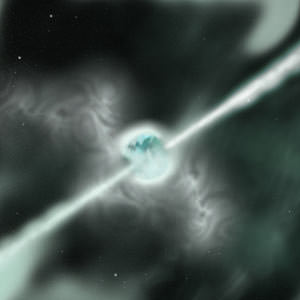
According to the Sky and Telescope blog, NASA’s Swift satellite captured a faint gamma-ray burst (GRB) last Thursday which has smashed the record for the earliest, most distant known object in the universe. Various ground-based telescopes following up on Swift’s initial detection of the GRB have measured redshifts of the object, varying from 7.6 to 8.2. Whatever the final determination is of how much this GRB’s afterglow has been redshifted by the expansion of the Universe, it will set a record. In September 2008, Swift captured GRB 080913, the most distant gamma-ray burst ever detected, with a redshift of 6.7. Astronomers using the Very Large Telescope in Chile have determined that this current GRB (090423) went off about 600 million years after the Big Bang.
A GRB comes from the cataclysmic explosion of a massive star, which could signal the birth of a black hole, a collision of two neutron stars or some other unknown phenomenon. These bursts occur approximately once per day and are brief, but intense, flashes of gamma radiation. They come from all different directions of the sky and last from a few milliseconds to a few hundred seconds.
Since the Swift satellite was launched in 2004, it has undoubtedly seen GRBs with even higher redshifts, but many bursts have afterglows so faint that astronomers are unable to determine their redshifts. The most distant galaxies with well-measured redshifts are in the 6’s.
NASA is supposed to issue a press release with more information later today, and we’ll provide an update at that time.
“It seems likely that redshift may not be due to an expanding Universe, and much of the speculations on the structure of the universe may require re-examination.” — Edwin P. Hubble, astronomer, 1947
“… if redshifts are not primarily velocity-shifts, the picture is simple and plausible. There is no evidence of expansion and no restriction of time-scale, no trace of spatial curvature, and no limitation of spatial dimensions.” — Edwin P. Hubble, astronomer, 1937
Do you have sources for those quotes, Total Science? I’m interested to know the context within which Hubble wrote this, and his reasons (and reasoning) for them.
Thanks.
First quote you can find here Pages 165-66: http://articles.adsabs.harvard.edu/full/seri/PASP./0059/0000153.000.html
For reason and logic see here: http://www.haltonarp.com/
Total Science, thanks for the link. I seem to understand from it though that Hubble is suggesting that future results from multiple telescopes larger than 100 inches might not support what he says there. Instead of the views out to 1 billion lyr that Hubble was anticipating with a 200 inch we can now see quite a bit further than that.
@IVAN3MAN: You are now my eyes and ears in the comment boxes, I thought I smelled something fishy 😉
I am at full alert and my finger hovers over the Big Red Button™. Keep an eye open for any quotes from papers dating before 1950…
Cheers! Ian
Thanks for the link, Total Science.
As BeckyWS has already noted, the PASP paper from which you quoted Hubble is not, principally, about redshifts or cosmology.
Indeed, a more detailed look at what we today call the Hubble relationship is but one of three areas of research in astronomy that he chose as examples of how the (then) new 200″ Palomar telescope would likely make a difference (the other two are canals on Mars, and the chemical/elemental composition of stars).
The full context of the Hubble quote is interesting:
“Thus the most important observational problems in cosmology may be described as the small, second-order effects of great distances. The nebulae [i.e. galaxies] appear to be distributed in a roughly uniform manner and the red-shifts appear to be roughly proportional to distance, out to the limits of the 100-inch. The next step is to determine these features more precisely over the limited range of the 100-inch and approximately out to far greater distances.
Attempts have been made to attain the necessary precision with the 100-inch, and the results appear to be significant. If they are valid, it seems likely that red-shifts may not be due to an expanding universe, and much of the current speculation on the structure of the universe may require re-examination.”
(BTW, it seems that you slightly mis-quoted Hubble; apart from some typos, you left out the critical first phrase “If they are valid, “).
As you noted, Hubble wrote these words over 60 years’ ago.
Much has happened since then, including the revolution in astronomers’ workhorse detector, from the photographic plate to the CCD. I do not know what results at the limits of the 100-inch Hubble is referring to (but I’ll look into it); however, since 1947 the Hubble relationship has been extensively examined, in ways Hubble could scarcely have imagined, and the one big surprise was the (unexpected) discovery of dark energy (in 1998/1999). Otherwise, the “Big Bang theory” (a phase not invented until two years after Hubble’s PASP paper) has gone from strength to strength.
(I’ll comment on “reasons and logic” later)
OK, I’ve checked out the second link you provided (thanks Total Science).
I’m afraid I can’t see any connection, in logic or reason, between what’s on that website and the 1947 Hubble quotation (taken in its proper context).
Certainly there are no papers published by Arp which seem to reference the Hubble PASP 1947 one (though, as Arp has published hundreds, it’s entirely possible I may have missed any – do you know of any, Total Science?).
Arp didn’t graduate until after Hubble had died (though Arp did work at Mt Palomar).
Arp is well-known for his controversial – and now overwhelmingly inconsistent with vast numbers of high quality astronomical observations – opinions on the ‘intrinsic redshifts’ of quasars; but Hubble, in 1947, cannot possibly have been referring to quasars (they were not discovered until over a decade later, well after he – Hubble – had died).
Etc.
Would you mind elaborating please, Total Science?
The alternative explanations for the redshift of galaxies and other distant objects have largely been discarded as incommensurate with observational data. I think we can dispense with caviling over this matter.
Lawrence B. Crowell
Methinks that “Total Science” is OilIsMastery under a different name!
Me thinks you should just ban anyone that posts quotes from famous people in a way that distorts what they were saying. 95% of them are going to be OilIsMastery, anyways.
Ian O’Neill:
Will do! 😎
At his web-site, on the left-hand side of the page, OilIsMastery has one very long column of mined quotes taken out-of-context; including those two stated above verbatim with the essential opening phrase, “If they are valid,…”, deliberately omitted from the first quote.
Sneaky!
@ Nereid: I think that the reference made by Hubble about results obtained “near the limits of the 100 inch” refers to redshifts observed in relatively nearby galaxies. If I recall, at least one spectrum of a galaxy (NGC 7814?) taken by his associate Milton Humason with the 100 inch scope took 12 hours spread over 3 nights! This was due to the poor sensitivity of photographic film at the time (hence the desire for bigger scopes to collect galaxy spectra in a decent amount of time.) @IVAN3MAN: I see you have a sense of deja vu, too. Sorta reminds me of how creation science morphed into intelligent design.
@ Jon Hanford,
Indeed! All types of pseudoscience share one thing in common: cherry-picking data that supports their ‘theory’, but ignoring the vast amount that does not!
@Jon Hanford, Total Science: I’ve still not nailed down the issue Hubble hints at in his 1947 PASP paper, however, this 1953 MNRAS one, “The law of red shifts (George Darwin Lecture)” is a follow-on to the 1947 paper in that it includes a ‘progress report’ of the use of the 200-inch in investigating the Hubble relationship (among other things; URL in my next comment).
In the 1947 paper, Hubble may be referring to possible non-linearity in the distance-redshift relationship; in the 1953 one he mentions the much larger dataset (due to the use of the 200-inch, among other reasons), resolution of a number of questions, and presents a clear linear distance-z relationship.
He also mentions a number of then current questions, among which is the distance ladder, which, in a nice turn of history, was essentially resolved by one of the Key Projects of the Hubble Space Telescope (lead by Wendy Freedman), to nail down the value of the slope of the distance-z relationship.
Appropriately, the last para of section III reads as follows (written in 1953, remember):
“These results are important for the present discussion because they indicate the reliability of the measured red-shifts for clusters used in the formulation of the law of red-shifts [a.k.a. the Hubble relationship]. The percentage errors are trivial except possibly for the nearby Virgo Cluster where it is about 5 percent (in addition to the unknown peculiar motion of the cluster). With increasing distance the percentage errors diminish, and, beyond the Coma Cluster, they can safely be ignored. Evidently the uncertainties in the formulation of the law of red-shifts are entirely those in the distances. Furthermore, because distances are derived from the apparent faintness of objects of supposedly known luminosity, the difficulties seem to be largely those of photometry, except for uncertainties in the fundamental unit of distance.”
IOW, and drawing from the rest of this 1953 paper, well before Arp even began his career as an astronomer, the ‘Fingers of God’ illusion was known and understood … and shown to have essentially no effect on the Hubble relationship.
OK, for some reason the URL didn’t post …
The reference is: Monthly Notices of the Royal Astronomical Society, Vol. 113, p.658;
and the (ADS) Bibliographic code is 1953MNRAS.113..658H
Nereid, The paper ‘The Law of Redshifts’ by Edwin Hubble can (hopefully) be found at: http://articles.adsabs.harvard.edu/full/1953MNRAS.113..658H .Thanks for the mention of this paper, I’ll definitely check it out.
This discussion is really interesting, I think I understand Arp’s theory as saying that quasars are not really very distant but spawned by nearby galaxies and having erroneous redshifts because of (?)dust…. but what is the ‘Fingers of God’ illusion Nereid refers to? Is this the same thing?
There was a recent article in the Sky at Night magazine where Patrick Moore defended Arp in the sense that he was shunned by the research community, and seemed to suggest that there may still be something to his theories. On the other hand he also refers to climate change as another example of maintstream science not allowing dissent, so perhaps it’s more of a personal gripe.
I’ve done a bit of surfing but can’t find much on Arp’s actual evidence beyond some rather unconvincing photos of alignments on his website. What are the opinions of people here?
Thanks, and I’m not trying to have a discussion promoting alternate theories, I am just interested in exactly what what said in terms of how Arp interpreted evidence that most astronomers see as supporting red shift distance.
BeckyWS: A reasonable place to start to read up on Arp and his career is his Wiki page here:http://en.wikipedia.org/wiki/Halton_Arp . Check out, also the many links to his papers from this site to get an unbiased look at his body of research. His early to mid-career work was outstanding, so Arp is a complex character to figure out. But I digress…..
Ian,
“Keep an eye open for any quotes from papers dating before 1950…”
Newton and Einstein wrote before 1950.
@BeckyWS: “Fingers of God” refers to long, thin lines of points (which represent individual galaxies) that point back to us (the Milky Way) when you draw a (radial) graph of galaxies’ redshifts against their position on the sky.
This webpage, from a UCLA Berkeley astronomy course, illustrates the effect: http://astro.berkeley.edu/~louis/astro228/redshift.html
In a cluster of galaxies, the individual galaxies will have a component of their velocity (the line of sight one) that varies a great deal about the mean (average) for the cluster as a whole; the paper by Hubble that I mentioned in an earlier comment discusses this dispersion, and concludes per the para I quoted. Note that the term, Fingers of God, was not invented until well after Hubble had died.
Re Arp: are you familiar with ADS? It’s a wonderful tool for finding the published work of scientists, especially astronomers. When you put “Arp, H.” as author in the search field, it returns >400 entries! Now not all of them are papers published in relevant peer-reviewed journals of course, and it may be that there’s another H. Arp; however, I think it’s fair to say that he has had no difficulty getting his papers published. Further, he has a position at the highly respected Max-Planck-Institut für Astrophysik; hundreds of astronomers would just die to be so shunned by the research community.
His idea about quasars being expelled from the nuclei of (active) galaxies is quite dead, as science. Perhaps the simplest way to show how dead the idea is is to start with the recognition that many classes of astronomical object are simply different manifestations of the same thing: active galactic nuclei (AGNs): quasars, QSOs, blazars, BL Lac objects, Seyferts, LINERs, … Quite a few (>100?) quasars have been found lensed (gravitationally) by foreground galaxies, and these objects can be studied to get direct, independent estimates of their distances. They are all at distances consistent with their redshifts.
So, logically, the Hubble relationship is a highly reliable means of estimating distances (for objects outside the Local Group, and the Virgo cluster), OR quasars are a heterogeneous class (some are truly distant, some not), OR every method of estimating extra-galactic distances is hopelessly flawed (if you can think of some other logical conclusions, please share them!).
Initially Arp tried to show that the lensed quasars were not, in fact, lensed, but as more and more were found it became harder and harder to make this kind of case.
Curiously, as far as I know, no one tries to make the case that quasars, and AGNs in general, are a heterogeneous class, and only crackpots try to argue that all methods of estimating extra-galactic distances are fatally flawed.
I hope this short summary helps.
PS: I think I’ve tracked down what Hubble was referring to in his 1947 PASP paper; I’ll write it up later.
@ Nereid
Wow thanks so much for taking the time to explain all that, it really helps it make a bit more sense to me why Arp came up with the theory originally and why it’s no longer relevant.
I’m not sure either why Patrick Moore thinks working at Max Planck is somehow being rejected, I was just wondering if he was talking about his personal opinion or if there was actually any real debate about it.
AGNs and the way they can all look different depending on angle etc is one of my favorite things about astronomy 🙂
Thanks again
Becky
To keep anyone who’s following this informed: I wrote a lengthy comment on what I found regarding what Hubble was referring to in his 1947 PASP paper that Total Science mis-quoted. That comment is “awaiting moderation”.
In the meantime, a sound-bite summary: an enormous amount of research since 1947 has shown that the specific concerns Hubble was hinting at (“If they are valid,”) do not in any way suggest that the Hubble distance-redshift relationship is invalid.
My comment is still awaiting moderation.
So let’s see if I can get it up, by breaking it into smaller pieces, with no more than one URL per piece.
Part 1
===================================
OK, here’s what I found wrt the 1947 PASP Hubble (mis-)quote by Total Science.
If you apply General Relativity (GR) to a homogeneous, isotropic universe which is not ‘empty’ (i.e. it has mass-energy), you find only two stable solutions: expanding and contracting; and for ‘low’ redshift, observers like us should see a linear Hubble relationship.
However, in GR ‘distance’ is a rather tricky thing; you can estimate the distance to an object in an expanding universe in several different ways – ‘luminosity distance’, ‘angular diameter distance’, ‘co-moving distance’, and so on. This webpage gives a good summary: http://www.atlasoftheuniverse.com/redshift.html
So far, so good.
Part 2
===================================
However, if we do not live in an expanding, GR universe, but one with flat, Euclidean geometry, all distances will be the same.
So an independent test of an expanding, GR universe model might be to see if luminosity distances and angular diameter distances and … are consistent.
And that’s what Hubble seems to be referring to, as you can see for yourself by reading this Hubble 1936 ApJ paper, and this Hubble 1942 Science one (my thanks to BAUT Forum’s dgruss23 for finding these):
http://adsabs.harvard.edu/abs/1936ApJ….84..517H
Continuing.
Part 3
===================================
http://adsabs.harvard.edu/abs/1942Sci….95..212H
His, and others’, attempts to use galaxy number-magnitude relationship were fraught with systematics, not least of which was the ‘K correction’; however, by 1947 there seemed to be some hints in the data that we may not live in an expanding, GR universe, and that’s what he refers to in his 1947 PASP paper.
Since 1947 a great deal of research has been done, and the magnitude and redshift limits extended far, far beyond what Hubble and colleagues could reach in 1947 or 1953, and the GR-based models of the 1930s and 1940s became today’s consensus LCDM ones.
===================================
The end.
OK, the ADS links didn’t copy correctly; here is the first one (1936 Hubble paper):
http://adsabs.harvard.edu/abs/1936ApJ….84..517H
The second (1942 Hubble paper):
http://adsabs.harvard.edu/abs/1942Sci….95..212H