
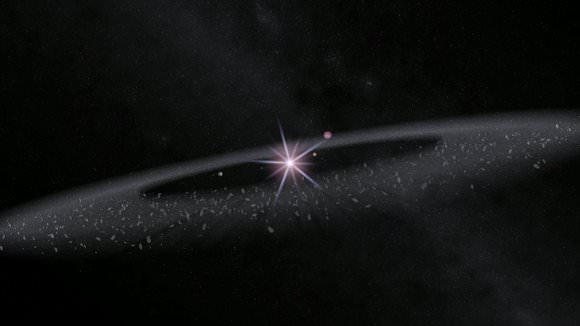
[/caption]
When Mars and Jupiter migrated to their present orbits around 4 billion years ago, they left scars in the asteroids belt that are still visible today.
The evidence is unveiled in a new paper in this week’s issue of the journal Nature, by planetary scientists David Minton and Renu Malhotra from the University of Arizona in Tucson.
The asteroid belt has long been known to harbor gaps, called Kirkwood gaps, in distinct locations. Some of these gaps correspond to unstable zones, where the modern-day gravitational influence of Jupiter and Saturn eject asteroids. But for the first time, Minton and Malhotra have noticed that some clearings don’t fit the bill.
“What we found was that many regions are depleted in asteroids relative to other regions, not just in the previously known Kirkwood gaps that are explained by the current planetary orbits,” Minton wrote in an email. In an editorial accompanying the paper, author Kevin Walsh added, “Qualitatively, it looks as if a snow plough were driven through the main asteroid belt, kicking out asteroids along the way and slowing to a stop at the inner edge of the belt.”
Walsh hails from the Observatoire de la Côte d’Azur in France. In his News and Views piece, he explains that the known Kirkwood gaps, discovered by Daniel Kirkwood in 1867, “correspond to the location of orbital resonances with Jupiter — that is, of orbits whose periods are integer ratios of Jupiter’s orbital period.” For example, if an asteroid orbited the Sun three times for every time Jupiter did, it would be in a 3:1 orbital resonance with the planet, he wrote. Objects in resonance with a giant planet have inherently unstable orbits, and are likely to be ejected from the solar system. When planets migrated, astronomers believe objects in resonance with them also shifted, affecting different parts of the asteroid belt at different times.
“Thus, if nothing has completely reshaped the asteroid belt since the planets settled into their current orbits, signatures of past planetary orbital migration may still remain,” Walsh wrote. And that’s exactly what Minton and Malhotra sought.
The asteroid belt easily gave up its secrets, showing the lingering evidence of planetary billiards on the inner edge of the asteroid belt and at the outer edge of each Kirkwood gap. The new finding, based on computer models, lends additional support to the theory that the giant planets — Jupiter, Saturn, Uranus and Neptune — formed twice as close to the sun as they are now and in a tighter configuration, and moved slowly outward.
“The orbit of Pluto and other Kuiper belt objects that are trapped in [orbits that resonate] with Neptune can be explained by the outward migration of Neptune,” Minton and Malhotra write in the new study. “The exchange of angular momentum between planetesimals and the four giant planets caused the orbital migration of the giant planets until the outer planetesimal disk was depleted.” Planetesimals are rocky and icy objects left over from planet formation.
“As Jupiter and Saturn migrated,” the authors continue, they wreaked havoc on the young asteroid belt, “exciting asteroids into terrestrial planet-crossing orbits, thereby greatly depleting the asteroid belt population and perhaps also causing a late heavy bombardment in the inner Solar System.”
The late heavy bombardment is proposed to have occurred about 3.9 billion years ago, or 600 million years after the birth of the Solar System, and it’s believed to account for many of the Moon’s oldest craters. Walsh said a reasonable next step, to corroborate the theory about the newly described clearings in the asteroid belt, is to link them chronologically with the bombardment.
LEAD PHOTO CAPTION: Artist’s depiction of the asteroid belt between Mars and Jupiter. Credit: David Minton and Renu Malhotra
Source: Nature
Some notable quotes from the post:
“Qualitatively, it looks as if a snow plough were driven through the main asteroid belt, kicking out asteroids along the way and slowing to a stop at the inner edge of the belt.”
“When planets migrated, astronomers believe objects in resonance with them also shifted, affecting different parts of the asteroid belt at different times. ”
The lead sentence in the post states: “When Mars and Jupiter migrated to their present orbits around 4 billion years ago…”
What basis do scientists have for the timing of the planets’ “migrations”?
Could it be that the “migrations” didn’t happen 4 billion years ago, but at some other time?
And what possible dynamics would be generated by those planetary migrations.
Is it possible that those planetary migrations would effect the electromagnetic equilibrium of the interplanetary medium which science knows is of a electromagnetic nature being made up of plasma (the solar wind)?
Could it be possible electrical discharges were released as a result of this electromagnetic disequilibrium?
And what possoble scientific evidence could there be as a result of these hypothesized electrical discharges?
An interesting line of scientific inquiry.
Hi, I will try to answer your questions as best as I can.
“What basis do scientists have for the timing of the planets’ “migrations”?”
The timing is uncertain, but it is not likely to have occurred any later than about 3.8 billion years ago (4 billion is just rounding up). That is because 3.8 billion years ago is about the end of the period of heavy bombardment (or the so-called “late heavy bombardment,” or LHB) that is recorded in lunar rocks. While it is still debated as to whether planet migration can be linked to the LHB, certainly if the migration had happened any later than 3.8 billion years ago then the destabilized asteroids would have left quite a few craters on the Moon from that time. But the lunar cratering record shows us that cratering rates were not much different over the last 3.5-3.8 billion years as they are today. So this period of migration must have occurred early in the solar system’s history, between 4.5-3.8 billion years ago (give or take).
“And what possible dynamics would be generated by those planetary migrations.”
Lots of interesting orbital dynamics, that we are trying to understand. Pluto’s orbit, and the orbits of other Kuiper belt objects that are in resonance with Neptune, is explained nicely by Neptune’s outward migration. Other populations of objects in the solar system were also probably affected, and planetary migration has been implicated in everything from the Trojan asteroids to Saturn’s rings. It’s a great topic in solar system dynamics right now, and there is a lot of work being done to understand this period of orbital rearrangement in our solar system (and other solar systems).
“Is it possible that those planetary migrations would effect the electromagnetic equilibrium of the interplanetary medium which science knows is of a electromagnetic nature being made up of plasma (the solar wind)?”
A lot of these asteroids may have ended up in the Sun, so they may have had a small effect on the composition of the solar wind. Beyond that, I’m not sure what effect planet migration could have on any “electromagnetic equilibrium” of the interplanetary medium
Interesting theory-however, timeframes can be different periods depending on who does the research-therefore, I stay neutral in these ‘exchange of truths’!!
Anaconda said;
“And what possible dynamics would be generated by those planetary migrations.
Answering theses questions…
“Is it possible that those planetary migrations would effect the electromagnetic equilibrium of the interplanetary medium which science knows is of a electromagnetic nature being made up of plasma (the solar wind)?”
NO
“Could it be possible electrical discharges were released as a result of this electromagnetic disequilibrium?”
NO
“And what possoble scientific evidence could there be as a result of these hypothesized electrical discharges?”
NONE
Gravitational effects were (and are) the principle causes of such migrations, whose outcomes can be understood as to be caused by the “…exchange of angular momentum.” Gravitational perturbations of all planetary bodies has been well researched and reasonably well known. These accretion processes, including planet creation via planetesimals and the formation of rings and role of small moonlets to make such structures stable. Much has been learnt, primarily from the rings of Saturn.
The solar wind has very little to do with the behaviour of the accretion processes. On that issue, the evidence is absolute and well documented.
Looks like Democritus and Velikovsky were 100% correct about worlds in collision. Shock and awe.
OillsMastery said
“Looks like Democritus and Velikovsky were 100% correct about worlds in collision.”
Nice try, but total NOT true, especially in Velikovsky’s case.
Immanuel Velikovsky is a proven out and out nutter, who thought that recent catastrophic collisions and close contacts occurred in Ancient times – especially towards both mythological and Biblical events. He even attempted to prove this evidence was retained in the geological record.
Velikovsky also wrongly argued that electromagnetic effects play an important role in celestial mechanics. He was completely proven wrong in this assumption, and it has been shown that gravitational and perturbational effects are quite sufficiently precise to account for the general evolution of the Solar System.
Furthermore, as this article eludes, evidence of such processes can account for bombardment of some of the planets, Moon and moons in the earlier stages of the development of the solar system.
Oh my….that one finally made my head explode. Someone please give me a rag to mop off my monitor.
Salacious B. Crumb,
“NOT true”
Do you deny the fact that worlds collide?
“Immanuel Velikovsky is a proven out and out nutter, who thought that recent catastrophic collisions and close contacts occurred in Ancient times – especially towards both mythological and Biblical events.”
Are you saying that comets, meteor showers, and meteorite impacts are mythological events?
“Velikovsky also wrongly argued that electromagnetic effects play an important role in celestial mechanics.”
Why don’t you believe in electromagnetism?
“He was completely proven wrong in this assumption, and it has been shown that gravitational and perturbational effects are quite sufficiently precise to account for the general evolution of the Solar System.”
Gravitation causes the moon to fall away from the Earth at 3.8 cm/year?
Can you please explan how F = G x m^1m^2/r^2 accounts for the fact that the moon falls away from the Earth at 3.8 cm per year?
“Furthermore, as this article eludes, evidence of such processes can account for bombardment of some of the planets, Moon and moons in the earlier stages of the development of the solar system.”
Are you saying there have been no meteorite impacts on Earth in the past 4 billion years? That’s funny, I guess the dinosaurs didn’t have anything to worry about then.
OilIsMastery: Oh dear. Really how silly are you?
I mean, how vacuous are you to state such a silly question as; “Why don’t you believe in electromagnetism?”
I.e. How else did I communicate this post. Why does the sun hurt the eyes and how come the stars appear bright in the night sky?
As to”Gravitation causes the moon to fall away from the Earth at 3.8 cm/year?
Can you please explan how F = G x m^1m^2/r^2 accounts for the fact that the moon falls away from the Earth at 3.8 cm per year?”
Very simply this is caused by conservation of angular momentum, where the Earth rotation is slowing due to tidal forces from the moon. As a consequence the moon is receding from us by a small rate per year. This is easily confirmed by physical observations of the Earth’s rotation and the accurate measure of the distance of the moon.
As to your unrelated questions, clearly you have absolutely no clue about what this article is all about. Hence, I do suggest you perhaps read a basic textbook on gravitation and get some idea on perturbation theory. Plenty of them in nearly every library in the Western World. I’d be willing to help, but I do charge $20 bucks for the tutelage.
Salacious B. Crumb,
You didn’t answer the questions. Do you or do you not think that worlds collide? Do you or do you not think comets, meteor showers, and meteorite impacts are mythological?
You say on the one hand electromagnetic effects play no important role in the universe and on the other hand you acknowledge electromagnetism is required for you to communicate. How do you reconcile your contradictory beliefs?
“Very simply this is caused by conservation of angular momentum”
So the conservation of angular momentum is anti-gravity?
“the Earth rotation is slowing due to tidal forces from the moon.”
“Currently, the moon is moving away from the Earth at such a great rate, that if you extrapolate back in time — the moon would have been so close to the Earth 1.4 billion years ago that it would have been torn apart by tidal forces (Slichter, 1963).” — Dennis D. McCarthy, geoscientist, 2003
“The implications of employing the present rate of tidal energy dissipation on a geological timescale are catastrophic. Around 1500 Ma the Moon would have been close to the Earth, with the consequence that the much larger tidal forces would have disrupted the Moon or caused the total melting of Earth’s mantle and of the moon.” George E. Williams, geologist/geophysicist, 2000
“…it does not seem likely that it will ever be possible to evaluate the effective rigidity of the earth’s mass by means of tidal observations.” — George H. Darwin, physicist, 1907
“…in the course of our experiments, we were led away from the primary object of the Committee, namely, the measurement of the Lunar Disturbance of Gravity….” — George H. Darwin, physicist, 1882
“Among the great men who have philosophized about [the action of the tides], the one who surprised me most is Kepler. He was a person of independent genius, [but he] became interested in the action of the moon on the water, and in other occult phenomena, and similar childishness.” — Galileo Galilei, physicist, 1632
OilIsMastery said:
“So the conservation of angular momentum is anti-gravity?”
No, of course not.
If you don’t even understand that, then there is no one that can help you.
How about a far more modern and up to date quote;
“Some people in this world will always remain fruitcakes” – Salacious B. Crumb, Feb 2008
Salacious,
6 years ago not modern enough for you?
Do you always believe the most recent fashions and fads in science? What do you do when the fad changes?
Clear, 6 years ago it is not even close to current investigations.
One of the current expert in this field is Prof. Bruce Runnegar, who is an Australian born palaeontology expert who currently works at the Department of Earth and Space Sciences and Institute of Geophysics and Planetary Physics, University of California, Los Angeles,
Whilst it is true that the current rate of increase in the lunar orbit at 3.82+/-0.07 cm per year, extrapolating the orbit backwards comes to the Roche limit some 1.6 billion years ago, there are other reasonable and logical explanations for the changes. (One of the biggest failures in these arguments in the currently observed changes are linear, which since have been proven to be non-linear and influenced by long-period variations in planetary orbital behaviour in the long-term.
Again the solution is via simple angular momentum. It is thought that the way oceans dissipate tidal energy. Physical evidence for this appears in the geological record by sedimentary layering of tidalites.
Furthermore, if you knew anything on this subject, you will find that the work into the so-called Milankovitch periods, can provide understanding of the behaviour of planetary bodies in the solar system. We can predict with certainty to some 235 million years ago. Much of the testing for this theory has been from deriving the so-called angular momentum J2 constant known as the solar quadruple moment.
A discussion paper of his appears in the 6th October 2008 at the Joint Meeting of The Geological Society of America, Soil Science Society of America, American Society of Agronomy, Crop Science Society of America, Gulf Coast Association of Geological Societies with the Gulf Coast Section of SEPM. (JSM)
You might like to read the ten papers presented in Houston, Texas; in the Session: “The Astronomically Forced Sedimentary Record: From Geologic Time Scales to Lunar-Tidal History ”
Sorry quotes from Galileo, George H. Darwin (and even the nitwit Velikovsky) really don’t cut the mustard.
“Clear, 6 years ago it is not even close to current investigations.”
Does that mean you’re throwing out Newton and Einstein? Glad to hear it.
“it is true that the current rate of increase in the lunar orbit at 3.82+/-0.07 cm per year, extrapolating the orbit backwards comes to the Roche limit some 1.6 billion years ago”
I’m happy to hear you acknowledge reality.
“Again the solution is via simple angular momentum.”
But you already conceded that angular momentum is not anti-gravity.
“Physical evidence for this appears in the geological record by sedimentary layering of tidalites.”
They don’t mean jack.
“Determination of absolute ‘Earth-Moon’ distances and Earth’s paleorotational parameters in the distant geological past from tidal rhytmite, however, is ambiguous because of the difficulties in determining the absolute length of the ancient lunar sidereal month.” — Rajat Mazumder and Makoto Arima, geologists, July 2004
” We can predict with certainty to some 235 million years ago. ”
How do you predict the past when it’s already happened?
You think you can.
“That the sun will not rise to-morrow is no less intelligible a proposition, and implies no more contradiction, than the affirmation, that it will rise.” — David Hume, philosopher, 1772
“Sorry quotes from Galileo, George H. Darwin (and even the nitwit Velikovsky) really don’t cut the mustard.”
Well at least we know how you feel about Galileo. Do you also deny the moons of Jupiter?
OilIsMastery Said:
“How do you reconcile your contradictory beliefs?”
followed by
“So the conservation of angular momentum is anti-gravity?”
Even I learnt about angular momentum in Junior High. I know it is not anti-gravity.
Salacious in the end might in fact be right about you after all.
OilIsMastery. Whose being a naughty little boy now?
Four months ago probably feels like an eternity to you.
In my view perhaps we ought to get out the turpentine.
Feeling very sorry for you mate.
Well, it’s certainly been interesting to see such a spirited discussion inspired by this work!
I ought to mention that this work really has absolutely nothing in common with Velikovsky, aside from the idea that some planets moved in the past, which is a trivial similarity.
Now, I know some people like to point out that scientists seem to change their minds quite a bit, so today’s ideas might turn out to be wrong. Well, yes, but only to a point. It’s important to keep in mind that scientific theories don’t change arbitrarily. Any new theory *must* be compatible with the preponderance of evidence, as it is. To take Velikovsky as an example, his ideas about planetary motion were not compatible with our understanding of physics, or solar system history when Worlds in Collision was published in 1950, at a time when very little was known about the solar system. His ideas are even more incorrect now after over fifty years of space exploration and the accumulation of evidence about the solar system’s history. We can safely rule out large-scale planetary orbital rearrangement in the historical past as easily as we can rule out the notion that the Earth is a cube rather than an oblate spheroid (Timecube guy notwithstanding).
OIlIsMastery, can you please explain how F = k*q1*q2/r^2 accounts for the fact that the electron doesn’t crash on to the nucleus of an atom?
David,
In response to: “Now, I know some people like to point out that scientists seem to change their minds quite a bit, so today’s ideas might turn out to be wrong. Well, yes, but only to a point.”
“The history of science demonstrates, however, that the scientific truths of yesterday are often viewed as misconceptions, and, conversely, that ideas rejected in the past may now be considered true. History is littered with the discarded beliefs of yesteryear, and the present is populated by epistemic corrections. This realization leads us to the central problem of the history and philosophy of science: How are we to evaluate contemporary sciences’s claims to truth given the perishability of past scientific knowledge? … If the truths of today are the falsehoods of tomorrow, what does this say about the nature of scientific truth?” — Naomi Oreskes, historian, 1999
In response to: “It’s important to keep in mind that scientific theories don’t change arbitrarily.”
“The history of cosmic theories can be called, without exaggeration, a history of collective obsessions and controlled schizophrenias, and the manner in which some discoveries have been made resemble the conduct of a sleepwalker, rather than the performance of an electronic brain.” — Arthur Koestler, polymath, 1959
In response to: “To take Velikovsky as an example, his ideas about planetary motion were not compatible with our understanding of physics, or solar system history when Worlds in Collision was published in 1950, at a time when very little was known about the solar system. His ideas are even more incorrect now after over fifty years of space exploration and the accumulation of evidence about the solar system’s history.”
While I agree that pre-Space Age ideas such as gravity and relativity can safely be discarded, I think you mischaracterize Velikovsky.
Was Velikovsky incorrect when he predicted Venus was hot and not room temperature as as thought by Carl Sagan before he formulated his ad hoc global warming hypothesis? Was Velikovsky incorrect when he predicted Venus’s cometary tail? Was he incorrect when he predicted the Earth’s magnetosphere? Was he incorrect when he predicted Jupiter emitted radio noises?
“We can safely rule out large-scale planetary orbital rearrangement in the historical past”
Can I borrow your time machine? How do you explain the fact that galaxies collide? How do explain meteorite impacts?
“as easily as we can rule out the notion that the Earth is a cube rather than an oblate spheroid (Timecube guy notwithstanding).”
Nice straw man but it has nothing to do with worlds in collision or Velikovsky.
Arcturus,
“OIlIsMastery, can you please explain how F = k*q1*q2/r^2 accounts for the fact that the electron doesn’t crash on to the nucleus of an atom?”
Sure.
It doesn’t.
The mathematical proofs of Newton are totally erroneus. Quantum gravity is a myth just as the so-called “Law of Universal Gravitation.”
The alleged “Law of Universal Gravitation” was empirically falsified on August 22nd 1963 when Joseph A. Walker first experienced zero g. So much for universal gravitation.
“An atom differs from the solar system by the fact that it is not gravitation that makes the electrons go round the nucleus, but electricity.” — Bertrand Russell, physicist/philosopher, 1924
OIlIsMastery, I did’t know that Coulomb’s Law was discovered by Newton. So it’s not the electromagnetic force and it’s not gravity that governs the motion of the electron…so what is it?
Arcturus,
“OIlIsMastery, I did’t know that Coulomb’s Law was discovered by Newton.”
Oh sorry I thought you were asking about the formula I posted. My mistake.
“So it’s not the electromagnetic force and it’s not gravity that governs the motion of the electron?”
Correct.
OIlIsMastery,well what governs the motion of the electron (and celestial objects) according to your theory?
No I mean it is electromagnetism as indicated by the quote I posted.
As far as your question is concerned, it’s a good one. If a proton has a positive charge and an electron has a negative charge then why don’t they attract to one another?
So you’re saying that that the moon doesn’t “fall” towards the Earth because there is a repulsive force due to the charge of the two bodies, correct? If so, why do they orbit each other and don’t they just move away from each other?
Arcturus,
Another wonderful question. I have no clue, but the question obviously needs to be investigated. I am in the process of learning as much as I can as I’m sure you are to.
OIlIsMastery,
so before you go on preaching on how electrical currents and plasma explain the large-scale universe (as you’ve done on other posts), I think it would help you to learn some basic physics first. And to give you a clue on how to answer the above questions please try and read about conservation of angular momentum.
Arcturus,
Electromagnetism is basic physics. But apparently basic physics isn’t so basic.
Do you think conservation of angular momentum is anti-gravity?
OIlIsMastery said,
“Another wonderful question. I have no clue, but the question obviously needs to be investigated. I am in the process of learning as much as I can as I’m sure you are to”
Bingo. We’ve finally hit the jackpot!
So how the hell do you think you have the right to speak out on subject matter you have absolutely no idea about?
Sophistry and deception is your game. If you actually listened for a change you truly might learn something instead of speaking out and looking like a total jackass.
LOL Salacious. I think it’s pretty obvious from your lack of intelligent responses to my questions that knowing nothing puts me light years ahead of you.
OilIsMastery,
gravity is a force, cons. of AM is not. What stops the moon from crashing to Earth is the centripetal force which has an opposite direction to gravity. I mean think about it: you can throw a rock parallel to the ground and it won’t fall directly to the ground but it will travel some distance. Now imagine you throw it so fast that it will leave the Earth forever. Somewhere in between there is a certain velocity that it will set the rock in orbit around the Earth (of course if you are standing high enough to avoid any obstacles!)
This is how we sent all these thousands of satelites on orbit, it’s not magic.
OIlIsMastery said,
“Do you think conservation of angular momentum is anti-gravity?”
If you actually understood Noether’s theorem, which has some applications to your precious electric charge you keep rabbeting on about, you might have a much better understanding of physics in the real world. Perhaps only then you might comprehend how actions in physical systems and conservative laws like angular momentum.
Until that time, your electromagnetism malarky will keep you looking like an ignorant jackass.
Arcturus,
“gravity is a force, cons. of AM is not.’
Why do you think something which is not a force can counteract something which is alleged to be a force?
“What stops the moon from crashing to Earth is the centripetal force which has an opposite direction to gravity.”
Centripetal force is anti-gravity? How can centripetal force act in the opposite direction of gravity?
“I mean think about it: you can throw a rock parallel to the ground and it won’t fall directly to the ground but it will travel some distance.”
If I exert a horizontal electromagnetic force on a rock that does not counteract gravity which acts vertically. That’s why when you throw a rock it falls to the ground.
“Now imagine you throw it so fast that it will leave the Earth forever.”
That’s called escape velocity.
“Somewhere in between there is a certain velocity that it will set the rock in orbit around the Earth”
That’s called the orbital velocity.
“This is how we sent all these thousands of satelites on orbit, it’s not magic.”
Newton said orbital velocities are magic because they require divine intervention and miracles.
“…lest the systems of the fixed stars should, by their gravity, fall on each other, he [God] hath placed those systems at immense distances from one another.” — Isaac Newton, mathematician, 1687
OilIsMastery Said:
“LOL Salacious. I think it’s pretty obvious from your lack of intelligent responses to my questions that knowing nothing puts me light years ahead of you.”
Same ol’ lawyer trick “Accuse the accuser”. (Perhaps you should have a little word with friend Anaconda, who appears on the same link page you give – because he uses exactly the same blithering obvious tactics.)
We know already. Sophistry and deception – that’s all the mastery you have.
OilIsMastery,
“If I exert a horizontal electromagnetic force on a rock that does not counteract gravity which acts vertically. That’s why when you throw a rock it falls to the ground.”
and
“That’s called escape velocity.”
So you do accept the notion of gravity.
“Why do you think something which is not a force can counteract something which is alleged to be a force?
Centripetal force is anti-gravity? How can centripetal force act in the opposite direction of gravity?”
I didn’t say CAM counteracts gravity but that it governs the motion of planets (among other things). The centripetal force causes the mass to react with an opposing force, called centrifugal force.
Do you imply that the satellites are there by magic and NASA is a witch?
If a free falling object reaches terminal velocity when the downward force of gravity equals the force induced by the drag. Ie. Fg=Fd
Now if gravity is not a force, then it must mean drag must be Fd=0 or Fd>0. Therefore, using this logic, if you step from an aeroplane, you should actually float in mid-air, or if the drag is significant, he will zip of into space and expire from lack of atmosphere .
Perhaps OilIsMastery might try this little experiment himself.
Note: The only sad thing if he tried this experiment is that someone might have to clean up the mess when he hits the ground or his head decompresses in space. Perhaps only then he will realise he was a jackass knowing that electromagnetism isn’t all that it is cracked up to be.
“the centripetal force which has an opposite direction to gravity”
Apologies for this mistake, I meant to write the centrifugal force!
Its the blind leading the blind.
You all need to take some time to actually learn physics, instead of just reading bits and pieces from various sources. Then you may be able to explain the truth in terms a 10 year old would understand.
Oills.. this doesn’t really apply to you, because it seems you don’t grasp well, the information you are reading. Let alone, try to paraphrase it so someone can understand it.
It seems you don’t even grasp the difference in forces between the very small and the very large.
A clue: the forces at work when you throw a rock, is the forces which keep the molecules of the rock and your hand from falling apart, and the other is keeping the molecules of the rock and the molecules of your hand from mixing together; to learn a bit, go research which is the electromag and which is the nuclear. Toss the rock straight up above you, wait a second or two, and you’ll feel the affect of the third force.
Now…can we get back to the point of the article?
Oil,
You really, really, really need to read up on gravity and other concepts that govern the movement of the planets. You have some deep misunderstandings on what current science says about gravity and QM and relativity.
And quotes don’t cut it. Those are opinions. One can dig up quotes to counter everything you’re saying.
Just to keep this game going. What does zero-g mean? I’d really like to hear your thoughts on what keeps satellites in orbit.
Arcturus,
“So you do accept the notion of gravity.”
Yes. If by gravity you mean that objects close to the surface of the Earth fall. I do not accept gravitation or any other occult Newtonian forces.
“Do you imply that the satellites are there by magic and NASA is a witch?”
You’re confusing me with Issac Newton.
“…to establish it [gravity] as original or primitive in certain parts of matter is to resort either to miracle or an imaginary occult quality.” — Gottfreid W. Leibniz, polymath, July 1710
“…lest the systems of the fixed stars should, by their gravity, fall on each other, he [God] hath placed those systems at immense distances from one another.” — Isaac Newton, mathematician, 1687
ND,
“What does zero-g mean?”
It means zero gravity.
“I’d really like to hear your thoughts on what keeps satellites in orbit.”
Electromagnetism.
“All planets revolve in approximately one plane. They revolve in a plane perpendicular to the lines of force of the sun’s magnetic field.” — Immanuel Velikovsky, cosmologist, 1946
“Magnetism is possessed by the whole mass of the earth and universe of heavenly bodies, and is an essence of known demonstration and laws. By adopting it we have the advantage over the gravity theory by the use of the polar relation to magnetism. A magnetic north pole presented to a magnetic south pole, or a south pole to a north pole, attracts, while a north pole to another north pole or a south pole to another repels. This gives to us a better reason than gravitation can for the elliptical orbit of the planets instead of the circular. It also gives us some light on the mystery of the tides, the philosophy of which the profoundest study has not solved. Certain facts are apparent; but for the explanation of the true theory such men as Laplace and Newton, and others more recent, have labored in vain.” — C.H. Kilmer, historian, October 1915
“What we call mass would seem to be nothing but an appearance, and all inertia to be of electromagnetic origin.” — Henri Poincaré, physicist, 1908
“…the great truth, accidentally revealed and experimentally confirmed, is fully recognized, that this planet, with all its appalling immensity, is to electric currents virtually no more than a small metal ball….” — Nikola Tesla, physicist, 1904
“The example of the magnet I have hit upon is a very pretty one, and entirely suited to the subject; indeed, it is little short of being the very truth.” — Johannes Kepler, astronomer/mathematician, 1609
“It is therefore plausible, since the Earth moves the moon through its species and magnetic body, while the sun moves the planets similarly through an emitted species, that the sun is likewise a magnetic body.” — Johannes Kepler, astronomer/mathematician, 1609
“But come: let us follow more closely the tracks of this similarity of the planetary reciprocation [libration] to the motion of a magnet, and that by a most beautiful geometric demonstration, so that it might appear that a magnet has such a motion as that which we perceive in the planet.” — Johannes Kepler, astronomer/mathematician, 1609
Can you elaborate more on how electromagnetism keeps a satellite in orbit?
Is EM what makes a rock drop from your hand or gravity? You said it’s gravity that makes things close to the surface of the earth fall. At what point above earth’s surface does gravity give to EM in keeping objects in orbit? How does EM keep non-metallic objects in orbit around the earth?
I don’t know who Kilmer is but I doubt a historian has any deep understanding of physics.
As for Kepler, he’s expressing an opinion without any evidence to back it up.
Which experiments is Tesla refering to?
ND,
“Can you elaborate more on how electromagnetism keeps a satellite in orbit?”
Can you ignore the quotes I posted above?
“Is EM what makes a rock drop from your hand or gravity?”
Most likely.
“You said it’s gravity that makes things close to the surface of the earth fall.”
Yes but most likely electromagnetism causes gravity.
“At what point above earth’s surface does gravity give to EM in keeping objects in orbit?”
I believe it’s somewhere around 100km but I’m not a pilot so I’m not sure. It could also vary since the atmosphere itself increases and decreases in width with the solar plasma, so-called solar wind. If you know I would love to have the exact answer.
“I don’t know who Kilmer is but I doubt a historian has any deep understanding of physics.”
Ad hominem fallacies do not address the issues raised.
“Which experiments is Tesla refering to?”
Terella experiments e.g. Kristian Birkeland.
I have a quote or two you should really take to heart:
Isaac Newton wasn’t correct about everything, and neither is anyone else.
Don’t believe everything you read on the Internet.
Science cannot be explained by God.
I can type out some quotes by Einstein, Hawking, Tesla etc. which we now know are wrong. So trying to prove a point through quotes, or even base a theory only on words is rediculous. Research what you hear, and try experimenting and duplicating things yourself. Then instead of quoting others, you can quote YOURSELF.
G-force in common terminology is an issue of measurement. A satellite in orbit can sustain more than 1G for instance; like when it is accellerated to change orbits.
In fact, a satellite is actually falling. However, it is moving parallel to the Earth fast enough to fall beyond the curvature of the planet (there are different variations of this, based on the type of orbit).
Now, if you are a student of gravity and orbital dynamics. You know the content of this story has another, and in fact more probable means for Jupiter and Saturn to have messed with the asteroid belt. This being, their orbit was once highly eliptical, possibly at times affecting one another. Slowly, their orbits stabilized to where they are now, nearly circular. If their orbits slowly moved through the asteroid belt, there wouldn’t be pathways, it would be in 2 two 4 belts and all together very wide; since both of them would have stayed near the orbit of the asteroid belt for some time.
Its common for modelers to believe objects in the solar system were created with stable and circular orbits, when it is likely they were not. Especially when planets are created from collision after collision with other large objects. This dynamic changes the outcome quite a bit.
Oil,
Are you saying scientists are confusing an existing phenomenon, electromagnetism, as a separate force, gravity, when in fact they’re one and the same? Or are you saying gravity and electromagnetism are related somehow? Gravity being a manifestation of electromagnetism but is observed to act separately?
Let me rephrase the following section from my previous post:
“Or are you saying gravity and electromagnetism are related somehow? Gravity being a manifestation of electromagnetism but is observed to act separately?”
to
“Or are you saying gravity and electromagnetism are separate phenomenon, but related. Maybe where gravity is a different manifestation of electromagnetism?”
I hope the latter makes it clearer. Because the terms you’re using does not make it clear, to me at least, on what you mean by gravity and electromagnetism.
hahaha!!!
This is an awesome discussion. It’s really funny to read from beginning to end.
Oil’s- if anybody else tells you to go read a book or go out and learn something about physics, you just ignore them. It’ll be much more amusing that way.
Rob,
I think you hit upon some subconscious, Freudian desire in us all that he not educate himself. It *is* more amusing this way.
Ah, Salacious B. Crumb, what would I do without my favorite curmudgeon?
Curmudgeon: a crusty, ill-tempered, and usually old man, full of stubborn old ideas.
Yes, that fits you to a tee.
You are reactionary, and given your stated reasons, “no”, “no”, and “none”, you really are a character…do you have a night club act?
Maybe, your nickname should be Dr. No.
Actually, there is evidence for all the questions I posed. Think comets, realize planets are charged electrical bodies, and so-called “impact” craters and other formations on planets are actually evidence of electrical discharging.
I appreciate David Minton answering my questions and and congratulate him for his work and being published in Nature.
And as curmudgeon wrote: let’s focus on the paper mentioned in the post.
I asked David Minton about the timing of Saturn and Jupiter’s migration. And he graciously responded: “That is because 3.8 billion years ago is about the end of the period of heavy bombardment (or the so-called “late heavy bombardment,” or LHB) that is recorded in lunar rocks.”
Dating craters on the Moon is an inexact science at best. The dating is mostly assumptions based on probability and incomplete radiometrical dating.
As one paper studying the date of solar system caters stated: “Upon study of figure 1 it becomes apparent that, while the cratering history of the solar system between 4.5 and 3.0 billion years (Gyr) is well known, that little is known afterwards. ”
“…author Kevin Walsh added, “Qualitatively, it looks as if a snow plough were driven through the main asteroid belt…”
Surely, in the course of 3.8 billion years ago, such a neat hole in the asteroid belt would have blurred as gravity from Jupiter pulled on the various asteroids.
So, while I greatly respect Minton’s work, I do find reason to disagree with his certainty as regards the conclusions he makes on the timing of the orbital migrations.
As regards the evidence of electromagnetic causality of migrating planetal orbits, I suspect he is unfamiliar with the evidence.
I guess we won’t be hearing from Oil. Too bad.
ND Said:
“I guess we won’t be hearing from Oil. Too bad.”
I doubt it. He is probably trying to get his head around “Noether’s theorem”, which gives him the knowledge to sort things out in that disordered illogical head of his. Knowing out luck, he’ll deny it, or lash out in some unexpected way.
I am still stunned that anyone would even dare to suggest anything as absurd as; “Yes but most likely electromagnetism causes gravity.”
Furthermore, I am perplexed by Anaconda’s opening statement followed by the rise of OilIsMastery. His linked page mentions Anaconda a few times, so I presume they are somehow linked. Do you think they sniff the same bottle of turpentine together?
Nah! People like Oils never go away!
Ah, Anaconda, even more contributions of mistruths and deceitfulness.
Two jackasses together… how wonderful! You don’t see that every day!
Reallt, how does all this fit into the nit-wit Immanuel Velikovsky wacko view of the universe, eh? Your mate Oils seems to think all this just happened in the last 6000 to 8000 years!
Let’s see, what I really like to hear is;
What is your own grand perspective on “Noether’s theorem”?
Is that also nonsense too?
Do you also believe like your mate OilIsMastery; “Yes but most likely electromagnetism causes gravity.” ?
Salacious,
Here are more quotes for you to ignore by someone you’ve probably never heard of:
“I have long held an opinion, almost amounting to conviction, in common I believe with many other lovers of natural knowledge, that the various forms under which the forces of matter are made manifest have one common origin; or, in other words, are so directly related and mutually dependent, that they are convertible, as it were, one into another, and possess equivalents of power in their action. In modern times the proofs of their convertibility have been accumulated to a very considerable extent, and a commencement made of the determination of their equivalent forces.” — Michael Faraday, physicist, 1845
“The long and constant persuasion that all the forces of nature are mutually dependent, having one common origin, or rather being different manifestations of one fundamental power, has often made me think on the possibility of establishing, by experiment, a connection between gravity and electricity …no terms could exaggerate the value of the relation they would establish.” — Michael Faraday, physicist, 1865
OilIsMastery.
There is one thing that hasn’t sunk into to you vacuous head of yours – these things were said in 1845 and 1865. Today is 2009!
Science advances has long surpassed Faraday’s and even Maxwell. Their works have been incorporated and absorbed into mainstream science. Clearly, Faraday knew nothing of relativity or quantum mechanics.
According to distorted logic, are we supposed to dump them just because some uneducated jackass says so. Since slipped up when you said “Yes but most likely electromagnetism causes gravity.” it is just hard to believe anything you say.
Seems OilisMastery is reading alot of quotes, but skip the harder parts like
Let me get this straight, Oil’s:
The satelites orbiting earth, carefully placed into orbit using alot of trajectory calulations, and in many cases being monitored for any deviation to the underlying theory (gravity) are what ? A hoax ?
Because if gravitational theory was off by even 0.01% it would have devastating effects on the orbits of these successfull satelites. And you want to replace that with something you cant even explain yourself, that radically contradicts measurements, based on random quotes ?
Salacious,
Are you saying that if 2+2=4 in 1845, then 2+2=5 in 2009?
Are you saying that if Galileo observed the moons of Jupiter in 1610, they don’t exist anymore because it’s 2009?
You say science has advanced but you’re 100% ignorant of where it began.
If you want experimental confirmation of the fact that gravity is electromagnetic I suggest you google “Geophysical Fluid Flow Cell.”
I realize you’ll just ignore it but I’m hoping for a miracle.
” By applying an electric field across a spherical capacitor filled with a dielectric liquid, a body force analogous to gravity is generated around the fluid. The force acts as a buoyant force in that its magnitude is proportional to the local temperature of the fluid and in the radial direction perpendicular to the spherical surface.” — James E. Arnold, geoscientist, March 1995
“The advantage of using this apparatus is that it simulates atmospheric flows around stars and planets, i.e. the “artificial gravity” is directed toward the center of the sphere much like a self-gravitating body.” — James E. Arnold, geoscientist, March 1995
“The experiment verified that dielectric forces can be used to properly simulate a spherical gravitational field….” — James E. Arnold, geoscientist, March 1995
Excalibur,
“The satelites orbiting earth, carefully placed into orbit using alot of trajectory calulations, and in many cases being monitored for any deviation to the underlying theory (gravity) are what ? A hoax ?”
The satellites are in zero-g. So much for universal gravitation.
“Because if gravitational theory was off by even 0.01% it would have devastating effects on the orbits of these successfull satelites. And you want to replace that with something you cant even explain yourself, that radically contradicts measurements, based on random quotes?”
That’s what the geocentric cult used to say to bash Copernicus. They said, “if the Ptolemaic model were off by just 0.01% they wouldn’t be able to predict eclipses.”
Random quotes? LOL. Do you even know what random means?
Funny. Statements like; “analogous to gravity”, “like a self-gravitating body” and “simulate a spherical gravitational field”
does not actually mean producing “gravity” or even “a gravity field”.
Only a jackass would be silly enough to make such a wildly ridiculous and totally irrelevant connection.
OilsMastery: If the satellites are in zero-g without anything acting on them, why are they orbiting the Earth and not just aimlessly drifting ? So much for OilsMastery’s understanding…
You clearly dont get it, and you clearly dont want to get it, but luckily there are plenty people in this world who do get it. Electric Universe theory so far is a complete failure in terms of explaining things in detail, with formulas and mathematics to support. If EU was true the way you explain it, satellites would fail to orbit, space probes would drift aimlessly or even worse – magically, as would planets and stars. And somehow “..most likely..” do not convince me that you understand what you are talking about…
If something is choosen arbitrarily because of a preference, then it can be deemed random – as your choices of quotes. You may think they are well choosen, but in reality they just proove your chosen preference. And given all available quotes to pick from, they become random from any logical perspective. You choose your quotes because you believe they support your beliefs, but the quotes are not logically connected to an understanding and thus become – random – in terms of logic. Since your preference is so obvious, clearly you dont possess an open mind… Close minded people are common…
Notice Salacious B. Crumb, aka Curmedgeon, while offering the usual abuse, declined to challenge any of the substance of my comment. Namely, that the timing of the orbital migrations can’t be pinpointed with any degree of certainty by relying on crater data from the Moon.
Nor did Curmudgeon even touch the facial evidence of elecetromagnetism I offered for consideration.
That’s the science, yet ,Curmudgeon in a “shuck and jive” manner offered personal abuse to distract from his failure to address the scientific merits of the issue.
My views are different than OilIsMastery.
For one, I don’t believe in the Velikovskian timing for orbital migrations — planetary electrical discharges at a steady dose would likely wipe-out nearly all higher forms of life on any “worlds” being visited by those planetary “thunderbolts.”
No.
While evidence of electrical discharge dependent on planetary orbital migrations is substantial, the evidence for it’s timing is uncertain at best and likely does stretch into the distant astrophysical past.
The challenge is to increase the data and knowledge of past solar and interplanetary events, thus hopefully also increasing science’s knowledge of the timing of events, not dismiss the evidence entirely as Curmudgeon would have us do.
But dismissal of an idea without even studying it would entirley be in line with a curmudgeon’s way of thinking.
As to gravity, yes I am convinced gravity exists, and Newton did an admirable job of describing its mechanics (particularly in reference to the general state of scientific knowledge at the time) and developing mathematical equations (calculus) to predict gravity’s effects. After all, with little modification those equations took Man to the Moon and back, alive!
No small achievement.
But Newton specifically stated he offerered no opinion about the cause of gravity.
So, the question placed on the table is thus: Is gravity an intrinsic property of matter, itself; or, is gravity a result of a geometric or spatial relationship of matter, space, and time?
In my opinion, it’s scientifically fruitful to examine the properties of matter, itself, especially when one considers the alternative theory puts science at a dead end of investigation. The idea that geometry dictates gravity simply can’t be investigated further, it is, what it is. But investigation of the intrinsic properties of matter, itself, follows lines of scientific inquiry that are already being investigated in sub-atomic physics — only slight modification in investigatory emphasis be made to possibly discover the fundamental principles of gravity, and thus possibly also evidenciary leads to a Unified Theory of the Four Fundamental Forces of Nature.
I suspect the objectors to electromagetism as a basic force of large scale structures in the Universe are content to allow OilIsMastery to spout his quotes and obscure datum knowing the average casual observer will write him off as pedantic if not worse.
I consider OilIsMastery as a kind of savant: Specialized knowledge about somethings, but wholly incapable of grasping the logic and reason of issues that he already has contrarily decided (think Dustin Hoffman’s rain man).
So, while it’s easy to blow OilIsMastery off, or better still, lead him on and allow him to sink his own credibility, there are nuggets where his savant capability should be followed up and investigated.
The question is seperating the “wheat from the chaff.” Gold prospecting has always involved seperating loads of worthless rock in order to find the gold nuggests. I suggest OilIsMastery’s comments should be viewed in similar context.
Curmudgeon, whenever you engage in abuse without debating the scientific issues — you lose. Because while a curmudgeon can carry a well reasoned argument, their fall back tactic of personal invective, brings out all their worst qualities that repel even thoses sympathetic with their views.
And reminds people of instances in their own personal lives when some mulish individual simply would not accept what was evidently the case.
But in the spirit of scientific cooperation and offering a token to the idea of shared reason, I offer a paraphrase of yours that I agreed with and thought was actually made in the spirit of scientific advance (although given in a typically curmudgeon fashion): All the forces of nature need to be investigated in Man’s quest to understand his world and now the Universe.
To dismiss any one force from science’s inquiry is to tie one arm behind the back.
And, I for one, believe Man needs both hands for the scientific quest ahead.
And, deep in that Curmudgeon’s heart of yours, you know that, too.
Salacious,
Your characterization of Faraday, Tesla, Poincaré, Lodge, the United States Microgravity Laboratory, and NASA as “jackasses” is hilarious.
Excalibur,
“If EU was true the way you explain it, satellites would fail to orbit.”
If you were alive in Copernicus’s time you would be saying, “If heliocentrism were true they way you explain it, we wouldn’t be able to predict eclipses.”
OilsMastery: Is it correct to say that EU can not properly explain orbital mechanics ?
If you claim that is not true, then provide the mechanism that ‘mimics’ gravity to such a degree that gravitational based orbital mechanics work within measurable degree of accuracy.
And Oils – If the village idiot says EU is true, does it make it so ?
OilIsMastery said
“Your characterization of Faraday, Tesla, Poincaré, Lodge, the United States Microgravity Laboratory, and NASA as “jackasses” is hilarious.”
Oh dear, did you also fail basic comprehension at school too?
@ David Minton:
Thank you for answering my response. You’re gracious to answer an amateur’s comments on an open website. I commend you for your devotion to communicating your ideas and facilitating dialogue which hopefully attracts popular interest and spreads knowledge and understanding.
As well as on the off-hand chance the dialogue will raise scientific questions that merit further investigation.
David Minton states: “…[I]t [lunar crater dating] is exact enough that we have a general picture of the cratering history of the Moon (and by extension, the inner solar system). ”
Because you disagree (“I would say that this is almost exactly backwards. It’s the cratering history between 4.5-3.5 Gyr that has been the source of much of the contention in the field for the last forty years or so.”) with the quote I offered substantiating my contention that lunar crater dating is problematic, I tender the paper the quote comes from:
http://muller.lbl.gov/pages/crateringrates.htm
In a friendly suggestion, I would submit that the idea that the early history of the solar system accounts for the majority of so-called “impact” craters, results more from assumptions based on the “accretion” theory of planetary formation than on actual direct physical in situ observation and measurement.
Therefore, drawing conclusions based on that assumption are also problematic.
David Minton states: “It’s been my experience that most scientists love to argue and disagree with each other, but we like it best when the arguments are backed up by rigorous science.”
I whole heartedly agree with the latter part of the quote, “…backed up by rigorous science.” But humbly suggest there are bright lines in scientific discussion which are taboo to cross. In other words, vigorous dispute inside the “box” is welcome, but challenging certain basic assumptions can be heavily frowned upon.
David Minton states: “I’m not sure what you mean by ‘blurred’…”?
Of course, rhetorically, what does, “…snow plough were driven through…” mean?
However, your answer is in essence a response to what I meant.
And I appreciate your answer.
David Minton states: “In fact, our main conclusion is that there are regions in the main belt where Jupiter’s influence is small and that these regions are perfectly capable of keeping asteroids around for 4 billion years, yet they seem to be depleted in asteroids.”
If such is the case, and I have no reason to dispute your conclusion regarding gravity’s influence, is it possible that another force, much stronger than the ‘weak’ force of gravity could have a role?
As you know electromagnetism is a much stronger force than gravity, and recent NASA, in situ observations & measurements have confirmed the ubiquitous presence of electromagnetic forces in the interplanetary medium.
It seems premature to readily dismiss such a ubiquitous fundamental force when at present, it seems almost weekly, NASA announces an observation & measurement that confirms electromagnetism’s significant interaction in interplanetary space.
“Surprise” is a repeated refrain in response to these observations & measurements.
David, I appreciate your concern and highlighting of the lack of quantitative analysis of Electric Universe theory. You are right to point that weakness out.
But are you aware of the work of Dr. Anthony Peratt of the Los Alamos National Laboratory? Dr. Peratt has applied rigorous quantitative analysis to what he labels the “Plasma Universe.”
In fact, the principles of plasma physics has been quantified in the laboratory in much more rigorous fashion than astronomers have been able to quantify in situ observations & measurements of space objects and processes.
And the history of these plasma physics laboratory quantified phenomenon being confirmed by NASA in situ observations & measurements of near-space phenomenon is remarkable.
This remarkable prediction success rate is due to the scalability of electromagnetism. As EM is known to scale up to 14 orders of magnitude, but may scale many orders of magnitude larger than that.
A theory’s utility in large measure is it’s ability to predict future observations & measurements. Dr. Peratt and his colleague’s work has demonstrated electomagnetism’s utilitiy and I respectfully and strongly disagree with your dismissive, “I have found that the evidence put forth by its proponents is lacking in any rigor, and fails to stand up to real scrutiny,” throw away line at the end of your comment.
I suspect Dr. Peratt would disagree. too.
Quantitative rigor is needed for various hypothesis of Electric Universe theory, But there has also been little if no quantitative analysis that demonstratively refutes Electric Universe theory.
And as your co-author stated, “qualitative” observation can be a valuble starting point for further scientific investigation.
Perhaps, a rigorous quantitative investigation would go along way towards laying to rest my questions, one way or the other.
Thanks, again, for your engagement in give and take discussion, I’ve enjoyed it.
David Minton states: “
Excalibur,
“Is it correct to say that EU can not properly explain orbital mechanics?”
Define properly.
I think it’s correct to say that Newton’s occult force which relies upon divine intervention and miracles doesn’t exaplin anything.
“All planets revolve in approximately one plane. They revolve in a plane perpendicular to the lines of force of the sun’s magnetic field.” — Immanuel Velikovsky, cosmologist, 1946
“If you claim that is not true, then provide the mechanism that ‘mimics’ gravity to such a degree that gravitational based orbital mechanics work within measurable degree of accuracy.”
I refer you to the Geophysical Fluid Flow Cell experiment you are deliberately ignoring posted above.
Excalibur,
“And Oils – If the village idiot says EU is true, does it make it so?”
Yes. If an idiot says 2+2=4 does that mean 2+2=5?
OilIsMastery said;
“Yes. If an idiot says 2+2=4 does that mean 2+2=5?”
So even the jackass can’t add up either.
Every one knows that 2+2=100
@ Salacious B. Crumb:
Any fair reading of your prior comments directed at me reveal a string of abusive personal invective. My nicknaming you, “Curmudgeon” was an attempt to diffuse your unpleasant personal attacks in a humorous and hopefully lighthearted fashion.
But all you do is confirm my characterization of your comments and perhaps your personality as well.
I stand corrected and acknowledge you did offer a confirmational perspective regarding “exchange of angular momentum.”
But frankly, the scientific evidence doesn’t support the “accretion” theory. It was so flawed that at one point, it was all but discarded, but with the lack of an alternative theory in the early 20th centruy it was resurrected.
(Early in the 20th century, electromagnetism simply wasn’t understood well enough to offer a counter alternative theory at that time.)
But the contradictions and paradoxes of “accretion” theory still remain .
Don’t like my nickname for you? Hits to close to home? simple, grow up and carry on a scientific conversation like an adult and knock-off the personal invective.
Salacious B. Crumb states: “Electromagnetism (whatever) is mostly irrelevant to the story presented.”
You might be right except for one salient point left silent in the paper’s abstract and the further discussion in the post with the authors: They never discuss the cause for the orbital migration.
You would think that would be relevant to any discussion of evidence of orbital migration. Might even provide evidence that confirms orbital migration or to the contrary, disprove it.
I started this discussion thread by posing questions that could lead to a possible hypothesis and concordant results of that hypothesis. And one of the authors was gracious enough to respond to my posed questions.
I respect his willingness to respond even to a comment that implied a disagreement to his postition.
That is mature scientific discussion.
Too bad, Salacious, you quickly engage in personal attacks at people who disagree with your position.
Salacious B. Crumb offers this quote: “Presently explanations of astrophysical phenomena seem mostly and significantly influenced by gravity, and that the effects of electromagnetic forces are fairly minor.”
NASA’s in situ observations & measurements of near-space and the interplanetary medium refute your quote in its entirety.
“I refer you to the Geophysical Fluid Flow Cell experiment you are deliberately ignoring posted above”
Your precious “Geophysical Fluid Flow Cell experiment” was that, an simulation experiment. Moreover it was a simulation of gravity and NOT a generator of gravity.
As for that chimpanzee that is helping you to translate your ambiguous diatribe and writing you own material for you. Why don’t you ask him what the following might actually means;
“diuef fi oos sokfmu udnns, jackass.”
At least he will get the actual joke, because clearly you haven’t a clue.
Oil’s:
Not understanding how gravity works does not make you look very clever. Every satellite in orbit shows that EU as you explain it is incorrect, and on a repetetive basis, with high accuracy. Show numbers, or formulas, Oils!
I am not ignoring http://wwwghcc.msfc.nasa.gov/gffc.html. You are not showing that this experiment has any relevance to the orbital mechanics that you are claiming – there is a huge difference between artificially creating a random field, with arbitrary value, and the field implied by gravitational theory. Again this random quoting or linking into nothingness…
Quoting someone who did not understand how gravity worked doesnt make you look very clever either.
“Yes. If an idiot says 2+2=4 does that mean 2+2=5?”
Well Oils, it seems you are claiming 2+2=9 when gravity claims that 2+2=4 within observational accuracy, and you simply not understanding what you are claiming. Luckily most people do understand though…
If we are to award victory in these debates I usually give it based on their perceived aplomb. Insults lose massive marks on this scale!
I understand that those who advocate a theory often fall into error as they must know their experimental and observational history very well and it is difficult to find references to others experiments in time for a thorough debate, let alone a resolution. Poor advocacy on one side or another means that frustration often wins.
I will say what I think we can all agree that scientific method acknowledges that current theories are likely to fall to more relevant ones as experimental and observational evidence increases.
Salacious,
Have you ever observed a graviton?
Pat,
Thx for going easy on me…=)
To explore the relevance of EU theory, there should be an event or experiment that clearly wounds or vindicates it. To ascertain a suitable proof requires that experts from both “sides” acknowledge this and agree on the test, do you agree? I understand that EU theory have predicted matters on likely results of the collision by comet Tempel and a man made impactor. I doubt that this would prove or disprove EU theory but perhaps it would encourage constructive debate about a test that would amount to such proof?
Oil,
Zero-g does not mean no gravity. Gravity is in affect.
You really did not address that satelites and any object for that matter is put in to orbit based on our understanding of gravity. And gravity is in affect there as much as it is now keeping you on the Earth’s surface.
You did not answer my question regarding. Based on what you’ve brought up, is gravity actually the same as electromagnetism or are they different phenomenon but related?
Please read the following, it should clear up some misconceptions you apparently have about orbiting the earth.
OilIsMastery said:
“Have you ever observed a graviton?”
Actualliy, more to the point;
Have you ever observed a photon?
While it is inevitable that future generations of scientist will dismiss this debate with what is eventually established to be the truth, there is an undercurrent of conspiracy theory about EU proponents that disturbs me.
I do not say that they are wrong, merely that it suggests that paranoia is vital in view of powerful vested (and would be vested say the green lobby, as a poor example) interests who would distort matters by suppression.
I would dismiss this paranoia were it not for a poor knowledge of history, which suggests that Popes and non-christian arbiters also perhaps, were wont to interfere in these matters at will. They treated theory as dogma. There are other types of vested interests who operate and the most implacable of these is those with the urge to protect, as in another example, to ensure humanity is controlled into preventing self-annihilation. There are almost industries devoted to this noble pursuit. To add effective scientific knowledge is to endanger humanity or profits from variations from existing medical treatments as another poor example.
To make my point again, the EU theorists tend to want to establish electro-magnetism and that it is being attacked suppressed. A double burden?
I am, unlike some who contribute to this debate, open to and welcome contradiction!
EU theory says (what I understand to be possibly factual) electro-magnetism, (in mainly electrical form?) is 10^39 times stronger than gravity and that a small effect of electricity, observationally difficult to discen, given the enormous disparity in magnitude of power/effect, might account for all that we know or ascribe to what we call gravity. I think that I should use e, m and g for the obvious terms as I tire easily.
e & m have been misdescribed in Heaviside’s simplified em equations, according to EU theory, is this correct? Clerk-Maxwell put up ?42? equations which use quaternions (and thereby cause headaches for non-engineers) and these original equations have more solutions than appear as a result of the Heaviside equations.
This is an example of the possible paranoia of EU adherants, but is simple to address: why abandon the original equations if not to hamper future experimental encounters?
The sun in EU theory, is possibly wholly explained as a pinch in a large, galacti size, give or take a few magnitudes, current of plasma, which thereby accretes more energy and matter until we have what we see, am I correct?
Thereafter, the Sun behaves exactly like a terella, with the external feed in the experiment approximating to the hypothesized current?
We have seen stellar explosions, but EU propose that these do not have to be nova in size? Such explosions may be a preferable route to explaining where planets come from than a disk, with insurmountable mathematical difficulties relating to conservation of momentum, meaning that all the spin should be in the Sun when it apparently, is in the planets?
Oh dear, the rise of the third fruitcake. (Looks like it is becoming a convention)
“To make my point again, the EU theorists tend to want to establish electro-magnetism and that it is being attacked suppressed.”
Sounds the same diatribe, except different name.
Hail OillsMastery!
I note the reservation expressed in your smiley: I am being pleasant to folks as they are pleasant to me! By way of thanks, you might tell me where my rendition of EU theory is wrong?
I would hope that all in the debate would focus on an issue at a time having clearly stated it?
Probably too much to hope for, I know.
This issue is too important to neglect as there seems to be a fair amount of EU theory that has been subjected to irrational dismissal.
Surely we are all happy to be proven wrong in our views, if it be the case, as with less error we are more likely to find our way to our rightful destination? Or am I naif?
http://www.sott.net/articles/show/177417-Hot-Solar-Winds-Energy-Simulation-Explains-Physical-Mystery-of-the-Voyager
Hail Salacious B Crumb!
What are they doing in this area of science? How can you tell I am a fruitcake? I may be a Turing program. How can you tell?
“Diatribe” well spotted! Yes it is. I am summarizing what many EU theorists say. Not content with putting forward a theory that is revolutionary although stretching back centuries, they say others are against it. Is it more than conventional scientific fear of truth or do they have a point?
That was what I was asking? Is that clear now? Perhaps you can address it? Or anything else I said?
Hi!
Hey Salacious!
http://veritasshow.blogspot.com/2009/02/one-of-few-truly-new-aircraft-since.html
See a new lifting wing! If you open your mind, this could be a wonderful place, don’t you agree?
Hi Pat:
OilIsMastery have been asked for examples of how the electromagnetic mechanism that mimics gravity works, he have failed to do so.
Whether anyone likes it or not, the gravitational model have great success in explaining orbital mechanics. That does not make it the only force in action, but it does lend great credibility. Oil is disqarding that credibility completely based on what looks like his own ‘beliefs’ as he have not explained any further. The examples he have submitted do not explain what he claims they do.
Rest of his polemic is only quoting random sources that say things he like, and implying conspiracy. Not much of a debate.
It would seem I forgot to include the link in my previous post:
http://en.wikipedia.org/wiki/Zero_gravity
This is for you Oil. Please read it. If you have any questions I’m sure there are people here who can help you.
Anaconda:
“Dating craters on the Moon is an inexact science at best. The dating is mostly assumptions based on probability and incomplete radiometrical dating.”
Dating craters is an inexact science, but it is exact enough that we have a general picture of the cratering history of the Moon (and by extension, the inner solar system). We see evidence that there was a period of heavy bombardment, and that the cratering rate seems to have declined rapidly at about 3.9-3.8 billion years ago. By about 3.5 billion years ago the cratering rate had dropped to a low, steady rate that has persisted to the present day. There may have been fluctuations in the rate due to collisions between asteroids in the main belt, but the rate has remained relatively constant (within a factor of 2 or so) as objects have slowly leaked out of the asteroid belt (plus the occasional comet strike). This big picture story is supported by a wide range of evidence from numerous independent sources (dating of lunar lava flows and dating of lunar impact melts using multiple radiometric isotope systems, statistical crater counting studies, studies of rate of impacts on Earth, studies of meteorites, etc.). All these studies tend to converge on this story in the broad sense. The details are what we tend to argue.
“As one paper studying the date of solar system caters stated: “Upon study of figure 1 it becomes apparent that, while the cratering history of the solar system between 4.5 and 3.0 billion years (Gyr) is well known, that little is known afterwards. “”
I would say that this is almost exactly backwards. It’s the cratering history between 4.5-3.5 Gyr that has been the source of much of the contention in the field for the last forty years or so. It also happens to be my favorite period of time in solar system history, in part because of the contentiousness. It’s been my experience that most scientists love to argue and disagree with each other, but we like it best when the arguments are backed up by rigorous science.
“…author Kevin Walsh added, “Qualitatively, it looks as if a snow plough were driven through the main asteroid belt…”
“Surely, in the course of 3.8 billion years ago, such a neat hole in the asteroid belt would have blurred as gravity from Jupiter pulled on the various asteroids.”
I’m not sure what you mean by “blurred” but one of the main points of our study was to actually figure out what Jupiter’s gravity actually does to the distribution of asteroids over 4 billion years. In fact, our main conclusion is that there are regions in the main belt where Jupiter’s influence is small and that these regions are perfectly capable of keeping asteroids around for 4 billion years, yet they seem to be depleted in asteroids. These depleted, but stable, regions are distributed throughout the main belt in a very systematic way, and we hypothesized that this was the signature of giant planet migration. So we tested that hypothesis against a model of planet migration, and (so far, at least) it passed the test.
“So, while I greatly respect Minton’s work, I do find reason to disagree with his certainty as regards the conclusions he makes on the timing of the orbital migrations.”
I’m sure many of our colleagues will disagree with our conclusions too! That’s the great thing about science: there’s plenty of room to disagree.
“As regards the evidence of electromagnetic causality of migrating planetal orbits, I suspect he is unfamiliar with the evidence.”
I am somewhat familiar with EU and related ideas, mainly from my days lurking about in various web forums before I decided to study science as a career. I have found that the evidence put forth by its proponents is lacking in any rigor, and fails to stand up to real scrutiny.
Anaconda.
Oh I see, now your playing the victim of some gross travesty…
Well I’ve got news for you. Co-ordinated attacks like this were to be expected, especially after the hammering you took from the article; “Cosmologists Search for Gravity Waves to Prove Inflation Theory.” You were EXPOSED AS BEING BOTH FRAUDULENT AND MISLEADING, especially in presenting bogus websites, The moment you did that your credibility went to zero.
As to your little rant here well I think you really sadly show aspects of delusions.
Firstly, I think you are a little misguided in saying ” while offering the usual abuse.” I think I mostly ignored you altogether. If I recall, I think it was you whose actually started the abuse, when you said;
“Ah, Salacious B. Crumb, what would I do without my favorite curmudgeon?
Curmudgeon: a crusty, ill-tempered, and usually old man, full of stubborn old ideas.
Yes, that fits you to a tee.
You are reactionary, and given your stated reasons, “no”, “no”, and “none”, you really are a character…do you have a night club act?
Maybe, your nickname should be Dr. No.”
If this isn’t abuse, then I like to know what is.
You above you also said; “…declined to challenge any of the substance of my comment.”
Well I hate to disagree with you, but this is what I actually also said;
“Gravitational effects were (and are) the principle causes of such migrations, whose outcomes can be understood as to be caused by the “…exchange of angular momentum.” Gravitational perturbations of all planetary bodies has been well researched and reasonably well known. These accretion processes, including planet creation via planetesimals and the formation of rings and role of small moonlets to make such structures stable. Much has been learnt, primarily from the rings of Saturn.
The solar wind has very little to do with the behaviour of the accretion processes. On that issue, the evidence is absolute and well documented.”
Towards; your statement about ;
“Nor did [Salacious B. Crumb] even touch the facial evidence of elecetromagnetism I offered for consideration”.
I actually did. I dismissed it completely out of hand. Why shouldn’t I, when it is clearly unverifiable and unproved BS. Again this position is absolutely delusional, since it assumes I am some how obliged to consider what you write as “factual evidence.” I’m not.
Electromagnetism (whatever) is mostly irrelevant to the story presented.
Remember, you made these generalised statements, I did not. If you can’t defend them, you shouldn’t have stated them
If you don’t like – well bad luck!
As for the rest of the diatribe written after this, well frankly that is your own misguided opinion. So what.
The position regarding the role of electromagnetism (whatever} and gravity is crystal clear, and what is held by current theory and 99.9% off the astronomical community is that;
“Presently explanations of astrophysical phenomena seem mostly and significantly influenced by gravity, and that the effects of electromagnetic forces are fairly minor.”
End of story.
@ Alex Jones:
Review my comments on this thread.
They are on topic (other than my commentary on OilIsMastery and my response to Salacious B. Crumb’s personal attacks) and pertinent.
It seems that you characterize my proceeding comment as disgusting, so now who’s the one attempting to elicit an emotional response?
@ Salacious B. Crumb:
You rely on angular momentum for most of your explanations.
But have you heard of the three body problem? That is gravity alone has problems keeping three bodies or more in a stable orbit.
And angular momentum is what causes problems for the “accretion” theory of planetary development.
I didn’t introduce the idea of planetary orbital migration into this post.
That was the theme of the post to begin with.
@ Salacious B. Crumb
This person OilsMastery is a troll, i.e. someone who posts controversial, inflammatory, irrelevant or off-topic messages in this forum, with the intention of provoking others into an emotional response and to disrupt normal on-topic discussion. Yes, indeed, I think, this person’s posts are disruptive, and –– interpreting his numerous “contributions” –– indeed, i think, this person has the aformentioned intensions.
Above that, there are some of those pertinent “open minded” participants, who are willing to “discuss” each and every rubbish.
The disgusting post, where the terms “scientific conversation”, “adult”, “hypothesis “, “gracious”, “respect”, and “willingness” are used, and “That is mature scientific discussion” is said, is the limit.
With all due respect –– and I’m serious about this respect for you ––, Salacious B. Crumb, you are guilty ;-), because by responding again and again you encourage the troll to continue his disruptive posts.
Please, do not feed the troll!
This should be a forum about _ astronomy_ again.
“My nicknaming you, “Curmudgeon” was an attempt to diffuse your unpleasant personal attacks in a humorous and hopefully lighthearted fashion.”
Sorry, it didn’t work.
“Don’t like my nickname for you? Hits to close to home? simple, grow up and carry on a scientific conversation like an adult and knock-off the personal invective.”
I would, but much of what you say I really take with a grain of salt. Losing trust can be at a snap of the finger, gaining it back is much harder.
As to the rest of your recent words, it is interesting that you (and OilIsMaster) profess some kind of equalness with your distorted opinions. It is quite clear you understand very little, especially even on the very basic and fundamental ideas on gravitation. All you do is simple argue from a position on mostly already rejected ideas that are grossly . You set out to attack those who know better – with pre-calculated agenda – even though they are far most qualified to justify their own views and can prove their conclusions (both verbally and mathematically).
Even you last words here verify this view;
“Salacious B. Crumb offers this quote: “Presently explanations of astrophysical phenomena seem mostly and significantly influenced by gravity, and that the effects of electromagnetic forces are fairly minor.”
You actually replied ;
“NASA’s in situ observations & measurements of near-space and the interplanetary medium refute your quote in its entirety.”
Sadly this is just so wrong, and even more sadly you can even see it. (Note my quoted words are not a “A OR B” statement, but are an “A AND B” statement. I am not rejecting either premise, I am actually putting them in order of their respective importance.)
Why is this wrong? Let’s see…
Gravitation as a predictive tool is very useful, because it can explain the behaviours of nearly all astronomical phenomena. This can be from the Solar System, binary stars, galaxy interactions and rotation, accretion disks, etc.
However, it is true that not all bodies act in an exact predictable way. This does not mean that our gravitation theory is wrong. It means there are additional source causing the discrepancy or there is energy being dissipated from the system. Ah ah! you say, it must be those dreaded “magnetic fields”, well that is not necessarily exactly true. There are a plethora of other influences. I.e. Relativistic effects, unseen gravitational sources, mass loss, etc. might be at play, or that mass is being exchanged say between two close stars in a binary system, or between an accretion disk and star.
We can directly measure the gravitational effects by the motion of the bodies in question in terms of the energy the system contains. Any energy changes observed from the interactions are measured in terms of angular momentum. (Assumed that conservation of angular momentum in the exchange – which is a constant value for a given system.)
Now, except in extreme phenomena, the effects of magnetic fields are actually mostly invisible to us. If so then how do we know their effects? Astronomers must actually rely primarily on the observational evidence of the gravitational interaction, find any discrepancy or changes in the phenomena (angular momentum), then account for the differences causing the loss or exchange.
If you want a classic example of magnetic and electric fields in the recent story on an old pulsar. The change in the slowing rotation of the degenerate component star is a loss of angular momentum, which are due to dissipation of energy and matter by the very strong magnetic field. By the extremely important point is how do we know this because of the observed changes in the period and the consequences determined by gravitational calculations (including relativistic effects.) The difference in angular momentum, therefore tells us of the strength of the field, its energy and rate of the mass loss. Note: We can also confirm these calculations by measuring the field strength by using spectroscopy. I.e. The Stark effect or Zeeman effect.
Although simplistic, were it not for the understanding of gravitational phenomena on astronomical bodies, we would actually be unable to deduce many of the ancillary effects like magnetic fields.
The fact of the matter is;
However pulsars are extreme phenomena. Most astronomical phenomena for stars and planets, etc. electric and magnetic field are of little consequence. We know this, because the changes in angular momentum are very small or whose effects, although cumulative, change little expect on extended timescales. Hence, “Presently explanations of astrophysical phenomena seem mostly and significantly influenced by gravity, and that the effects of electromagnetic forces are fairly minor.”
[Note: This is NOT an invitation for debate, as I’m not a wet-nurse.]
Alex Jones, said;
“This person OilsMastery is a troll, i.e. someone who posts controversial, inflammatory, irrelevant or off-topic messages in this forum, with the intention of provoking others into an emotional response and to disrupt normal on-topic discussion.”
I disagree. Historically, mostly his attacks are solely to gain some credibility. The difference is that he honestly believes what he is writing. He has a known history of disrupting many forums, whose main aimed is to discredit the current role of cosmology and astrophysics – forming doubt in the way science obtains its results from observation. Much of what he contends has made him banned from many places on the internet, and even his own website is a reactionary consequence of such imposed bans.
I have used tactics of provocation (probably wrongly in some eyes) to expose his fraudulent behaviour and clearly wrong beliefs, as he specifically avoids direct scrutiny by attempting to bamboozle the reader. The means of success is confronting him directly so he makes the occasional slip-ups. It mostly works. I.e. He stated, for example, “Yes but most likely electromagnetism causes gravity.” – which will now haunt him for the rest of his days.
Admittedly my responses doesn’t look very pretty, but the question is do you tolerate the deception or do you confront it and expose it? (From my perspective, I have been totally upfront. I have no real agenda, and respond in the way I see it.)
So Sorry. In this case, IMO, ignoring him is more dangerous than not directly confronting him. He deserves not quarter and no resting place. After a time he will go somewhere else for his “jollys”, but he will still profess the same deluded garbage.
As towards your statement;
“With all due respect –– and I’m serious about this respect for you ––, Salacious B. Crumb, you are guilty ;-), because by responding again and again you encourage the troll to continue his disruptive posts.”
As I’ve already stated provocation sometimes can be a particularly effective and useful tool – especially if with someone who is trying to influence others who don’t know any better. In the end, blog site are supposed to be about exchange of information, but what it up as is a physiological laboratory of anonymous people who really know little about each other. There is an assumption that the opinions are always benevolent, yet the disruptive blogger knows this. The eternal dilemma is not to simply to ignore the individual causing the disruption, but at what time you should strike down the deceit.
However, I do take you point that “This should be a forum about _ astronomy_ again.”
Perhaps Universe Today moderation needs to consider to start removing more points that stray far from the topic at hand (like this reply to you) or are absolutely dishonest towards scientific credibility. But on this latter point, is this necessary censorship?
Anaconda said;
“You rely on angular momentum for most of your explanations.”
No, not really. I brought up the issue because it is exactly the place in your misguided logic about your completely wrong and ridiculous application of electromagnetic (whatever) and plasma (whatever) theories are forever doomed to failure.
You don’t understand do you? Otherwise you wouldn’t be asking silly things like; “And angular momentum is what causes problems for the “accretion” theory of planetary development.”
So be my guest. Go right ahead and try to destroy the very basis of angular momentum in astrophysics and physics. (Be very careful though, because the laws governing angular momentum (and its conservation) also equally apply to relativistic mechanics, quantum mechanics, atomic theory, and even your precious electrodynamics.
Note: I notice your total and absolute silence on “Noether’s theorem” (like OilIsMastery) Do you understand its implications? If you do, then you might learn the link in various fields and understanding of the laws of physics.
Now of course, if you can logically prove any part of Noether’s theorem is wrong, then you might have some justification to claim the overall physics adopted by all the cosmologist and astrophysicists is also wrong. Well really, and until you do, whatever you say is well frankly absolutely and totally meaningless.
Anaconda said;
“You rely on angular momentum for most of your explanations.”
No, not really. I brought up the issue because it is exactly the place in your misguided logic about your completely wrong and ridiculous application of electromagnetic (whatever) and plasma (whatever) theories are forever doomed to failure.
You don’t understand do you? Otherwise you wouldn’t be asking silly things like; “And angular momentum is what causes problems for the “accretion” theory of planetary development.”
So be my guest. Go right ahead and try to destroy the very basis of angular momentum in astrophysics and physics. (Be very careful though, because the laws governing angular momentum (and its conservation) also equally apply to relativistic mechanics, quantum mechanics, atomic theory, and even your precious electrodynamics.
Note: I notice your total and absolute silence on “Noether’s theorem” (like OilIsMastery) Do you understand its implications? If you do, then you might learn the link in various fields and understanding of the laws of physics.
Now of course, if you can logically prove any part of Noether’s theorem is wrong, then you might have some justification to claim the overall physics adopted by all the cosmologist and astrophysicists is also wrong. Well really, and until you do, whatever you say is well frankly absolutely and totally meaningless.
Obviously, somebody is playing a silly prank.
@ Salacious B. Crumb:
You state: “Gravitation as a predictive tool is very useful, because it can explain the behaviours of nearly all astronomical phenomena. This can be from the Solar System, binary stars, galaxy interactions and rotation, accretion disks, etc.”
No.
That’s why “black holes”, “neutron” stars, “dark” matter, and “dark” energy were hypothesized because gravity alone could not explain various structures and processes in deep space, or the hypothesized “big bang”. Those supposed phenomenon when closely scrutinized are not natural outcomes of the laws of gravity, but were ad hoc solutions to the paradoxes of an all encompassing theory of gravity that failed by its own constraints and requirements.
Electromagnetism doesn’t require the above exotics that have been assumed and incorporated into “modern” astronomy.
Because the properties of electromagnetism can account for the various observed objects and phenomenon for which “modern” astronomy has recruited the above exotics.
It is the belief that gravity must account for all the observed objects and processes in deep space that has led into the adoption of exotics.
Let’s take your examples one at a time.
Solar System — Do you deny that NASA has confirmed electromagnetic processes and phenomenon are ubiquitous in the Solar system?
Binary stars (and multiple star sytems) — Gravity doesn’t account for binary and multiple star systems. Electromagnetism does.
Galaxy interactions — Again, gravity doesn’t explain those interactions very well.
Rotation — Yes, some objects can be explained by gravity, but electromagnetism does a much job of explaining rotation. Rotation is a product of electromagnetic force, think electrons spinning around a magnetic field as in synchrotron radiation.
Accretion disks (Which one, the one supposedly around a “black hole” or the one that supposedly formed planets?) — How to account for “hot jupiters” giant gas exoplanets in close orbit to their stars, “accretion” theory doesn’t explain their formation. That is why there is interest in planetary orbital migration. Also, angular momentum stands in the way of the “accretion” theory. “Accretion disks” around “black holes” are a complete ad hoc reaction to the paradox that jets are emitted from an object who’s gravity is supposedly so strong that no even light can escape, but it does.
I’ve paraphrased this before, and I will here, all forces need to be considered because all forces have a role in the structrue and dymanics of the Universe.
The relevant question is what is their respective roles in relation to each other?
what the….
Who’s writing under who’s name?
ND said;
“what the…. Who’s writing under who’s name?”
I thought I posted this, but I don’t understand how OilIsMastery also actually posted this. Makes you wonder.
Anaconda: “Binary stars (and multiple star sytems) — Gravity doesn’t account for binary and multiple star systems. Electromagnetism does.”
How sow? Please be specific provide evidence that it’s not gravity at work in a binary system. In Bad Astronomy, I provided links to gravity based simulations of galaxy collisions which attempted to understand what happens when galaxies collide. They produced results just like what we observe of collided galaxies. But you never aknowledge them.
In the BA discussions, others also provided links to criticisms of plasma cosmology. But you never responded to those either. Could it be that these criticisms discussed in terms of the actual science of plasma physics and cosmology? Could it be that you could not understand the science and math?
Yeah, someone is playing a silly prank. I just can’t tell if it’s Salacious or Oils.
@ Salacious B. Crumb:
You wrote “nearly all astronomical phenomena”.
Certainly, gravity is useful, but not nearly all.
Anaconda: “But have you heard of the three body problem? That is gravity alone has problems keeping three bodies or more in a stable orbit.”
Are you saying that it’s not gravity that keeping all those bodies in our solar system in their orbits? Are you still trying to sneak in the assertion you made on Bad Astronomy that EM is the predominate driving force in the solar system?
Anaconda Says:
February 28th, 2009 at 9:40 am
@ Salacious B. Crumb:
You state: “Gravitation as a predictive tool is very useful, because it can explain the behaviours of nearly all astronomical phenomena. This can be from the Solar System, binary stars, galaxy interactions and rotation, accretion disks, etc.”
No.”
You are kidding aren’t you?
If not, it is the funniest thing I’ve ever read in years.
How do you calculate the planetary positions in the sky then?
How to you find the mass of the star in a binary star? (Electromagnetism?)
Now let’s assume your proposition are correct. Coulomb’s Law is F = q1 x q2 / 4 x pi x epsilon0 x r^2
OK. Say what values do you use for q1 and q2 is alpha Centauri ?
What emissivity would you use for the space around them? (it can’t be zero, can it.)
The distance between them is about 22 A.U.
Also where do you get the calculated masses from then?
@ Salacious B. Crumb
I appreciate your answer very much.
“… mostly his attacks are solely to gain some credibility. … to discredit the current role of cosmology and astrophysics – forming doubt in the way science obtains its results from observation.”
More reasons for OilIsMastery’s contributions _not_ being appropriate for this astronomy website.
“… blog site are supposed to be about exchange of information, but what it up as is a physiological laboratory of anonymous people …”
Do you mean “psychological” (something for psychologists) or “psychic” (for the rest of us)? 😉
Whatever, that some participants run such a laboratory, is _not_ appropriate for this astronomy website.
“There is an assumption that the opinions are always benevolent …”
Yes, I know, but the assumption — _always_ benevolent — is not correct, I think. And especially those pertinent people, who assess themself as “open minded”, make this mistake, may be, because they have no faculty of judgement at all.
“As I’ve already stated provocation sometimes can be a particularly effective and useful tool …”
Yes, and for me, your, say, more provocational style is still correct in the cases I have seen.
Anaconda Says:
“You wrote “nearly all astronomical phenomena”.
Certainly, gravity is useful, but not nearly all.”
Sorry, I already answered that. I.e.
“The position regarding the role of electromagnetism (whatever} and gravity is crystal clear, and what is held by current theory and 99.9% of the astronomical community is that;
“Presently explanations of astrophysical phenomena seem mostly and significantly influenced by gravity, and that the effects of electromagnetic forces are fairly minor.” ”
Did you fail comprehension at school, or what?
Anaconda,
We’ve gone over the dark matter discovery issue before. You’re going back to your original accusations as if we never discussed this.
There is no denial Anaconda. In fact it was DrFlimmer who first brought up the Io/Jupiter currents. The people in the BA discussions were quite aware and knowledgeable of forces in affect in the solar system. If we’re going to talk about denial, do you still deny that anti-matter has been verified as real, and not just some theory?
Anaconda: “Gravity alone doesn’t do it.
See, three body problem.”
Please explain what this means and how the 3-body website fits into all this? The website appears to talk strictly about the 3-body problem and how to deal with it in calculations. Are you still talking about solar system formation or after formation with orbiting planets? How does the 3-body (n-body) problem affect these?
ND
I think our Anaconda is actually referring to the Jacobi Theorem, which still has been partially solved.
He is desperately trying to find chinks in the theories of gravitation, as the three-body problem is possibly an example of almost discontinuous phenomena.
Whilst the exact solution of the three-body problem remains, it does not mean that triple/ multiple stars do not exist or cannot be predicted. In the real world, orbital motion in triples star are set at a given epoch.
His apparent assumption is that the failure is not gravitational, but is caused by some electromagnetic phenomena. The issue, however, is that gravitational perturbations are mathematically very complex,
The other possibility is the covariant of the Hamilton-Jocobi framework – a coupling of the framework electromagnetic and gravitational fields in the so-called relativistic space-time manifold. However this is simply far beyond Anaconda’s obsession or comprehension.
(It seems, if only Anaconda could just glimpse and grasp the real beauty of four forces all working in unison, he cold look in awe at the complexity and wonder the real Universe and see it as it really is. Pity dreams don’t work when applying the scientific method. Occum’s razor be damned!)
Salacious,
There has been a great irony in these debates with Anaconda ever since he started on Bad Astronomy. He accused or insinuated that his debaters were closed minded and as thinking in a of gravity-only mindset. This is even when they were openly looking into and evaluating his assertions and that of the PC/EU ideas. They brought in scientific knowledge that he lacked. He has overcommitment himself to PC and I don’t understand why. Superiority complex maybe?
I have searched and searched for this answer with no luck.
Have we been able to produce a “complete” vacuum?
Can it be achieved?
ND said;
“He has overcommitment himself to PC and I don’t understand why. Superiority complex maybe?”
ND
No, I beginning to think it might be something else. Perhaps he has followed Oillsmastery line of reasoning in PC, then has pulled back from his seemingly even more extreme contentions.
I beginning to wonder if Oillsmastery and Anaconda are actually either the same or are know each others opinions. They write as almost juxtapositions on PC, yet they never write together nor contradict each other in any of the debates. (Probably secretly agreed as of limits) Only one division I have seen reading all their words across the blogs, and this is in regards Oills extraordinary omission that “Yes but most likely electromagnetism causes gravity.” (Confronted, he just went silent.) While Anaconda now contends gravity is now a force, and now he says; “My views are different than OilIsMastery.”.
I have also noticed the more you confront Anaconda, and question him he avoids it by either arguing on something else it deflect it are starts to get very abusive the closer you logically tie him down.
This behaviour is quite obvious when I have pressed him on his statements or contentions. See “Ancient Pulsar Still Pulsing” discussion.
It is interesting that his latest deluded position to me is that ;
“Your arguments are designed to roil gravity “only” minded folks’ opinions by playing to their prejudice against the scientific theory I bring to their attention.”
Yet this is exactly as you said above; “He accused or insinuated that his debaters were closed minded and as thinking in a of gravity-only mindset. This is even when they were openly looking into and evaluating his assertions and that of the PC/EU ideas. They brought in scientific knowledge that he lacked.”
If he real thinks that, I think he has little understanding about science or the scientific method.
He can’t even define even basic definitions – so we can a least comprehend what he means. Yet he still thinks he’s a victim in all this! Really this is bizarre behaviour.
As to “Superiority complex maybe?” I really don’t know. Perhaps he just fell into the debate and he realised his shortcomings compared to others, and now he is desperately trying to ‘save face’.
Anaconda has also strangely and cryptically just said;
“My arguments are designed to appeal to their reason. Why? because if they do respond emotionally, likely it will only work against my position, whereas, if you roil their emotions against me it will work to your side of the argument.
(Their emotions being predisposed to your side of the argument.)
In that regard, your intentions and tactics are clear.”
Now is this just paranoia, perhaps? (Pity we are not so adverse in the field of clinical psychology)
Oils: Velikovsky was NOT a cosmologist. He was a psychiatrist and G.P. [general practioner]
Paul said:
“Oils: Velikovsky was NOT a cosmologist. He was a psychiatrist and G.P. [general practioner]”
He.He!!!!
I wonder if he is also a follower of L. Ron Hubbard ???
It might just explain an awful lot!
Found an answer:
There’s no escaping black body radiation.
Believe it or not , the question was related to this thread as well as the Ancient Pulsar still pulsing thread.
I have duplicated this post to aid in the issues brought up in aspects for the portions of discussion on this article.
(If the moderators feel this was not particularly necessary, I would not be put out if you removed it.
*****************************************
Quite frankly, probably like most responding here, I have become very frustrated especially in arguing against Anaconda. Reading some of the ancillary response here, I’m beginning to know why.
Two points I would like to make, who aim is to quell the continuous and somewhat bitter debate here;
1) In a general short discussion at a meeting yesterday with some astronomical educators and professional astronomers, I brought up the issue of those who express dogmatic views on astronomical phenomena. I gave an example of Anaconda views regarding plasma physics and the presumed importance / weakness in our knowledge of gravitational sources.
Needless to say two main ideas were raised
a) The perception that the majority of the astronomical sources in universe are comprised of exotic phenomena.
b) That components of magnetic fields, generation of electromagnetic radiation, and gravitational sources were of significant importance to explain the vast majority of known astronomical phenomena.
However, the first contention is probably the most interesting and relevant. Articles on galactic or extragalactic stories (like we see throughout Universe Today”) tend to concentrate on exotic phenomena. I.e. Gamma-ray bursters, X-ray sources, interacting close binary system, galaxy jets, quasars, etc.
What some forget to realise is that most observed astronomical phenomena is in fact very very ordinary – passive going through formation and their evolution. Electromagnetic activity in most cases is quiescent.
So in the end, Anaconda is basically right that electromagnetic activity can be significant, but mostly only in active objects. Regarding the run-of-the-mill objects in the universe its influence is small compared to gravitational sources. (exactly like Lawrence B. Crowell has said above and ND.)
[Perhaps the other biggest question is the proportion of exotic phenomena to quiescent astronomical phenomena – but that is yet another matter]
2) I have been reading some of the issues Anaconda has brought up, because few papers discuss gravitation and their electromagnetic counterparts.
A recent released arvix article given on 2nd March 2009 (you can get more recent than that) might be very useful as an independent source. This will also aid greatly in relevant discussion
Entitled; “Finding and Using Electromagnetic Counterparts of Gravitational Wave Sources”, by E. Sterl Phinney http://arxiv.org/pdf/0903.0098
This paper joins information and perspective, study into the immediate future and the role of electromagnetic and gravitational sources.
[If Anaconda (and Oillsmastery) cannot accept such relevant an up to date information, then I suggests he/they takes his views to another forum.]
Again many apologies for the length of this reply, or if it is irrelevant.
The topic is quite hot in the net at the moment. What do you pay the most attention to while choosing what to write ?