Jupiter, Saturn Plowed Through Asteroids, Study Says

by Anne Minard on February 25, 2009

Want to stay on top of all the space news? Follow @universetoday on Twitter


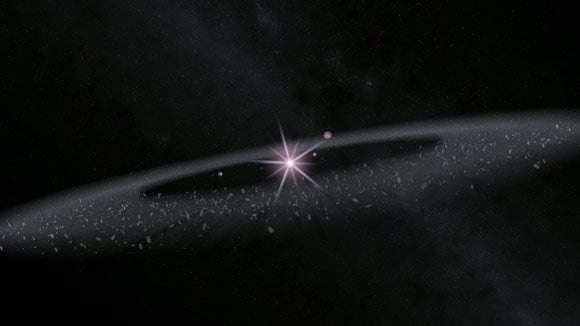
Artist's depiction of the asteroid belt between Mars and Jupiter. Credit: David Minton and Renu Malhotra

Artist's depiction of the asteroid belt between Mars and Jupiter. Credit: David Minton and Renu Malhotra

When Mars and Jupiter migrated to their present orbits around 4 billion years ago, they left scars in the asteroids belt that are still visible today.

The evidence is unveiled in a new paper in this week’s issue of the journal Nature, by planetary scientists David Minton and Renu Malhotra from the University of Arizona in Tucson.  

The asteroid belt has long been known to harbor gaps, called Kirkwood gaps, in distinct locations. Some of these gaps correspond to unstable zones, where the modern-day gravitational influence of Jupiter and Saturn eject asteroids. But for the first time, Minton and Malhotra have noticed that some clearings don’t fit the bill.

“What we found was that many regions are depleted in asteroids relative to other regions, not just in the previously known Kirkwood gaps that are explained by the current planetary orbits,” Minton wrote in an email. In an editorial accompanying the paper, author Kevin Walsh added, “Qualitatively, it looks as if a snow plough were driven through the main asteroid belt, kicking out asteroids along the way and slowing to a stop at the inner edge of the belt.” 

Walsh hails from the Observatoire de la Côte d’Azur in France. In his News and Views piece, he explains that the known Kirkwood gaps, discovered by Daniel Kirkwood in 1867, “correspond to the location of orbital resonances with Jupiter — that is, of orbits whose periods are integer ratios of Jupiter’s orbital period.” For example, if an asteroid orbited the Sun three times for every time Jupiter did, it would be in a 3:1 orbital resonance with the planet, he wrote. Objects in resonance with a giant planet have inherently unstable orbits, and are likely to be ejected from the solar system. When planets migrated, astronomers believe objects in resonance with them also shifted, affecting different parts of the asteroid belt at different times. 

“Thus, if nothing has completely reshaped the asteroid belt since the planets settled into their current orbits, signatures of past planetary orbital migration may still remain,” Walsh wrote. And that’s exactly what Minton and Malhotra sought.

The asteroid belt easily gave up its secrets, showing the lingering evidence of planetary billiards on the inner edge of the asteroid belt and at the outer edge of each Kirkwood gap. The new finding, based on computer models, lends additional support to the theory that the giant planets — Jupiter, Saturn, Uranus and Neptune — formed twice as close to the sun as they are now and in a tighter configuration, and moved slowly outward. 

“The orbit of Pluto and other Kuiper belt objects that are trapped in [orbits that resonate] with Neptune can be explained by the outward migration of Neptune,” Minton and Malhotra write in the new study. “The exchange of angular momentum between planetesimals and the four giant planets caused the orbital migration of the giant planets until the outer planetesimal disk was depleted.”  Planetesimals are rocky and icy objects left over from planet formation.

“As Jupiter and Saturn migrated,” the authors continue, they wreaked havoc on the young asteroid belt, “exciting asteroids into terrestrial planet-crossing orbits, thereby greatly depleting the asteroid belt population and perhaps also causing a late heavy bombardment in the inner Solar System.”

The late heavy bombardment is proposed to have occurred about 3.9 billion years ago, or 600 million years after the birth of the Solar System, and it’s believed to account for many of the Moon’s oldest craters. Walsh said a reasonable next step, to corroborate the theory about the newly described clearings in the asteroid belt, is to link them chronologically with the bombardment.

LEAD PHOTO CAPTION: Artist’s depiction of the asteroid belt between Mars and Jupiter. Credit: David Minton and Renu Malhotra

Source: Nature

  • ND

    Anaconda: “Binary stars (and multiple star sytems) — Gravity doesn’t account for binary and multiple star systems. Electromagnetism does.”

    How sow? Please be specific provide evidence that it’s not gravity at work in a binary system. In Bad Astronomy, I provided links to gravity based simulations of galaxy collisions which attempted to understand what happens when galaxies collide. They produced results just like what we observe of collided galaxies. But you never aknowledge them.

    In the BA discussions, others also provided links to criticisms of plasma cosmology. But you never responded to those either. Could it be that these criticisms discussed in terms of the actual science of plasma physics and cosmology? Could it be that you could not understand the science and math?

  • ND

    Yeah, someone is playing a silly prank. I just can’t tell if it’s Salacious or Oils.

  • Anaconda

    @ Salacious B. Crumb:

    You wrote “nearly all astronomical phenomena”.

    Certainly, gravity is useful, but not nearly all.

  • ND

    Anaconda: “But have you heard of the three body problem? That is gravity alone has problems keeping three bodies or more in a stable orbit.”

    Are you saying that it’s not gravity that keeping all those bodies in our solar system in their orbits? Are you still trying to sneak in the assertion you made on Bad Astronomy that EM is the predominate driving force in the solar system?

  • Salacious B. Crumb

    Anaconda Says:
    February 28th, 2009 at 9:40 am
    @ Salacious B. Crumb:
    You state: “Gravitation as a predictive tool is very useful, because it can explain the behaviours of nearly all astronomical phenomena. This can be from the Solar System, binary stars, galaxy interactions and rotation, accretion disks, etc.”
    No.”

    You are kidding aren’t you?
    If not, it is the funniest thing I’ve ever read in years.

    How do you calculate the planetary positions in the sky then?

    How to you find the mass of the star in a binary star? (Electromagnetism?)
    Now let’s assume your proposition are correct. Coulomb’s Law is F = q1 x q2 / 4 x pi x epsilon0 x r^2
    OK. Say what values do you use for q1 and q2 is alpha Centauri ?
    What emissivity would you use for the space around them? (it can’t be zero, can it.)
    The distance between them is about 22 A.U.
    Also where do you get the calculated masses from then?

  • Alex Jones

    @ Salacious B. Crumb

    I appreciate your answer very much.

    “… mostly his attacks are solely to gain some credibility. … to discredit the current role of cosmology and astrophysics – forming doubt in the way science obtains its results from observation.”

    More reasons for OilIsMastery’s contributions _not_ being appropriate for this astronomy website.

    “… blog site are supposed to be about exchange of information, but what it up as is a physiological laboratory of anonymous people …”

    Do you mean “psychological” (something for psychologists) or “psychic” (for the rest of us)? ;-)
    Whatever, that some participants run such a laboratory, is _not_ appropriate for this astronomy website.

    “There is an assumption that the opinions are always benevolent …”

    Yes, I know, but the assumption — _always_ benevolent — is not correct, I think. And especially those pertinent people, who assess themself as “open minded”, make this mistake, may be, because they have no faculty of judgement at all.

    “As I’ve already stated provocation sometimes can be a particularly effective and useful tool …”

    Yes, and for me, your, say, more provocational style is still correct in the cases I have seen.

  • Salacious B. Crumb

    Anaconda Says:
    “You wrote “nearly all astronomical phenomena”.
    Certainly, gravity is useful, but not nearly all.”

    Sorry, I already answered that. I.e.
    “The position regarding the role of electromagnetism (whatever} and gravity is crystal clear, and what is held by current theory and 99.9% of the astronomical community is that;
    “Presently explanations of astrophysical phenomena seem mostly and significantly influenced by gravity, and that the effects of electromagnetic forces are fairly minor.” ”

    Did you fail comprehension at school, or what?

  • ND

    Anaconda,

    We’ve gone over the dark matter discovery issue before. You’re going back to your original accusations as if we never discussed this.

    There is no denial Anaconda. In fact it was DrFlimmer who first brought up the Io/Jupiter currents. The people in the BA discussions were quite aware and knowledgeable of forces in affect in the solar system. If we’re going to talk about denial, do you still deny that anti-matter has been verified as real, and not just some theory?

    Anaconda: “Gravity alone doesn’t do it.

    See, three body problem.”

    Please explain what this means and how the 3-body website fits into all this? The website appears to talk strictly about the 3-body problem and how to deal with it in calculations. Are you still talking about solar system formation or after formation with orbiting planets? How does the 3-body (n-body) problem affect these?

  • Salacious B. Crumb

    ND
    I think our Anaconda is actually referring to the Jacobi Theorem, which still has been partially solved.
    He is desperately trying to find chinks in the theories of gravitation, as the three-body problem is possibly an example of almost discontinuous phenomena.
    Whilst the exact solution of the three-body problem remains, it does not mean that triple/ multiple stars do not exist or cannot be predicted. In the real world, orbital motion in triples star are set at a given epoch.
    His apparent assumption is that the failure is not gravitational, but is caused by some electromagnetic phenomena. The issue, however, is that gravitational perturbations are mathematically very complex,
    The other possibility is the covariant of the Hamilton-Jocobi framework – a coupling of the framework electromagnetic and gravitational fields in the so-called relativistic space-time manifold. However this is simply far beyond Anaconda’s obsession or comprehension.
    (It seems, if only Anaconda could just glimpse and grasp the real beauty of four forces all working in unison, he cold look in awe at the complexity and wonder the real Universe and see it as it really is. Pity dreams don’t work when applying the scientific method. Occum’s razor be damned!)

  • ND

    Salacious,

    There has been a great irony in these debates with Anaconda ever since he started on Bad Astronomy. He accused or insinuated that his debaters were closed minded and as thinking in a of gravity-only mindset. This is even when they were openly looking into and evaluating his assertions and that of the PC/EU ideas. They brought in scientific knowledge that he lacked. He has overcommitment himself to PC and I don’t understand why. Superiority complex maybe?

  • Will

    I have searched and searched for this answer with no luck.
    Have we been able to produce a “complete” vacuum?
    Can it be achieved?

  • Salacious B. Crumb

    ND said;
    “He has overcommitment himself to PC and I don’t understand why. Superiority complex maybe?”

    ND
    No, I beginning to think it might be something else. Perhaps he has followed Oillsmastery line of reasoning in PC, then has pulled back from his seemingly even more extreme contentions.
    I beginning to wonder if Oillsmastery and Anaconda are actually either the same or are know each others opinions. They write as almost juxtapositions on PC, yet they never write together nor contradict each other in any of the debates. (Probably secretly agreed as of limits) Only one division I have seen reading all their words across the blogs, and this is in regards Oills extraordinary omission that “Yes but most likely electromagnetism causes gravity.” (Confronted, he just went silent.) While Anaconda now contends gravity is now a force, and now he says; “My views are different than OilIsMastery.”.
    I have also noticed the more you confront Anaconda, and question him he avoids it by either arguing on something else it deflect it are starts to get very abusive the closer you logically tie him down.
    This behaviour is quite obvious when I have pressed him on his statements or contentions. See “Ancient Pulsar Still Pulsing” discussion.
    It is interesting that his latest deluded position to me is that ;
    “Your arguments are designed to roil gravity “only” minded folks’ opinions by playing to their prejudice against the scientific theory I bring to their attention.”
    Yet this is exactly as you said above; “He accused or insinuated that his debaters were closed minded and as thinking in a of gravity-only mindset. This is even when they were openly looking into and evaluating his assertions and that of the PC/EU ideas. They brought in scientific knowledge that he lacked.”
    If he real thinks that, I think he has little understanding about science or the scientific method.
    He can’t even define even basic definitions – so we can a least comprehend what he means. Yet he still thinks he’s a victim in all this! Really this is bizarre behaviour.
    As to “Superiority complex maybe?” I really don’t know. Perhaps he just fell into the debate and he realised his shortcomings compared to others, and now he is desperately trying to ‘save face’.
    Anaconda has also strangely and cryptically just said;
    “My arguments are designed to appeal to their reason. Why? because if they do respond emotionally, likely it will only work against my position, whereas, if you roil their emotions against me it will work to your side of the argument.
    (Their emotions being predisposed to your side of the argument.)
    In that regard, your intentions and tactics are clear.”
    Now is this just paranoia, perhaps? (Pity we are not so adverse in the field of clinical psychology)

  • Paul

    Oils: Velikovsky was NOT a cosmologist. He was a psychiatrist and G.P. [general practioner]

  • Salacious B. Crumb

    Paul said:
    “Oils: Velikovsky was NOT a cosmologist. He was a psychiatrist and G.P. [general practioner]”
    He.He!!!!
    I wonder if he is also a follower of L. Ron Hubbard ???
    It might just explain an awful lot!

  • Will

    Found an answer:
    There’s no escaping black body radiation.
    Believe it or not , the question was related to this thread as well as the Ancient Pulsar still pulsing thread.

  • Salacious B. Crumb

    I have duplicated this post to aid in the issues brought up in aspects for the portions of discussion on this article.
    (If the moderators feel this was not particularly necessary, I would not be put out if you removed it.

    *****************************************
    Quite frankly, probably like most responding here, I have become very frustrated especially in arguing against Anaconda. Reading some of the ancillary response here, I’m beginning to know why.
    Two points I would like to make, who aim is to quell the continuous and somewhat bitter debate here;
    1) In a general short discussion at a meeting yesterday with some astronomical educators and professional astronomers, I brought up the issue of those who express dogmatic views on astronomical phenomena. I gave an example of Anaconda views regarding plasma physics and the presumed importance / weakness in our knowledge of gravitational sources.
    Needless to say two main ideas were raised
    a) The perception that the majority of the astronomical sources in universe are comprised of exotic phenomena.
    b) That components of magnetic fields, generation of electromagnetic radiation, and gravitational sources were of significant importance to explain the vast majority of known astronomical phenomena.
    However, the first contention is probably the most interesting and relevant. Articles on galactic or extragalactic stories (like we see throughout Universe Today”) tend to concentrate on exotic phenomena. I.e. Gamma-ray bursters, X-ray sources, interacting close binary system, galaxy jets, quasars, etc.
    What some forget to realise is that most observed astronomical phenomena is in fact very very ordinary – passive going through formation and their evolution. Electromagnetic activity in most cases is quiescent.
    So in the end, Anaconda is basically right that electromagnetic activity can be significant, but mostly only in active objects. Regarding the run-of-the-mill objects in the universe its influence is small compared to gravitational sources. (exactly like Lawrence B. Crowell has said above and ND.)
    [Perhaps the other biggest question is the proportion of exotic phenomena to quiescent astronomical phenomena - but that is yet another matter]
    2) I have been reading some of the issues Anaconda has brought up, because few papers discuss gravitation and their electromagnetic counterparts.
    A recent released arvix article given on 2nd March 2009 (you can get more recent than that) might be very useful as an independent source. This will also aid greatly in relevant discussion
    Entitled; “Finding and Using Electromagnetic Counterparts of Gravitational Wave Sources”, by E. Sterl Phinney http://arxiv.org/pdf/0903.0098
    This paper joins information and perspective, study into the immediate future and the role of electromagnetic and gravitational sources.
    [If Anaconda (and Oillsmastery) cannot accept such relevant an up to date information, then I suggests he/they takes his views to another forum.]
    Again many apologies for the length of this reply, or if it is irrelevant.

  • http://www.linkedin.com/in/howtogetasixpackfast How to Get Six Pack Fast

    The topic is quite hot in the net at the moment. What do you pay the most attention to while choosing what to write ?

Previous post:

Next post: