
When we look at the night sky, filled with stars, it’s hard to resist counting. Just with the unaided eye, in dark skies, you can see a few thousand.
How many stars are there in the entire Universe? Before we get to that massive number, let’s consider what you can count with the tools available to you.
Perfect vision in dark skies allows us to see stars down to about magnitude 6. But to really make an accurate census of the total number of stars, you’d need to travel to both the Northern and Southern Hemispheres, since only part of the sky is visible from each portion of the Earth. Furthermore, you’d need to make your count over several months, since a portion of the sky is obscured by the Sun. If you had perfect eyesight and traveled to completely dark skies in both the Northern and Southern Hemispheres, and there was no Moon, you might be able to get to count up almost 9,000 stars.
With a good pair of binoculars, that number jumps to about 200,000, since you can observe stars down to magnitude 9. A small telescope, capable of resolving magnitude 13 stars will let you count up to 15 million stars. Large observatories could resolve billions of stars.
But how many stars are out there? How many stars are there in the Milky Way?
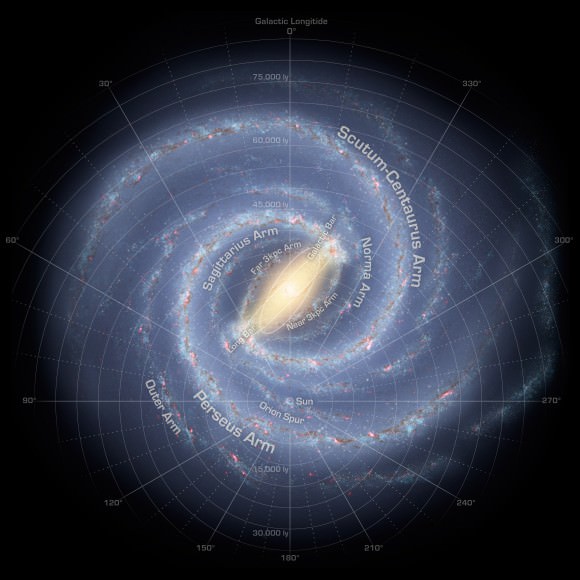
According to astronomers, our Milky Way is an average-sized barred spiral galaxy measuring up to 120,000 light-years across. Our Sun is located about 27,000 light-years from the galactic core in the Orion arm. Astronomers estimate that the Milky Way contains up to 400 billion stars of various sizes and brightness.
A few are supergiants, like Betelgeuse or Rigel. Many more are average-sized stars like our Sun. The vast majority of stars in the Milky Way are red dwarf stars; dim, low mass, with a fraction of the brightness of our Sun.
As we peer through our telescopes, we can see fuzzy patches in the sky which astronomers now know are other galaxies like our Milky Way. These massive structures can contain more or less stars than our own Milky Way.
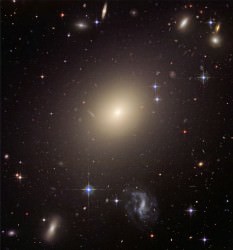
There are spiral galaxies out there with more than a trillion stars, and giant elliptical galaxies with 100 trillion stars.
And there are tiny dwarf galaxies with a fraction of our number of stars.
So how many galaxies are there?
According to astronomers, there are probably more than 170 billion galaxies in the observable Universe, stretching out into a region of space 13.8 billion light-years away from us in all directions.
And so, if you multiply the number of stars in our galaxy by the number of galaxies in the Universe, you get approximately 1024 stars. That’s a 1 followed by twenty-four zeros.
That’s a septillion stars.
But there could be more than that.
It’s been calculated that the observable Universe is a bubble of space 47 billion years in all directions.
It defines the amount of the Universe that we can see, because that’s how long light has taken to reach us since the Big Bang.
This is a minimum value, the Universe could be much bigger – it’s just that we can’t ever detect those stars because they’re outside the observable Universe. It’s even possible that the Universe is infinite, stretching on forever, with an infinite amount of stars. So add a couple more zeros. Maybe an infinite number of zeroes.
That’s a lot of stars in the Universe.
Additional Resources:
How Many Stars Can you See?
Astronomy Cast: How Big is the Universe?
How Big is Our Observable Universe
Astronomy Cast: The Observable Universe
How Many Galaxies in the Universe?
Thanks, I’ve always wondered. Seems like a pretty good estimate. Can we say anything about the rates for star formation vs. dying? are they about the same?
Funny… when I go up into the local mountains with my telescope to do some star gazing, I tell the wife I’m going up to ‘count stars’. She always looks at me cross-eyed when I say that!
LOL….Thank God I never ever married. I’m a ‘free-bird’ to count each grain of sand on the plant if I decide too! What type of t-scope do you own Aqua4U? I had one as a b-day-gift. I left it in Arizona. Now it is in Utah where the woman who bought it for me still has it. And people wonder why I never marred…LOL.
@ Planemo… Hello! I own three scopes. I have a 4″ Meade Schmidt Cassegrain model 2040, a Kueffel and Esser (sp?) 60 mm refractor that I have mounted on a German Eq. mount and modified to look at sunspots using a projection technique and I am _still_ building a handmade 12 1/2″ Newtonian. This last one is to be my ‘baby’ (I hope) when completed. Like many of us, monetary considerations have slowed progress for this scope – I need to get the mirror coated. Want to see them?
http://www.universetoday.com/98111/notes-from-an-amateur-telescope-makers-journal-part-1/
http://www.universetoday.com/98255/notes-from-an-amateur-telescope-makers-journal-part-2/
The images of the 12 1/2″ are somewhat dated.. I have added a R.A. drive and embellished the mount with stars and stuff I cut out of Alum. HVAC tape. Recently, I made another secondary housing which will allow me to use either the secondary mirror and eyepiece focuser or remove the mirror and mount a webcam or other sensor at the prime focus. I’ll be posting a 3rd installment soon! (I hope) I thought I’d have my mirror coated by now and wanted to include some images from this scope for the next installment…
SWEEEEET!!! They all look GREAT! Good for you! Thanks for the peak! lol@3wives! Funny how you express things a wives. I do the same. I also have 3 wives. Well, 2 passed away over the last 30 years or so. I still have my 3rd wife. They all have 10 nipples, 4 legs, and a whips for tales!…lol. I swear, like you, I tell people that, and they all crack up. My current wife is 7 years old now. Mans best friend. What a great factual reality that saying really is. 😉
I never married. I almost did 2-x’s. But oh well. I was not the greatest catch out there. So it was probably for the best for the ladies. Besides, each one of my individual dog (wiives), never ever talked back to or at me, ever. All were so extremely happy to see me even if I left the room and re-entered it within 3 minutes! Plus they never ask for “$”! Never!…lol.
You seem pretty cool to me Aqua4U. God speed to you 😉
HeyNOW! I wrote up my ATM activities here at UT to inspire others to think about how they might use readily available materials to build their own telescopes and/or eyepieces for star gazing. Many of us are fascinated with the night time sky yet don’t have the resources to buy expensive equipment, so we are left to our own devices. Key here is realization that ‘mind’ is infinite.. use like the universe, if you make it so.
You are just too cool! I was just typing you in a 2nd post about you building me a 2nd hand rebuilt t-scope. Instead of me going out and purchasing those very expensive Meade’s or the etc’s out there. We could both benefit.
Your so passionate about space science and I’m so endlessly interested to learn. There would be no one else who could pull this off but you. If you could, think about building for me(from scrap parts) a t-scope.. Yes, funds are low, but I could send you a helper check just to let you know I am damn serious with my intentions. This is too cool. I just saw your email pop up. This is all ESP!…lol. Look, no pressure ok. It is an off the wall request.but if you don’t ask. Just think about it Aqua4U ok? I await your reply asap.
At 98.6* F I am not exactly ‘too cool’… yet. But, I AM totally into astronomy! When I wrote the ATM articles I got responses back from all over the world from others like us who are on tight budgets yet have a passion for learning everything they can about the glories above. My thing is to encourage anyone the least bit interested into looking at what they _can_ do with limited resources. I found that it is the ‘doing’ that is the most important – that creative effort. John Dobson started out while he was a Jesuit monk, grinding mirrors out of the bottoms of old gallon glass containers! He had zero money yet his passion led him onward and now his name will live on with the telescope design he developed. THAT to me is true wealth. Key is to follow your bliss! You have given me something important to think about…
LOL…98.6-F – Whitty ;-)…- I never heard it put quite like that before. I am glad you totally agree with me when I said your a “passionate’ dude about space-science. Passion is what we have. Your deeper in knowledge, but equal in passion. I just do not remember reading Dobson was a Catholic Monk. I thought he was a Deacon in the Catholic church. I was an Alter Boy. Does that rate?…lol.
I was glad reading your post saying I have given you something very important to think about. It could help you financially Aqa4U. Baby steps. From the “thinking about”, will come “conceived concepts”. Then the “conceived concepts” will become the “how to”. Then the “how to” will give birth to the assembling of your 1st t-scope made and for sale. Even if you start off with “MY” t-scope, the very 1st to t-scope you build. Every part conceived will give birth to new idea’s with better parts to use. Heck, I’ll let “MY” t-scope be the ginny-pig. Just as long as “MY” t-scope can focus in on the woman of Venus walking in their bikini’s, I’ll be good to go!…;-).
@Aqua4U…I don’t want to bother you anymore my friend. You just do what you have to do. Its been nice chatting with you. You are so 98.6 to me! ..lol,. God speed..;-)
@ Aqua4U-PS; please remember, this is just a suggestion. Just think about ok. Nothing etched in stone. Like I explained in my 1st post to you today. Your passionate devotion to space-science is the reason for my asking. I feel a bit odd doing this here. I have no clue who you are, but yet oddly I do. Just give it some thought ok. 😉
how many miles on the Gold Wing?
Hey Sloppy… Only 53K miles on her… My brother bought it from a collector who had it garaged for 20 years. Still it was in pretty poor shape – lots of rust and hadn’t run in all that time. I got it running for him and he drove it into the ground. Then, when he moved back in with his 3rd wife & didn’t have room… he gave it to me! (I’d kept it running for him for a couple years) I totally restored it. This model was the ‘Harley Killer’. No fairings & lightweight rims. It now has a ‘Drag Specialist’ seat and leather paniers with a cafe style fairing. Looks new now! I like!
the truth is that i don’t know and neither do you. nice guess though…
How many stars in the universe? Shoot, I stayed at a “Holiday Inn” last night. I know how many, and I ain’t tell’n!…lol.
As many stars as there are dollars in the federal deficit. Trillions and trillions.
Trillions upon trillions upon trillions of dollars.
Perhaps a good corollary to use might be the number of atoms in all the cells of our brain added to the number of brains out there? ~@; )
Astronomers have estimated the actual Universe is at least 93 billion light-years across
How can that be tue, I mean it that is the case then what is beyon that. That why I think the universe goes in to infinity. If there is a science major out there what am I not understanding. Thanks
Wrong number given for the observable universe. No time for a long explanation right now, but it is considerably larger than the above quoted 13.8 billion light years.
I’m not a science major, but I will do my best to explain. First of all, the 93 billion figure is the lower limit for the size of the universe. It is possible that the universe is significantly larger, but the precision of our measurements allow us only to set this lower limit on its size. As our measurements become more precise, it is possible that this number will rise significantly.
Secondly, like many, you appear to be thinking of a finite universe as something that mist exist inside of something. The fact is that words like “beyond” which describe spatial relationships have meaning only within space. But, if our theories are correct, the universe encompasses all of space…in fact it *is* all of space. So the question of what lies ‘beyond’ the universe is really quite meaningless since there is no such place as ‘beyond the universe.’
Thanks..I guess I misunderstood the meaning of the universe, I thought it was everything including all of space, if it’s just the objects since the “big Bang”, stars, planets, and other mater then that now makes sense. thanks again..
I think you misunderstand me. The Universe *is* all of space, time, matter and energy. That is a perfectly acceptable description of it. But you seem to be assuming that space is infinite…that it goes on forever. That’s not necessarily true. While it remains possible that space is infinite, it is equally possible that space is finite, that it has an edge, and that there simply is no such thing as “beyond” that edge.
I’ve given up hope that UT will stop conflating lookback time, comoving distance, and proper distance.
At a certain point you need to simplify things. As I understand it, the observable Universe is the 13.8 billion light-years radius number, since that’s the maximum distance we can see in all directions; essentially the maximum number of stars we could possibly count.
But the Universe is much larger, estimated to be 93 billion light-years, but we can only see that smaller portion. That estimate comes from the last scattering surface from the CMBR. It’s possible that it’s much larger, and maybe even infinite; 93 is just the lower limit.
The Universe contains all of space and time, so there’s nothing “outside” the Universe. Even though it’s expanding, it’s not expanding into anything.
A useful analogy is to consider the surface of a balloon in two dimensions. If you inflate the balloon, two dots on the surface are going to appear to be moving apart from one another. But there’s no direction you could go on the surface of the balloon to get outside it.
Scale that up one dimension for the Universe. Just like dots on the surface of a balloon, the Universe is expanding, but there’s nothing outside it.
This is not right either. You are confusing the age of the universe (13.8 billion years) with the size of the observable universe which has a diameter (not radius) of about 93 billion light years. The size of the observable universe is the distance that light has traveled to us, meaning the photons we can observe from CMBR. The size of the observable universe is much larger than 13.8 billion light years because of cosmic inflation, the rapid expansion of the universe shortly after the Big Bang. The Princeton study that did the detailed calculations was published in 2005 and there is a good diagram here: http://www.pbs.org/wgbh/nova/physics/blog/2012/10/how-large-is-the-observable-universe/.
Thanks Hugh, I see my misunderstanding. I’ll fix the article and annotate the video. And never get it confused again. 🙂
Thanks, Fraser.
On another note: if I remember right, I read an article on here about a bayesian analysis of variations in the CMBR that put a lower limit to the curvature of the universe that implied a diameter for the universe at least 250 times the diameter of the observable universe. That puts the the diameter of the universe at *at least* 23,000 ly and a volume of the observable universe at 16 million times the volume of the observable universe. So we can add at least 7 more zeroes, putting it at 10^34 stars, or more than 10 decillion.
“…23,000 ly…” A typo? Dang… 23,000 light years would only get you 1% of the way to the Andromeda Galaxy!
Yes, that should have read 23,000,000,000,000 (quadrillion) light years.
Sorry… that number is in the trillions, not quadrillions.
This is why I use scientific notation. 2.3×10^16. And the resulting volume is 6×10^48 cubic ly, about 16 million times the volume of the observable universe.
Also an informative article (that also discusses common misconceptions) on Wikipedia: http://en.wikipedia.org/wiki/Observable_universe
I’m no scientist but have been trying to explain to scientist friends and family why I believe that the Big Bang and Nothing But the Bang version of the “origin” of the universe is bunk — I mean the version that claims to be able to prove that what we can see is the “Universe”, rather than just a popping bubble in the Cosmic Coffee Cup (so to speak) and that it is a mere 13 billion years old. Even more bizarre are those scientists who claim to be able to prove (by circular reasoning!) that their little universe caused itself. “And thus the world was created not in seven days, but in seven atto-seconds, saith the Scientist …”
So thanks for these wise words:
“This is a minimum value, the Universe could be much bigger – it’s just
that we can’t ever detect those stars because they’re outside the
observable Universe. It’s even possible that the Universe is infinite,
stretching on forever, with an infinite amount of stars. So add a couple
more zeros. Maybe an infinite number of zeroes.”
Purely instinctively, I’d go for the infinite universe as the default logical position that needs to be disproved rather proven. But an infinite universe (which has existed forever and will exist forever), that contains only bubbles of structured matter and stars and a lot of sheer chaos or even emptiness as well. In fact, an infinity of each, because infinity times infinity = infinity?
Infinity may make the first difficult steps of evolution — from minerals to DNA — easier to explain — in an infinite universe what is even remotely possible, will happen somewhere (or at an infinite number of somewheres, separated by very large distances.
“What caused the universe” is a non-question; cause and effect only applies to elements of the universe, not to the whole catastrophe, or am I missing something?
It seems as if we left out the fact that the human eye can only see certain colors, maybe leaving out many stars and galaxies that aren’t visible to the human eye ? Just a thought of mines.