
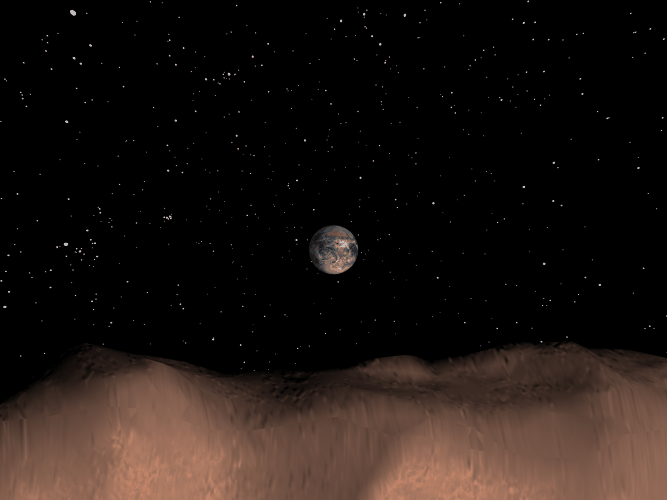
[/caption]A 10 meter-wide asteroid named 2009 BD discovered earlier this month is making a slow pass of the Earth, coming within 400,000 miles (644,000 km) of our planet. The near-Earth asteroid (NEO) poses no threat to us, but it is an oddity worth studying. Astronomers believe the rock is a rare “co-orbital asteroid” which follows the orbit of the Earth, not receding more than 0.1 AU (15 million km) away. It is stalking us.
On looking at the NASA JPL Small-Body Database orbital plot, it is hard to distinguish between the orbital path of the Earth and 2009 BD, showing just how close the asteroid is shadowing the Earth on its journey around the Sun…
In 2006, NASA announced that Earth’s “second moon” was an asteroid called 2003 YN107 (with a diameter of about 20 meters) and it was about to leave the vicinity of Earth, leaving its “corkscrewing” orbit around our planet for seven years, only to return again in 60 years time. 2003 YN107 was of no threat (and wont be in the future), but it is interesting to study these bodies to understand how they interact with Earth. Having NEOs in stable orbits around the Earth could be of benefit to mankind in the future as missions can be planned, possibly sending mining missions to these rocky visitors so we can tap their resources.

So far, little is known about the new 10 meter asteroid in our near-Earth neighbourhood, but it provides us with an exciting opportunity to track its laborious orbit to see whether it will eventually be ejected after making a close pass to the Earth’s gravitational field (as was the case with 2003 YN107 in 2006). From preliminary observations, 2009 BD is projected to shadow our planet for many months (possibly years) to come. Until November 2010 at least, the asteroid will hang around the Earth, within a distance of 0.1 AU.
It is worth emphasising that 2009 BD is of no threat to the Earth, its closest approach takes it 644,000 km from us. For comparison, the Moon’s apogee is 400,000 km, so 2009 BD is stalking us from afar, beyond lunar orbit.
As time goes on, astronomers will be able to track 2009 BD’s orbit with more precision (for updates, keep an eye on the JPL Small-Body Database), but for now, we have a micro-second moon following the Earth on its orbit around the Sun…
Source: Space Weather
Lets visit it already! A great constellation mission to practice for deep space work.
Why not try to nudge it into a stable orbit? It would be good practice (for the day when we may need to divert a dangerous one) and the asteroid might be a valuable resource.
Perhaps it could also be used as a counterweight for a future space elevator.
Watch it when it comes to talking about using one of these NEOs as a staging area or for mining — the Greens will have hysterics! 😉
BTW — Max, the only two planets in the Solar System that have “cleared their orbits” are Mercury and Venus. Everybody else has one or more moons and, in some cases, huge flocks of itsy bitsy asteroids and comet debris in their gravitational clutches. So is everything except Venus and Mercury a “planetoid”?
i anybody thinking alien satelite.
I understand where it comes from, but I must say I don’t like to see these asteroids being called moons. They aren’t. The major influence in their orbits is the Sun, and even if/when they come whithin Earth’s Hill Sphere, it’s always just a while. Yes, their orbit is influenced by our planet, but so is our orbit influenced by Jupiter, and nobody suggests that the Earth is a moon of Jupiter…
These are more or less co-orbital asteroids. Just that. Our closest neighbors beyond our only natural satellite and a whole fleet of artificial ones.
I’m just waiting for someone to come out and say “It’s Nibiru!!!!!!!!!”
Errata: I meant to write “it’s just for a while”.
And perhaps I should add that this isn’t directed at Ian: the culprit of this trend seems to be NASA itself with the announcement of YN107. All sorts of crazy headlines about a second Earth moon followed, which I’m sure was ment to stir public interest, but probably ended up confusing it further.
I, at least, had a frustrating conversation with my mother, who knows I’m into this stuff, and came all knowy to me one day saying “so, they found another moon, eh?”, and I said “er… no, mom, not really”, followed by an attempt to give her some hints of orbital dinamics. Not an easy task in normal circumstances, much less with a 77 year-old who never had much interest in space stuff anyway. It ended with her not entirely convinced (the report had those magic words “NASA announced”, who can blame her?) and not feeling too sure about her wits… or mine.
Sigh.
Actually it is overwhelming evidence that the earth has not properly cleared its orbital neighborhood of debris, and is therefore not a planet…
(2 down, 7 to go!)
that was the first thing I thought too Max. maybe we inhabit an earthoid.
Seems to be an interesting target for exploration…
Hey outcast…
It’s Nibiru 😛
haha
How many kilometers in diameter?
OH MAN 2012
But seriously, that’s a very cool find. It would be nice to see some sort of exploration project involving a crash-landed satellite.
It is a great opportunity for an unmanned, relatively inexpensive space probe to check out.
Save the constellation mission for Apophis.
I hope the IAU has a better definition of “clearing their orbits”.
My guess is that the proportion of the remaining mass in the orbit to the mass of the planet must be small enough. Define “small”.
Why did you have to use the phrase ‘stalks the earth’? That’s bound to have the aluminium-foil hat brigade wading in with catastrophe theories.
Um, lets go get it! it’d look great on my mantle aka the earth bwahaa.. but seriously, can’t we have like a redbull race to this thing?
“The near-Earth asteroid (NEO)”
I think the ‘O’ stands for object…
Co-orbital? Hmm…where have I heard that…oh, yea! Remember when Pluto was de-planetized because it hadn’t cleared out its orbit?
Actually, having only two planets or less suits me just fine.
Of late I’ve gotten the distinct feeling that the word planet is more defined by who discovers an object rather than what it is.
They willfully over complicated something that could have been simply defined by tonnage (weights this much) and location (orbits a star) to produce an answer that soothes egos more than describes what we’re looking at.
Maybe the word planet is too simplistic and needs to go. Left for school children and laymen, while experts babble on with dozens of new and distinct definitions to confuse themselves with.
Has anyone wondered if some of these bits in orbit with us might be the remains of that collision between the early Earth and that Mars sized object so very long ago?
Also stalking us: Nibiru. Noticed by NASA in 1983.
Interesting point, Marshall. I remember hearing about another NEO some time ago that was though to be an asteroid, but turned out to be a discarded stage from a Saturn V. I think it would be fascinating if Ranger 3 or 5, or one of the Mariner flyby probes, or even the first Luna, would make its way back near Earth. I’d be curious as to the effect that deep space would have on the probes.
These things are a worry. As someone said, it’s not the ones we know about that give concern – it’s the countless ones we don’t know about, as they come in from disturbances in places like the Oort Cloud etc. The Earth is still in the shooting gallery and it is not “if” but when the planet is hit again. Let’s hope we won’t be smelling too good when it happens!
On a related subject, I think the Apollo 11 astronauts saw on asteroid on their way to the Moon, (when they asked the position of the Saturn V S4B third stage booster). Sorry UFO fans!
Very interesting ,as time goes by,more advanced telescopes and satillite systems
may detect many small pieces of asteroids/comets
in the Earth-Moon L4-L5 regions. I don’t have any worry about these ‘rocks’ as they have probably been Earths’ ‘companions’ for millions of years. This L4-L5 regions will be a great area to have tracking satillites to give a great chance to detect ‘invisible asteroids/comets coming from the direction of the Sun’ as things now stands.
is an alien ship..
NIBURU WILL DESTROY US ALL WHEN IT IS AMOUNGST US
Has anyone wondered if some of these bits in orbit with us might be the remains of that collision between the early Earth and that Mars sized object so very long ago?
Nope. 🙂
It’s a good question, but I suspect the odds that such a small object would remain in the same orbit as Earth for billions of years or more without colliding with it or being thrown out of it are vanishingly small.
These things are a worry. As someone said, it’s not the ones we know about that give concern – it’s the countless ones we don’t know about, as they come in from disturbances in places like the Oort Cloud etc. The Earth is still in the shooting gallery and it is not “if” but when the planet is hit again. Let’s hope we won’t be smelling too good when it happens!
Well, yeah, but the odds are we will be be able to protect ourselves from all asteroid and comet strikes within a few decades, and it will soon be impossible for an object large enough to cause devastation on Earth to sneak close to us without being spotted. Remember, 100 years ago we only knew of a couple of asteroids, now we track tens of thousands. The rate of discovery will only increase.
Even if it’s an unknown object from the Oort Cloud, the odds of something coming from there on a collision course with Earth within the next few hundred years are infinitesimal. You take a million times greater risk every morning just by stepping outside your front door.
If you really want something big to worry about, something we won’t have the power to prevent for hundreds of years, if even, then worry about the flanks of the islands of Hawaii or the Canaries collapsing, or perhaps the eruption of a supervolcano like Yellowstone. We will soon be able to stop space rocks from hitting us, but we’re going to have a devil of a time stopping those.
is an alien ship
tacitus, I agree with you 100% there are far greater threats from our Earth itself, it will do what it will do when it feels like it. Humans have only been monitoring earthquakes, volcanos for a relatively brief period of time-a ‘super’ earthquake +9.5 will probably shatter a region not known for having earthquakes–perhaps it only happens onces every 10,000 years in these so-called ‘earthquake free zones’. The Earth has plenty of nasty surprises and it sure has nothing to do with these so-called ‘prophets’. The Earth couldn’t care less about humans or their beliefs ,
Meteor, really ?
Why are we worried about stones in space ?
Wake up, there are people dying everywhere.
This is our world, let’s worry about our home first and about our garden later.
Don’t reply me with, “What can I do all alone ?”
We’re all doing it, we’re all doing nothing.
We can all stop it.
It’s a choice.
Are you proud of your race and what it does ?
Make a choice.
Marshall,
You write interesting info…… Would you tell us your qualifications cause I don’t think you are a layman on this topic. And can I find info about these rocket pieces on the Internet?
And, would you talk a little bit more on “perturbances?”
kinda funny how the vatican just came out and said its “ok” to beleive in extra terrestrials…makes me wonder what they see from their satellite “siloh”…….probably nibiru…..
What if it is artificial – but not from around here?
maybe2009 DB is stalking us because it wants a proper name.
Michel Duchaine – “How many kilometers in diameter?”
Well 0.01 km!
Fun read such asteroids remind me of how some of Saturn’s SHEPERD MOONS keep Saturns rings “in order”.
So I have to wonder are these asteroids are stablelizing the Earth’s orbit &moon’s somehow? Or helping our somewhat egg shaped planet from flipping over? (Pole shift?) Anything is possible.
Robby — good point about those earthquakes. The fact that the a major one can strike just about anywhere is often overlooked, even by the doomsayers!
Gold, a 10 meter object will not have any influence on Earth at all or it’s moon. The ISS is bigger than that.
Also how can a planet flip over? In space there is no up and down, and as far as I can recall, Earth never flipped so that the Earht started to rotate upside down. This even has nothing to do with the pole shift which is only magnetic different orientation.
“Having NEOs in stable orbits around the Earth could be of benefit to mankind in the future as missions can be planned, possibly sending mining missions to these rocky visitors so we can tap their resources.”
Well unless they are a heck of a lot bigger than 10 meters I don’t see any value in mining them for resources. Come on, it’s 30 feet in diameter at a few tens of million dollars for a space mission it better be made of solid gold.
“at a few tens of million dollars for a space mission it better be made of solid gold.”
Not necessarily.
If the presumption is we’re going to bring this material back to earth to work on it then yes, even a solid gold asteroid does not currently pay back for the mission.
…But lets say we aren’t bringing it home here.
The high cost of space missions comes from taking things into space. If we can use the materials we find and direct them to other space based projects, the costs of doing business is drastically reduced.
So I wouldn’t ask how much such an asteroid is worth on earth, but how much it may be worth to another astronaut.
In such a scenario a rock with a few tons of water ice in it could be worth billions.
So the Earth has not cleared its orbit of other bodies (even Jupiter has not), so what does this mean for the IAU’s new definition of ‘planet’?
Oops, I hadn’t noticed the other pages of comments where people have beat me to the punch. Glad I’m not the only one with these thoughts.
Max “So I wouldn’t ask how much such an asteroid is worth on earth, but how much it may be worth to another astronaut.
In such a scenario a rock with a few tons of water ice in it could be worth billions.”
—————
Really now it’s thirty feet across. Tons of water from a tiny asteroid? BTW, putting mining equipment, refining capabilities, miners, etc in space is by no means cheap comparatively.
It’s value to an astronaut is in any scientific discoveries it may hold about the dynamics of our solar system, it has no mining value at all. I’ll say again, it’s THIRTY FEET across.
RE: “clearing its orbit”
clearing your orbit means that anything that’s stably orbiting inside your orbit must be gravitationally bound to you. this means: it’s orbiting you, or it’s in one of your lagrange points, or its orbital period makes a nice, clean ratio with yours.
jupiter has cleared its orbit because the moons and rings are in orbit, the trojans are at lagrange points, etc etc. things may fall into a temporary, unstable orbit with jupiter, and will eventually be ejected or fall in, at which point they would be “cleared.”
on the other hand, pluto and ceres are swarmed with non-resonating objects (all sorts of countless kuiper belt objects and asteroid belt objects, respectively)
it looks like we don’t know much about this new guy that’s stalking us, but i’m sure that it’s either a transient (it’s only temporarily and unstably associated with us, and a close encounter with us or the moon will eject it–“clear” it), or its orbit around the sun makes a nice clean ratio with our orbit (it would have to be a very complex and improbable orbit).
@Norm
You could be talking anything up to 800 tons of water from a relatively small 20 meter object… Of course its highly unlikely to be solid ice.
Still, unless I’ve got the number wrong, we’re looking at about a dozen Ares V launches to do what a robotic mission might accomplish in one or two. Simply by moving materials already in orbit into reach of astronauts.
That means allot more payload room for scientific equipment and more range given to the mission.
can anyone spell NIBIRU
Oops, I hadn’t noticed the other pages of comments where people have beat me to the punch. Glad I’m not the only one with these thoughts..
We need to study these asteroids. We should go up there with a long tether which will be attached to the asteroid by spikes on the tether. The now tethered asteroid is attached to the spacecraft fueled by negative ion propulsion, which is fueled by solar power. Why does it take a lonely software developer to envision this unique idea? Hire me and find out!
jdm0703 @ gmail.com
Weeeel. This thirty foot diameter object if made of gold may not be worth the cost of retrieval now, but the way the gold price is rising it could be worthwhile in six months time!!! HA.
Why the tizzy over the correct spelling of something that doesn’t exist?
I wish we had the technology to land on this baby and do some research. Maybe in another 100 years what we see on tv will be a reality.
Then again its not like NASA’s budget is growing they might not be around then.
This proves the Power of God Almighty and His endless mercy. Everything that happens has got its reasons…
omg! its the nd of the world! and theyre all lying to us!!!
i mean, its the end of the world!!!
That’s no moon. It’s a space station.