
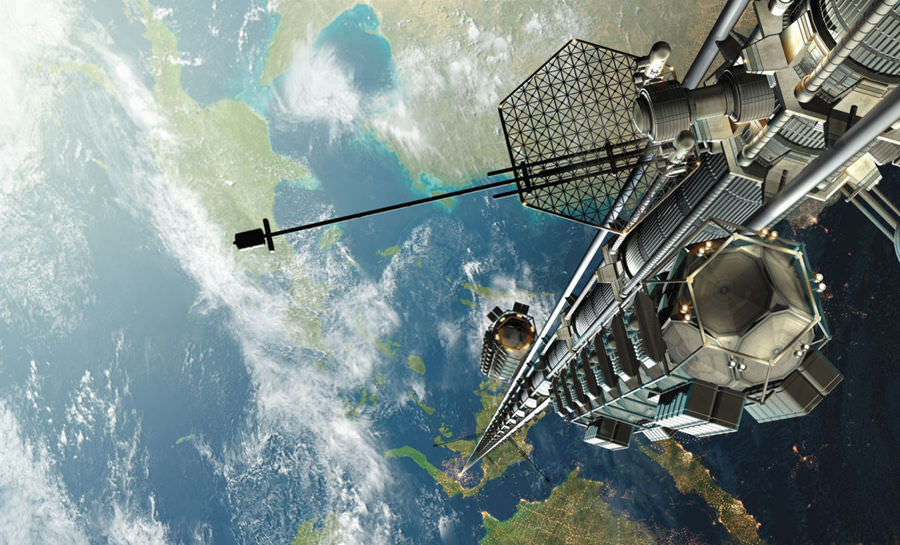
[/caption]
A coalition of leaders working on the concept of a space elevator has joined forces to form the International Space Elevator Consortium (ISEC). The new independent group is designed to promote standards and foster research relating to the construction of an Elevator to Space at the global level. Founding members of ISEC include the Spaceward Foundation, the Space Elevator Reference, the Space Elevator Blog, EuroSpaceward and the Japan Space Elevator Association. Heading the new organization is Ted Semon of the Space Elevator Blog, who will serve as president. Michael Laine, president of the space elevator company Liftport is excited about the consortium. “I think it’s a great thing,” he said. “This has been in the works for months, and the need to bring the different organizations under one roof has been long overdue. All five of the major organizations have been acting independently, which made sense in the beginning, but now we need coordination and cooperation.”
“The Space Elevator is a project whose time has come,” said Semon. “With the challenges facing today’s global economy, it is clear that new industries and new ideas are needed to help our planet in the 21st Century. The Space Elevator can be a key positive contributor, from providing inexpensive nanotechnology material science breakthroughs that will make your car stronger and lighter, to the creation of new industries that offer opportunities for investment and job creation. The International Space Elevator Consortium devoted to its development can make this happen.”
According to the Consortium, the goal of ISEC is to promote the development, construction and operation of the Space Elevator as a revolutionary and efficient way to space for all humanity. The group will accomplish this through these key areas:
• Development of a unified plan and roadmap for the Space Elevator and the coordinated assignment of specific research topics
• Funding of research on technologies relevant to the Space Elevator
• Development of the international legal framework necessary for the operation of the Space Elevator
• Global public outreach and central information exchange on Space Elevator activities
“In the past, some things fell through the cracks because no one knew what anyone else was working on,” said Laine. “Some needed tasks didn’t get done because everyone assumed that someone else was working on it. What we’re going to do with the consortium is refine the tasks, and have a better coordinated effort.”
Laine is very excited about upcoming projects for the consortium, to be announced in the next few weeks. “They’ve got some good things coming,” he said. ISEC will be unveiling additional plans and details, including a board of directors, technical journals, university and industry relationships, research opportunities and scholarships. Memberships will be available on the individual, corporate, academic and governmental levels.
The ISEC is headquartered in the Los Angeles area, a center of the aerospace industry. The consortium is a non-profit organization devoted to the research and construction of an elevator to space. See the ISEC website for more information.
Source: Business Wire, interview with Michael Laine
I remember reading a new scientist article showing a study that shows the space elevator may be too unstable to be practical… and unfortunately the solutions to the instability problem seem to make it more trouble than its worth….
Is the space elevator still a viable idea?
http://www.newscientist.com/article/dn16223-space-elevator-trips-could-be-agonisingly-slow.html?DCMP=OTC-rss&nsref=online-news
“The Space Elevator is a project whose time has come”
The Space Elevator is a project whose time has come to be summarily dismissed as lunacy. A space elevator just sounds like so much BS to me that I simply can’t believe people are seriously talking about. it.
Yeah, I’m pretty much on the same page as Astrofiend. Very, very skeptical about the whole idea.
“If man were meant to fly, he would have been born with wings”.
I gotta head to the airport now to catch a flight …
I agree with DanSolo, Inter-continental jet flights would have sounded completely ridiculous a little over a century ago and now it’s commonplace. FYI Astrofiend, a lot of the greatest technological innovations were dismissed as lunacy by many when they were first theorized.
Kevin — “I’m all for the space elevator, but I tire quickly of groups saying things like The Space Elevator can be a key positive contributor, from providing inexpensive nanotechnology material science breakthroughs that will make your car stronger and lighter, to the creation of new industries that offer opportunities for investment and job creation which is a promise on roughly the same level as buying a lottery ticket.” So now you’re a prophet who can tell exactly what the future will hold? Like the head of the US Patent Office at the turn of the last century who said that his office should lock its doors, as everything of any significance that could be invented, had been invented?
Consider: “The moment that one definitely commits onself, then Providence moves as well. All sorts of things occur to help one that would never otherwise have occurred. A stream of events issues from the decision, raising in one’s favor all manner of unforeseen accidents, meetings and material assistance that no one could have dreamed would come their way. Whatever you can do or dream that you can do, begin it. Boldness has genius, power and magic in it. Begin it now.” — Goethe
There is also the Grimm Brothers’ fable of Nail Soup, which pretty much comes down to the same thing: http://en.wikipedia.org/wiki/Stone_soup Looks like somebody’s come up with the nail. Now for some leeks, veggies, potatoes, and maybe a slice of mutton . . .
C’mon guys. It’s Christmas, time for joy, hope, and optimism. Sure the ” space elevator” concept has been around for a long time and has been right up there with real-time FTL travel and time travel in do-ability, but materials science is advancing rapidly and nano-materials may just hold the key to making a structure strong enough to work. The advances in nano-tech and materials sciences alone make a project like this worthwhile as the spin-offs have the potential to improve so much more than just the automotive industry, eg. storm and earthquake – proof buildings, bridges, etc.
(side note: carbon sequestration + nanotech could = the cheap manufacturing material we need to replace plastic.)
Dosen’t the space elevator rely on the use of long carbon nanotubes which aren’t available yet. A great thing to aspire to but a number of decades off I believe.
I think Launch Loops and Rotovators need attention too. ..
I believe it might work… but the problem is even if we could make it today, the costs of construction and upkeep would be too high to justify such a thing.
There is not enough going on in space.
Some sort of interim system would be a better investment. A DC-3 of spacecraft rather than a super tunnel across the Atlantic.
Get some people up there, get some business going, and projects like this would flesh themselves out.
Simon, yes. The space elevator rely on materials that aren’t available yet and that some people even doubt to be at all possible.
It’s a grand idea, but unless some pretty radical shift in technical paradigm happens really soon, it becomes a grand nonsense. Not by any means something “whose time has come”.
Anyone comparing this to aviation is pretty much clueless as to the challenges involved. And, besides, before aeroplanes happened there were birds around, proving without a shadow of a doubt that things heavier than the air could fly. Where are the natural space elevators? Exactly.
Yes, it will take decades. That’s why I’m glad to see some coordinated research into some of the problems now. A DC-3 type spacecraft is probably necessary too — these things can’t be built from the ground up. You have to start in geosynchronous orbit and work down. Maybe even move an asteroid into earth orbit to use as an anchor. It will be the biggest engineering project in the history of the world, but it’s possible (unlike FTL travel). Extremely difficult, but not impossible.
Columbus was a Dope. And these space elevator guys seems to be in the same category. There just needs to be a Queen Isabella to con.
Oh Man. For anyone who feels like throwing themself off a cliff after reading all these comments .. watch “Rise” …. a ST: Voyager episode … http://en.wikipedia.org/wiki/Rise_(Star_Trek:_Voyager) … curiously partly a dramatic interaction between the optimism and moral raising of Neelix and the logical pessimism of Tuvok .. anyway I digress.
WOW ! What news. I think everything has been answered on my Christmas list now .. Space X, Elevator and a few others I won’t go into here. Thankyou Father Christmas !
The dangers of a Cat. 5 hurricane passing through it or a 747 Boeing hitting it could be catastrophic. What would hold it steady?
I’m all for the space elevator, but I tire quickly of groups saying things like The Space Elevator can be a key positive contributor, from providing inexpensive nanotechnology material science breakthroughs that will make your car stronger and lighter, to the creation of new industries that offer opportunities for investment and job creation which is a promise on roughly the same level as buying a lottery ticket.
The idea of a space elevator is nice: Replacing all that expensive and energy consuming rockets by an elevator which is erected by exploiting centrifugal force. But to obtain that force you must increase the horizontal speed while travelling up, in oder to reach the speed of the orbiting station (9424,7 km/h). Where do you get that energy from? And as you travel down you have to reduce that speed to the equator ground speed (1675,5 km/h). By what means will you dor this without affecting the stability of the orbiting station?
You can´t cheat physics, even with phantasy.
Regards,
Günther
“FYI Astrofiend, a lot of the greatest technological innovations were dismissed as lunacy by many when they were first theorized.”
Yeah, I’m well aware of that. There have also been a great deal of supposed future breakthroughs and inventions dismissed as lunacy that turned out to be, well, lunacy.
Time will tell with the space elevator. In any case, it’ll be quite some time of even if it is possible.
GBendt:
That energy comes from the decrease in horizontal speed of an elevator carriage of similar mass descending at the same time as another rises. Isn’t that the point?
I reckon there’ll be a fully functioning space elevator well within my lifetime – provided I don’t meet a premature end of sorts. I’m 57…
The concept seems sound. The energy for “horizontal” acceleration is supplied by the rotation of the Earth. The Earth will slow down a little with each launch… just like it does for “gravity assist” accelerations. That should be cool for the next few million or billion launches, or thereabouts.
Carbon Nanotubes ARE available. Ribbons have been made (“Bucky Paper”) and are strong. Fabrics (Bucky Cloth?) are being made now and will be much stronger.
A few months ago “Colossal Carbon Tubes” were invented accidentally. Look up the properties, if you have the trime. Each molecule the size of an individual cotton fiber (visible to the naked eye, held together by Strong Interaction), 35 times stronger than Kevlar, as light as Aerogel.
With a bit of luck and determination, it’ll be installed before NASA takes humans to Mars.
A confidence-inspiring bit of trivia: AC Clarke described geosynchronous comsats in detail long before they happened. He also described space elevators in great detail.
There are still many technical issues to solve, but the incentive of a 10 to 100-fold reduction in the cost per kg for payload will keep the entrepreneurs and scientists focused. Carbon nanotube research into stronger and longer threads and faster production is growing in leaps and bounds. They have already produced very short threads with up to 1/3 the required tensile strength. Compare where we are to just 5 years ago, there is every reason to hope the material science will get there within the next decade.
There may be a show-stopper found along the way, but the space elevator is based on sound science not fantasy.
Humans have no balls these days.
No spirit to achieve hard goals.
Saying no before you even try something is a pathetic excuse for human.
A little optimism is needed, and if you want a little madness, we, humans can build a space elevator.
A little materials science will tell us whether it is possible or not. I guess most readers here may understand the physics, but the materials science is what makes it work or not.
( knowledgeable reader can probably skip this)
Geostationary orbit is about 36,00 km up. A piece of string might just about hold up a kilometer of itself before snapping. So you dangle a kilometer of string, and tie the end to two kilometers of string, and tie them to four bits of string and so on. At the top end you would need less than 2^36000 pieces of string because you don’t have any dead weight at geostationary orbit, but you would need an awful lot. Okay, so string is probably out. However, if you find some material that is light and tough so it can safely support a much longer length of itself – such as 4000 Km – then the top might be 512 times the cross-section of the bottom if we keep to our simple exponential model, which is not great but possible. A small improvement of the self-hanging length from 4000 KM to 6000 Km reduces the cross-section ratio to 64:1, so you save 7/8 of the mass.
If it snaps, you can’t repair it. One half falls to earth, possibly wrapping itself entirely around the earth as it falls. The other end shoots off into a higher, elliptical orbit, which would probably dance in and out of the geostationary orbit and make a real nuisance of itself. We have to be really sure that the thing will not break, so it will have to be overdesigned somewhat.
So, what material has the best safe self-hanging length? Carbon has strong directional bonds to itself, and it is light. There isn’t really anything below Carbon in the periodic table that shows much promise (though Boron and Nitrogen can make tough things). Unless you are going to make your elevator out of something other than conventional matter, some sort of unfaulted, regular Carbon-Carbon chain is likely to be about as strong and light as you will get.
It is clearly possible to make a buckytube to macroscopic lengths, and it is not a great leap from there to making almost infinite lengths. Such a material would be very useful for suspension bridges, cable cars, bulletproof jackets, and so forth. If it can be made, it will probably be made whether a space elevator uses it or no. We might well see it happen in the next decade. If and when we can get large lengths of Buckytube, then we will know how tough it is, and hence how practical a space elevator is.
Is a space elevator a practical solution? We won’t know that without knowing the competition, and that is much harder to predict. My personal feeling is that an elevator is too easily wrecked, but we will see, won’t we? Fun.
The risk of a broken cable wrapping itself around the Earth is very low — if it breaks high enough up for that to happen, most of it will burn up during reentry.
There is a debate over whether oscillations can be controlled — the backers believe they can be — and if the cable is shaped into a curved ribbon, the chances of a meteorite severing it completely are greatly reduced. Further up, the cable can be maneuvered out of the way of trackable space junk in orbit.
In the end, if we’re serious about exploiting orbital space, the Moon, Mars, and beyond, we’re going to need a cheap, safe, and reliable way to get into orbit. So far, the Space Elevator is the most promising solution to the problem.
I followed the last space elevator initiative for a while via a private firm’s website. The issue for developing this project has always been sufficient capital. The concept is sound. But I don’t see anything new in a consortium that wasn’t hasn’t already been tried. If we had something closer to limitless resources, the time might be right. But we don’t, so it isn’t.
Remember the tether in space? If a short run of wire could accumulate insanely high potential voltages could this elevator become a useful or otherwise dangerous source of electrical charge? Could this be harnessed favorably? Carbon is a good conductor and someone could get zapped somewhere along the ladder.
The concept is far from sound. There are practical limits in weight/chemical bond strength that limit tether lengths. There is no reason to be even thinking of a space elevator unless there is first a mateial science breakthrough that can be demonstrated in bridge building and such. Otherwise, we are talking about a tower of babble.
LLDIAZ, the location of the Space Elevator would be on the equator in the Pacific Ocean, in a place where no hurricanes have ever been recorded, let alone a cat 5 storm. As for an aircraft, the odds of an accidental strike are minimal. Terrorism would be a bigger problem, of course.
Ribbons made from carbon nanotubes are theoretically strong enough to be used in a practical space elevator. They’re not there yet, but there is every incentive to get there — not just for the SE, but for thousands of uses for construction and others. Breakthroughs in strength, length, and manufacturing techniques are happening almost every month. This is a very fertile area of development and will be for the next decade or more.
After the results of gravity probe B basically validated space/time frame dragging, I’ve been curious exactly how that’d modify a space elevator. How would people deal with our planet ultimately rotating faster than the rotational velocity minus frame dragging on the outermost end of the thing?
A lofstrom loop (http://en.wikipedia.org/wiki/Lofstrom_loop) is a far more practical solution than a space elevator.
this is the sickest idea, an elevator to space. how will it work :S?!
Ionguy:
The currents in those tethers were induced because they were moving through the earth’s magnetic field. The space elevator would be moving at the same rate the earth spins. No motion relative to the magnetic field so no induced currents.
If you want a tether that’s moving through the magnetic field you can use an insulating material. The tethers that got melted by electric currents were made of some good conductor because the experimenters wanted to see if they could get useful power out of the effect & got a bit more than their system could handle.
Assi: As usual Wikipedia gives a good introduction to a subject.
http://en.wikipedia.org/wiki/Space_elevator
Richard Kirk’s post (with the exception of a missing zero) is right on. I would not invest a penny in this non-profit and not want a single tax dollar until this unobtainium is discovered that could might it work.
Jim Baeg,
The Earth’s magnetic fiels is not stationary. It shifts and moves, as people who’ve witnessed an aurora know pretty well. And, due to the pressure of the solar wind, it changes drastically between Earth’s dayside and nightside. So there would be motion through the magnetic field and induced currents. Big ones.
So, the material we need is infinitely resistant, extremely light and insulating, capable of withstanding extreme temperature and pressure variations, while keeping it’s physical properties unchanged within the kind of strict parameters needed for frequent operation.
Unobtainium indeed.
Infinitely resistant or infinitely conductive? Resistant ribbon would induce static charge buildup, while conductive would discharge every passing cloud. Very weakly conductive might work best; but the real limit comes down to mass/density/chemical bond strength. “One third of the necessary tensile strength’ vertical loading is just one part of the picture. Differential wind loading perpendicular to the path – jet stream – loading is tremendous – virtually infinite, especially if the material is ribbon. The appropriate mechanical model is a long bow: A two year old on a tricyle could exert enough force in the middle of a 5 km long string to move 10kt boulders anchored at both ends.