
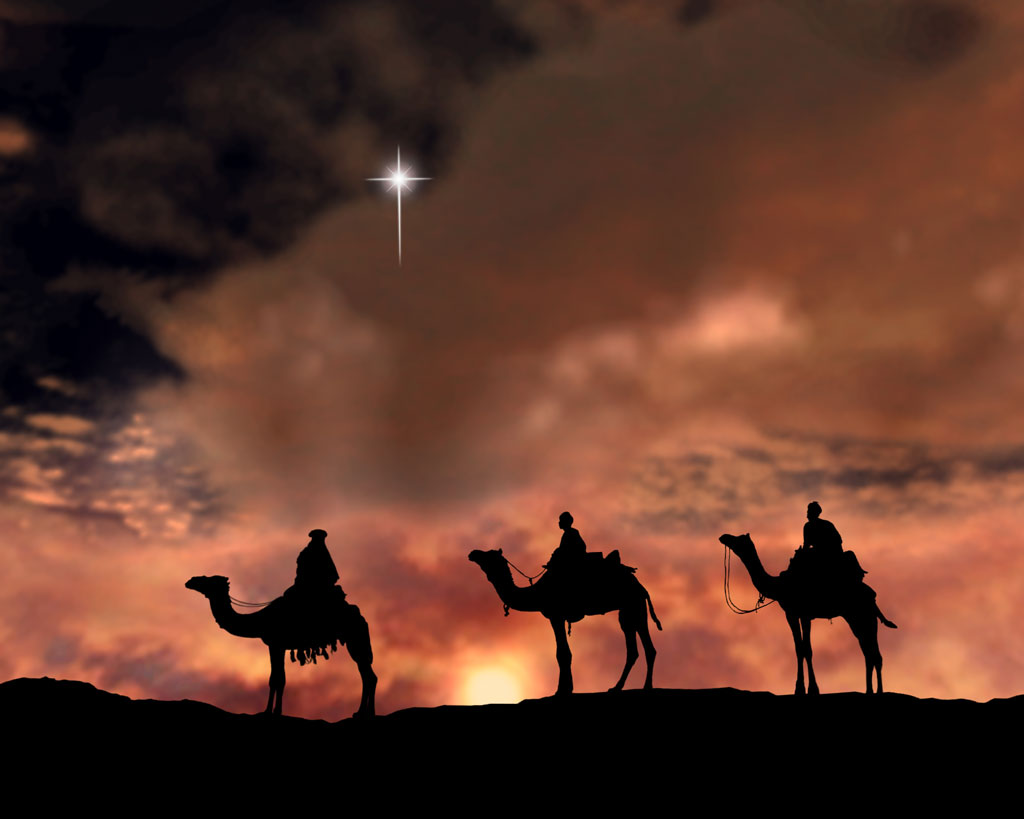
‘Tis the season… And every year around this time people notice the brilliant ‘star’ to the west just after sunset. For astronomers, we know it’s the appearance of the planet Venus, but noticing it for the average person brings on questions about the holidays. Was the Christmas Star real?
Regardless of your faith, the story of the ‘Star of Bethlehem’ is one of the most powerful and enigmatic symbols of Christianity. For centuries, scientists, scholars and historians have debated about the nature of this biblical light that heralded an event. Was it purely a divine sign, created miraculously to mark a special birth? Or was it an astronomical event in its own right?
David Reneke, news editor of Australia’s Sky and Space Magazine, believes astronomers may have found the answer – or at least something that fits all the known facts – basing his research on the highly esteemed gospel according to Matthew, the first of the four gospels in the New Testament. It would appear to be the first written and this version places key players together in the same time period. “It’s generally accepted by most researchers that Christ was born between 3 BC and 1 AD.” says Dave. With the aid of modern astronomy software programs astronomers can reproduce the night sky exactly as it was, thousands of years ago. Humans are curious and so was Dave, so he turned back the hands of time and the stars to the time of that long ago Christmas…
“We found out something startling.” said Reneke, “It looks like the ‘Christmas star’ really did exist,”
Two thousand years ago, astronomy and astrology were considered one and the same. The motions of the heavenly bodies were used to determine the events of history, and the fate of people’s lives. Of the various groups of priests and prophets of this period, those which commanded the most respect were the Magi – whose origins are not entirely clear. Known as ‘wise men’ , we can only assume they were actually priests who relied on their knowledge of astronomy/astrology.
Armed with an approximate date, Dave assumed the ‘Star of Bethlehem’ was not just a localized event and could be observed by sky-watchers elsewhere in the world, not just by the Magi. Historical records and modern-day computer simulations indicate a rare series of planetary groupings, also known as conjunctions, during the years 3 BC and 2 BC In fact, this was one of the most remarkable periods in terms of celestial events in the last 3,000 years!
“Like the final pieces of a difficult jig-saw puzzle, our fabled biblical beacon is starting to reveal itself,” David said. “On 12 August, 3 BC, Jupiter and Venus appeared very close together just before sunrise, appearing as bright morning ‘stars.’ It would have been visible in the eastern dawn sky of the Middle East from about 3:45 to 5:20 a.m.”
But it didn’t stop there. The crowning touch came ten months later, on 17 June 2 BC, as Venus and Jupiter joined up again in the constellation Leo. This time the two planets were so close that, without the use of our modern optical aids, they would have looked like one single, brilliant star. According to Dave’s research, Jupiter was known as the “planet of Kings” and Saturn as the “Protector of the Jews”. This could easily have been interpreted as a sign that the Jewish Messiah had been, or was about to be, born. Also, Leo was thought to denote royalty and power. An interpretation? Perhaps. But, do not forget the times in which this occurred. Astronomy and astrology intermingled. This whole sequence of events could have been enough for at least three astrologers to see this as sign in the heavens and make their way Jerusalem.
“Now, this doesn’t mean that astrology works,” Reneke said. “We haven’t ruled out other possibilities for the Star of Bethlehem but it does make our search more rewarding to find a truly interesting astronomical event that happened during the most likely time for the Nativity.”
Whatever the Star of Bethlehem was, it has had more impact on humankind than any star before or since. It is also possible that the mystery of the Star will never be completely solved. For many of us though, it is the mystery itself that drives us to find the solution.
David Reneke, one of Australia’s most well known and respected amateur astronomers and lecturers, has over 40 years experience in astronomy with links to some of the world’s leading astronomical institutions. David is also the News Editor for Australia’s Sky and Space Magazine, he teaches astronomy at college level, is an invited speaker at astronomy conventions throughout Australia, a feature writer for major Australian newspapers, and is a science correspondent for ABC and commercial radio stations. In these weekly radio interviews David regularly appears on about 60 networked stations around the nation with all the latest news and on general astronomy and space discovery issues. Look for his story about the “Christmas Star” to air locally on Good Morning, America. Our thanks to Dave for sharing with us!
I see David Reneke is well credentialed as an astronomer and journalist, but I wonder about his scholarship of ancient events. How, for example, does he deal with Herod’s death in 4BC?
Considering that only 2 Gospels mention the nativity and that nowhere is a date given, astronomers have been on a wild goose chase for centuries. The closest we get to a date is in Luke where shepherds were keeping watch over their flocks by night which happens in the lambing season which is springtime.
December 25th was actually the time of the Roman Saturnalia and the birthdate of Mithras (born of a virgin in a cave/stable, greeted by wise men etc) who preceded Jesus by some 600 years. At some point the date was apparently appropriated by the Church as the birthday of their savior.
Lol, superb article Tammy… who would have thought it would ignite such excitement in the comment box? 😀 Remember: don’t mention religion or politics… sssshhhhhhh
I’m not a religious guy (in fact, completely the opposite), but I find these studies fascinating. Many religious accounts are based on stories that were told thousands of years ago. Granted, there may be a lot of inaccuracies and outright lies, but until astronomers actually make the effort to study the phenomena described in religious texts, we’ll never know about their accuracy.
So, on a scientific basis, why not study whether the Christmas Star could have been real? The conjunction explanation seems pretty valid to me. Although I would have loved there to have been a huge supernova around that time…
Whether you’re religious or not, a nice festive article like this is certainly worth the read.
Great stuff Tammy!
Cheers, Ian 😉
/retch
to each his own, mr. “no”….
but i would be curious as to just how many of us out there who have used a planetarium program have done the same thing… or researched other historical dates for astronomical happenings. i know i have!
Except for the 3 wise men and the star being a complete myth….even by religious standards.
Weather you are religious or not, religious people were the keepers of record and science for many millennium. They were very much in tune with the movement of stars.
Using their records (which record things like prophetic stars) has helped us in the hunt for supernovas and comets before.
I mean, if you saw something so damn unusual that it made you hop on your camel to slog halfway around the known world… it must have been something breathtaking.
It certainly warrants a moment of consideration.
Even the recent grouping of the moon, Venus, and Jupiter caught the media’s attention.
The event is entirely plausible, and probable.
oblig.
“wise men?!? well what are you doing creeping ’round the barn at three in the morning? doesn’t sound to wise to me!”
I’m a bit confused by the mention of Saturn in this article. You state the significance of it but don’t mention how it was involved in the Jupiter/Venus conjunction.
Trying to apply scientific rational to mythology is an interesting pastime, but it’s getting a little tired?
The book we’re trying to analyse here isn’t even well translated. “Three Wise Men” are “Three Magi” (no mention of gender), the word taken to mean “Virgin” translates as “young woman”…
And the line: “It’s generally accepted by most researchers that Christ was born between 3 BC and 1 AD.” – so it’s generally accepted that a mythical character existed? By whom is that generally accepted, other than by followers of that faith?
The idea of stars as portents isn’t exactly unique to religion (Shakespeare uses the theme again and again).
I could go on (and on, and on) but I’d rather spend my time marvelling at the evidence for our galaxy’s supermassive black hole than spend it “proving” mythology to be “fact”.
Perhaps, ’tis the season to be silly.
you may start your flame-war now… 🙂
We could also chuck 10,000 years worth of astronomical observations out the window because the people who made them were not state approved scientists.
…But that would be stupid.
When using one oral history account to verify another, anyone looking for a plot hole is bound to find dozens. Simply because there is alot of history missing and I’m sure that more than one person has tampered with the retelling.
Regardless, its plenty obvious that in a very short time some very drastic events took place around that part of the world.
What a coincidental time for a heavenly sign to appear…
oh, i figured this piece would spark plenty of controversy.
as far as being a magi and gender concerns – ahem – why must someone always point out gender when it comes to astronomers? i’m sorry. i’m not militant enough to worry about whether or not you credit my gender and i think you just might find that any female astonomer worth her salt doesn’t care if you refer to her as he or she… as long as you get the astronomer part right.
as far as whether or not the religious implications are mythical or not – i feel that is up to each individual to decide. i do not impose my personal beliefs on others, but neither do i disregard historical figures and the roles they have played in other’s historical references. would you be less inclined to be critical if the same event occurred at the enlightment of Buddah? i respect all humankind’s faiths and practices, so why hide an excellent seasonal piece that so delightfully captures attention at this time of year?
as for saturn? this is only a guess on my part since i am not very familiar with astrology, but i believe saturn’s house is in leo. i am sure dave will be around to comment on his own research, but for those of you who are curious souls, try doing some odd things with your planetarium programs – such as researching comet appearances during battles, eclipses, planetary appearances, etc. oddly enough… you’ll find something strange here and there! my guess is marking these astronomical events was an inadvertent stroke of genius on behalf of these ancient historians… they instinctively knew that by keeping record of what was in the sky at the time, that some one, some day, would be able to define that date.
but… that’s just my opinion. i could be wrong!
😉
Liked your input Shakatany, a lot a people don’t know that.
The xmas star is a load of hogwash.
Hope this is the last time I see an article like this, although it is good starting point for people to inform the world today of the other saviors that humans have invented over the years like Mithras.
Get off your bottoms and save yourself.
you may start your flame-war now… 🙂 (had to steal that off you Hawkus 🙂 )
A well-time story, one that will continue to excite debate & controversy for a long time to come. When mankind can eventually transport himself back in time, all these theories can be really solved. Until then, Dave, & Tammy, keep up with the excellent articles.
Shevill
Tasmania 42 South
I ran Stellarium v.0.9.0 and found the Venus/Jupiter conjunction in Leo on June 17, 2 BCE, setting in the west just after sunset as viewed from Alexandria, Egypt. It was a spectacular scene and it would have been very cool to see that rare occurrence in person.
BTW 2 BCE = 9999 Holocene Era/Human Era for all you calendar reformists out there!
(Google “Holocene Era” to find out more).
Jesus was a space alien sent to Earth to warn humanity about not taking our warlike and environmentally unfriendly ways into the galaxy, or else.
Oh wait….
Happy Winter Solstice, Everyone!
@ Huygens:
If you are not religious man , you should write more carefully. 90 % of all humankind belives in something. Is it Jesus Christ, Allah, Buda, whatever, you should’nt talk like that.
I am christian by religion, and i dont wanna make research about Christmas star. I mean what is the diference…
They sad there was i bright star on the sky when Jesus Christ was born. Was it Jupiter or Venus, or both of them, or special Jesus star, i dont wanna know…
Anyway, someone sad “… i hope i see this article for the last time…”
We had Jupiter/Venus conjunction few days ago. Jesus was’nt born. Is it ?
Someone also sad a Jupiter/venus conjunciton was 3 BC… HEY PEOPLE !!! You wanna move Jesus Christ birthday 3 years only because it fits with bright conjuction.
If you say 3 BeforeChrist it means that Jesus Christ was born three years AFTER Jupiter/Venus conjunction…
SUPERNOVA ??? HA ?
Nice article .. yet nothing to fret about if you happen to disagree with it. I remember seeing a program on the telly about 8 years ago concerning something along the same line; only this had to do with the sudden appearance of a bright supernova at the time in question. I’ll try to look into this. Right or wrong it makes for a good mystery.
“Like the final pieces of a difficult jig-saw puzzle, our fabled biblical beacon is starting to reveal itself,” David said. “On 12 August, 3 BC, Jupiter and Venus appeared very close together just before sunrise, appearing as bright morning ‘stars.’ It would have been visible in the eastern dawn sky of the Middle East from about 3:45 to 5:20 a.m.”
—
The problem with this is that the star led the magi from the East to Bethlehem. Wouldn’t that mean the star should have been in the West? Or is my geography wrong?
oops. watchful stone guardian got it right.. That’s what I get for not reading all of the comments before making my own!!! 🙂
I read the account in Matthew, and it mentions the star settling just above the house where Jesus was (at least, in the translation I used). I’ve always personally believed this was a supernatural event, not a celestrial event, mostly because of this rendition. But regardless, it is rather neat that this conjunction happened. I would love to see Venus and Jupiter coincide like that.
Dave Reneke’s reply:
This is in reply to the large number of inquiries I’ve had on this story I originally wrote called “Was the Xmas Star Real?” Our noted writer Tammy Plotner graciously saw merit in revamping and running the story here on ‘Universe Today’ and I thank her for that. As you will see, its evoked considerable response.
I didn’t intend to validate anyone’s birth date. The story was simply an ambitious scientific exercise, using modern astronomical software, to go back and reconstruct the night sky of biblical times to either validate or refute the existence of a “Xmas Star.” What it actually implied was not tantamount to my research, and neither do I claim my work was unique. I simply followed on from previous speculation and investigation from other similarly confused souls (err, no pun intended) like myself attempting to puzzle out another ‘fact’ or ‘fantasy’ story.
We take too many things for granted today because we’ve become complacent. Here’s a tip – question everything, it’s called ‘curiosity and it’s what made us stop chiselling round wheels out of square blocks of stone and start building spaceships. I have a simple philosophy. Fill what is empty. Empty what’s full. And scratch where it itches?
The chronological baseline I used was Matthew’s version of the bible, the first book of the New Testament. Among all the conjecture, confusion, hyperbole, and general misinformation it’s the only one that has all the key players assembled in the same place in (generally) the same time.
For the die-hards out there, here’s some of the text. Oh, and don’t shoot me, I’m only the messenger, OK?
“Now after Jesus was born in Bethlehem of Judea in the days of Herod the king, behold, wise men from the east came to Jerusalem, saying, “Where is he who has been born king of the Jews? For we saw his star when it rose and have come to worship him… After listening to the king, they went on their way. And behold, the star that they had seen when it rose went before them until it came to rest over the place where the child was. When they saw the star, they rejoiced exceedingly with great joy.” Matthew 2
The Christmas Star, or the Star of Bethlehem, is mentioned only in chapter two of the book of Matthew. But this story of a bright star leading the magi, or wise men, to the birth of Jesus Christ has become an iconic symbol of the Christmas season. It sounds fantastic, and even has miraculous or divine overtones, but it could have happened.
The French scientist, Descartes once stated, “In order to reach the truth it is necessary, once in awhile, to put everything in doubt… as far as possible.” This rule seems to be very applicable to the discussion of the evolution of Christianity in our tragic time. I realised this story would become an emotive issue. It cuts to the very core of our existence and questions our very place in this amazing and complex Universe.
I’ve received hundreds of emails from all around the world on this story with mixed and insightful sentiments. I’ve been featured on some of the biggest programs in the world, from a live spot on Romanian TV complete with interpreters (really!) and dozens of global radio stations to prime spots on major U.S. networked breakfast programs, like GMA – Good Morning America.
The number of websites my story has appeared on is countless. I chuckled at a few abridged versions – one has me as a research “team leader” using “complex computer software” (its Starry Night guys) and another claims I’m trying to change the day Xmas is celebrated to June 17. Oh, I almost forgot the one where I declared Jesus to be a Gemini! Go figure.
I must say, in researching this story, I’m surprised how there is no absolute, undisputed record of Jesus’ birth date and the date of his death. Indeed, many accounts place his existence in the 2nd, 4th and even 6th decades BC! There is so much disagreement and general discord among students of the Bible about everything from actual dates key figures lived to whether in fact they existed at all. For instance, the biblical ‘Magi.’
There is, I believe, no mention at all of December 25 in the Bible in connection with Jesus. Apparently it is an arbitrary figure laid down by the church, perhaps a dozen centuries ago, to celebrate or align with various religious festivals. I’m not a theologian, I’m not even scholastically gifted when it comes to biblical prophecy or the strict application of biblical verse, but I have my beliefs. In trying to unravel history the more simple anything is, the less liable it is to be disordered in my view.
For arguably the most important person who ever lived, and someone who started a column of progress that still exists today with billions of followers, nobody can tell me with absolute unchallenged certainty when he walked the earth. It’s sad for I want it to be true! For most it is – but I just wanted some little bit of proof… can’t blame me for that, I’m human.
I do however firmly believe this type of retrospective investigation, archaeo-astronomy if you will, is a minefield so badly populated with hidden traps, turns and disguised meanings it would be impossible for anyone to get to the truth. There are simply too many loose ends!
OK, so what do we do with all this? So what if certain dates don’t relate to certain figures. It’s still a great story. We should stop right here and remember the reason we celebrate as we do this time of the year and ponder over the meaning of it all. For those who understand, no explanation is needed. For those who don’t understand … no explanation is possible.
Merry Xmas – and thanks again Tammy for helping move everyone’s ‘grey matter’ around. :).
PLEEZE!!!
Questions: 1) “‘Tis the season… And every year around this time people notice the brilliant ‘star’ to the west just after sunset. For astronomers, we know it’s the appearance of the planet Venus . . .” Venus’s passage from conjunction with the Sun to the next conjunction with the Sun takes a year and a half. Rather than setting not long after the Sun at that time *every year*, about half the time Venus rises before dawn at that time of year, the rest she sets after the Sun. 2) “The crowning touch came ten months later, on 17 June 2 BC, as Venus and Jupiter joined up again in the constellation Leo. This time the two planets were so close that, without the use of our modern optical aids, they would have looked like one single, brilliant star. According to Dave’s research, Jupiter was known as the “planet of Kings” and Saturn as the “Protector of the Jews”. This could easily have been interpreted as a sign that the Jewish Messiah had been, or was about to be, born.” Where does Saturn come into this? If the conjunction was between Venus and Jupiter, why rope Saturn into the discussion? Or did somebody drop a stitch? 3) Gary Thompson says, “Your article is misleading and will simply add to all the existing confusion. Your research is so limited and uniformed that you do not know that the Jupiter-Venus theory dates back to 2002 and was discussed by John Mosely and Eric Flescher.” In fact, that possibility was discussed much earlier than that, in the late 1980s or early 1990s. An astronomer friend of mine who died in 1995 told me about it in the years before his death — I’m not sure of the details, but that places its origins prior to 1995. Perhaps this article needs to be rewritten?
For those interested in this subject you should google ‘Frederick Larson Star of Bethlehem.’ He has put out an excellent DVD on this subject.
And, it is Merry Christmas, not Merry Xmas. Who celebrates the need for more Xs?
OK !. But are those the Star of Betlehem ”
This is another fairy tale, of this theme,..this time more astronomically presented, and without removing completely the astrology. Very appropiated for the Season, and the astronomical event, the Solstice of Winter,. ( Dec-21-22) which is the real origin of these celebrations at the end of the year, Christianity just planted over the date por Christ birth, (it was in Sartun god honor with the Romans, named the Saturnali , and other countries ‘s gods, too,…Hannukah is also related, to this astronomical event date ),..that in no place says when this happenned,., , but most had been in any other season of the year, but winter,…if we take the Gospel, where it says, that pastors were in the fields with theirs lambs, They don’t do that in winter. as every body knows.
Any way, nice try,…in the name of Disney, Thanks David,
David,
Your article is misleading and will simply add to all the existing confusion. Your research is so limited and uniformed that you do not know that the Jupiter-Venus theory dates back to 2002 and was discussed by John Mosely and Eric Flescher. The very confused and garbled account in Matthew – undoubtedly fictional – it sets out that nobody except the Magi saw the star. Also, it sets out the Magi interpreted events through both celestial observation and dreams. (I wonder who was around to record all this – if it actually occurred.) You are simply another person who loosely introduces a ‘two-star’ theory to explain a ‘one-star’ narrative. It is hard to deny that the writer of Matthew is using Numbers 22-24 and Micah 5:2 for the basis of the story. I am not claiming anything new by stating the gospels are hardly historical documents.
Regards,
Gary Thompson
is it not possible there was another celestial event… like a super nova. I seem to recall that being discussed somewhere, but i can’t quite remember where i heard about it!
I was at first a bit shocked by the audaciousness of this article, especially with the quote; “With the aid of modern astronomy software programs astronomers can reproduce the night sky exactly as it was, thousands of years ago. Humans are curious and so was Dave, so he turned back the hands of time and the stars to the time of that long ago Christmas…”
I have known of these two events since about 1991, upon reading on article by William P. Bidelman in the Royal Astronomical Society Journal “Observatory”, 111, 121 (1991) . The time of these was also stated in 1968 by Roger Sinnott (of S&T fame) in “Thoughts on the Star of Bethlehem” (S&T, 23, 384 (1968). Bidelman’s comments are particularly interesting, as he points out Venus-Jupiter conjunctions are “actually extremely common.” If such as conjunction was the spark the drove the Magi to the birth place of Jesus, they either new the planetary orbits awfully precisely (doubtful) or they just happen to select the right one of many possible planetary other conjunctions events. For the coming of the Messiah predicted for so many centuries prior to his arrival – such a close planetary conjunction may have been really a coincidence.
Adding some additional positive comments, readers here might to investigate some more on the available detailed discussions on the subject before taking this as gospel. Many useful sources can be referenced at the Astrophysical Data Service (ADS), and three of high relevance are;
1) Kim Paffenroth (1993) from the Department of Theology at Notre Dame;
The Star of Bethlehem Casts Light on its Modern Interpreters
2) Ivor Bulmer-Thomas (1992),
The Star of Bethlehem [ This paper examines the historical sources of the “star” and translations. (Particularly interesting is another “star” was reported in AD 70 that was reported as a “resembling a sword over Jerusalem’ upon the destruction of the Temple.)
3) Colin J. Humphreys (1991),
The Star of Bethlehem a Comet in 5-BC and the Date of the Birth of Christ
[**Another is by Christopher Cullen “Can we Find the Star of Bethlehem in the Far Eastern Records?”; QJRAS, 20, 153-159 (1979). This has some discussions on independent astronomical records meeting the appearance of a “star” in the time frame.]
The 17 June 2 BC has been noted before, but the precision depends on the ephemeris source. You can easily check this conjunction and ephemeris using JPL’s HORIZONS on-line ephemerides system.
If you use Jupiter’s barycentre data (from DE406 parameters), with Venus, the separation is closest on 17th June at 18h UT, where the positions are;
Venus : RA 08h 43m 19.19s Dec. +19d 26′ 16.2
Jupiter : RA 08h 43m 19.84s Dec. +19d 26′ 50.0″
This calculates as 35 arcsec in position angle 164 degrees [Jupiter from Venus]. Assuming this is correct – both planets were experiencing a very rare planetary occultation. At nearest approach, the “star” would have been about -5.0 magnitude!
However, much caution needs to be adopted with this conclusion, as the data on Jupiter orbit isn’t that accurate.
In my own view, It has always amazed my why it necessitates applying religious faith that has to so heavily rely on portents via miracles, mythology, fable or simple circumstance – just to validate its own dogma.
Another additional thought…
Kepler had suggest the triple conjunction of Jupiter and Saturn in 7 B.C., but he was not the first to do so. This event was also noted within the records of the Abbey of Worcester in AD 1285.
Yael Dragwyla,
On your Point 3. The “Jupiter-Venus theory” as you say I think actually dates back to around 1899, though I do not have the actual reference on-hand. I think it was H.N. Russell (yes the Russell of H-R Diagram fame) where, as the story goes, Russell become interested in astronomy by observing Venus as a child. He wrote a general piece on conjunction, which was related to his work on the phases of Venus in the “Atmosphere of Venus”, ApJ., 9, 284 (1899). This was also from the early perturbation theory work that he did between 1899 and 1901, before moving on to binary stars and stellar evolution theory (which he is more famous for.)
However, Sinnott S&T article of (1968) is commonly given for the origin in many modern references. (as I gave previously .)
i think the opening explanation in zietgeist the movie pretty well covered it. the 3 stars in orions belt pointing at sirius thence at the sun goin low on the horizon on the solstice, 12/21, then starting its rise again on 12/25. this coupled with astrological legends and the need for a state unifing religion, solidified this event in culture. it does make a wonderful story, but i got a great one about the fish that got away too!
Most myth and legend is interpretations of ‘real’ events. So its safe to say something happened that caught someone’s attention.
Jesus and Mohammed were obviously real people and any cosmic event is easily cut and pasted into a good story to enhance the cosmic drama.
If I had no knowledge of the universe I could easily say the appearance of Comet Mc Naught was a ‘sign’ of the times….perhaps a signature to honour one of the world truly great minds, George Bush…or the emergence of the iPhone.
Its easy to do.
Life is a jigsaw puzzle…great fun putting together the pieces
“That’s not a Christmas Star; that’s the light from the sewage treatment plant!”
Dear Dave,
if you refer to King Herod, who talked to the Magi, your explanation – which indeed is not a new one as I have heard a similar story in 1980 at Morehead-Planetarium -, is obsolete, as King Herod died in March 4 BC.
Who cares!
December 25 comes from the pagan celebration of the Winter Solstice, and is easily traced back to Roman times and celebrations.
Trying to Christianize pagan Holy days was a common practice of the Catholic Church, when they could not stop the pagans among them from celebrating their Holy days.
Christ’s birthday was never even originally celebrated, as birthdays were irrelevant in those days, and that is why there is no mention of the day of his birth in the Bible.
Once again the celebration of birthdays is a another pagan celebration.
Celebrating events of Nature is even strictly forbidden as found in the very first of the Ten Commandments.
Don’t believe me, then look it up yourself.
The Magi were “professional” star gazers. They told prophesies from reading the stars. It makes no sense that they would call a conjunction of two planets a new star. Conjunctions were not new events, therefore, there is not way on earth that they would miss that call.
maudyfish
Probably the most sensible comment to date.
Andrew James said;
“Particularly interesting is another “star” was reported in AD 70 that was reported as a “resembling a sword over Jerusalem’ upon the destruction of the Temple.”
IMO, it sure looks like the image of the star in the one accompanying this article!
I was at first a bit shocked by the audaciousness of this article, especially with the quote; “With the aid of modern astronomy software programs astronomers can reproduce the night sky exactly as it was, thousands of years ago. Humans are curious and so was Dave, so he turned back the hands of time and the stars to the time of that long ago Christmas…”
I have known of these two events since about 1991, upon reading on article by William P. Bidelman in the Royal Astronomical Society Journal “Observatory”, 111, 121 (1991) . The time of these was also stated in 1968 by Roger Sinnott (of S&T fame) in “Thoughts on the Star of Bethlehem” (S&T, 23, 384 (1968). Bidelman’s comments are particularly interesting, as he points out Venus-Jupiter conjunctions are “actually extremely common.” If such as conjunction was the spark the drove the Magi to the birth place of Jesus, they either new the planetary orbits awfully precisely (doubtful) or they just happen to select the right one of many possible planetary other conjunctions events. For the coming of the Messiah predicted for so many centuries prior to his arrival – such a close planetary conjunction may have been really a coincidence.
Adding some additional positive comments, readers here might to investigate some more on the available detailed discussions on the subject before taking this as gospel. Many useful sources can be referenced at the Astrophysical Data Service (ADS), and three of high relevance are;
1) Kim Paffenroth (1993) from the Department of Theology at Notre Dame; “The Star of Bethlehem Casts Light on its Modern Interpreters”
2) Ivor Bulmer-Thomas (1992), The Star of Bethlehem
[This paper examines the historical sources of the “star” and translations. (Particularly interesting is another “star” was reported in AD 70 that was reported as a “resembling a sword over Jerusalem’ upon the destruction of the Temple.)
3) Colin J. Humphreys (1991), “The Star of Bethlehem a Comet in 5-BC and the Date of the Birth of Christ”
[**Another is by Christopher Cullen “Can we Find the Star of Bethlehem in the Far Eastern Records?”; QJRAS, 20, 153-159 (1979). This has some discussions on independent astronomical records meeting the appearance of a “star” in the time frame.]
The 17 June 2 BC has been noted before, but the precision depends on the ephemeris source. You can easily check this conjunction and ephemeris using JPL’s HORIZONS on-line ephemerides system.
If you use Jupiter’s barycentre data (from DE406 parameters), with Venus, the separation is closest on 17th June at 18h UT, where the positions are;
Venus : RA 08h 43m 19.19s Dec. +19d 26′ 16.2
Jupiter : RA 08h 43m 19.84s Dec. +19d 26′ 50.0″
This calculates as 35 arcsec in position angle 164 degrees [Jupiter from Venus]. Assuming this is correct – both planets were experiencing a very rare planetary occultation. At nearest approach, the “star” would have been about -5.0 magnitude!
However, much caution needs to be adopted with this conclusion, as the data on Jupiter orbit isn’t that accurate.
In my own view, It has always amazed my why it necessitates applying religious faith that has to so heavily rely on portents via miracles, mythology, fable or simple circumstance – just to validate its own dogma.
First of all, I commend David for taking time to seek the truth. I wish him well.
Secondly, my independent research of the matter(meaning not searching for other ‘opinions’ then forming my own)has shown me the ‘star’ would have been Aldeberan. I know this for a couple of reasons: 1)There was a sign in 2002 involving Aldeberan with Mars, Saturn, Venus and Mercury. 2)Using Starry Night, I also found a similar sign Mar. 19th, 5 BC involving the same star
In order to gain meaning to the sign to begin with, you must know the Bible pretty well. Once you understand God’s timing of events, you can then start putting the pieces together.
The 5 bc sign fell during pesach(passover), and marked the birth of John the Baptist, who was born 6 months before Messiah. This then gave the ‘Magi’ time to travel most likely from Babylon to Jerusalem. This also fits well with someone here that commented that Herod died in 4 BC. This occurred during his reign, and might also fit in with the order that children 2 and younger be killed.
This, of course, is a ‘reader’s digest’ version of the study I’ve done. But there is another reason why it is ‘unclear’ to his day of birth…
Solomon wrote ‘…the day of death(is better)than the day of birth'(Eccl. 7:1) Messiah’s death, on the day of passover, is held greater in observance than the day of His birth, fulfilling that part of scripture.
It is a complete FICTION! There was no such event as the “Star of Bethlehem”.
“Matthew”made it up–AND THE ONLY GOSPEL MENTION. Why weren’t there mentions in every gospel? Like the first NT “Gosepl of Mark”?
Things to consider…
1) Whatever was seen by the “wise men”, possibly three of them (as there were three gifts presented), had to be seen before Herod’s death, which came in 4 BC.
2) No bright astronomical object will shine upon any given town, assuming no Divine intervention. However, astronomers/astrologers could assume Israel would be the place to look if the “star” were in a constellation associated with Israel: Aries is one of them.
This would explain two things:
a) Why they had to stop in Jersualem and get directions.
b) Why they were called “wise men”, and probably by women. 🙂
What a waste of time and minds.
Stellarium doesn’t seem to backup these conjunctions.
The Star of Bethlehem had to be something.
“Oh ye, of little faith.”
Obviously it was not a star. It was something else. God only knows.
I being to be slightly offended with some of the posters here, especially macellus’s previous statement “Oh ye, of little faith.” No one really is questioning the Christian faith nor of the possibility of its supernatural occurrence as the Star of Bethlehem.
The main scientific issue here is to try and explain the existence of some observable astronomical event that might explain the phenomena.
One of the biggest fault with this whole article is the assumption that; “It’s generally accepted by most researchers that Christ was born between 3 BC and 1 AD.”
This actually just isn’t true.
As other point out, the death of Herod the Great was in 4 AD; with his issuing of the decree of the presumed slaughter of the first born by Herod himself. Furthermore, knowledge of the 2 B.C. conjunction has been known for at least a century. It was clearly rejected by theologians, historians and scientists alike as a sign of the coming of the Messiah, because it did not match the known historical events that preceded it. Hence forth, this is why the triple conjunction of Venus, Jupiter and Saturn in 7 BC has been studied so much, or of the possibility of a bright comet in 5 BC.
IMO. Whilst Australian David Reneke may have just stumbled onto this conjunction of 2 BC, it has been shown that this was already known to researches before hand. I.e. Roger Sinott in 1968.
I don’t wish to be cynical, but Australian Sky and Telescope is certainly gain some great free notoriety – no doubt selling more magazines. After reading this, especially as Roger Sinott also published a similar story in Sky and Telescope in 1968… well let’s say it’s not hard not to the dots.
come on guys… it’s a ~story~ and that’s it. this is at some points a reputable source of astronomy news, and at other times a bunch of crap.
Sigh said;
“…this is at some points a reputable source of astronomy news,”
It might be, but it should also be reputable an acknowledge its origins. Too often new claims of “discovery” are based on more original discoveries made earlier by others. Sometimes sadly some astronomical news is really rehashing what has been established.
In a journalistic appraisal is supposed to be factual as well as being properly researched. Davis Reneke in his reply to this blog said it himself in Universe Today.
I.e. “The number of websites my story has appeared on is countless. I chuckled at a few abridged versions – one has me as a research “team leader” using “complex computer software” (its Starry Night guys) and another claims I’m trying to change the day Xmas is celebrated to June 17. Oh, I almost forgot the one where I declared Jesus to be a Gemini! Go figure.”
All this shows is that controversy and aiming at the common denominator simply sells – in this case astronomy magazines or as it seems.
Really. Should general misinformation be deemed as better than well-informed and astute commentary on some controversial subject? The main problem is the subject has been debated for not only decades but centuries… but the central essential point is it ain’t ‘new’ news. Pity it was not presented like that rather than to degenerate the faithful and split religion and science down the middle just for a popularist story-line.
Come on guys, indeed.
it was a supernova which lasted for days, only god knew this from his travels between earth and heaven but still some people believe that heaven is a Metaphor and not a place!
It was Sirius. Please watch the “Zeitgeist” documentary, freely available on the internet and youtube. Worth the watch!
The one point of the gospel Christmas story that has bewildered me is that if it was a significant conjunction of planets, or a sudden brightening of a star, I would would think Herod and his court of experts would have seen it, as would others in Israel and other nations around the world. Our very recent conjunction of Jupiter and Venus drew much attention, and was very obvious to most people. How can such a dramatic event be so hidden? I am not having a problem with the events authenticity, but like many what is the nature of it.
The oldest books in the NT are Paul’s writings. He never talks about the “events” in Matt. Mark is the oldest Gospel, and neither does he talk about any of the tales of Matt. Like most of the stories in the Gospels, they have little connection to any possible historical Jesus.
In constructing the story of Jesus’ birth, Matt (or the originators of the story he borrowed) would have used details that may have occurred or been thought to occur, and that would have included any stories of bright stars. And as the fable of Herod killing children shows, Matt. was willing to make up whatever he needed to for his tale. In other words, the event of the Christmas Star need not have actually happened to find it’s way into Matt.’s book, but if there were many events about the “right” time, he would have made use of them.
Henry Wysmulek Your my hero!
I have heard this theory before, and I prefer it to Arthur C. Clarkes story about the Star of David having being a supernova, that wiped out a civilization in the process. My personal religious belief has been that God works through the natural. If this is what happened, then it makes sense in that I don’t see how other natural phenomena would have encouraged the Maji to go to Israel specifically.
Herod’s death is usually referred to, as it has been in this discussion, as being 4 BC. This date has been inferred from the writings of the historian Josephus. However, it has recently been noted that the oldest manuscripts of Josephus indicate record Herod’s death as 1 BC. Apparently, a sixteenth century copyist’s error is responsible for the incorrect date, which has been propagated to modern editions of Josephus. When you look before 1 BC, you’ll find some very compelling astronomical events occurring. An attorney named Frederick Larson has done his homework on this and it’s very interesting. I know, I know… there are a lot of wacked out theories out there, but Larson is worth listening to, no matter what your faith perspective. His web site is bethlehemstar.net. The production quality of the DVD presentation is top-notch and his subject material is well researched.
Correction.
I made below the follow assumption, which is not correct.
Dave Reneke was the actual editor of the now defunct Sky and Space magazine and NOT Australian Sky and Telescope, which is not associated with him or these views.
“I don’t wish to be cynical, but Australian Sky and Telescope is certainly gain some great free notoriety – no doubt selling more magazines. After reading this, especially as Roger Sinott also published a similar story in Sky and Telescope in 1968… well let’s say it’s not hard not to the dots.”
Tammy’s article wrote in the third line of bi-line as
“Australia’s Sky and”, which I thought inferred when scanning the text as “Telescope Magazine” instead of “Space Magazine.”
As the last issue published of Sky and Space was in November 2007, this is an easy assumption to conclude.
My unreserved apologies to “Australian Sky and Telescope” for the incorrect inference. No offence was intended.
Christ was born between BC what and AD when? If he was still alive today he would be some confused child.
“it has had more impact on humankind than any star before or since.” What about the sun? Has it had no impact on our daily lives what so ever?
I feel the article is referring to the fact that at least two major world religions have used that particular star as part of their formation stories.
The Sun’s impact is obvious!
Fascinating. If accurate, this sheds some light on the Gospel mystery of Herod’s slaughter of the innocence. The story goes that all boys under 2 in the area were executed based on the King’s questioning of the Magi about when the star first appeared.
David said… “Fascinating. If accurate, this sheds some light on the Gospel mystery of Herod’s slaughter of the innocence. The story goes that all boys under 2 in the area were executed based on the King’s questioning of the Magi about when the star first appeared.”
Yeah. but where’s he proof. Glib response to support as if the story is true. Good propaganda if you ask me.
According to my research, Venus and Jupiter WERE indeed very close on 16th June 2002…however they were also very close to the Sun and only would have been visible at sunset.
Hardly a fixed point for any ‘Magi’ to follow though.
Sorry!My bad it was the 17th!
In the Qur’an (holy book of Muslims) the story of the birth of baby Jesus is stated in the following verses:
“Relate in the Book the story of Mary, when she withdrew from her family to a place in the East. She placed a screen to screen herself from them; then We sent her our angel, and he appeared before her as a man in all respects. She said: I seek refuge from thee to Allah Most Gracious: come not near if thou dost fear Allah. He said: Nay, I am only a messenger from thy Lord, to announce to thee the gift of a holy son. She said: How shall I have a son, seeing that no man has touched me, and I am not unchaste? He said: So it will be: Thy Lord saith, ‘that is easy for Me. And we wish to appoint him as a Sign unto men and a Mercy from Us: It is a matter so decreed. So she conceived him, and she retired with him to a remote place. And the pains of childbirth drove her to the trunk of a palm-tree: She cried in her anguish: Ah! would that I had died before this! would that I had been a thing forgotten and out of sight! But a voice cried to her from beneath the palm-tree: Grieve not! for thy Lord hath provided a rivulet beneath thee; And shake towards thyself the trunk of the palm-tree: It will let fall fresh ripe dates upon thee. So eat and drink and cool thine eye. And if thou dost see any man, say, I have vowed a fast to Allah Most Gracious, and this day will I enter into not talk with any human being. At length she brought the babe to her people, carrying him in her arms. They said: O Mary! truly an amazing thing hast thou brought! O sister of Aaron! Thy father was not a man of evil, nor thy mother a woman unchaste! But she pointed to the babe. They said: How can we talk to one who is a child in the cradle? He said: I am indeed a servant of Allah: He hath given me revelation and made me a prophet;And He hath made me blessed wheresoever I be, and hath enjoined on me Prayer and Charity as long as I live; He hath made me kind to my mother, and not overbearing or miserable; So peace is on me the day I was born, the day that I die, and the day that I shall be raised up to life again! Such was Jesus the son of Mary: it is a statement of truth, about which they vainly dispute. It is not befitting to the majesty of Allah that He should beget a son. Glory be to Him! when He determines a matter, He only says to it, “Be”, and it is. Verily Allah is my Lord and your Lord: Him therefore serve ye: this is a Way that is straight. But the sects differ among themselves: and woe to the unbelievers because of the coming Judgment of a Momentous Day!” (Qur’an 19:16-37)
The verse that got my attention is the one states:
“And shake towards thyself the trunk of the palm-tree: It will let fall fresh ripe dates upon thee.” (Qur’an 19:25)
Ripe dates are widely known for it’s season, which starts in the summer of June and ends in September.
I thought it was something interesting to know.
Colombian astronomer said that 10 years before that australian cientific. Astronomer autodidact German Puerta Restrepo book :
GUIA PARA VIAJEROS DEL CIELO 1997.