 Universe Today
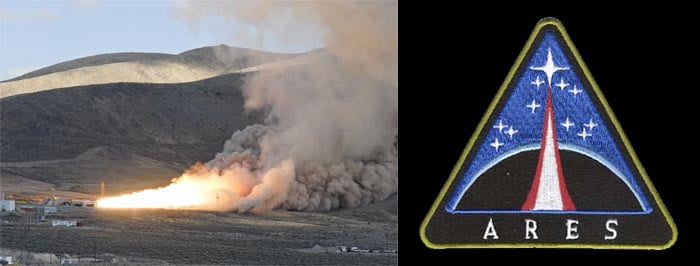
[/caption]Despite being the subject of some bad news of late, development of the Ares rocket system and Orion crew module pushes ahead. In the Utah Desert on Thursday, the oldest ever Shuttle engine was tested. The seven-year old rocket (two years past its "guarantee") performed a 123 second burn, simulating how long it would be in use during an optimal Shuttle launch. You may be asking,
what does this have to do with Ares?
Data from the Shuttle engine tests will be applied to the design of the Ares 1 rocket system, aiding engine nozzle design and boosting the robustness of the future Constellation Project. Environmental change measurements caused by pressure and sound during the firing will also be assessed.
While the Utah Desert rumbles with the sound of rockets, over at NASA's Langley Research Center, in Hampton, Virginia, the Orion crew module and tower-like launch abort system simulators are rapidly being constructed toward the goal of full-scale Ares I-X atmospheric tests in 2009...
[caption id="attachment_21972" align="alignleft" width="250" caption="NASA Langley technicians work to attach the external panels for the Ares I-X crew module simulator (NASA/Sean Smith)"]
[/caption]"
This test is an example of the aggressive testing program NASA pursues to assure flight safety
," said David Beaman, manager of the Reusable Solid Rocket Booster Project Office at NASA's Marshall Space Flight Center, about Thursday's rocket test in the Utah Desert. "
It also allows us to gather information on how motors with different ages perform
."
These are significant tests for NASA, as the space agency certifies the use of the reusable shuttle solid rocket engines for five years past the date of manufacture. This most recent test was carried out on a seven-year old shuttle engine, and it appeared to function exactly as it should, if not better. This test was ground-breaking as the engine used was the oldest of its kind to be ignited.
During a shuttle launch, each solid rocket booster generates an average thrust of 2.6 million pounds for 123 seconds. The seven-year old engine surpassed this average, generating 3.3 million pounds for slightly over two minutes. The data from this test firing will be used in the continuing development of the Ares I engine and rocket nozzle.
Development of the Constellation Program doesn't stop at exciting rocket tests, the Orion crew module is slowly taking shape too. The next hurdle for NASA engineers is to prepare Orion for full-scale launch tests beginning in 2009, including more work on assembling the
Orion pad launch-abort simulator
. The two-minute full-scale launches will carry an Ares test vehicle (called the Ares I-X) to an altitude of 25 miles to test the first stage performance and first stage separation, plus the parachute recovery system.
Kevin Brown, project manager for the Ares I-X Crew Module/Launch Abort System (CM/LAS) project commented on the complexity of the task in hand, saying a lot of people from NASA and external contractors are working in tandem to arrive at a common goal, on schedule. "
We have a team doing fabrication and assembly work in conjunction with an off-site contractor, and we have another team readying to install about 150 sensors once the crew module and launch abort tower are completed
," he said.
All going well, next years tests will be successful, acting as a key stepping stone toward the first crewed launch to the International Space Station in 2015 and then carrying explorers to the Moon in 2020...
Sources:
Spaceflight Now
,
Science Daily