
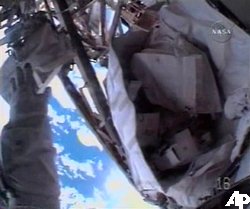
[/caption]
The toolbag lost by spacewalkers this past week is being tracked by satellite observers and one veteran observer actually captured the toolbag whizzing by on video! Kevin Fetter from Brockville, Ontario video-recorded the backpack-sized toolbag last night, Nov. 22 from his backyard. “It was easily 8th magnitude or brighter as it passed by the 4th magnitude star eta Pisces,” Fetter said. Check out the video here. What these “amateurs” can’t do these days! If you’d like to try to see the toolbag yourself, here’s the link to Space Weather’s Satellite Tracker, so you can find out when it will be traveling over your backyard. This site provides satellite observations times for residents of the US and Canada. The expensive toolbag floated away from Endeavour astronaut Heidemarie Stefanyshyn-Piper during the STS-126 mission’s first spacewalk on Nov. 18th. Whoever said the toolbag was lost never to be seen again!
And just why does that toolbag cost $100,000?
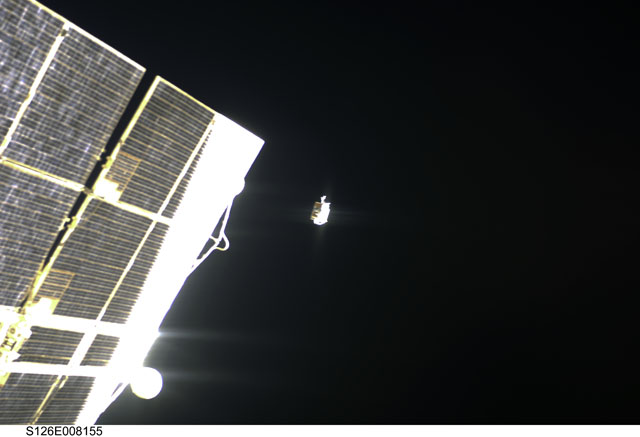
“The cost included the EVA crew lock bag itself, four retractable tethers, two adjustable equipment tethers, a grease gun with a straight nozzle, two wire ties, a grease gun with a J-hook nozzle, an EVA wipe caddy, six EVA wipes (two wet, four dry), a scraper debris container, a SARJ scraper and a large trash bag,” NASA spokesman Mike Curie.
Most of that equipment and the bag are not just something you can pick up at your local hardware store. They are specialized hardware that had to be specifically created and certified for the harsh environment of space, able to work properly in a vacuum and withstand temperature swings from plus 200 degrees F (93 C) and minus 200 degrees F (-128 C).
And if you want to complain about astronauts losing things in space, then you go put on a pair of bulky, stiff gloves and a spacesuit (and a diaper) and try to do some very intricate, demanding work in zero gravity for about seven hours!
sources: SpaceWeather.com, Orlando Sentinel
Thanks, Nancy, for a great article on the whereabouts of the famous “lost” toolkit from STS-126 and all the links to video and tracking sites. This story was posted just after I commented on the Edmonton fireball not being related to the toolkit, and this story bears this out. Any rough idea on when this object may reenter? Given its’ size & weight, it should create a brilliant fireball but probably burn up entirely before reaching the ground.
Monitoring the item and where it is going is one thing, controlling what it might hit in orbit or where crash land is another.
Again, with all these excuses, their variants, and seemingly biassed nationalism stated cannot hide the original complacency.
Clearly, common sense tells us that the uncontrolled loss of anything in orbit is dangerous practice. Really all those occupying low Earth orbit and those organising the mission on the ground, have a important responsibility of both safety and prevention of potential present and future dangers if they are in orbit.
The issue in the end isn’t really the astronaut in question, the fault lies in the adopted operational procedures adopted by NASA and the consortium of the International Space Station. No one expects Heidemarie to do things like fine needle work in orbit, but what we expect is some redundancy methods so such careless in avoided in the future. Anyway, still reckon she ought to be “hauled over the coals” for the incident.
“And if you want to complain”? If the incident is brushed a side and excused on account of a diaper, then you soon be tracking real astronauts.
Good thing I wasn’t in that space suit, NASA would have had to bleep the living bleep out of my radio comms…. 🙂
Unfortunate, but it just goes to show astronauts are humans.
the $100,000 price tag included four tethers that apparently were still in the bag instead of being attached to it and something else. No one is complaining about the work done in space with bulky gloves and suits on, but maybe some extra steps taken before the gloves went on could have prevented this.
Silver Thread said
“So much whining about the tool bag getting loose. Worse is bound to happen, we learn from mistakes and move ahead, now for sake of not being total douche bags about it, stop trolling and move on.”
Again you miss the point. The problem isn’t really loosing the the tool bag. It is basically the need for denial and cover-up by the general media – including the NASA publicity department.
If we are supposed to “learn from mistakes and move ahead”, well the question is why haven’t we do so?
Really. Let’s talk about facts….
According to studies done in 1999, there is estimated to 1.8 million kilograms of space junk in orbit. With roughly 110,000 objects larger than 1 centimetre! Most are stray nuts and bolts lost by carelessness, and all have the capacity of permanently disabling spacecraft.
According to the official NASA Orbital Debris Program Office as of today, on their “Orbital Debris : Frequently Asked Questions”
“Approximately 17,000 objects larger than 10 cm are known to exist. The estimated population of particles between 1 and 10 cm in diameter is greater than 200,000. The number of particles smaller than 1 cm probably exceeds tens of millions.”
Of this, because of the size, only 2% to 5% of the all particles could be tracked by NASA and the Space Command. Worst, is that most cannot be tracked over all places over the Earth.
As to “learning from mistakes”, but three incidences for me highlight the concern if anyone is heeding the warning.
– On the Gemini 4 mission, Edward White in 1965 (now 44 years ago!) lost a glove in orbit during the U.S.’s first ever space walk
– A U.S. Pegasus rocket upper stage was exploded in 1996, which presumable generated between 300000 and 400000 fragments. The orbit is high enough so that the majority remains in Earth orbit to at least 2050, and is travelling in the path of Hubble Space Telescope.
– In May 1963, under the title “Project West Ford”, America launched bunches of copper needles into Earth’s orbit in an ill-conceived plan for post-nuclear war communications. They are 1.8 centimetres long weight 40 micrograms apiece and
These needles are still there in a vastly expanding donut cloud (15×30 km) some 3,700 kilometres above the Earth!
Historically, there has been some rare interest in the topic,
like the informative CBS New report of 14th September 2006. I.e.
Spacewalkers Add to Orbiting Space Junk
The interesting and relevant (damning) quote is made from a former astronaut, Jay Ap in 2006, who said; “You worry about (losing tools) all the time,”
Therefore Silver Thread saying, “So much whining about the tool bag getting loose.” does not really get to solving the actual problem – the first being of course, just admitting there is a problem in the first place!
As Mark Matney, a chief scientist at NASA’s Johnson Space Centre rightly says; “The astronauts living aboard the orbiting lab may not think of it as junk, but for me, every spacecraft is destined to become debris.”
Where can I take NASA up on their offer? Give me a space suit so I can do this the right way.
So much whining about the tool bag getting loose. Worse is bound to happen, we learn from mistakes and move ahead, now for sake of not being total douche bags about it, stop trolling and move on.
I wonder if they can calculate its track well enough to pick it up on the way down…
wow, so people make mistakes, yes it happens… why you focussing so hard on the toolkit? i understand you have an issue with space junk but using the toolkit as a trojan horse to get that issue more attention is just silly really, and looks more like you are simply trying to bash the US space program and its astronauts…
im a euro btw, so no nationalism here…
law mc,
True, we all make mistakes, but are not supposed to learn from them and avoid them in the future?
Also the significant issue here of the “toolkit” is the overall media response that is really avoiding the facts and direct responsibility – basically trivialising the consequences of ones actions.
One of these days a serious catastrophic accident will happen, and we will get the usual incriminations, blame-shifting and “we should do more.” We have already seen the consequences of the two Shuttle disasters – with the loss of all on board – caused by what was seemingly only minor impacts on the spacecraft’s fragile surface. The result was inspections of all the Shuttle’s surfaces before re-entry – if only for the sake of the safety of the astronauts – but also for the loss of expensive hardware of the orbiter. In this case I have great admiration of the ingenuity to solve it. I also respect the bravery astronauts knowing the dangers and still willing to go into space.
Yet in all, I really rue (and I hate having to say this) – when the day comes – when some manned craft is destroyed and all hands are lost. We would be probably unable to recover their bodies from the surrounding debris field for years, and we would have to live knowing full-well they are continuously orbiting the Earth above us. Surely this would be the bitterest feeling of all.
In then end there are direct consequences for our actions – if not now but for our future. How sad is it if we know that just by using procedures in prevention we could reduces the risks. In this view it is no joke.
law mc
You said “im a euro btw, so no nationalism here…”, which I assume was in my direct response in saying ; “…and seemingly biassed nationalism.”
To clarify. I really meant to say here is that It is hard to criticise ones own country against negative events or consequences – biassing just on your nationalistic viewpoint. This view just of the U.S., though but applies to all nations.
Conceded, Americans collectively are a particularly prideful people, and while sometimes acting somewhat “over the top”, does not mean they should be universally condoned for what they have so far achieved or haven’t achieved in space or elsewhere. Far from it.
Nationalism does have its really advantages – but it is fair to say sometimes it is not always positive. Perhaps by hiding behind our nationalism just deludes us from the realities or even the underlying truth.
From the some of the general responses in this thread and the November 19th, 2008 Universe Today thread “Lost in Space: Tool Bag Overboard, Spider Missing.”; clearly shows the fragility of challenging strongly held nationalism views against this same underlying truth.
After all, it is not as George W. said on 6th November 2001; “Over time it’s going to be important for nations to know they will be held accountable for inactivity. Your either with us or against us.” We can still be with you, but we don’t necessarily have the same coloured glasses.
Salacious B Crumb — There’s this phenomenon called “entropy.” *No* process is perfect; there are bound to be losses of mass/energy in some form during the course of any process. While we must ever strive to minimize losses, I’d say the world’s space programs have done far better in that respect than most Earth-bound activities. Astronauts and others in the space industry work constantly to minimize accidents like the loss of the toobag. Okay, it happened. Now let’s get over it and do what can be done.
loved your comments, crumb. thank you.
People mess up, stuff gets lost, and what are we supposed to do?
Send someone to jail every time they drop a hammer?
We have to build thing in space, and that means we have to repair things. That means we’ll be dropping things and not every job will got to plan.
Learn what you can and move on. Self flagellation wont achieve anything.
Yes, we are only human and humans make mistakes from time to time. But we expect more from our trained professionals. Would you just let it go if your doctor gave you the wrong medication or performed the wrong surgery? What if your auto mechanic put volkswagen parts into your ford? Suppose the fire truck showed up to your burning home without hoses? I work in a factory making air conditioners. It is a relatively low skilled, low wage kind of job. If I lost a tool kit, especially one with that kind of price tag, I would be fired. But maybe that would be my boss’s mistake. He’s only human after all.
When I was writing the responses above, I was unaware of a heartfelt developing story in the Australian media. Although seemingly unrelated to this incident, it brought home to me the direct of avoiding consequences of using prevention against ones actions.
It might be seemingly contrite, but it involves the sad death of a 4 year old little girl from a dam in Queensland, Australia.
Here a dam bladder, a device to control water flow, burst, and 6000 megalitres of water was released, flowing down stream taking an innocent group at Blackwater who were engaging in a harmless picnic into a catastrophic flood.
Paradoxically, the dam bladder was put in place to prevent flooding, caused by large floods which incidentally broke years of devastating drought in the region.
Losing a young child with her life before her is very tragic, but it more devastating to think that the reason why she died was only because the Queensland Government was rightly trying to prevent problems with water security in times of drought and climate change.
Whilst no fault can be really be immediately ascertained at the moment, it highlights the best intentions can still lead to devastating disaster. The same issue faces catastrophic impacts to low-Earth orbits.
Although fortunately something as heart-wrenching as this has not happened in this region of space, it generally shows that even with the best knowledge and intentions, we are vulnerable
to our seemingly inconsequential actions.
Food for thought, methinks.
Note: The report of this sad event is at;
Dam tragedy: Nelani dies a week before birthday
Maxwell
All I can say is ; Just do you best and plan for every possible contingency.
Some things are avoidable, but the genius solves the problems before it actually happens.
For the cynics. I still wept for the loss of this child..
According to Mexico’s President, Felipe Calderon,
“The next US administration must assume leadership in a very firm manner – not just for Americans but for the whole world.”
Let’s hope so…
Box of tools – $100,000
Constellation program $16 Billion
International Space Station $100 Billion
Not having to dring your own urine because a $16 Million dollar waste recycler doesn’t work – Priceless.
🙂
About the cost of the toolbag……..
I understand that some pieces had to be created for temp fluctuation. Or because they were one of a kind. And if that is the case, then fine…..this time. But, seeing as we are sending tons of satellites, telescopes etc in space. Is there no standard to follow so that the tools that are needed can be left on the ISS without such a dear price?
While I’m sure Putin and Chavez will be glad to head Obama is taking on leadership of the world… the loss of a bag does not signify anything more than one astronaut catching a case of butterfingers and being nailed on a lapse in judgement.
Genius or not, the brain was not designed for zero gravity and frictionless environments. It does not expect a big sitting next to you to slowly fly away into infinity after brushing your arm.
By the time she or anyone on the ground realized it, it was too late…
You could spend a billion dollars on clips or revamp the entire training system for space workers, but I’ll bet you a dollar this is not the last time we’ll lose something out there.
Maxwell and Yael Dragwyla
I don’t recall ever saying or inferring that accidents like this could be reduced to zero.
As to media reporting, Backyard space watcher films lost tool bag, The Associated Press on Wednesday has stated that “…after losing the bag, Stefanyshyn-Piper vowed to triple-check all tethers to avoid another incident.” They further state;
“”We’re definitely not going to do it again. You’re not going to see us lose another bag,” she said.”
Good. We’ll hold her and NASA for that from now on.
Salacious B. Crumb Says:
November 24th, 2008 at 1:45 am
– On the Gemini 4 mission, Edward White in 1965 (now 44 years ago!) lost a glove in orbit during the U.S.’s first ever space walk
@Salacious
This is a bit misleading since it implies that the glove is still out their posing a danger. In fact, the glove was only in orbit for a month. It should be noted that most of the items lost in low earth orbit tend to de-orbit within weeks and are not a major contributor to space junk to begin with. Even so, it should be noted that NASA’s policy is to not leave anything floating in orbit if it can help it.
Additionally, NASA is attempting to come up with ways to deal with the space junk that already exists as well as having measures in place to reduce the amount of space junk that it currently leaves in orbit. Do accidents happen? Of course, its part of being a space faring (or at least an orbit fairing) civilization. And there may be lapses of judgement involved in some of them. However until you can prove that it is possible for someone to never accidentally drop something, its pointless to blame an individual or a country unless you can show serious disregard for protocol (protocols which haven’t even been fully established internationally yet).
Maybe we should just stop doing anything in orbit like use satellites or go to other planets so that we stop adding to the space junk. Would that make you any happier?
Response to Shadow Dancer
My point about Gemini 4 was the first space walk lost an item whilst in orbit. You said earlier “learning from mistakes.” The point here is the problem still exists!! I.e. Things are still being dropped in orbit.
Also you said;
“However until you can prove that it is possible for someone to never accidentally drop something, its pointless to blame an individual or a country unless you can show serious disregard for protocol (protocols which haven’t even been fully established internationally yet).”
Exactly the problem we need to both improve the protocols for everyone, and bring in International rules (which I’ve stated elsewhere in Universe Today on this subject.)
The mistake here WAS avoidable. I.e. The bag wasn’t tethered down properly. Fact.
As to your statement;
“Maybe we should just stop doing anything in orbit like use satellites or go to other planets so that we stop adding to the space junk. Would that make you any happier?”
No, of course not. We must obviously continue our exploration – but spend more time reducing the overall error rate. As time goes by, the increasing number of items in orbit the risk just becomes worst. The central problem of a serious catastrophic accident, say an impact with the ISS, could stop exploration in lower Earth for years or centuries. For this option, space would be shut for everyone.
Space junk must be managed by all nations and have strict rules (and even fines) for any transgressors.
Based on experience with the sometimes laissez-faire attitudes of all governments and their agencies… well my faith in their reliability ain’t that great – especially U.S. ones. (observed experience).
In this case of dropping thing in space, Ooops! is no longer an option.
Salacious B. Crumb Says:
November 25th, 2008 at 12:26 pm
The mistake here WAS avoidable. I.e. The bag wasn’t tethered down properly. Fact.
Response to Salacious:
Well, its obvious that the bag wasn’t tethered properly since it floated away. That’s not what is at debate here. But can you with 100% certainty rule out that the tether on the bag wasn’t faulty for one reason or another? I personally haven’t seen anything that proves that the attempt to follow NASA protocol for tethering the bag was ignored.
All I can say is that your previous comments have made it seem like the items lost in low earth orbit are a major cause of space junk which just isn’t so. A majority of space junk has in fact come from satellites that haven’t been moved to the proper orbits after the end of their use, satellites that have malfuntioned (both of these cases are company as well as country caused problems), spent rocket stages and exploding debris which includes the satellites blown up by both China and the U.S. (and don’t get me started on that one because it was a stupid idea to begin with – there were other options that could have been utilized in both cases and that is an excellent example of what I mean by disregard for protocol). Unfortunately this is what happens when you have less than scientific minded individuals as leaders of your government…Hopefully things will change on January 20th for the better in this regard.
I honestly doubt that anything short of a piece of space junk driving the ISS out of orbit and into a major city would stop the use of low Earth orbit and I doubt that is likely to happen since a piece of space junk large enough to do that would be easily detected. I would be all for fines being imposed on countries and companies for needlessly causing space junk. The real trick of course would be coming up with a way to actually enforce it. I would also have to say that this should not be used as a license to fine countries and companies for previously created space junk all the way to the beginning of the space age – that would likely be more of a detriment to the development of space than anything else that anyone could come up with.
One last thing I would like to say on the matter is that even though the U.S. has created a large amount of space junk, part of that has to do with the number of launches done by the U.S. It should also be noted that a number of those launches were for foreign countries as well. I would want to see a breakdown of space junk versus the number of launches before making an assessment of who has the worst space junk record. And the U.S. is by no means the supreme leader in the creation of space junk. Russia is a close second (and possibly was in front before the satellite missle was deployed by the U.S.) and China is certainly gaining rapidly.
ShadowDancer said;
“But can you with 100% certainty rule out that the tether on the bag wasn’t faulty for one reason or another? I personally haven’t seen anything that proves that the attempt to follow NASA protocol for tethering the bag was ignored.”
FACT. The Associated Press on Wednesday has stated that “…after losing the bag, Stefanyshyn-Piper vowed to triple-check all tethers to avoid another incident.”
Ergo. She implies directly she didn’t check it. She really stuffed up, so why does NASA cover it up? Grease made the bag slip… give me a break!
No.1 rule for NASA, especially when in space, “Safety before action!”
As for other countries, is just a diversion. It avoids the fact that the protocols need to be tightened up. If America prides itself on its 50 year record it needs to lead the way, and show all the countries how it should be done. Felipe Calderon got it right – and he ain’t American.
Mark Matney, a chief scientist at NASA’s Johnson Space Centre rightly says; “The astronauts living aboard the orbiting lab [ISS] may not think of it as junk, but for me, every spacecraft is destined to become debris.”
Meanwhile, everyone just follows “duck and cover”… and pray like hell!
Cast iron—iron alloyed with greater than 1.7% carbon—melts at around 1370 °C
Really? specialized tools that costs 100K. So they could withstand the harsh conditions of space? What baloney.
200 degree swings in temperature are pretty wild I grant you. But there is little to qualify the cost of that toolbag, or by extension the space program in general.
Perhaps (space certification) like all forms of red tape is the real price of space exploration.
Our latest foray into space filled the headlines about the eek value of drinking urine and focused in on a (inconsequential) error by an astronaut.
Way to inspire the masses. Meanwhile Chandra is photographing the moon , Kayuga should be almost finished mapping the moon, and the public sees nor hears none of the collected data.
Damian
The simple minded COST of the tool bag is the LEAST important aspect of the story, and shouldn’t have even been mentioned.
ANY and ALL Space Junk is a serious threat to our future in space and should never be taken lightly.
The last thing the space industry and us space enthusiasts need is for space junk to cause a catastrophic accident with the loss of lives. That would just give the anti-space idiots something else to whine about.
Right now the problem of space junk is being addressed by just trying to get to the point of tracking the small junk (with in ten years!?!?!) so they can then “plan” around it when launching missions. (By dodging the junk!) There’s a concept! That is just postponing the inevitable need to clean it up somehow. We should be able to come up with a way of dealing with it….
We’ve managed to leave our own Solar System, inventing a “Space Junk Vaporizer – Cleaner – Magnet” shouldn’t be that tough.
Oh yeah, I forgot! The problem won’t be addressed seriously UNTIL someone gets killed! What was I thinking????
Salacious B. Crumb Says:
November 26th, 2008 at 2:11 am
FACT. The Associated Press on Wednesday has stated that “…after losing the bag, Stefanyshyn-Piper vowed to triple-check all tethers to avoid another incident.”
Ergo. She implies directly she didn’t check it. She really stuffed up, so why does NASA cover it up? Grease made the bag slip… give me a break!
Response to Salacious:
Actually, that just proves that she didn’t triple check it. It says nothing about whether it was checked or double-checked. But that is semantics no matter how you look at it since the end result is that it floated away.
And as I said before, I agree that things need to be done to establish protocols for creating space junk.
gudenboink Says:
November 26th, 2008 at 1:10 pm
Oh yeah, I forgot! The problem won’t be addressed seriously UNTIL someone gets killed! What was I thinking????
Response to Gudenboink:
Actually, NASA is already working on ways to deal with space junk. According to reports, the one that seems to be most feasible is using lasers to vaporize part of the piece of junk in order to alter it’s trajectory so that it can be made to burn up in the atmosphere. Obviously this has some drawbacks since some larger pieces might not burn up on re-entry. On the other hand, it is possible that it would make it feasible for low earth orbit pickup or accessible in order to add a thruster to push it into the graveyard orbit.
ShadowDance
You really are a great joker. Defending NASA to the hilt regardless what they do, they still stuff up, then you want to forget it and move on until it happens again, and again , and again… Of course, while you wait, the number of items continues to increase. Don’t do today what you can leave for tomorrow.
As for putting thing is a “graveyard” is an even better joke. Most of the junk is too small to notice, but has a velocity high enough kill the astronaut stone dead in his or her tracks. Really. How many orbital bits is acceptable, 100 million, one billion, hundred billion? Where is the limit before we act? Oh I forgot – she’ll be apples (via good ‘ol American complacency.)
NASA is simply not working on the problem fast enough. If this wasn’t true, then they would not be as lackadaisical in their approach – both in what they say and what they do.
For a third time…
Mark Matney, is the chief scientist at NASA’s Johnson Space Centre rightly says; “The astronauts living aboard the orbiting lab [ISS] may not think of it as junk, but for me, every spacecraft is destined to become debris.”
Meanwhile, everyone just follows “duck and cover”… and pray like hell!
I wasn’t defending NASA to the hilt. They have created space junk and their is no point in saying otherwise. However pointing fingers at NASA and blaming them for all the woes of space junk isn’t the solution either.
NASA does have research going on to attempt to help alleviate the problem and no one has yet come up with a perfect solution. I doubt that anyone will ever come up with one. On the other hand, there are satellites that were supposed to have been moved out into the designated graveyard orbit that are currently considered space junk because they weren’t moved. Moving those satellites to where they are supposed to be or recovering them would be a step in the right direction.
The real problem is that no one has come up with a way to recover satellites and other items that have been placed into orbit and until someone can come up with it, space junk will remain an unsolved issue. And if the concept of using a laser to alter a satellites orbit can be perfected, their is a real posibility that a vehicle such as the space shuttle which sometimes returns with an empty cargo bay can be used to return previously launched items at little cost. Its not a perfect solution, but its a start.