
[/caption]
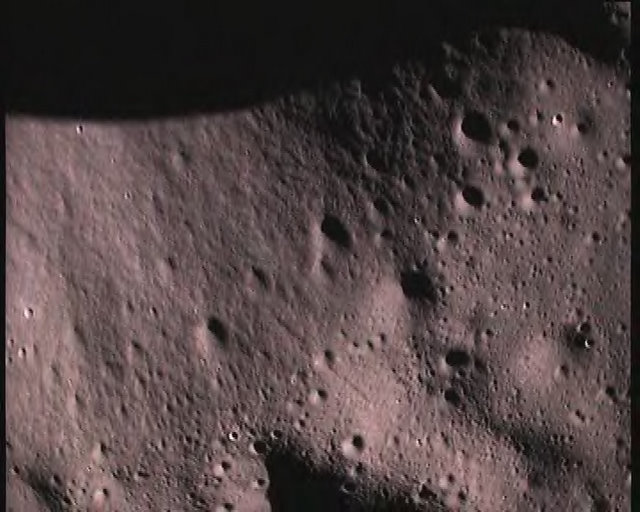
The lunar impactor from the Chandrayaan-1 mission today successfully made it to the surface of the moon, impacting inside the Shackleton crater on the moon’s south pole. Above is an image transmitted back by the 34 kg box-shaped MIP (Moon Impact Probe) before it slammed into the moon. Incoming!!! The MIP carried three instruments, and data was successfully transmitted from the 25-minute descent of the probe after it was ejected from the orbiting Chandrayaan-1. The impact, however caused a cessation of the instruments’ transmissions, but not before providing useful descent data. The ISRO has already released a couple of images.
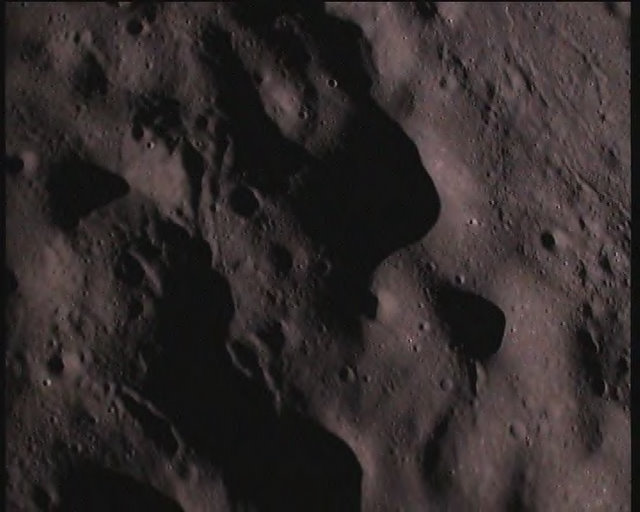
The instruments included a video imaging system, a radar altimeter and a mass spectrometer. The video imaging system took pictures of the moon’s surface as MIP approached and the radar altimeter measured the rate of descent. These two instruments will help subsequent lunar missions for the ISRO, aiding in future soft landing missions to the moon. The mass spectrometer studied the extremely thin lunar atmosphere.
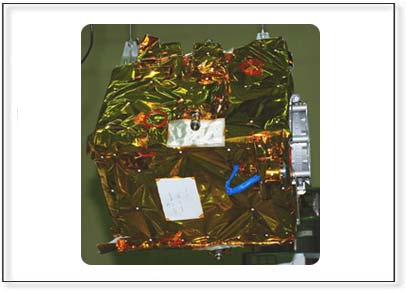
Here’s a recap of the probe’s mission today from the ISRO:
“MIP’s 25 minute journey to the lunar surface began with its separation from Chandrayaan-1 spacecraft at 20:06 hrs (8:06 pm) IST. This was followed by a series of automatic operations that began with the firing of its spin up rockets after achieving a safe distance of separation from Chandrayaan-1. Later, the probe slowed down with the firing of its retro rocket and started its rapid descent towards the moon’s surface. Information from the instruments was radioed to Chandrayaan-1 by MIP. The spacecraft recorded this in its onboard memory for later readout. Finally, the probe had a hard landing on the lunar surface that terminated its functioning.”
Chandrayaan-1 is now in its science orbit. During the spiraling flight to the moon, two payloads were turned on – the Terrain Mapping Camera (TMC) and Radiation Dose Monitor (RADOM). The eight other instruments on board will be activated in the coming days.
Source: ISRO
Wow! Congratulations team Chandrayaan-1! An amazing achievement 🙂 Looking forward to hearing more.
Great reporting Nancy, you beat most of the breaking news sites on this!
Cheers, Ian
Regardless of status or position the same holds true for all people of all nations we need to get our priorities straight.
How can you justify spending hundreds of millions of dollars on a peice of hardware smacking a rock thousands of miles away to see what the rocks made of in hopes of one day living on the rock. There is so much hunger and strife here stop the nonsense plz…
Agreed Huygens. But did you see how much a single experiment from NASA cost ~100USD?
“Check here to see an animation of the probe’s journey”
hmmmm…. no animation…. what am I missing?
Images already started to appear!
Visit the website of ISRO.
Feenixx — check the link again, the annimation is on the middle of the page.
Zvexdichko — thanks for the heads up. I’ve inserted the new images! Thanks!
Ok, Feenixx, you are right. They have taken the animation out from that page. I’ll see if I can find it somewhere else.
Diaz Hi! ISRO has done this on just 50 million USD. (30 million went into the DSN. Why not campaign against NASA, ESA, JAXA spending half a billion USD on probes that India can design and launch for a tenth? The problem is not with ISRO spending money, but NASA and ESA doing now..BTW ISRO gives back to society 2 dollars for every 1 dollar on the space program.
Cheers!
Congrats ISRO. Nice to see images here first.
Here’s your justification LLDIAZ:
You have not seen the future as indeed nobody has. You cannot have foreseen the conditions that your own descendants may be living in 20 generations from now. Perhaps our planet will be a better place to live on. Perhaps, equally, it will not, without including some material assistance from distant rocks.
Some folks, like those that try to send controlled and controllable pieces of hardware to smash into distant rocks, are doing service to YOUR descendants. There are immediate problems like those you mention. They ARE being dealt with; inform yourself. (The numbers for large populous nations are mind bogglingly large enough for any developmental issue to be dealt with satisfactorily within a single generation or even several. For India, e.g., the literacy rate in the wake of the Brits in 1947 was 12%. It is now, 60 years later, >70%. That is a TREMENDOUS achievement if you think about it, given that the population increased from 300 millions to 1 billion and 200 millions, and given that from 1881 to 1947, also about 60 years under the Brits, the “literacy rate” went from 3% to 12%.)
Then there are potential considerations that you call nonsense. They are ALSO being dealt with, like so. You cannot seriously have an issue with it, right? 🙂
Rgds,
BhootNaath
Chandrayaan is the Tata Nano of the space world and a result of thinking outside the box. Stupendous achievement. Think what ISRO can do with a tenth of NASA’s budget, not just for India but for the whole world. I feel another outsourcing opportunity coming up!
Welcome to the club, India. Congrats to all involved. Where’s the video this impactor returned during its fall to the lunar surface? I wonder how it compares to the ‘movies’ returned from the US Ranger program in the sixties. The still pictures look awesome. And, ditto to remarks by BhootNaath & Paul. Some need to look at the big picture & how this impacts all of us Earthlings.
Not to offend, but one small probe to the Moon is much easier to spend carefully on than say, a full-out Mars rover or probe to one of the giant outer planets.
India has done well, but when it has sent probes over the entire solar system for decades and has its own manned program, then we will see how well they can spend more frugally than NASA – which still has a very paltry budget compared to, say, the DoD
or HUD.
Beautifully written, BhootNaath. Thank you for the balance sheet, Paul. Congratulations, India. This is a wonderful achievement.
Congrats to India. I think NASA should start using ISRO as a vendor and outsource the building of future rovers/probes to India. Cost is a major factor. While the space program continues to be hit by budget cuts, we require more of these economy class vehicles. Coming to the intellect, its a known fact that 30% of NASA employees are from Indian origin. NASA will run into problems if it continues to build its expensive rovers. Hey, did somebody say BAILOUT !!!..I think I heard BAILOUT 🙂
When arguing humans vs. robots, remember the comments of LLDAZ. Remember that, unfortunately, there’s a category of people out there who aren’t impressed with *any* of this, and the idea that it’s cheaper than a manned mission, will not impress them, and will object to so much as a nickel being spent on anything space-related.
To paraphrase:
They came for the manned missions, claiming the money should be spent elsewhere and I said nothing.
They came for the unmanned space probes, claiming the money should be spent elsewhere and I groaned, but said nothing.
Then they came for the ground based telescopes…
When we were cultivating our land so that there are no poor, they trained their farmers to become Hoplites. They travelled 1000’s of miles from the far off lands to invade us and loot our lands. We still thought it is important to feed the people than build war machines.
We let it go and we worked on our literature, philosophy and science so every one can get an education. We made the highest grade steel and the people of the desert turned it into swords to kill us and convert. We let it go, education is more important than war.
We forgot, forgave and mingled and we went on to build a prosperous nation that contributed 40% of the worlds GDP. They built ships of war and came to our shores under the guise of trading. They looted us and enslaved us for 200 years. Still we let it go. It is important to build economy than build ships of war.
We will let it go now and go on rebuilding our country. Help the millions of poor left poor, malnutritioned and uneducated in the wake of colonialism. We will forget and forgive and work on rebuilding our nation. They will build space ships, go to moon and then to mars. They will become more powerful and loot us again.
We will not let it go. We will rebuild our nation, provide food for our people and education. We will also build great big space ships that can fire devastating weapons. We will be there in space watching your every move. 2000 years of rape and voilence had taught us one lesson. Might is right. Power is respected.
Jagadish, save us from the drama here. This is a scientific site.
Jagadish – your skills are better spent on some poetry or creative writing site, not here.
“Watch his might and wail in distress”, etc…a bit of an overkill, don’t you think? After all, this is just another moon probe, isn’t it? A great accomplishment, no doubt, but not quite the earth-shaking event you are making it out to be.
This is good science, as befits a major nation like India. Do NOT make your nation a laughing stock through your fanciful, jingoistic comments.
What does that lunar atmosphere consist of?
“The mass spectrometer studied the extremely thin lunar atmosphere.”
Is it floating dust of regolith?
Both NASA and ESA have been pioneers. They accomplished their missions 50 years before India did the same. The Indian Space Scientists have benefited significantly from the strides made by the Americans and the Europeans. So claiming post-fact that Indians can do better than Americans is too much chest thumping. Knowledgeable Americans, including this writer, appreciate the strides the Indian Scientists are making. By the same token scientific achievement everywhere has to be recognized for innovation, creativity and originality and the pioneering scope. I think folks should appreciate all the scientists on this planet who studied outer space.
Indian Says:
November 14th, 2008 at 6:23 pm
“Jagadish, save us from the drama here. This is a scientific site.”
Indian,
do you make the rules about what somebody is allowed to post here? Or do you just try to.
Of course if you make the rules than give us an email address so that everybody can bring his or her comments before you before they are allowed to submit them here.
congratulation to india its a grate achievement
From the time India contributed to the number system we use today, and to the most popular Indo-European language we’re conversing here in, we are all in this together, and we have always leveraged off of each other.
We stand on shoulders of giants only to become giants for other noble humans to stand upon. Let our tradition of sharing knowledge with the world continue once again, as it is happening now, after a 1000 years of invader rule.
This has been the most transparent and the most collaborative moon mission so far – somewhat of an inexpensive, “open source” platform of the space-farer’s world.
In order for our species to progress we need to do research in all scientific fields, yes lots of money is wasted in the pursue of knowledge but it is a necessary evil as is insurance premiums. What about all the money that spent on keeping all nonproductive assets instead of recycling them, which would free up more money for science.
The challenge the world faces seems to be a topic no one is willing to discuss and that is the over population of the planet. If we do not get that under control, it makes no difference how much we spend on science.
If you want more saving in science, the space programs of all countries combined under one organization, but that may never occur because of men varies degrees of greed, selfishness, cultural differences, national pride, etc.
Good science India, keep up the good work, do not forget to share the results with those who came before you that share all their knowledge with you.
Whatever people say, Madhavan Nair and team done a wonderful job. We congratulate them and vishing them success on their future missions.
biju
dollhopf asks:
“What does that lunar atmosphere consist of?
…..
Is it floating dust of regolith?”
“Atmosphere” translates as “gas ball” or “vapour ball” – dust alone doesn’t make an atmosphere.
The moon’s atmosphere is mainly argon, some helium, a tiny bit of methane, oxygen, nitrogen… and traces of carbon dioxide and monoxide – in total about 80000 atoms per cubic cm. That’s “almost no atmosphere”… ah well…
i would be great if they have send a soft landing probe.The probe lasted its journey for 25 minutes on air taking pictures of the moon and its is dead when it crashed on the moon within 5 secs.
Hope ISRO has great mission ahead like Chandraayan 2(It is going to have a soft lander for rover) and manned mission for moon, i think it also has Mars mission in its account.
I am very proud that india is well poised for its space technology compared to developed nations and as many suggessted it has carried instruments of many countries which makes as a open source for space.
People may say that there is poverty and poors are suffering , true but we have to look at a broader view and appriciate all our scientist who worked for our country to make the mission sucessful.Hope many indian scientists abroad may join hands with ISRO in future.
cheers!!!!
To LLDIAZ,
To feed the poor you need money, to earn money you need to sell goods, To sell goods you need competitive edge(better Tech and lower cost). And better Tech is developed thru advanced scientific projects like these. There are spin-off technologies that give competitive edge to a nation’s products. Diskless Hard-drive was first developed for Space then used for Military and now it is about to enter commercial laptops. Non-stick frying pans technology owes it to space tech too.
Feed the poor unconditionally and they will not even want to come out of poverty. In Sri-lanka, free government money distribution to poor led many poor to blow away that cash on booze.
Congratulations India.
Raymond,
a colleague at work (he is originally from West Africa) had a liaison with a local (German) chick. He visited her family and found the grandmother (an alcoholic) depending on “Sozialhilfe” while the mother received “Hartz IV”. And the girl itself received Hartz IV, too. He tried to persuade her to go to work, but she is much too content with her current conduct of life.
“To feed the poor you need money” but to feed people means also that they can unlearn to supply themselves. And in Germany there is a lot of money is simply going into “feeding the poor”. More money than is used for education and science. But it seems that nobody is ever satisfied with the results. I prefer to “feed” space missions than self-imposed immaturity.
But of course all the poverty in the world is not that easily explained. poverty in the world is not so easily explained.
Feenixx Says:
The moon’s atmosphere is mainly argon, some helium, a tiny bit of methane, oxygen, nitrogen… and traces of carbon dioxide and monoxide – in total about 80000 atoms per cubic cm. That’s “almost no atmosphere”
I wonder whether low gravity exhaustively explains the low density. Would it not be higher if the moon was enveloped by a magnetosphere, because the solar wind does carry away gas from the unprotected surfaces. Wouldn’t a magnetosphere in combination with natural sources for gas let the density be much higher?
Can we have some data (interesting facts to know about the MIP impact) like:
1. What was speed of impact?
2. How big is the size of impact crater?
3. What may be the equivalent energy generated by the MIP impact in TNT?
4. Was the impact site chosen has any scientific value for us or it was not pre-selected at all ?
People aren’t hungry due to lack of funds, material or food stuffs. They are hungry because war lords and other tyrrants keep it away from people.
Take your pitty to a web site which actually goes after these individuals in Africa, N. Korea etc; instead of wasting your breath here, where it will do no good.
Video of southern polar region of Moon taken by the Terrain Mapping Camera:
http://www.isro.gov.in/pslv-c11/videos/tmc.htm
Rgds,
BhootNaath
Yes, well done India. The current crop of scientists in India are just part of a long line of brilliant physicists and mathematicians. There’s no doubt India and China will go on and make huge strides in space technology and exploration should they want to.
“Where’s the video this impactor returned during its fall to the lunar surface?”
It got looted by the invaders.
Where’s the video this impactor returned during its fall to the lunar surface?
It got looted by the invaders.