
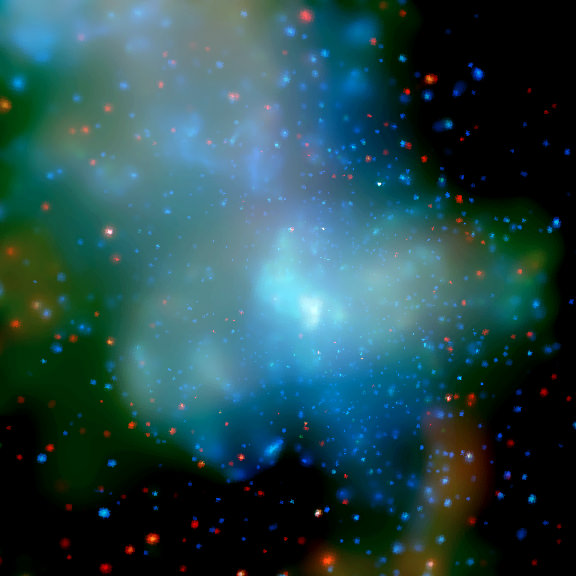
Are you ready for another Where In The Universe Challenge? Take a look at the image above and see if you can name where in the Universe this image is from. Give yourself extra points if you can name the spacecraft responsible for the image. We’ll provide the image today, but won’t reveal the answer until tomorrow. This gives you a chance to mull over the image and provide your answer/guess in the comment section. Check back tomorrow on this same post to see how you did. Good luck!
UPDATE: The answer has now been posted below.
The prize for the best answer this week goes to Steve who said “The Lights of Zetar” from Star Trek. (The only Star Trek episode where Scotty got the girl.) Thanks for making me laugh out loud, Steve! However, most everyone else had the correct answer, or close to correct anyway: This is a Chandra image of the center of our Milky Way Galaxy, Sagittarius A, aka Sgr A*. The image was produced by combining a dozen Chandra observations made of a 130 light year region in the center of the Milky Way. The colors represent low (red), medium (green) and high (blue) energy X-rays. For more information about this image, check out this page on the Chandra website.
Great job, everyone, and stay tuned for next week’s WITU Challenge.
Something in x-rays. Crab Nebula w/ Chandra?
looks like Sgr A* to me. Chandra?
In the grand Mysterium Cosmographicum, it is simply a point in space no more or less important than any other.
the galactic center
This image was produced by combining a dozen Chandra observations made of a 130 light year region in the center of the Milky Way. The colors represent low (red), medium (green) and high (blue) energy X-rays.
i think it is the heart of galaxy NGC 253 taken by the VLT.
the galactic center, Chandra.
The Lights of Zetar. Image created either by NCC-1701 USS Enterprise or Memory Alpha.
What do I win?
Well, I find it easier to pinpoint the spacecraft than the actual subject.
Unless I’m much mistaken, this is an X-Ray image shot by Chandra, showing hot gas glow and point X-ray sources. Where? I’m leaning towards the LMC, but it may also be our own galactic center.
While I prefer my first guess it does look a lot like Sagittarius A. But I’m not sure that is a Chandra image. Maybe it is combined with another observatory or satellite. Or like Mike above said, a combination of different xray energy levels from Chandra.
# Astrofiend Says:
January 21st, 2009 at 3:30 pm
“Something in x-rays. Crab Nebula w/ Chandra?”
Revised – Sgr A* for sure. Didn’t even think of that! Chandra.
Sgr A* & its light-echoes in x-ray ,so Chandra..
maybe some IR-elements composited from Spitzer to
but like “Johanes Kepler Says:January 21st, 2009 at 3:34 pm” above said
can be (~?) points-in-the -cosmos
that if U direct your instruments towards them
will look much-the-same
..
Chandra, SMC.
All wrong, folks…
It’s obviously a very clever, high-tech 3D pic from the Stardust probe approaching comet Wild 2. Here’s how to tell:
The blue dust particles appear red when they land on the camera. If you look very closely at the photo (and it works best with a CRT monitor and tired eyes), the red dots are blatantly in front of everything else. Awesome. 🙂
Center of the Galaxy, Hubble?
I can see why crab nebula was mentioned it does look a bit like.
I’ve no idea, but it sure is pretty!
Nancy,
I know this may be out of place and will show my lack of scientific knowledge but, I want to know why, when we view the center of an AGN galaxy like this view of our own Milky Way, we don’t observe a “hole” (nothing, nada, the absent of light). If it is true that once light enters the horizon, it is swallowed and cannot escape. That should include all of the radiation spectrum right? so no matter what instrument (visible, UV, IR, radio, etc.) is viewing the center, we should see “nothing” (a “black” hole) right?
Or are we seeing the unavoidable stuff in the foreground?
Or is it just too small for our current instruments to focus in on?