
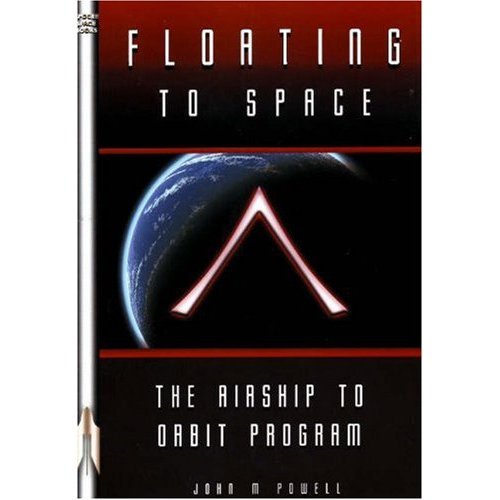
[/caption]
America’s OTHER space program is how John Powell bills his airship to orbit program. This endeavour, wonderfully encapsulated in his book Floating to Space, describes a less than typical application of a well-known technology. Using the concept of dynamic climbing, he believes and shows that airships are the better method to putting people and material into space.
Airships aren’t new. The Montgolfier brothers made the first modern edition and, since then, lighter-than-air transportation has been used to make determinations of weather in high latitudes, as well as to film sports events. Effectively, by trapping a less dense gas within an envelope, the envelope and a payload ascend. John Powell is fine tuning this concept for travelling into orbit and plans to soon elevate appreciable payloads to above 400 kilometres. And, as we all know, at that height, space travel becomes quite achievable.
Given this unconventional concept, Powell’s book follow the standard fare of all space dreamers. Like these, his book starts by admonishing the reader to accept physics and forgo tradition. Next, he justifies his beliefs by providing a review history. For example, did you know that the Nazca drawings might have been directed by a fellow in a hot air balloon? Continuing on, he provides a rational description of the current abilities of airships and their kin and ably convinces the reader that airships have got potential.
Now, if the reader perseveres through this brief background, they will get into the really exciting stuff. For it seems that John Powell is as much an engineer as he is a dreamer. Having amassed more than 80 missions over the previous 15 years, he can draw upon real experience and he does so in presenting the reader with steps he’s made of real progress. For example, during the early times he describes shooting rockets from balloons, nicknamed rockoons. Toward the end, he describes how he’s now floating platforms to above 100 000 feet. This story would warm any engineer’s heart. The technical progress described would set their hearts on fire.
Complementing the book is an enclosed DVD that is part documentary and part fanfare. In it, Powell’s placed some choice video taken from payloads as they climb to way-up-high and other videos that show a quite rapid descent from the same height. Equally exciting segments include footage of the next generation craft, Ascender 90, with ‘wings’ over 90 feet in length. It gently rises massively above a hanger floor as if coming to life for the first time. Given that this is a taste of things to come, this book is a wonderful place marker of what’s happened to date in Powell’s program and where things will hopefully be going.
In sum, this book’s got the touch of a visionary and the feel of a practitioner. It showcases a small cadre of people working against the grain of the norm. Yet, similarly, their goal is to achieve a great benefit for everyone. Optimism exudes from the pages as do technical triumphs. And, success just seems around the corner so that the reader may feel themselves getting drawn into the excitement and look to contribute.
Though not as flashy as rockets, airships provide similar capabilities. Both loft massive payloads up above the atmosphere. John Powell’s book Floating to Space – The Airship to Orbit Program shows the feasibility of this endeavour as well as results of his own efforts. With time, it seems, this program is destined for a lofty future.
Read more reviews online, or purchase a copy from Amazon.com.
While balloons could be a wonderful to get above the atmosphere, I don’t see how it would make getting to orbit easier. Most of the energy required to achieve orbit is to gain the necessary speed, not altitude.
Starting off that high can save you a lot of mGh and you’ve also reduced atmospheric drag to much lower levels. Probably more practical than a space elevater although I’m not sure which is cooler!
Air launched rockets have a strong future for lofting small things and people. The problem for the time being is that its difficult to lift hundreds of tons in fuel to launch larger payloads.
Simple fact is when you remove air resistance you save a great deal of fuel. However there will still be structural stresses to deal with.
Balloons are also difficult to control on the ground or in bad weather, especially big ones with thin skin. I think thats going to be the biggest problem here.
“John Powell is fine tuning this concept for travelling into orbit and plans to soon elevate appreciable payloads to above 400 kilometres.”
Is this a typo? 400 km in an airship does not seem possible. According to the following website, http://www.heavens-above.com/orbitdisplay.asp?satid=25544 , the ISS orbits at a height between 337 and 351 km. Space starts at 100 km.
This book sounds OK – but it can’t be anything like “Imminent Discovery”…..but maybe I’m biased. 🙂
Cynthia-
A space elevator is much, much cooler. But why not combine the two ideas?
The demands of building a structure strong enough to reach the 20,000km from Earth to geostationary orbit are quite different to the demands of building a structure that can withstand the wind damage, weathering and corrosion caused by Earth’s atmosphere.
So why not build the space elevator in two sections? The upper section, in space, could be made of carbon nanotubes or whatever super strong tensile material they come up with, and it could be made of light materials because it wouldn’t be exposed to atmospheric attack. The lower section, reaching from the surface to where the atmosphere becomes too thin to worry about, could be made of conventional material that’s resistant to weathering. It could be substantially heavier stuff, because you could hook big balloons to it to take much of the weight.
Very interesting idea Cynthia, I was thinking along the same lines but not quite. I think there is great potential in combining the two technologies.
I’m not sure if you actually have to tether a space elevator to the ground but if you could have come within 100,000 feet of the ground that would save on weathering and about 19 miles of structure.
In any case these two technologies where definitely made for each other.
Does the book say how they plan to get from floating 40 km up & going zero km/s to going at 8 km/s?
I’ve seen the JP Aerospace website & this wikipedia entry: http://en.wikipedia.org/wiki/Orbital_airship
They suggest the idea is to accelerate a specially designed high altitude blimp with ion drives. How this can possibly overcome the air drag, I fail to see.
OTOH launching a relatively conventional rocket from a high altitude balloon does have advantages. There are also uses such as communication & observation for high altitude balloons.
OK, I bit. I ordered it. Not because of the “floating to space” concept, but because of the Amazon.com note that mentions finding life 20 miles up and “plasma volcanos”. If I like the book, the author gets a free copy of “Imminent Discovery (available at Lulu.com)” If I don’t like it, the author gets 2 copies. 🙂
@Jim 90% of the atmosphere is below 15 km altitude. When you’ve got to 30 km, you’re above nearly 99%. So air drag’s not a problem, but getting from 0 to 8 km/s *is*. NASA’s state-of-the-art ion drive takes 4 days to accelerate from 0 to 60 miles per hour. Now, if you do the maths, that works out to 76 years if you have an acceleration of 60 miles/4 days (although the acceleration probably isn’t that) (http://www.google.co.uk/search?q=17,500+mph+/+24,140.16+m/day^2). I haven’t read the book though, so I don’t know what the specific proposal for propulsion is. It’s always possible that they will create a high-acceleration, high specific-impulse, ion drive.
@Josh A.:
Check your math?
What I get: 60 mph over 4 days works out to an accel of 0.0000776 meters/sec^2.
To reach 8 kps at that accel it would take a little over 3 years, not 76.
Put on 30 of the thrusters (instead of the 3 used by the NASA spacecraft in this example) and and you are looking at only 4 months – in this example.
I think.
Guys… after accidentally seeing the “Space Balloons” documentary on Discovery a couple of months back (you can see it yourself, it’s on Google Video) I said to myself, wow… I didn’t know balloons could really do that heavy stuff, but there they are really doing it.
However, I stayed focused on Rockets and the Space Elevator as “real” options. I was continuing to happily ignore the ElephantS in the room… the Cost Of Payload Launch AND (what no one ever talks about) the cost of getting worthwhile amounts of cargo Back down here.
Then I saw this book in the store and figured it would kiill a few hours.
Can I make a suggestion? Before adding more to the thread about how ‘it couldn’t work’ or ‘did he tinnk of XYZ?’ go sit in the bookstore and read the book. It is short and it is entertaining. Like the reviewer said, the first few chapters can either be loved or not, but the good stuff does all come in (Chapter 11 put me over the edge, he finally talked about micrometeors and later makes points that even Branniff should listen to about making money in Space Tourism – more like Disney and less like running a Concorde fleet.
Then let it sit in your head for a day and come back here and post. I’d really like to get other people’s opinions of The Book, because I could not (and can’t) get the ideas out of my head.
Aside from the recent news that inexpensive Helium may fast be gone from the reserves (and only Russia has the big H4 goods now), the book lays out a very interesting set of technical and business points that – when I stop the years of being told that only ICBMs can get to space – Powell appears to have thought out very well.
And unlike the Space Elevator (which IS a cool idea, even after reading the NASA papers that went into the real costs) Airships to Orbit don’t appear to suffer that fatal requirement called “Requires An International Commitment” we all saw how well that requirement turned out with the ISS 😉
You don’t know me… but I do strongly recommend this book. And I’d love to hear what you thought of it After you’ve read it.
Thanks. I’ll be lookin’ for updates.
I think it would be interesting to consider
what you could do if you had a sufficiently
strong and light material to make a thin hollow sphere enclosing a vacuum. What a lift!
🙂 Similar to Buckminster Fuller’s mile-diameter concrete balls just taking flight by natural sun heating …. page 85 of this book. Not told to advocate it, just a point that it seems that Powell has not only done a lot of real flying or various designs (for the air force, pongsats, science experiments, advertising runs, etc) but also that the book appears to cover a lot of the ground on its way to making the case for actual feasability of very high altitude large-payload hypersonic transports.
I really want someone to read this book 🙂
I’ve read it.
🙂
And…?
(btw: a pre-book and pre-several-flights 2004 discussion of JP Aerospace is here http://www.spacekb.com/Uwe/Forum.aspx/space-policy/1014/JP-Aerospace-Airship-to-Orbit )
oh.. “JP” got it 😉
hey, I wonder if you’ve got some rule of thumbs related to cargo tonnage to airship ‘size” in all three of the craft.
Dumb as it may sound in the grand scheme, what gets me good is the potential for being able to have some real commercial volume “shipping option” beyond the only one NASA & Co. seem to have on any books (crash-shipping product home from space in a cosmonaut’s pockets just doesn’t scale well, know what I mean?).
Robert-
A space elevator would not require an international commitment, it’s just a matter of priorities. For example, USA could do it for far less than we are squandering in Iraq. And whoever does it first will make a fortune.
Another very cheap (and much easier) way to get bulk payloads off earth would be a rail gun. A mountaintop exit (say at 5000-6000m) would get the launch point above half the atmosphere with no need for balloons.
Yes rail guns, I hear you Karl. No flame at all.
Here’s where they have an issue though, it’s what I’m starting to think is *The* Elephant because you – no flame at all, I am very happy and appreciative for your time and careful thought – but, you just forgot the big beast was in the room too, and it was all of the tail of my previous post:
How do you get big payloads *Down* from orbit?
Zubrin, Lewis, Schmitt, O’Neill and on and on have excellent plans for stuff that is already up there (and/or can justify the cost of going up) but they also all say that a reason for going up that normal non-space nuts can comprehend and get behind is that of all of the asteroidal platimum or Mars product or Lunar Heilum3 or all of those ISS Microgravity miracle claims including chip-revolutionary crystaline structures or pharmaceuticals.
All great. Till Andy Grove says “I’ll pay for manufacuring all the way… but I have to be able to have 100 ISO cargo containers of product on the surface grid per week.”
I was being over the top when I said that NASA appears to only be able to put those ISS products in the zip pockets of our American cosmonauts maybe once a month. A reentry capsule can probably bring down a half ton. Yes? No?
But that’s not the Trillions of dollars worth of product folks have been using to push the “easy pickings, as in potentially In Our LIfetime” value of Space Business.
On careful re-reading the experts that I’ve read like Zubrin, Schmitt and O’Neill I notice the tendancy to cleverly mix in that Space Resources and Space Manufacturing will be used primarily to power the manufacturing of more spaceside bases and platforms for doing more manufacturing.
It’s like that old joke: I use coke so I can work harder so I can make more money so I can buy more coke so I can work harder so I can … 🙂
The Space Elevator, yes, has the Down potential. I hear you, I have years in the choir.
However I have read one or two NASA bits (I have the Smitherman 2000-2006 Advanced Earth-Space Infrastructure compilation right here) and I just grabbed my Swan & Swan and skimmed it and I don’t know right now where my dog eared “blue book” went but I know it was only two nights ago that I had it out and found a mention of a 20,000 pound cargo target.
That’s not a single ISO container.
Could you perhaps provide me with more recent tonnage numbers and references? As you can tell, I am in need of data.
Again, it’s not up.. it’s down that has me.
Now.. I’m waiting for JP to come up with some just generally ballpark guesstimates because his book doesn’t have them either. But again, his book isn’t pretending to be of the technical ilk of Schmitt and Zubrin. But, I would give Powell’s numbers some pondering because he is actually flying his designs.
Karl, I am With You in the Space Elevator backing. I do however currently believe that it ain’t gonna happen without International Committment if only because the space where it will sit is alive with 13,000+ tracked objects from the USSTRATCOM catalog. And I want my DirecTV and cellphones to keep working. Yes, I’ve heard we can move the SE out of the way of the ISS but ISS isn’t the only workhorse we’ve sent up. Wall-E made it look clean.
However, while we wait for such issues to work themselves out and for the ribbon to start unwinding…
Have you read “Floating to Space” yet? Buy it from a half priced Amazon merchant and spend an hour and a half with it… then please tell me what you came away with after reading just the short chapters 1 through 15.
Many thanks.
Robert
Parts of the space elevator would want to orbit at 90 minutes, like sputnik, and other parts would be in stationary orbit. The whole thing would fall about your ears in a tangle.
How many G’s are you going to apply on the rail? Everything would be squashed flat against the capsule back wall.
And the balloon you have to lift whatever, fuel and machinery, is going to accelerate your rocket from zero to escape velocity.
If you all let the air out of your heads you will discover that neither the space elevator, the rail launch, nor the balloon trick are feasible.
Marty, I’ll grant you your points.
Now, here is the question. Stop talking a bout Launch, it’s all we ever talk about and it is not the only issue under the sun.
What system do you know of for for getting cargo ****Down From Orbit to the Earth Surface****?
The Balloon book, directly addresses this question, hence my interest. Have you read this book… it’s worth it if only to have real points to talk against.
Thanks.
Robert,
I’m afraid there’s no rules of thumb for the cargo to vehicle size. There are just too many factors. One of the big ones is the location of the Dark Sky Station.
Having the station large enough for cargo balancing is critical. It’s clear that mission cargo masses in the first stage won’t match those of the third stage. No at least in any optimized way.
The drag manage systems will also have a big impact on vehicle size. There is huge amount of lab data and very little flight data on these. We’re conducting a test of a system at 120,000 feet in just a few days. It won’t manage any drag, it’s a system shakedown at altitude.
JP
Thanks John,
I surely like to see some of that flight data. I’m not sure about balloons as the end-all (and without full flight data I’m sure that you aren’t yet finalized on full designs yet either)… but I am very intrigued by all that you have done. And, in my opinionk, it was a very well crafted book.
Best of luck, keep flying!
I’m interested in this scheme (haven’t read the book yet) but am wondering: why not use a vacuum? At that altitude it should be possible with current materials.
DARPA started paying Aeros Corp last year for a supposed LARGE-cargo ballast-free system. It was on the heels of the official leak of the Lockheed p-791 flight videos. Just the other day the Register reported that that DARPA deal was in fact still investing in this holy grail LTA technology.
Hmmm, no loss of Helium and VERY LARGE (read “real cargo levels”) load/unloads.
Put Aeros and JP together and perhaps the dual-use ICBMs won’t be the only way to get things up and Down … and, as noted, all current rocket/crashdown systems fail both routes for useful tonnage.
Who else has read the book?
Sept 22nd 2008: http://www.theregister.co.uk/2008/09/22/aeroscraft_pasternak_airship_design_darpa_pork/page2.html
(previous under the mainstream radar report: http://www.theregister.co.uk/2008/09/22/aeroscraft_pasternak_airship_design_darpa_pork/page2.html)
sorry, this was the “previous” back in november 07:
http://www.gizmag.com/go/8282/