

We’ve all asked this question at some point in our lives: How long would it take to travel to the stars? Could it be within a person’s own lifetime, and could this kind of travel become the norm someday? There are many possible answers to this question – some very simple, others in the realms of science fiction. But coming up with a comprehensive answer means taking a lot of things into consideration.
Unfortunately, any realistic assessment is likely to produce answers that would totally discourage futurists and enthusiasts of interstellar travel. Like it or not, space is very large, and our technology is still very limited. But should we ever contemplate “leaving the nest”, we will have a range of options for getting to the nearest Solar Systems in our galaxy.
The nearest star to Earth is our Sun, which is a fairly “average” star in the Hertzsprung – Russell Diagram‘s “Main Sequence.” This means that it is highly stable, providing Earth with just the right type of sunlight for life to evolve on our planet. We know there are planets orbiting other stars near our Solar System, and many of these stars are similar to our own.

In the future, should mankind wish to leave the Solar System, we’ll have a huge choice of stars we could travel to, and many could have the right conditions for life to thrive. But where would we go and how long would it take for us to get there?
Just remember, this is all speculative and there is currently no benchmark for interstellar trips. That being said, here we go!
Nearest Star:
As already noted, the closest star to our Solar System is Proxima Centauri, which is why it makes the most sense to plot an interstellar mission to this system first. As part of a triple star system called Alpha Centauri, Proxima is about 4.24 light-years (or 1.3 parsecs) from Earth. Alpha Centauri ? is the brightest of the three stars in the system (part of a binary 4.37 light-years away) while Proxima Centauri is an isolated red dwarf.
And while interstellar travel conjures up all kinds of visions of Faster-Than-Light (FTL) travel, ranging from warp speed and wormholes to jump drives, such theories are either highly speculative (such as the Alcubierre Drive) or entirely the province of science fiction. In all likelihood, any deep space mission will likely take generations to get there, rather than a few days or in an instantaneous flash.
So, starting with the slowest forms of space travel, how long will it take to get to Proxima Centauri?
Current Methods:
The question of how long would it take to get somewhere in space is somewhat easier when dealing with existing technology and bodies within our Solar System. For instance, using the technology that powered the New Horizons mission – which consisted of 16 thrusters fueled with hydrazine monopropellant – reaching the Moon would take a mere 8 hours and 35 minutes.
On the other hand, there is the European Space Agency’s (ESA) SMART-1 mission, which took its time traveling to the Moon using the method of ionic propulsion. With this revolutionary technology, a variation of which has since been used by the Dawn spacecraft to reach Vesta, the SMART-1 mission took one year, one month and two weeks to reach the Moon.
So, from the speedy rocket-propelled spacecraft to the economical ion drive, we have a few options for getting around local space – plus we could use Jupiter or Saturn for a hefty gravitational slingshot. However, if we were to contemplate missions to somewhere a little more out of the way, we would have to scale up our technology and look at what’s really possible.
When we say possible methods, we are talking about those that involve existing technology, or those that do not yet exist but are technically feasible. Some, as you will see, are time-honored and proven, while others are emerging or still on the board. In just about all cases though, they present a possible (but extremely time-consuming or expensive) scenario for reaching even the closest stars…
Ionic Propulsion:
Currently, the slowest form of propulsion, and the most fuel-efficient, is the ion engine. A few decades ago, ionic propulsion was considered to be the subject of science fiction. However, in recent years, the technology to support ion engines has moved from theory to practice in a big way. The ESA’s SMART-1 mission for example successfully completed its mission to the Moon after taking a 13-month spiral path from the Earth.
SMART-1 used solar-powered ion thrusters, where electrical energy was harvested from its solar panels and used to power its Hall-effect thrusters. Only 82 kg of xenon propellant was used to propel SMART-1 to the Moon. 1 kg of xenon propellant provided a delta-v of 45 m/s. This is a highly efficient form of propulsion, but it is by no means fast.
One of the first missions to use ion drive technology was the Deep Space 1 mission to Comet Borrelly that took place in 1998. DS1 also used a xenon-powered ion drive, consuming 81.5 kg of propellant. Over 20 months of thrusting, DS1 was managed to reach a velocity of 56,000 km/hr (35,000 miles/hr) during its flyby of the comet
Ion thrusters are therefore more economical than rocket technology, as the thrust per unit mass of propellant (a.k.a. specific impulse) is far higher. But it takes a long time for ion thrusters to accelerate spacecraft to any great speeds, and the maximum velocity it can achieve is dependent on its fuel supply and how much electrical energy it can generate.
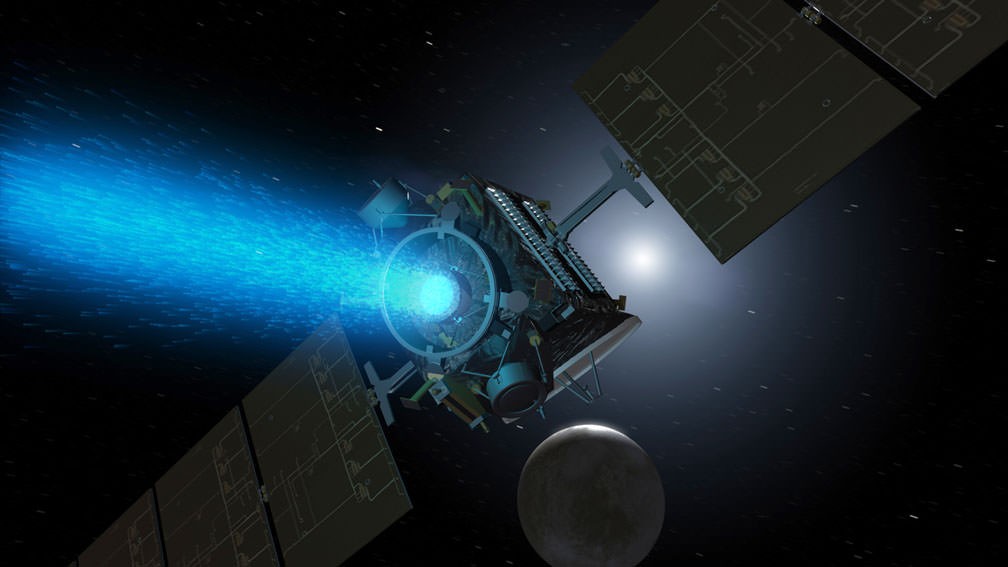
So if ionic propulsion were to be used for a mission to Proxima Centauri, the thrusters would need a huge source of energy production (i.e. nuclear power) and a large quantity of propellant (although still less than conventional rockets). But based on the assumption that a supply of 81.5 kg of xenon propellant translates into a maximum velocity of 56,000 km/hr, some calculations can be made.
In short, at a maximum velocity of 56,000 km/h, Deep Space 1 would take over 81,000 years to traverse the 4.24 light-years between Earth and Proxima Centauri. To put that time-scale into perspective, that would be over 2,700 human generations. So it is safe to say that an interplanetary ion engine mission would be far too slow to be considered for a manned interstellar mission.
But, should ion thrusters be made larger and more powerful (i.e. ion exhaust velocity would need to be significantly higher), and enough propellant could be hauled to keep the spacecraft’s going for the entire 4.243 light-year trip, that travel time could be greatly reduced. Still not enough to happen in someone’s lifetime though.
Gravity Assist Method:
The fastest existing means of space travel is known as the Gravity Assist method, which involves a spacecraft using the relative movement (i.e. orbit) and gravity of a planet to alter is path and speed. Gravitational assists are a very useful spaceflight technique, especially when using the Earth or another massive planet (like a gas giant) for a boost in velocity.
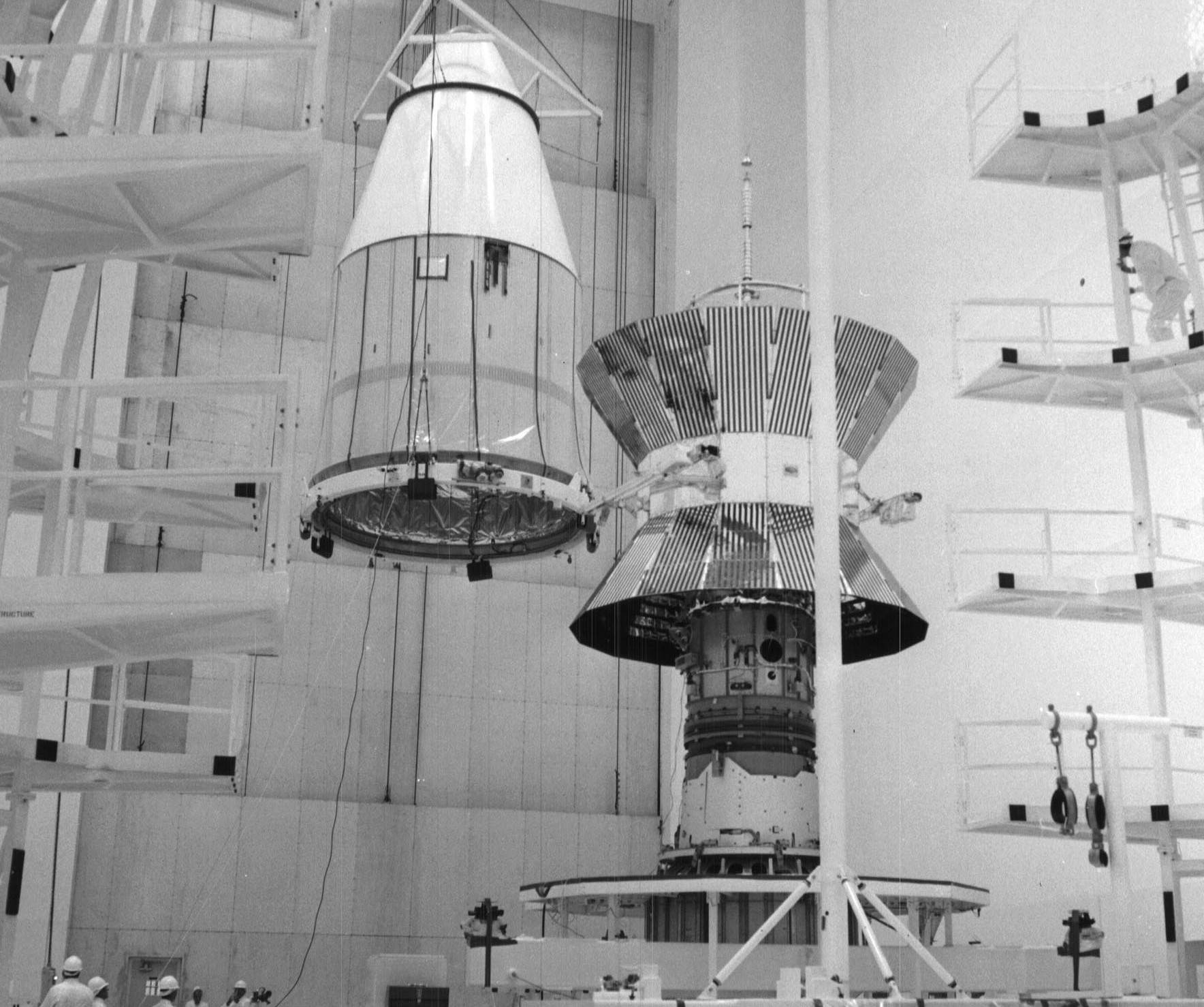
The Mariner 10 spacecraft was the first to use this method, using Venus’ gravitational pull to slingshot it towards Mercury in February of 1974. In the 1980s, the Voyager 1 probe used Saturn and Jupiter for gravitational slingshots to attain its current velocity of 60,000 km/hr (38,000 miles/hr) and make it into interstellar space.
However, it was the Helios 2 mission – which was launched in 1976 to study the interplanetary medium from 0.3 AU to 1 AU to the Sun – that holds the record for the highest speed achieved with a gravity assist. At the time, Helios 1 (which launched in 1974) and Helios 2 held the record for the closest approach to the Sun. Helios 2 was launched by a conventional NASA Titan/Centaur launch vehicle and placed in a highly elliptical orbit.
Due to the large eccentricity (0.54) of the probe’s solar orbit (190-days), at perihelion, Helios 2 was able to reach a maximum velocity of over 240,000 km/hr (150,000 miles/hr) – which was attained by the Sun’s gravitational pull alone. Technically, the Helios 2 perihelion velocity was not a gravitational slingshot, it was a maximum orbital velocity, but it still holds the record for being the fastest man-made object regardless.
So, if Voyager 1 was traveling in the direction of Proxima Centauri at a constant velocity of 60,000 km/hr, it would take 76,000 years (over 2,500 generations) to get there. But if it could attain the record-breaking speed of Helios 2‘s close approach of the Sun – a constant speed of 240,000 km/hr – it would take 19,000 years (or over 600 generations) to travel 4.243 light-years. Significantly better, but still not in the realm of practicality.

Nuclear Thermal/Nuclear Electric Propulsion (NTP/NEP):
Another possibility for interstellar space flight is to use spacecraft equipped with nuclear engines, a concept which NASA has been exploring for decades. In a Nuclear Thermal Propulsion (NTP) rocket, uranium or deuterium reactions are used to heat liquid hydrogen inside a reactor, turning it into ionized hydrogen gas (plasma), which is then channeled through a rocket nozzle to generate thrust.
A Nuclear Electric Propulsion (NEP) rocket involves the same basic reactor converting its heat and energy into electrical energy, which would then power an electrical engine. In both cases, the rocket would rely on nuclear fission or fusion to generates propulsion rather than chemical propellants, which has been the mainstay of NASA and all other space agencies to date.
Compared to chemical propulsion, both NTP and NEC offer a number of advantages. The first and most obvious is the virtually unlimited energy density it offers compared to rocket fuel. In addition, a nuclear-powered engine could also provide superior thrust relative to the amount of propellant used. This would cut the total amount of propellant needed, thus cutting launch weight and the cost of individual missions.
Although no nuclear-thermal engines have ever flown, several design concepts have been built and tested over the past few decades, and numerous concepts have been proposed. These have ranged from the traditional solid-core design – such as the Nuclear Engine for Rocket Vehicle Application (NERVA) – to more advanced and efficient concepts that rely on either a liquid or a gas core.
However, despite these advantages in fuel-efficiency and specific impulse, the most sophisticated NTP concept has a maximum specific impulse of 5000 seconds (50 kN·s/kg). Using nuclear engines driven by fission or fusion, NASA scientists estimate it would take a spaceship only 90 days to get to Mars when the planet was at “opposition” – i.e. as close as 55,000,000 km from Earth.
But adjusted for a one-way journey to Proxima Centauri, a nuclear rocket would still take centuries to reach a fraction of the speed of light. It would then require several decades of travel time, followed by many more centuries of deceleration before reaching its destination. All told, we’re still talking about 1000 years before it reaches its destination. Good for interplanetary missions, not so good for interstellar ones.
Theoretical Methods:
Using existing technology, the time it would take to send scientists and astronauts on an interstellar mission would be prohibitively slow. If we want to make that journey within a single lifetime, or even a generation, something a bit more radical (aka. highly theoretical) will be needed. And while wormholes and jump engines may still be pure fiction at this point, there are some rather advanced ideas that have been considered over the years.
Nuclear Pulse Propulsion:
Nuclear pulse propulsion is a theoretically possible form of fast space travel. The concept was originally proposed in 1946 by Stanislaw Ulam, a Polish-American mathematician who participated in the Manhattan Project, and preliminary calculations were then made by F. Reines and Ulam in 1947. The actual project – known as Project Orion – was initiated in 1958 and lasted until 1963.
Led by Ted Taylor at General Atomics and physicist Freeman Dyson from the Institute for Advanced Study in Princeton, Orion hoped to harness the power of pulsed nuclear explosions to provide a huge thrust with very high specific impulse (i.e. the amount of thrust compared to weight or the amount of seconds the rocket can continually fire).
In a nutshell, the Orion design involves a large spacecraft with a high supply of thermonuclear warheads achieving propulsion by releasing a bomb behind it and then riding the detonation wave with the help of a rear-mounted pad called a “pusher”. After each blast, the explosive force would be absorbed by this pusher pad, which then translates the thrust into momentum.
Though hardly elegant by modern standards, the advantage of the design is that it achieves a high specific impulse – meaning it extracts the maximum amount of energy from its fuel source (in this case, nuclear bombs) at a minimum cost. In addition, the concept could theoretically achieve very high speeds, with some estimates suggesting a ballpark figure as high as 5% the speed of light (or 5.4×10⁷ km/hr).
At this velocity, it would take an Orion spacecraft about 85 years to transport a crew of colonists to Proxima Centauri. Of course, that doesn’t take into account the time needed to get the spacecraft up to speed and then decelerate before arrival. So in reality, it would be more like a little over a century, which is still pretty impressive.
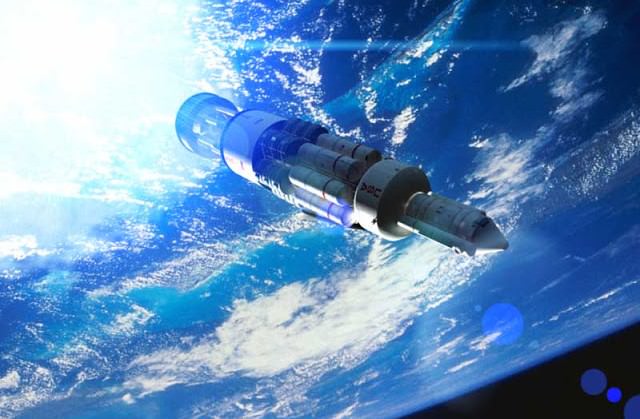
But of course, there the inevitable downsides to the design. For one, a ship of this size would be incredibly expensive to build. According to estimates produced by Dyson in 1968, an Orion spacecraft that used hydrogen bombs to generate propulsion would weight 400,000 to 4,000,000 metric tons. And at least three-quarters of that weight consists of nuclear bombs, where each warhead weighs approximately 1 metric ton.
All told, Dyson’s most conservative estimates placed the total cost of building an Orion craft at 367 billion dollars. Adjusted for inflation, that works out to roughly $2.5 trillion dollars – which accounts for over two-thirds of the US government’s current annual revenue. Hence, even at its lightest, the craft would be extremely expensive to manufacture.
There’s also the slight problem of all the radiation it generates, not to mention nuclear waste. In fact, it is for this reason that the Project is believed to have been terminated, owing to the passage of the Partial Test Ban Treaty of 1963 which sought to limit nuclear testing and stop the excessive release of nuclear fallout into the planet’s atmosphere.
Fusion Rockets:
Another possibility involves rockets that rely on thermonuclear reactions to generate thrust. For this concept, energy is created when pellets of a deuterium/helium-3 mix are ignited in a reaction chamber by inertial confinement using electron beams (similar to what is done at the National Ignition Facility in California). This fusion reactor would detonate 250 pellets per second to create high-energy plasma.

This plasma would then be directed by a magnetic nozzle to create thrust. Similar to nuclear reactors, this concept offers advantages as far as fuel efficiency and specific impulse are concerned. Exhaust velocities of up to 10,600 km/s are estimated, which is far beyond the speed of conventional rockets. What’s more, the technology has been studied extensively over the past few decades, and many proposals have been made.
For example, between 1973 and 1978, the British Interplanetary Society conducted a feasibility study known as Project Daedalus. Relying on current knowledge of fusion technology and existing methods, the study called for the creation of a two-stage unmanned scientific probe making a trip to Barnard’s Star (5.9 light-years from Earth) in a single lifetime.
The first stage, the larger of the two, would operate for 2.05 years and accelerate the spacecraft to 7.1% the speed of light (0.071 c). This stage would then be jettisoned, at which point, the second stage would ignite its engine and accelerate the spacecraft up to about 12% of light speed (0.12 c) over the course of 1.8 years. The second-stage engine would then be shut down and the ship would enter into a 46-year cruise period.
According to the Project’s estimates, the mission would take 50 years to reach Barnard’s Star. Adjusted for Proxima Centauri, the same craft could make the trip in 36 years. But of course, the project also identified numerous stumbling blocks that made it unfeasible using then-current technology – most of which are still unresolved.

For instance, there is the fact that helium-3 is scarce on Earth, which means it would have to be mined elsewhere (most likely on the Moon). Second, the reaction that drives the spacecraft requires that the energy released vastly exceeds the energy used to trigger the reaction. And while experiments here on Earth have surpassed the “break-even goal, we are still a long way away from the kinds of energy needed to power an interstellar spaceship.
Third, there is the cost factor for constructing such a ship. Even by the modest standard of Project Daedalus’ unmanned craft, a fully-fueled craft would weigh as much as 60,000 Mt and cost about $5,986 billion. In short, a fusion rocket would not only be prohibitively expensive to build; it would also require a level of fusion reactor technology that is currently beyond our means.
Icarus Interstellar, an international organization of volunteer citizen scientists (some of whom worked for NASA or the ESA) has since attempted to revitalize the concept with Project Icarus. Founded in 2009, the group hopes to make fusion propulsion (among other things) feasible in the near future.
Fusion Ramjet:
Also known as the Bussard Ramjet, this theoretical form of propulsion was first proposed by physicist Robert W. Bussard in 1960. Basically, it is an improvement over the standard nuclear fusion rocket, which uses magnetic fields to compress hydrogen fuel to the point that fusion occurs. But in the Ramjet’s case, an enormous electromagnetic funnel “scoops” hydrogen from the interstellar medium and dumps it into the reactor as fuel.

As the ship picks up speed, the reactive mass is forced into a progressively constricted magnetic field, compressing it until thermonuclear fusion occurs. The magnetic field then directs the energy as rocket exhaust through an engine nozzle, thereby accelerating the vessel. Without any fuel tanks to weigh it down, a fusion ramjet could achieve speeds approaching 4% of the speed of light and travel anywhere in the galaxy.
However, the potential drawbacks of this design are numerous. For instance, there is the problem of drag. The ship relies on increased speed to accumulate fuel, but as it collides with more and more interstellar hydrogen, it may also lose speed – especially in denser regions of the galaxy. Second, deuterium and tritium (used in fusion reactors here on Earth) are rare in space, whereas fusing regular hydrogen (which is plentiful in space) is beyond our current methods.
This concept has been popularized extensively in science fiction. Perhaps the best-known example of this is in the franchise of Star Trek, where “Bussard collectors” are the glowing nacelles on warp engines. But in reality, our knowledge of fusion reactions need to progress considerably before a ramjet is possible. We would also have to figure out that pesky drag problem before we began to consider building such a ship!
Laser Sail:
Solar sails have long been considered to be a cost-effective way of exploring the Solar System. In addition to being relatively easy and cheap to manufacture, there’s the added bonus of solar sails requiring no fuel. Rather than using rockets that require propellant, the sail uses the radiation pressure from stars to push large ultra-thin mirrors to high speeds.

However, for the sake of interstellar flight, such a sail would need to be driven by focused energy beams (i.e. lasers or microwaves) to push it to a velocity approaching the speed of light. The concept was originally proposed by Robert Forward in 1984, who was a physicist at Hughes Aircraft’s research laboratories at the time.
The concept retains the benefits of a solar sail, in that it requires no onboard fuel, but also from the fact that laser energy does not dissipate with distance nearly as much as solar radiation. So while a laser-driven sail would take some time to accelerate to near-luminous speeds, it would be limited only to the speed of light itself.
According to a 2000 study produced by Robert Frisbee, a director of advanced propulsion concept studies at NASA JPL, a laser sail could be accelerated to half the speed of light in less than a decade. He also calculated that a sail measuring about 320 km (200 miles) in diameter could reach Proxima Centauri in just over 12 years. Meanwhile, a sail measuring about 965 km (600 miles) in diameter would arrive in just under 9 years.
However, such a sail would have to be built from advanced composites to avoid melting. Combined with its size, this would add up to a pretty penny! Even worse is the sheer expense incurred from building a laser large and powerful enough to drive a sail to half the speed of light. According to Frisbee’s own study, the lasers would require a steady flow of 17,000 terawatts of power – close to what the entire world consumes in a single day.
Antimatter Engine:
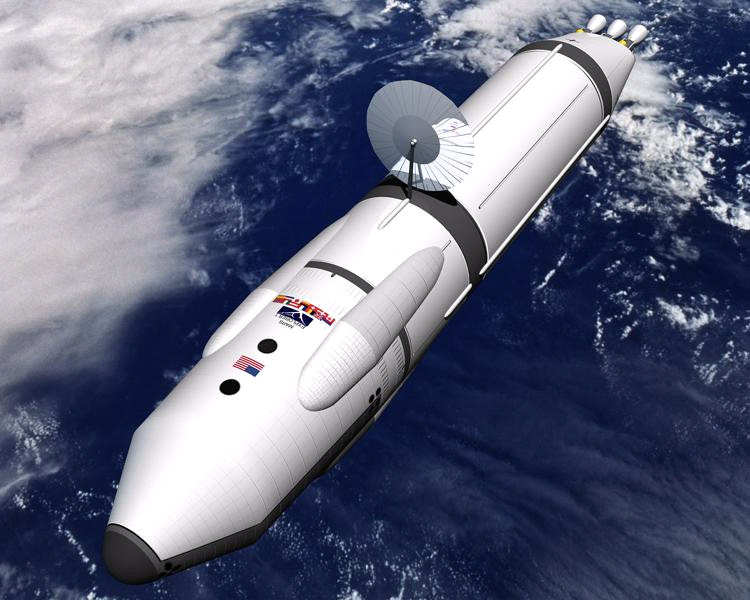
Fans of science fiction are sure to have heard of antimatter. But in case you haven’t, antimatter is essentially material composed of antiparticles, which have the same mass but opposite charge as regular particles. An antimatter engine, meanwhile, is a form of propulsion that uses interactions between matter and antimatter to generate power or to create thrust.
In short, an antimatter engine involves particles of hydrogen and antihydrogen being slammed together. This reaction unleashes as much as energy as a thermonuclear bomb, along with a shower of subatomic particles called pions and muons. These particles, which would travel at one-third the speed of light, are then be channeled by a magnetic nozzle to generate thrust.
The advantage to this class of rocket is that a large fraction of the rest mass of a matter/antimatter mixture may be converted to energy, allowing antimatter rockets to have a far higher energy density and specific impulse than any other proposed class of rocket. What’s more, controlling this kind of reaction could conceivably push a rocket up to half the speed of light.
Pound for pound, this class of ship would be the fastest and most fuel-efficient ever conceived. Whereas conventional rockets require tons of chemical fuel to propel a spaceship to its destination, an antimatter engine could do the same job with just a few milligrams of fuel. In fact, the mutual annihilation of a half-pound of hydrogen and antihydrogen particles would unleash more energy than a 10-megaton hydrogen bomb.
It is for this exact reason that NASA’s Institute for Advanced Concepts (NIAC) has investigated the technology as a possible means for future Mars missions. Unfortunately, when contemplating missions to nearby star systems, the amount of fuel needed to make the trip is multiplied exponentially, and the cost involved in producing it would be astronomical (no pun!).
According to a report prepared for the 39th AIAA/ASME/SAE/ASEE Joint Propulsion Conference and Exhibit (also by Robert Frisbee), a two-stage antimatter rocket would need over 815,000 metric tons (900,000 US tons) of fuel to make the journey to Proxima Centauri in approximately 40 years. That’s not bad, as far as timelines go. But again, the cost…
Whereas a single gram of antimatter would produce tremendous energy, it is estimated that producing just this much would require approximately 25 trillion kilowatt-hours of energy and cost over a trillion dollars. At present, less than 20 nanograms of antimatter have been created by humans. Even if we could mass-produce antimatter for cheap, a massive ship would still be needed to hold the necessary amount of fuel.
According to a report by Dr. Darrel Smith & Jonathan Webby of the Embry-Riddle Aeronautical University in Arizona, an interstellar craft equipped with an antimatter engine could reach 0.5 the speed of light and reach Proxima Centauri in a little over 8 years. However, the ship itself would weigh 400 metric tons (441 US tons) and would need 170 metric tons (187 US tons) of antimatter fuel to make the journey.

A possible way around this is to create a vessel that can create antimatter which it could then store as fuel. This concept, known as the Vacuum to Antimatter Rocket Interstellar Explorer System (VARIES), was proposed by Richard Obousy of Icarus Interstellar. Based on the idea of in-situ refueling, a VARIES ship would rely on large lasers (powered by enormous solar arrays) which would create particles of antimatter when fired at empty space.
Much like the Ramjet concept, this proposal solves the problem of carrying fuel by harnessing it from space. But once again, the sheer cost of such a ship would be prohibitively expensive using current technology. In addition, the ability to create antimatter in large volumes is not something we currently have the power to do. There’s also the matter of radiation, as matter-antimatter annihilation can produce blasts of high-energy gamma rays.
This not only presents a danger to the crew, requiring significant radiations shielding but requires that the engines be shielded as well to ensure they don’t undergo atomic degradation from all the radiation they are exposed to. So bottom line, the antimatter engine is completely impractical with our current technology and in the current budget environment.
Alcubierre Warp Drive:
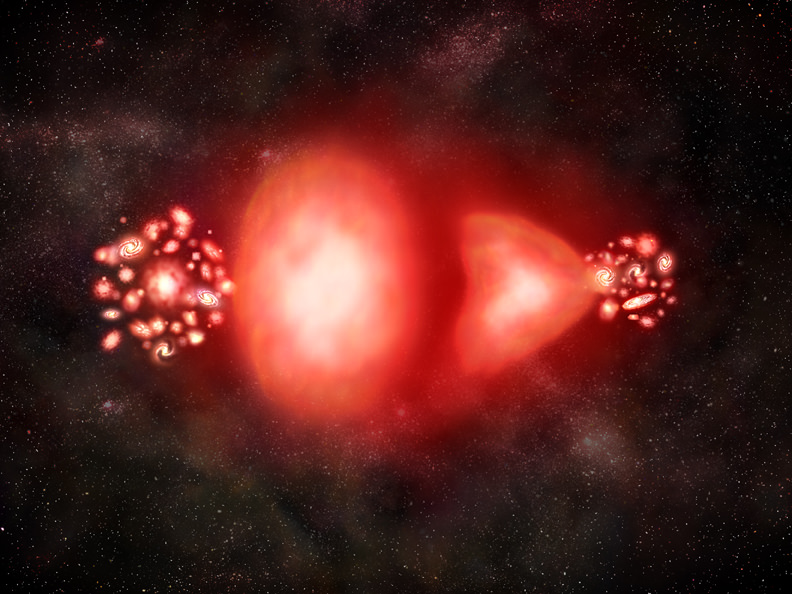
Fans of science fiction are also no doubt familiar with the concept of an Alcubierre (or “Warp”) Drive. Proposed by Mexican physicist Miguel Alcubierre in 1994, this proposed method was an attempt to make FTL travel possible without violating Einstein’s theory of Special Relativity. In short, the concept involves stretching the fabric of space-time in a wave, which would theoretically cause the space ahead of an object to contract and the space behind it to expand.
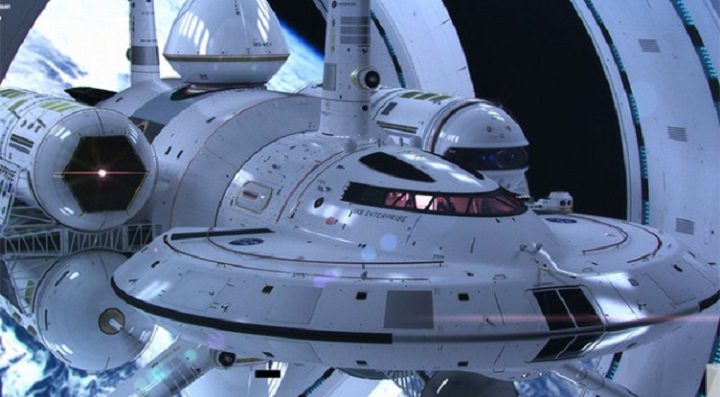
An object inside this wave (i.e. a spaceship) would then be able to ride this wave, known as a “warp bubble”, beyond relativistic speeds. Since the ship is not moving within this bubble but is being carried along as it moves, the rules of space-time and relativity would cease to apply. The reason being, this method does not rely on moving faster than light in the local sense.
It is only “faster than light” in the sense that the ship could reach its destination faster than a beam of light that was traveling outside the warp bubble. So assuming that a spacecraft could be outfitted with an Alcubierre Drive system, it would be able to make the trip to Proxima Centauri in less than 4 years. So when it comes to theoretical interstellar space travel, this is by far the most promising technology, at least in terms of speed.
Naturally, the concept has been received its share of counter-arguments over the years. Chief amongst them is the fact that it does not take quantum mechanics into account and could be invalidated by a Theory of Everything (such as loop quantum gravity). Calculations on the amount of energy required have also indicated that a warp drive would require a prohibitive amount of power to work. Other uncertainties include the safety of such a system, the effects on space-time at the destination, and violations of causality.
However, in 2012, NASA scientist Harold Sonny White announced that he and his colleagues had begun researching the possibility of an Alcubierre Drive. In a paper titled “Warp Field Mechanics 101“, White claimed that they had constructed an interferometer that will detect the spatial distortions produced by the expanding and contracting spacetime of the Alcubierre metric.
In 2013, the Jet Propulsion Laboratory published results of a warp field test which was conducted under vacuum conditions. Unfortunately, the results were reported as “inconclusive”. Long term, we may find that Alcubierre’s metric may violate one or more fundamental laws of nature. And even if the physics should prove to be sound, there is no guarantee it can be harnessed for the sake of FTL flight.
In conclusion, if you were hoping to travel to the nearest star within your lifetime, the outlook isn’t very good. However, if mankind felt the incentive to build an “interstellar ark” filled with a self-sustaining community of space-faring humans, it might be possible to travel there in a little under a century if we were willing to invest in the requisite technology.
But all the available methods are still very limited when it comes to transit time. And while taking hundreds or thousands of years to reach the nearest star may matter less to us if our very survival was at stake, it is simply not practical as far as space exploration and travel goes. By the time a mission reached even the closest stars in our galaxy, the technology employed would be obsolete and humanity might not even exist back home anymore.
So unless we make a major breakthrough in the realms of fusion, antimatter, or laser technology, we will either have to be content with exploring our own Solar System or be forced to accept a very long-term transit strategy…
We have written many interesting articles about space travel here at Universe Today. Here’s Will We Ever Reach Another Star?, Warp Drives May Come With a Killer Downside, The Alcubierre Warp Drive, How Far Is A Light Year?, When Light Just Isn’t Fast Enough, When Will We Become Interstellar?, and Can We Travel Faster Than the Speed of Light?
For more information, be sure to consult NASA’s pages on Propulsion Systems of the Future, and Is Warp Drive Real?
And fans of interstellar travel should definitely check out Icarus Interstellar and the Tau Zero Foundation websites. Keep reaching for those stars!
Excellent article, as usual. I’ll go out on a limb and sound like a wingnut. But what about theoretical aspects? We seem so hopelessly confined to conventional understandings of space travel, but I still wonder about the possibilities of interdimensional travel. Mathematics suggests the existence of a multi-dimensional universe. Could they be utilized to get from point a to point b in this dimension? What about alterations in space time, a-la black holes and worm holes? I understand gravity would prove a nasty foe to using these monsters, but is there still a possibility of creating one or finding one that could be used for human use? At least in our present understanding, we appear to have hit a wall in long distance space travel. Even if we utilize the above, even with suspended animation…our efforts would seem rather existential at best given that the round trip would return us to a home where we would not know anyone, where all our friends and family would long since have expired. It would seem we need to return to imagination in our theoretical constructs or resign ourselves to being confined to the solar system.
Well, some people are already seriously thinking of going way beyond nuclear pulse drives…
http://arxiv.org/pdf/astro-ph/0410511
David, I think reaching a black hole would take longer than it’d take to reach the star, so using one of those would be counter-productive? Unless we made our own temporarily, or something.
As for the other theoretical things, for all we know now we could say we could get there before we even left using interdimensional/time travel. Nobody knows for sure, though, and this article just sticks to conventional methods we’ve got down (or theories with a definitive speed like nuclear pulse propulsion). Maybe one day traveling anywhere in the universe can happen in the blink of an eye with those other ideas!
This article is cool, I love seeing answers to unorthodox questions like this.
One thing I always think of, though, is how people tend to think we’ll pick up the whole human race and relocate them. But in the actual case of us inhabiting another planet, only a few people would really go (at least, that’s how we’d do it now). Taking more than a few vital people would be too much added weight and supplies and the mission would never work out!
Hmm, not sure Nuclear Pulse would be a valid form of travel for us lowly humans. Wouldn’t the g force from such a pulse transform us into small piles of goo? Though for probes it would be nice.
Also, how do theoretical antimatter engines stack up? If we can eventually find a way to produce the stuff in sufficient quantity, that may be able to get us there.
im most interested in the last one
85 years , ok
but
does that include i mean , i would imagine to actually arrive there you would need to slow down , and any slowing down at those supposed speeds would take a long ass time ,
so is that factor in , when you say it’ll take 85 years to arrive to our closest star?
Great article.
I believe they figured out the g force problem for Project Orion. Something about a shock absorber. Smart, imaginative people back then I suppose.
Before we think about sending people to Alpha Centuari, we need to send a robot probe. Our government did a study and made a plan. There are a few problems to solve yet:
http://en.wikipedia.org/wiki/Project_Longshot
Excellent article, but “The Partial Test Ban Treaty of 1963 is largely attributed to the cancellation of Project Orion (due to the obvious design flaw that huge amounts of radioactive waste would be pumped into space)” sort of misses the point. That waste, injected into the near-total vacuum of interstellar space, would very quickly become an extremely tenuous, rapidly expanding mist of particles whose intense radioactivity would be far and away offset by the egregiously low density of the mist. Something like one atom of the stuff for every, what, 10,000 cubic miles? Anywhere near Earth, of course, that waste would definitely be a liability — but we could build the craft somewhere in the Solar System where Earth wouldn’t be in the firing line, and send it on its way from there. Other than that, great article. 🙂
Jorde Says:
July 8th, 2008 at 3:16 pm
“Hmm, not sure Nuclear Pulse would be a valid form of travel for us lowly humans. Wouldn’t the g force from such a pulse transform us into small piles of goo? Though for probes it would be nice.”
>>>>Google Project Orion. The space craft was designed to utilise a thrust plate and massive shock absorbers that reduced the apparent acceleration to something manageable for humans. You can actually see the concept drawing in this article – it’s the very first picture. The thrust plate is the big dish at the back of the craft near the explosion, and the shocks are those linear-looking poles between the plate and the spacecraft…
What we really need to do is get ourselves a technology that will get us up near the speed of light. Then good old Lorentz contraction will shorten the distance we need to travel considerably… Hmmm – easier suggested than done, me thinks.
I am sorry for the criticism, but unlike what told above, I think that this article is really of a exceptionally low quality, that I am surprised to see here on this blog. Not only it completely ignores that such long travel necessarily includes accelerating and decelerating phases (likely half of the journey each), it ignores maximal possible long-time acceleration and deceleration (which could not be much higher than 1G for human flights), but it also looks like the author completely misunderstood the principle of ion drive propulsion, and of gravitational assist.
At ion propulsion (or any other similar one), the thrust results in acceleration force, and that again in the acceleration. You need to dimension the propulsion according to available power and propellant supplies, and the mass that needs to be accelerated (including the propellant). The time the propulsion is active plays a role too, of course (ideally it would be accelerating 1/2 way, and decelerating the other half). And of course, as already written, you are limited by the maximal acceleration (at human travels it could not be much more than 10m/s2, but also at robotic probes there would be limits). So basing the calculation on the constant maximal speed achieved by DS1 is a nonsense. You can scale it up (technologically no big issue) to get higher acceleration, and let it on much longer (both for the acceleration and the deceleration), but you are limited by the power supply and by the weight of the entire system (including propellant tanks). The calculation would be much more complex, but the result would be quite different from the one shown in this article.
And as for the gravitational assist – you cannot use the Sun for assisting a space ship – the boost it gives the ship when it falls to the Sun, the vessel loses again when flying away. You can only use assist of planets that gravitationally pull the ship behind them, but that force is quite limited and not of a big interest for interstellar trips. You could only use pull of the Sun if you made huge spirals in the galactic space around the Solar system, using it relative speed to the galaxy center, but that would make the travel many times longer.
Yeah, the Orion designed called for a ‘pusher plate’, effectively a giant shock absorber at the back of the craft. The nuclear charges would be fired out the back, through an opening in the pusher plate, detonating behind the ship, and the pusher plate would convert the sudden impulse into a longer, gentler push, solving the ‘strawberry jam problem’. 🙂
I’m surprised Robert Forward’s solar-laser sail design didn’t rate a mention. It’s a little beyond our technology right at the moment, but could get a ship up to around 0.2c in reasonable time…
I’ll propose a possible scenario. Lets say we develop, in the not too distant future, say a highly focused beam of energy that could be transmitted to our craft, or perhaps fission drive with a hydrogen scoop for fuel/thrust. The important thing is we have a craft that can accelerate/decelerate to proxima all the way there ( decelerating at 1g halfway there). So our craft (freighter) can carry a crew and supplies and can accelerate/decelerate at a constant 1g. How long would it take? As a matter of fact lets skip this first model and go straight to a second model which has the ability to accelerate/decelerate at up to 8g, but would only be used as a reasonably healthy crew could withstand for short periods, then 1g.
The gravitational assist one stood out to me as wrong.
You can get a boost from a planet, by a hyperbolic fly-by. You end up moving away from the planet with the same relative velocity you had on approach (with comparatively minor course adjustments if necessary). This gives a boost in velocity with respect to some other reference point, due to the motions of the planet. You effectively grab a little bit of momentum from the planet. That can’t work with the Sun.
If you go 1g half-way and brake 1g the other half, you can calculate the necessary time with the following formula:
t = 2*SQRT(0.5*d/a)
where t is the time, d is distance, and a is the acceleration. In this case the a would be equal to g, which is 10m/s2. So you get these numbers:
t = 2*SQRT(0.5*4.37*365*24*60*60*300,000,000 / 10) = 90932608 s = 2.88 years
However, that’s impossible, because with 1g you would get close to the speed of light pretty soon, and there the relativistic laws apply, increasing the mass and decreasing the accelaeration. It would require a more complex formula to get the real time needed, but likely the journey would not be that long even with a more moderate acceleration rate (assuming sufficient energy for the propulsion is available during the entire flight).
>> The nuclear charges would be fired out the back, through an opening
>> in the pusher plate, detonating behind the ship, and the pusher plate
>> would convert the sudden impulse into a longer, gentler push
I did not see the numbers, so I do not know in what force and acceleration the nuclear explositions would result, but my very raw guess is that the absorber would need to be several miles long to allow for sufficient aborbtion. And that again would represent huge mass that needs to be accelerated, hence requiring much more additional energy.
A planet that can support life will have life, and we will have zero immunity to it. It’s better to just send our genetic information so if there is intelligent life they can simulate us and perhaps send back some suggestions.
Unless we discover a potentially life-sustaining planet about Alpha Centauri, I doubt we will attempt to send any spacecraft there until it can be done in less than 100 years — and that’s a long way off. I just don’t think there will be any incentive to invest in a multi-century mission unless there is some other factor involved, like a critical threat to our existence on Earth.
As for a manned mission, I reckon 40 years (averaging 0.1c) will be the longest attempted. I believe that fast a ship is theoretically possible, but again we’re a long long way off.
So for the next few decades at least, we are better pouring our resources into better and beefier telescopes to do long range surveys of the nearer solar systems. My guess is that before we set foot outside our own system, we will have a catalog of tens of thousands of exoplanets from which to choose from to visit first.
Instead of trying to force the universe to act how we think it should act(something we do here on earth), the whole of science would benefit greatly by working with natures grain not against it. Nature has already figured everything out for us, we just need to learn how we can tap into the inherant knowlege in such a way that we join with it in a “natural”manner.
The broader our perception becomes the more we need to keep in mind that all things interact.
An infant has a narrow understanding of what it sees. As it learns that understanding spreads to include bits of information that previously were isolated and not related in perception. This concept can be true when compared to science as a whole, humanity has not put much energy into trying to blend all scientific disceplines together to create a GUT.
Renniassance man= multi discepline learning= potential for great understanding.
I know we have the ability, I know we do not yet have the focus or long sightedness it would take to achieve any great things, such as interstellar travel or world harmony.
I think some of you are taking the article too seriously. He just answered a question, providing us with nothing other than the answer of ‘how long would it take us to reach our nearest neighboring solar system?”
This article doesn’t suggest any of them are that logical, nor that we need to invest in it. Because obviously right now it’d take way too long to reach it.
It was just food for thought, really.
In regards to the life on another planet, there are 3 possibilities.
1) Neither affect eachother
2) They lack immunity and some of them die off (perhaps all of them?)
3) We lack immunity and some of us die off (perhaps all of us?)
Of course, when the time comes to study other life, we’ll assume that #3 to be what we’re dealing with, to prevent getting stuck in a worst-case scenario, #2 to be of slightly-less-but-still-great importance, and #1 to be how we hope it turns out.
The way you spoke of it, you make it seem like you know 100% we’ll get destroyed by the life we find.
Again, the article is using estimations to just give us a general idea. You guys are like ‘MAN SENDING A SHIP TO ANOTHER STAR NEXT YEAR WOULD BE DUMB.” Yeah, obviously.
Todos alguna vez nos preguntamos cuánto tiempo tomarÃa viajar a las estrellas y si ese viaje serÃa posible en el transcurso de la vida propia. Hay muchas respuestas para esta posibilidad, de las cuales algunas son muy simples y otras pertenecen al reino de la ciencia ficción. […] Fuente: Ian O’Neill para Universe Today.
sera la imaginacion que nos lleva a un lugar tan lejo , pero no se puede decir , que lo que se saca de la imaginacion no puede existir , si no , es de la imaginacion que encontramos la inspiracion de hacer lo imposible , de ciencia a realidad y ficcion a lo mismo
Sadly at the moment we might as well tie bungy rope around 2 trees and call it a launcher. Hopefully we’ll come up with something better soon
Maybe I’m just dense, but you say Alpha Centauri is the dimmest, yet on the Hertzsprung – Russell diagram it’s by far the brightest (highest on the vertical luminosity scale) of all Centauri stars, second brightest on the whole diagram. The scale isn’t of apparent luminosity, is it?
Oops.. I made a typo myself. The error I’m pointing out is that you say Alpha is the brightest, whereas the diagram puts Proxima/Beta Centauri as brightest star, brighter than even both Alpha Centauri A and B put together.
Nevermind.. I found Proxima on the chart.. Nothing to do with “Beta” Centauri.
I fancy the idea of a very long rail gun myself. Granted this would be a one way trip for a probe but I like the fact that a system of rings could be set in a line and a probe would pass through them.
As the probe approaches the ring, the ring’s magnetic attraction increases around the probe drawing the two objects closer together then as the probe reaches the ring the Magnet is deactivated and the Probes inertia carries it onward.
You might even reverse the polarity of both so that magnetic repulsion occurs inspiring an even greater boost to velocity.
The More Rings you have placed in a straight line, the higher velocity you might potentially achieve and best of all, your ship needs not carry any sort of fuel except for navigational corrections.
Considering you’re traveling at 5% the speed of light, would there be a slow-down in time for the passengers of the ship?
In other words, would the trip be 85 years viewed by the people of Earth or would the trip seem to last 85 years for the people on board? Or would the time seem the same for both????
I’m a bit conservative as well when it comes to the point of “human” exploration. With so many technological advances in robotics I see no reason for putting anyone in harm’s way. Even though a pair of human eyes is always better in the observational sense the risk is just to great for that particular astro/cosmonaut and the space community as a whole can you imagine the moral problem we would face if someone were to die. There would’nt be another try for a 20 years or so.
Actually, these figures would only be true if the Alpha Centauri system was stationary relative to the solar system.
It ain’t!
Radial velocity is 22 km/sec in approach and proper motion 5 km/sec – almost toward us.
Can anyone do the trig and work out when Alpha Cent system will be closest to us and by how far? Then we could do the trip in much less time.
Martin
As far as The time issue goes I believe it is relative. Anything accelerating away from the earth appears to slow down while anything accelerating toward the earth appears to be faster. This throws the whole idea of a maximum velocity out the window though and our scientists seem to be stuck on that idea.
This also puts a kink in space travel in that we still have to aim our craft to intercept the object we are aiming for and its relative speed trajectory and now relative time difference into account.
But to make a long story short it would seem like 80 years to the people on board but to the people of earth it will look like it takes at least the amount of time the light from that object takes to reach earth no matter what speed we reach.
Oh and SUGARAT I agree completely and belive we should talk. I have been saying the same thing for years to all the people I know and wish more people would realize it.
I’ve been wondering what the chances are of hitting a solid object between here and there (where ever “there” may be). How much stuff is out in the Oort Cloud? How about dust, debris and larger objects in interstellar space?
Seems to me that a good strategy is to send a fleet of highly miniaturized (or even nano) robots with the understanding that there will be losses on the trip. Perhaps if they were smart machines they could join up at the destination and construct some sort of a transmitter to send information back to Earth.
Yes I agree first lets settle our own backyard then figure out what the hell to do about our neighbors yard
Even if we could travel close to the speed of light, surely this would be impractical.
At, say, around 20,000 km/sec or faster, any subatomic particle would manifest itself as a highly enegetic cosmic ray particle with disastrous consequences.
By 2020 we should know whether or not there would be habitable planets around Alpha Centauir A and B. They are both very close to what our star, the Sun is.
Forget Proxima. It is too tiny, and way too much unlike our Sun for humans too survive.
If we can discover other “Earth like planets” within 1 to 2 centuries of space travel using the Orion method, we should go for it.
Manifest Destiny
We are thinking too small and too short term. Also Proxima Centauri is doo-doo. For another .17 light years, you may as well go to Alpha and Beta.
Too short term: witihin the next 50 years, we should have effective immortality for humans through medical advances. That changes all the rules about how long you can take to get there.
Too small: don’t muck about with ships. Take a planet. Mars might be big enough. Either live underneath the surface or make an artificial sun. Plan B, consider taking the Sun and all the major planets. It can be done, it’s the space tug idea on a grand scale.
Well, that’s enough mind boggling ideas for today. Remember, you heard it here first.
Everyone needs to pause a bit and think about the motivation for the article. The article is a valid discussion of the distances and times it would take to travel to another star using diffenert technologies. Remember, around 200 years ago, a fast ship would take about 9 months to travel from England to Australia. Now it’s about day in a plane.
I often wondered about this very question – so thank you to the author. The article didn’t assert to predict the future, only discussed the present times to open further discussion. It seems so simple at first – only four point something light years away – but we all know that is still a very long way.
Currently, travel at, or remotely near, the speed of light is not realistic, so our fastest ‘feasible’ travel speed must be only a small fraction of light speed within the foreseeable future. There are obviously undiscovered ‘faster’ travel methods that we will hopefully discover in the near future, but others have decided to discuss the human challenges. I point to the technical, ethical and financial constraints that surround the present day discussions of travelling to the Moon or Mars to stress my point.
One-way trips to Mars are contriversial enough, so I say again – thanks for the article; others needn’t loose sight of the original purpose of the article was to simply discuss the times it would take using present technology, and to give us laypeople some ‘perspective’. Therefore I suggest we should debate always, but not ovely slant the debate towards the technical challenges of humans travelling to the stars when the ‘walk in the park to Mars’ is proving difficult enough.
Finally, a point I recall on this topic came up at school 20+ years ago. The teacher replied – it’s not currently worthwhile to travel to the starts, because say you could build a ship today that takes 1000 years to get there – in 100 years, a much faster ship would be built (say it took just 300 years), so you would have traveled for over 100 years (1/10th distance) and then some more, when a newer mission would follow, which would ‘pick you up’ as they passed by, to save you wasting your time. and then the story repeats – so wait until the times are realistic – and you know what is out there…
I think our first step is to colonize the solar system, that will give us better experience in developing faster propulsion systems. I’d say at least 50 to 100 years from now will be a more realistic attempt to send a probe to the nearest star system. I hope its within our life time.
Joe
Imagine travelling 80 to 1,000 years to the nearest star, and then finding out there is absolutely nothing of interest there.
Fuel is gone, next nearest star is another 80 to 1,000 years away.
It seems to me that for Humans and all the other alien species out there, we are all stuck in our own little solar systems.
Every 1,000 years, we will receive a communication that says …
… “Hi, how are you. We are fine. Nothing really happened since our last communication 2,000 years ago. We received your communication 1,000 years ago and we are glad you are fine. I guess you are not coming to visit and we won’t be able to visit you either.”
May I suggest reading the Chapter “You can get Here from There” in my new book “Flying Saucers and Science”. The author has ignored the Nerva and Phoebus nuclear rocket engines for upper stages and the D-He-3 fusion reaction to provide 10million times as much energy per particle as in chemical systems.See John Luce and John Hilton paper. Far more efficient than Orion. Soviets have
operated 3 dozen nuclear reactors in space for electricity production. At 1G it only takes a year to get to near c.
” It would seem we need to return to imagination in our theoretical constructs or resign ourselves to being confined to the solar system.”
Some do:
http://www.thespaceshow.com/detail.asp?q=968
http://archive.thespaceshow.com/shows/968-BWB-2008-06-24.mp3 (52.4mb podcast)
http://www.aiaa-la.org/flyers/Adv%20Space%20Propulsion%20for%20Interstellar%20Travel%20-%
As for the nuclear-pulse Orion, the Test Ban Treaty simply didn’t allow exceptions for nuclear detonations in space that were clearly *not* weapons tests, so they had nowhere else to go with the concept.
And
“Imagine travelling 80 to 1,000 years to the nearest star, and then finding out there is absolutely nothing of interest there.”
Imagine doing the best telescopic study from this solar system you can, first. And possibly sending robotic probes after that, befor committing people…just like here.
And define ‘nothing of interest.’ Some people (sadly) don’t care what probes are doing on Mars at this moment.
Along the lines of Marcellus regarding Proxima Cen as a viable destination for humans, the star ( a red dwarf) much less luminous than Sol, is classified as a ‘flare star’ (as are most magnetic dwarf stars) capable of producing flares intense enough to create copious amounts of X-rays (see Wiki listing for Proxima Cen for details). Alpha Cen A and-or B would seem more stable, luminous stars with a better likelihood of habitable planets (or moons orbiting gas giant planets). In any case, a great article on interstellar flight & great food for thought.
Great article! Great posts!
Thank You Stanton, I was thinking about your work on the Nerva & Phoebus systems when I read this. We could learn a lot by just looking at all the fantastic space technology that was developed 50 years ago.
Are there any theories relating to what space would be like between solar systems? would it be more of a vacuum so maybe more acceleration could be reached? or maybe you would get stuck in the spin of the milky way outside of the protection of our solar system and never get anywhere… (random thought i know)
MC, both ideas go kablooie. Space is a near vacuum anywhere you go, even in a nebulae. There are no meteor storms to watch out for in interstellar space. (Nothing to keep them together) It would be like watching out for meteorites while you are driving…not a major concern. The Milky way affects us here the same way it would outside our solar system. The heliopause affects atomic size particles, not spaceships. The Oort cloud is invisible mostly because “cloud” poorly defines it. It’s far more tenuous than whales in the ocean. How many times have you dived in to land on one’s back?
I personally think it’s hilarious anyone is worried about radioactivity in space. It’s got to be a red herring or simply the worries of bureaucrats with little astro-education. There is a radioactive belt or two surrounding the earth even now. Space is filled with radioactivity. Nasty place. As described in one post, bomb detritus would spread to near nothingness in little time. It would probably take off from moon orbit anyway. Too big to launch from earth surface.
And the blast absorbtion plate would have to be enormous? Where does that thinking come from? The blasts are smallish and continuous. It doesn’t have to be a Hiroshima every ten minutes. And whatever distance from the ship that works, doesn’t have to be just 15 metres away.
I think anti-matter will probably be the answer that gets us there. Massive energy from smallest quantity, and lacking in need for extra-dimensional travel which will probably always remain a tantalizing theory at best.
Here’s my suggestion:
Within two or three decades, we should have sufficient molecular manufacturing technology to create extremely efficient, small, light and highly intelligent robots, as well as small nanofactories capable of creating any object from patterns stored in computer memory. Sending them out to the nearest stars would take far less energy than sending humans.
If a robot arrived at a suitable exoplanet, it could use the nanofactory to construct a laser receiving station (or similar device), as well as living accommodations for humans.
The same technology that would allow the construction of the robots and nanofactories should allow us to disassemble human beings and reassemble them. This may allow us to store entire humans as digital information.
We could then beam the information to the receiving station on the exoplanet. The nanofactory would reassemble the human patterns, creating exact duplicates of the original human templates, and those humans would have living accommodations already waiting for them.
Of course that would still take a while: probably hundreds or thousands of years to get the robots to the exoplanets, then at least a few years to establish a connection with Earth (beaming info at lightspeed), and then a few more years to beam the human patterns to the exoplanets.
By that time we’ll likely have populated the entire solar system and probably won’t resemble modern humans in mind or body much at all.
So…forget it. At least for now. Maybe some AI will come up with a way to shorten the trip, so just wait a few decades and find out.
Thanks so much for the article and reader comments. Exciting visions. Always dreamt of such possibilities as a small boy.
Unfortunately, nowadays, the negative consequences of global warming accelerate faster than the development of interstellar propulsion engines.
Trying to be realistic, I only hope that there will be human astronauts after 2050 or so to board space ships.
Maybe we could travel to other planets with our mind rather than our bodies. OOBE’s anyone?
To: Peter K., While space is a near vacuum, I suspect there are chunks of unknown quantity and material within this near vacuum that can easily destroy a space vehicle. A couple of probes NASA has lost contact with over the years comes to mind. Another thought, for mankind to do any serious space traveling, it would be necessary to develop a means to exceed the speed of light several magnitudes. Attempting a trip to the Alpha C system, at just a fraction the speed of light, doesn’t make much sense.
Maybe we need to learn to live on this planet before we go to another?
Planet starbucks haha….drill for oil on planet exxon…kinda reminds me of several sci fi films where the lifeforms are called a disease or virus, they jump from planet to planet destroying each in the process and the only solution is to find another host.
Did anyone mention suspension, cryonic or other?
Wake up 20,000 years later orbiting a strange planet …
“Imagine travelling 80 to 1,000 years to the nearest star, and then finding out there is absolutely nothing of interest there.”
You miss the point of space travel. The trip between the stars is the interesting part.
I would love nothing more than the chance to travel alone in a spaceship to another star, even knowing I would die of old age before making it to that star, just for the chance to be out there, every day, watching the stars from outside of Earth’s atmosphere, knowing I am that much closer to another star.
If you have ever had the chance to look at stars through an actual telescope, not the internet pictures, taking the time to just look at some random name-unknown group of stars, it is fascinating. I am enthralled by the fact that I am looking at real suns live (minus light year distance of course). There is something about it that overwhelms.
I am not one who would immediately plant a carbon copy of human society on another planet. What difference does it make what planet you watch TV on?
It is the chance to leave this society behind and be out there with no one else except the stars that draws me like nothing else in life. Pick any one star, no matter how far, and head for it. Reaching it doesn’t matter, the chance to be out there does.
well for the G forge thingy you can be put in a room filled with some sort of material that dampens the effect of the inertial forces… or some sort. easy to be done, and there are some results in achieving this kind of material, for example Asics (shoe manufacturing) uses some kind of rubber on which u can drop an egg from 3-5 meters and it won’t break (the layer was just 1-2″ thick). so it can be done the means of propulsion must be developed more.
Intersting article. And even more interesting comments.
Aside from the fact that you’ve neglected to mention beamed power, it’s okay. But I’m sure that 80 year figure can be improved. Perhaps by launching the nukes ahead of the starcraft, or maybe by some other means.
“I would love nothing more than the chance to travel alone in a spaceship to another star, ”
Agreed. Although I’d quite like to have someone with me on the Starcraft.
We could always build a massive coil gun, preferably orbiting one of the outer planets. Build it in an elliptical shape, like a particle accelerator, accelerate a small craft to the maximum % of c we can get from storing power from nuclear generators and solar power in superconducting capacitors and then let it fly, using nuclear pulse propulsion or some other form of propulsion for additional thrust. Realistically, we can get a lot higher speeds and lower mass crafts by using robotics rather than manned voyages.
This method reduces the problem of on-board fuel. It all depends on how much power we can store, and what velocity we can accelerate the projectile to.
OK. We now can accellerate a stream of particles to 99.99% the speed of light. granted, these particles have very low mass and are easily pushed around CERNs tubing. How much energy would it take to accelerate a larger object to those speeds. Also the G forces from just the curvature of the earth would be enough to destroy any device we send around. But I propose that we create an orbital TRACK, one that works just like a particle accelerator that pushes an object around untill we reach the right velocity then it opens upon on end to let it fly. We could get a robot or transmitter to a distent star pretty fast, however there would be NO way to slow it down. in fact something going the speed of light that had any mass to it at all would literaly pass straight through ANything unscathed. We would need on accelerator to throw and another at the destination, to catch. But heaven forbid we should miss. lol. see ya
I suggested the coil gun over at NewMars. The unfortunate thing about it is how long it takes to get up to speed without killing its occupents and such.
So I suggested launching Ion beams instead. Others suggested Aluminum pellets. Those could work to, if they could perhaps be vaporised to form high speed Ions hitting the craft.
Decelerate at the target system using a combination of MagSail and Orion. Aim for a top speed of say maybe 25% of c, although I’m fine with 5% (extended lifespan, remember), But 20 years to Alpha Centauri would be good. Although I’d trade it in for 50 years to Tau Ceti or Epsilon Eridani (much more promising places).
I’m going to look at Interstellar travel a little differently. From a mission perspective and not from a propulsion perspective.
Let’s look at our goals: To find a habitable planet our race could call home.
Optics make it impossible for us to see what the planet actually has to offer us as far as living conditions goes. Is the planet habitable?
I think the first mission(s) around our local star group should be of the flyby variety. Gaining speed from day one and slowing down only after half our local group is visited for the return home. We may only be in a solar system for a few productive days, but we would gain more information about planets in that system than any kind of optical examination from Earth (or Earth orbit). This kind of mission reduces the cost of slowing up for each system and decreases the time it takes to examine all the local stars near us. We could send a burst signal with data if a system is suitable for human life as the mission progresses. This type of trip will most likely be a generational trip. But it also has the advantage of being able to be aborted if we find out we can actually move faster than light at some future time. And if the scientists and engineers get smarter over generations, who knows. Maybe this generational attempt to explore the stars comes up with the way to go faster than the speed of light while we on Earth are stuck with methods that still can’t get faster than 20% of light speed.