
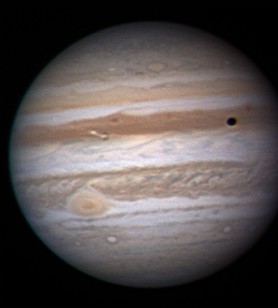
When it comes to the mighty Jupiter – and seeing Jupiter’s moons through a small telescope or binoculars – timing is everything. Jupiter’s satellites are constantly on the move, and almost any time you observe you’ll see at least one. The four largest of Jupiter’s moons are known as the Galileans, and go by the names of Europa, Callisto, Ganymede and Io. But which one is which and how do you know what you’re looking at?
Thanks to some very cool tools like Sky & Telescope’s Jupiter’s Moon you can tell exactly what time a Jovian event is about to happen and observe it yourself. For example:
Saturday, May 17, 2008
17:36 UT, Io’s shadow begins to cross Jupiter.
18:42 UT, Io begins transit of Jupiter.
19:54 UT, Io’s shadow leaves Jupiter’s disk.
21:00 UT, Io ends transit of Jupiter.
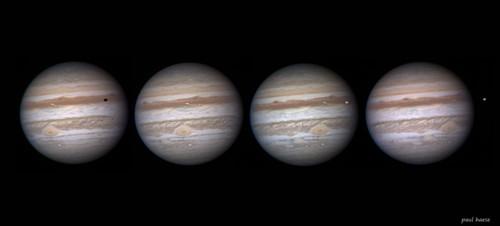
What transpires will look very much like this awesome photo done by Paul Haese. Jupiter Transit events are easy to observe even with a small telescope, but it does require some techniques. First of all, you cannot simply glance in the eyepiece and see it happening with ease. It does require higher magnification and patience! The trick is to get comfortable and just watch… During your extended observing session, moments of stability will come and go and it won’t take long before you notice a phenomena that recurs. The body of Jupiter’s moons are a little more difficult to spot, but the shadow becomes very easy when you take your time and really look!
So what happens if your equipment or skies aren’t up to the task? Never fear… You’re not left out of the game. Timing is everything. Begin by observing Jupiter well in advance of the event and take note of the Galilean moon’s position. By checking every few minutes or so, you will notice when one is about to go into transit because you’ll see it near Jupiter’s limb. Keep watching… Because it will simply disappear! (This is also a great clue for larger telescopes to understand where to look and where the shadow will appear.)
While viewing through the average telescope isn’t going to be as good as what can be seen photographically, just timing and participating in an event is a wonderful opportunity to expand your astronomy knowledge and experience. Watching a Galilean moon transit Jupiter, or Jupiter’s Red Spot is something which can be done from light polluted skies and doesn’t require a lot of technical skills – just patience. Mark your calendars for 3:50 Universal Time on May 22nd when Jupiter will appear to have no moons at all! Try following the event in advance of the predicted time and report what happens. So how many moons does Jupiter have? The real answer is 63. But the question should be…
How many can you see?
This incredible image of an Io transit was done by Paul Haese, a member of MRO, using a Peltier cooled C14 and Skynyx 2-0 monochrome camera with RGB Astronomik filters. Paul’s planetary imaging skills are legendary. The UK has Damien Peach, the US has Don Parker and AU has Paul Haese! Thank you so much for sharing…