
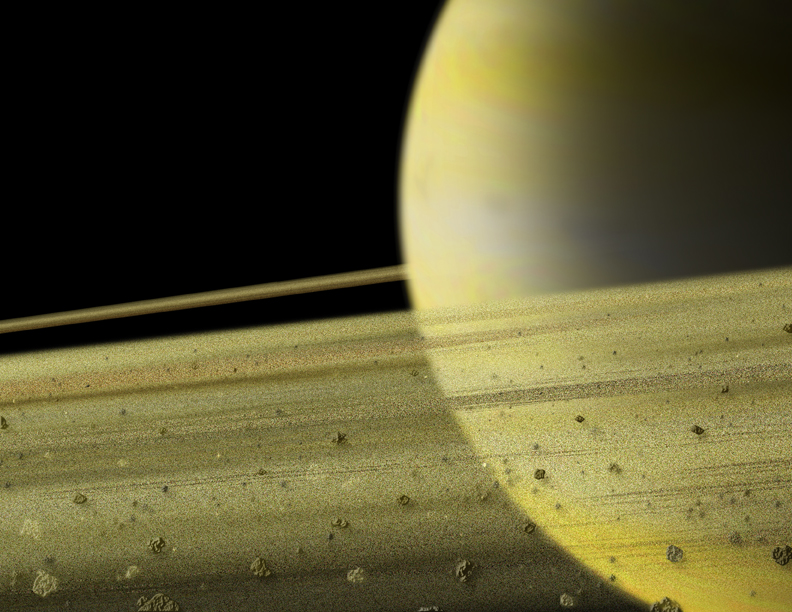
Saturn is sometimes called the ”Jewel of the Solar System” because its ring system looks like a crown. The rings are well known, but often the question ”what are Saturn’s rings made of” arises. Those rings are made up of dust, rock, and ice accumulated from passing comets, meteorite impacts on Saturn’s moons, and the planet’s gravity pulling material from the moons. Some of the material in the ring system are as small as grains of sand, others are larger than tall buildings, while a few are up to a kilometer across. Deepening the mystery about the moons is the fact that each ring orbits at a different speed around the planet.
Saturn is not the only planet with a ring system. All of the gas giants have rings, in fact. Saturn’s rings stand out because they are the largest and most vivid. The rings have a thickness of up to one kilometer and they span up to 482,000 km from the center of the planet.
The rings are named in alphabetical order according to when they were discovered. That makes it a little confusing when listing them in order from the planet. Below is a list of the main rings and gaps between them along with distances from the center of the planet and their widths.
- The D ring is closest to the planet. It is at a distance of 66,970 – 74,490 km and has a width of 7,500 km.
- C ring is at a distance of 74,490 – 91,980 km and has a width of 17,500 km.
- Columbo Gap is at a distance of 77,800 km and has a width of 100 km.
- Maxwell Gap is at a distance of 87,500 km and has a width of 270 km.
- Bond Gap is at a distance of 88,690 – 88,720 km and has a width of 30 km.
- Dawes Gap is at a distance of 90,200 – 90,220 km and has a width 20 km.
- B ring is at a distance of 91,980 – 117,580 km with a width: 25,500 km.
- The Cassini Division sits at a distance of 117,500 – 122,050 km and has a width of 4,700 km.
- Huygens gap starts at 117,680 km and has a width of 285 km – 440 km.
- The Herschel Gap is at a distance of 118,183 – 118,285 km with a width of 102 km.
- Russell Gap is at a distance of 118,597 – 118,630 km and has a width of 33 km.
- Jeffreys Gap sits at a distance of 118,931 – 118,969 km with a width of 38 km.
- Kuiper Gap ranges from 119,403 -119,406 km giving it a width of 3 km.
- Leplace Gap is at a distance of 119,848 – 120,086 km and a width of 238 km.
- Bessel Gap is at 120,305 – 120,318 km with a width of 10 km.
- Barnard Gap is at a distance of 120,305 – 120,318 km giving it a width of 3 km.
- A ring is at a distance of 122,050 – 136,770 km with a width of 14,600 km.
- Encke Gap sits between 133,570-133,895 km for a width of 325 km.
- Keeler Gap is at a distance of 136,530-136,565 km with a width of 35 km.
- The Roche Division is at 136,770 – 139,380 km for a width 2600 km.
- F ring is begins at 140,224 km, but debate remains as to whether it is 30 or 500 km in width.
- G ring is between 166,000 – 174,000 km and has a width of 8,000 km.
- Finally, we get to the E ring. It is between 180,000 – 480,000 km giving it a width of 300,000 km.
As you can see, a great deal of observation has been dedicated to understanding and defining Saturn’s rings. Hopefully, having the answer to ”what are Saturn’s rings made of” will inspire you to look more deeply into the topic.
We have written many articles about Saturn for Universe Today. Here’s an article about the orbit of Saturn, and here’s an article about the temperature of Saturn.
If you’d like more info on Saturn, check out Hubblesite’s News Releases about Saturn. And here’s a link to the homepage of NASA’s Cassini spacecraft, which is orbiting Saturn.
We have recorded two episodes of Astronomy Cast just about Saturn. The first is Episode 59: Saturn, and the second is Episode 61: Saturn’s Moons.
Source: NASA
wowww
haha wow such amazingg:] il ove this
wwwwwwwooooooowwww weird
wowwwww:]
i<33denise hershey :] wow amazing guy:0
wowww!!!! this is amazing
what a load of codswallop..never read so much baloney in all my life. Saturn sucks.