

This article was originally published in 2008, but has been updated several times now to keep track with our advancing knowledge of the cosmos!
My six-year old daughter is a question-asking machine. We were driving home from school a couple of days ago, and she was grilling me about the nature of the Universe. One of her zingers was, “What’s the Biggest Star in the Universe”? I had an easy answer. “The Universe is a big place,” I said, “and there’s no way we can possibly know what the biggest star is”. But that’s not a real answer.
So she refined the question. “What’s the biggest star that we know of?” Of course, I was stuck in the car, and without access to the Internet. But once I got back home, and was able to do some research, I learned the answer and thought I’d share it with the rest of you But to answer it fully, some basic background information needs to be covered first. Ready?
Solar Radius and Mass:
When talking about the size of stars, it’s important to first take a look at our own Sun for a sense of scale. Our familiar star is a mighty 1.4 million km across (870,000 miles). That’s such a huge number that it’s hard to get a sense of scale. Speaking of which, the Sun also accounts for 99.9% of all the matter in our Solar System. In fact, you could fit one million planet Earths inside the Sun.
Using these values, astronomers have created the terms “solar radius” and “solar mass”, which they use to compare stars of greater or smaller size and mass to our own. A solar radius is 690,000 km (432,000 miles) and 1 solar mass is 2 x 1030 kilograms (4.3 x 1030 pounds). That’s 2 nonillion kilograms, or 2,000,000,000,000,000,000,000,000,000,000 kg.
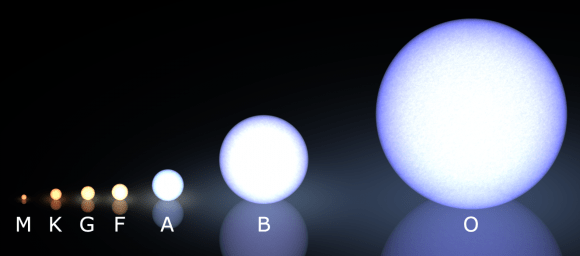
Another thing worth considering is the fact that our Sun is pretty small, as stars go. As a G-type main-sequence star (specifically, a G2V star), which is commonly known as a yellow dwarf, its on the smaller end of the size chart (see above). While it is certainly larger than the most common type of star – M-type, or Red Dwarfs – it is itself dwarfed (no pun!) by the likes of blue giants and other spectral classes.
Classification:
To break it all down, stars are grouped based on their essential characteristics, which can be their spectral class (i.e. color), temperature, size, and brightness. The most common method of classification is known as the Morgan–Keenan (MK) system, which classifies stars based on temperature using the letters O, B, A, F, G, K, and M, – O being the hottest and M the coolest. Each letter class is then subdivided using a numeric digit with 0 being hottest and 9 being coolest (e.g. O1 to M9 are the hottest to coldest stars).
In the MK system, a luminosity class is added using Roman numerals. These are based on the width of certain absorption lines in the star’s spectrum (which vary with the density of the atmosphere), thus distinguishing giant stars from dwarfs. Luminosity classes 0 and I apply to hyper- or supergiants; classes II, III and IV apply to bright, regular giants, and subgiants, respectively; class V is for main-sequence stars; and class VI and VII apply to subdwarfs and dwarf stars.

There is also the Hertzsprung-Russell diagram, which relates stellar classification to absolute magnitude (i.e. intrinsic brightness), luminosity, and surface temperature. The same classification for spectral types are used, ranging from blue and white at one end to red at the other, which is then combined with the stars Absolute Visual Magnitude (expressed as Mv) to place them on a 2-dimensional chart (see above).
On average, stars in the O-range are hotter than other classes, reaching effective temperatures of up to 30,000 K. At the same time, they are also larger and more massive, reaching sizes of over 6 and a half solar radii and up to 16 solar masses. At the lower end, K and M type stars (orange and red dwarfs) tend to be cooler (ranging from 2400 to 5700 K), measuring 0.7 to 0.96 times that of our Sun, and being anywhere from 0.08 to 0.8 as massive.
Based on the full of classification of our Sun (G2V), we can therefore say that it a main-sequence star with a temperature around 5,800K. Now consider another famous star system in our galaxy – Eta Carinae, a system containing at least two stars located around 7500 light-years away in the direction of the constellation Carina. The primary of this system is estimated to be 250 times the size of our Sun, a minimum of 120 solar masses, and a million times as bright – making it one of the biggest and brightest stars ever observed.
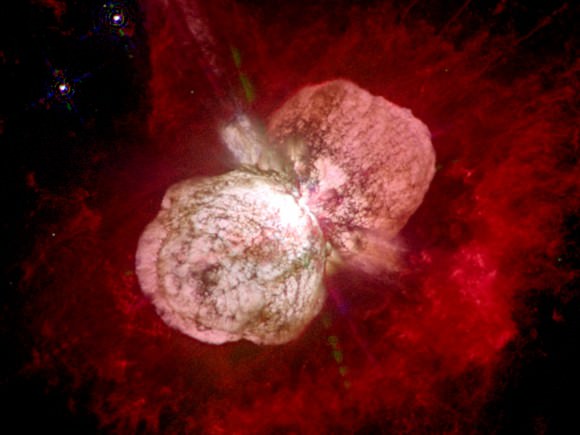
There is some controversy over this world’s size though. Most stars blow with a solar wind, losing mass over time. But Eta Carinae is so large that it casts off 500 times the mass of the Earth every year. With so much mass lost, it’s very difficult for astronomers to accurately measure where the star ends, and its stellar wind begins. Also, it is believed that Eta Carinae will explode in the not-too-distant future, and it will be the most spectacular supernovae humans have ever seen.
In terms of sheer mass, the top spot goes to R136a1, a star located in the Large Magellanic Cloud, some 163,000 light-years away. It is believed that this star may contain as much as 315 times the mass of the Sun, which presents a conundrum to astronomers since it was believed that the largest stars could only contain 150 solar masses. The answer to this is that R136a1 was probably formed when several massive stars merged together. Needless to say, R136a1 is set to detonate as a hypernova, any day now.
In terms of large stars, Betelgeuse serves as a good (and popular) example. Located in the shoulder of Orion, this familiar red supergiant has a radius of 950-1200 times the size of the Sun, and would engulf the orbit of Jupiter if placed in our Solar System. In fact, whenever we want to put our Sun’s size into perspective, we often use Betelgeuse to do it (see below)!
Yet, even after we use this hulking Red Giant to put us in our place, we are still just scratching the surface in the game of “who’s the biggest star”. Consider WOH G64, a red supergiant star located in the Large Magellanic Cloud, approximately 168,000 light years from Earth. At 1.540 solar radii in diameter, this star is currently one of the largest in the known universe.
But there’s also RW Cephei, an orange hypergiant star in the constellation Cepheus, located 3,500 light years from Earth and measuring 1,535 solar radii in diameter. Westerlund 1-26 is also pretty huge, a red supergiant (or hypergiant) located within the Westerlund 1 super star cluster 11,500 light-years away that measures 1,530 solar radii in diameter. Meanwhile, V354 Cephei and VX Sagittarii are tied when it comes to size, with both measuring an estimated 1,520 solar radii in diameter.
The Largest Star: UY Scuti
As it stands, the title of the largest star in the Universe (that we know of) comes down to two contenders. For example, UY Scuti is currently at the top of the list. Located 9.500 light years away in the constellation Scutum, this bright red supergiant and pulsating variable star has an estimated average median radius of 1,708 solar radii – or 2.4 billion km (1.5 billion mi; 15.9 AU), thus giving it a volume 5 billion times that of the Sun.
However, this average estimate includes a margin of error of ± 192 solar radii, which means that it could be as large as 1900 solar radii or as small as 1516. This lower estimate places it beneath stars like as V354 Cephei and VX Sagittarii. Meanwhile, the second star on the list of the largest possible stars is NML Cygni, a semiregular variable red hypergiant located in the Cygnus constellation some 5,300 light-years from Earth.
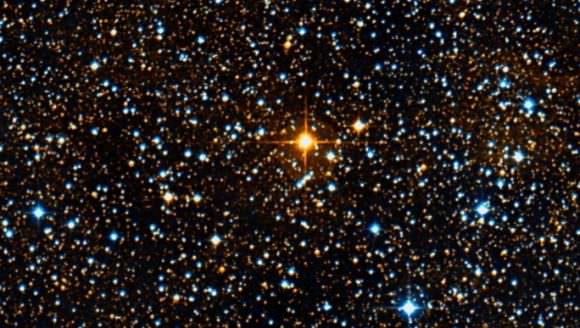
Due to the location of this star within a circumstellar nebula, it is heavily obscured by dust extinction. As a result, astronomers estimate that its size could be anywhere from 1,642 to 2,775 solar radii, which means it could either be the largest star in the known Universe (with a margin of 1000 solar radii) or indeed the second largest, ranking not far behind UY Scuti.
And up until a few years ago, the title of biggest star went to VY Canis Majoris; a red hypergiant star in the Canis Major constellation, located about 5,000 light-years from Earth. Back in 2006, professor Roberta Humphrey of the University of Minnesota calculated its upper size and estimated that it could be more than 1,540 times the size of the Sun. Its average estimated mass, however, is 1420, placing it in the no. 8 spot behind V354 Cephei and VX Sagittarii.
These are the biggest star that we know of, but the Milky way probably has dozens of stars that are even larger, obscured by gas and dust so we can’t see them. But even if we cannot find these stars, it is possible to theorize about their likely size and mass. So just how big can stars get? Once again, Professor Roberta Humphreys of the University of Minnesota provided the answer.
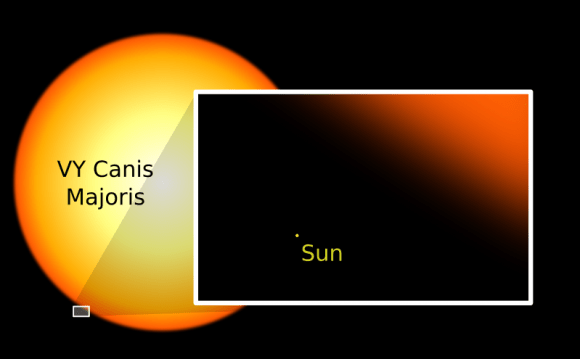
As she explained when contacted, the largest stars in the Universe are the coolest. So even though Eta Carinae is the most luminous star we know of, it’s extremely hot – 25,000 Kelvin – and therefore only 250 solar radii big. The largest stars, in contrast, will be cool supergiants. Case in point, VY Canis Majoris is only 3,500 Kelvin, and a really big star would be even cooler.
At 3,000 Kelvin, Humphreys estimates that cool supergiant would be as big as 2,600 times the size of the Sun. This is below the upper estimates for NML Cygni, but above the average estimates for both it and UY Scutii. Hence, this is the upper limit of a star (at least theoretically and based on all the information we have to date).
But as we continue to peer into the Universe with all of our instruments, and explore it up close through robotic spacecraft and crewed missions, we are sure to find new and exciting things that will confound us further!
And be sure to check out this great animation that shows the size of various objects in space, starting with our Solar System’s tiny planets and finally getting to UY Scuti. Enjoy!
We have written many articles about stars for Universe Today. Here’s The Sun, What’s the Brightest Star in the Sky Past and Future?, and What Is The Smallest Star?
Want to learn more about the birth and death of stars? We did a two part podcast at Astronomy Cast. Here’s part 1, Where Stars Come From, and here’s part 2, How Stars Die.
Erm, the animation wasn’t there. Could somebody please redo this page?
@Polaris93: Are you sure you haven’t got some Google-blocker or something like that, preventing the animation (video?) you’re referring to from loading?
I leave you the same animation but with music, Also Sprach Zaratustra (sp?), and it adds a lot more to the effect.
http://www.youtube.com/watch?v=jyhT2v5DMwU
Cheers.
Mi hija de seis años es una máquina de hacer preguntas. Hace un par de dÃas regresábamos a casa en el auto y ella me torturaba con preguntas sobre la naturaleza del universo. Una de sus preguntas más ocurrentes fue ¿Cuál es la estrella más grande del universo? […] Fuente: Fraser Cain para Universe Today.
Gotta love the curiosity and the ability of asking simple but almost impossible to answer questions of 6-year olds…
Thank your daughter from me!
Indirectly she increased my feeling of awe for the universe.
Mike Portugal.
You watch a cool video like that and the most important thing to pop into your head is to complain about Mr. Bush’s ego?
Get a life.
Welcome back, Fraser. I was worried something might have happened to you. Ian is doing a good job. However, please don’t scare us like that again.
When I was that age, I was told to shut up when I asked questions like that @ school.
Full marks on attempting to answer a very curious child’s question.
Cool animation
The followup question is what is the star with the most mass?
Damn we are so small… yet our Human ego wouldn’t fit on any of those stars… In fact it would take a lot more than that just to accomodate Mr. Bush’s ego wouldn’t it ?? lol
I haven’t gone anywhere, I’ve just gotten helpers. There’s just too much news for me to cover all by myself. And there are too many other jobs that had been piling up. With Nancy and Ian’s help, I’m able to finally tackle it.
My poor dsl hookup is fussy, but by going to that other (Thanks Haplo!!) on Youtube I got one reaction, W O W ! ! And that was repeated all 5 times I watched and listened to it.
Crazy! My almost-5-year-old son asked me the same question in the car today! I told him I really didn’t know, but I guessed maybe a star might exist that was 1 million solar masses (he pretended to understand), but if it did, it wouldn’t last long. That leads to the next question, mentioned by Mr. van Loon in a comment above: what’s the greatest know mass of a star, and is there a theoretical upper limit to a star’s mass? My son is waiting…
Hmmm. It seams there is a larger star named A1. This new Star has an apparent mass of 114 times the Sun which would be 3.2 times larger then VV Cephei. With a possible Diameter of 5140-6080 times the Sun. So yes it would be even LARGER then VV Cephei and VY Canis Majoris.
http://www.cosmosmagazine.com/node/1383
2600 solar raddi is biggest star in universe.Right?
Your little daughter is asking difficult questions at the age of 6.Be ware.
Keep in mind that mass isn’t the same as size. Some of the most massive stars aren’t as large as the cool, red supergiants. As you see in the article, Dr. Humphreys calculated that the largest star would be about 2,600 times the size of the Sun.
I’ll do another article about the most massive stars, and explain the size limits, and what happens when you get too much mass.
dre, there isn’t a star over 200 solar masses.
Hey Mr. Marcellus,
I DO have a life, for the time being at least, and YES that IS what comes to mind because this is where we all live, breath and everything else so i am much more interested in what is going on here on THIS planet and the politics which govern us all.
So if you do not think that we should all take a “closer” look to what is going on here you sir are a child without a hint of a brain.
So YOU get a life and by all means start contributing with something other than love for Bush cause we ( outside the US ) have already seen and felt what it feels like to have our entire World suffer from the US politics alone.
Be more polite next time and “maybe” you’ll come across as a bit more inteligent than you seem.
Grow up please.
BTW, it is a GREAT article and the sheer dimensions of it all make me wonder how can Earthlings have such big egos yet be so small.
Mike
Peace
Is it me, or do these two ginormous examples seem uncomfortably close (reletively) to us?
It’s me, right??
There’s a star called LBV 1806-20 that’s ridiculously massive (150 solar masses), unbelievably bright (40 MILLION times solar) and sits right in our backyard – the Milky Way! This monster is so huge that if placed side-by-side with Eta Carinae, the latter would not be detectable. I for one don’t want this monster going hypernova any time soon…
Harin, the star LBV 1806-20 is 2 million times as bright as the sun, not 40 mil. It is also 130 solar masses, not 150 and it’s diameter is 150 solar. Please check things out before spreading garbage. https://en.wikipedia.org/wiki/LBV_1806-20
yup that one ( LBV 1806-20 is blue and certainly HUMONGOUS to say the least…
http://www.space.com/scienceastronomy/brightest_star_040106-1.html
Peace
Mike
Haplo, this is a great soundtrack to that sequence as well
The biggest star in the Umiverse will be a mystery till the existence of the Universe
I tend to think that all this is way too speculative to be of real value for the moment. We still have a LOT to learn before we can even begin to answer these questions about how many living worlds or intelligent worlds there are in the galaxy. We’re only now starting to answer some of the premilinary questions to that one, such as how common planetary formation really is, we haven’t gone much beyond hypothesis in other such questions, like how common the birth of life as we know it is when conditions are favorable. And we really have no way of knowing anything yet about the eventual emergence of intelligence in other worlds: there’s no statistical value in studying ONE data point, which is what we really have.
The answer is: investigate, investigate, investigate. Investigate Mars, Europa, Titan, every place in our planetary system where life might have been able to grow roots in, investigate nearby stars in search of planets, and especially planets that might be similar to our own. Investigate how those systems behave dynamically, to better understand how common or uncommon our system really is. Investigate much better the past of life on Earth and how it reacts and reacted to typical events that are likely to happen in other worlds, such as impacts, star energy output irregularities, major geological events, etc. THEN, we might be able to have a solid answer to those questions about extraterrestrial life and intelligence.
And it’s what we have been doing, really. I, personally, feel the progress as painstakingly slow, but then again I’m not the most patient of men (and I’m not getting any younger). And even I agree that the progress has been vast in the last couple of decades. I’d like a lot more, I’d like to see a proper Europa probe, something being sent to Triton, more Mars rovers, a Titan lander able to move around the place, a Jupiter or Saturn (or even Uranus or Neptune) atmospheric probe, and so on, but I know I can’t complain about what has been done.
Er… how on Earth did this happen?! I click to comment on the odds of intelligent life and my comment gets posted in this post?! 😮
What the heck?!
I’ll try to repost it in the proper place now. Hopw it won’t be placed here once more…
The scale of space and time in the universe is beyond our understanding. Given enough time we could unlock every secret the universe has, alas we are victims of our own success. Like a massive star burning all of its energy in only a fraction of the time given we as arace will fizzle and burn under the weight of our own technology.
The literature always points to stars of 4-to-8 solar masses as being black holes. How can stars larger than 8 solar masses remain as stars and not instantly become black holes? I realize there must be balancing act between inward gravity and outward radiation, but at some point, we’ve been taught that the number of solar masses cannot stop the gravitational implosion. Does the Schwartzchild radius also make the determination for black hole formation, even for 200 solar mass stars?
@Rusty. All stars generate energy by fusion of lighter elements (starting with hydrogen) to create heavier elements. This energy counteracts the gravitational effect of the star’s mass so as to maintain its size. The fusion reaction in stars stops when iron is formed. At that point the outward pressure is insufficient to counteract gravity and the star collapses, becoming a black hole if the star is sufficiently massive. Very large stars go through the same process, but at a much faster rate than dwarf stars like the Sun. The short answer to your question is that so long as fusion proceeds, even the hypergiants will not go nova.
THe number of solar masses does not matter as long as the star is burning through fusion. The star will always produce just enough energy to counterbalance gravity and remain a star. It is only when the fusion cannot proceed (when all fuel is exhausted) that the star has no way to avoid a gravitational implosion. When an implosion is underway, it is at this time the star’s mass is the only parameter that decides whether the star will be a bh, ns or wd. THere is no question of a say 100 solar mass star imploding instantly into whatever because a star can and will produce the energy required to keep itself afloat.
What if there’s a planet that big? How big would the alien beings be? Size of Earth or bigger maybe? What if they used spacecrafts that used all of Russia to land? Scary.
Complete novice with a passing interest alert..
I seem to remember being told by my cathode ray tube that, if the moon hadn’t been knocked out of the earth at a relatively early age, our lovely planet would have more mass and therefore stronger gravity.
Stronger gravity would prevent animals from growing to even human size (and prevent them walking upright). So on a massive planet, the aliens would likely be smaller than us.
But hold on.. that would mean that “spacecraft the size of Russia” would have to come from smaller planets…. parking space would presumably be at a premium on that world :O/
@Curly. Evolution would dictate that if lifeforms develop on a planet which is either more massive than the Earth, or less massive, those lifeforms would be “tailored” to the prevailing conditions. I could envision that if a human analog should develop on a “super-earth”, that being might be a quadruped or even a hexaped, only because all those legs would confer enhanced stability; accidental falling down could cause much more than just bruises in the much higher gravity.
Sorry… forgot to say.
Great article, and a brilliantly inquisitive daughter.
A future Universe Today contributor no doubt.
Daughters of 6 years old can indeed ask some very difficult questions. Enjoy them while you can.
Daughters at 15 can ask questions somewhat more difficult. Fathers’ hair turns gray for a reason.
My biggest cosmological wish is to be around to witness Eta Carinae going supernova. When it finally does clearly it will be the most important astronomical event in human history and even current technology will permit the astronomical community to obtain the most complete and important data about our universe ever. Go Eta go.
Yep. It would be a “new star”, visible even during the daytime!
I truly enjoyed your article! And if your little girl’s mind is like this at 6 (?!) I envy the things she’ll see, the places she’ll go, the thing’s she’ll do…
SAdly watching Eta go up in smoke WILL be the last thing you do. The ejecta and strong neutronic blast will wipe all but the simplest life forms from the earth, IF it lasts more than 24 hours. If less some portion of the Earth will be spared. The Mayans predicted this oooh, 2000 years ago.
@Ron B. Ummm…no. Astrophysicists tell us that such a scenario is highly unlikely. The star is 7,500 light years away from the Solar System; if it was only 50 ly distant, then that would be cause to worry. A lot of nonsense can be found on the internet.
Ron B., that’s actually unlikely if current estimations are correct – unless it’s a particularly powerful hypernova (which would only happen if solar winds don’t make it shed enough mass to become a Wolf-Rayet star), our atmosphere and magnetic field should be enough to protect us. Its axes are currently not pointing at the earth, so even a gamma ray burst from it would probably mostly not affect our planet unless it shifts somehow. Either way, it’ll probably be bright enough to read books during the nighttime.
Kamal, planets as we know them could not exist at that size, as the gravity exerted by that much mass would ignite nuclear fusion and turn it into a star.
To Ron B.; it’s getting tiresome, this Mayan talk. Every year, some religion/culture/guy says the world’s gonna end… in 1993! Wait, no, 1995! Oops… um, 2000? No, 2001, that’s when the new century starts! Crud, that didn’t work either…
Isn’t the point of this subject to point out how tiny we are as not just people or countries or planets, but entire galaxies? If the fate of the world hinges on a small group of guys that may have gotten SOME stuff right (when lunch was going to be served, etc.), I’d say the universe was pretty danged petty. SO don’t say “They predicted this ohh, 2000 years ago…” like you’re the well of information when it comes to Mayan culture, as if they have ANY say when it comes down to it.
Here’s a youtube clip including VY Canis Majoris – not as well put together as the progressive one, though:
My dad say’s that beattle jucie is the biggest star in our galaxy I am sorry if I mad some spelling misstakes. I am wondering if you know god and belive that god created everything.
This video on YouTube is more dramatic. I teach science to K-5, and my 5th graders were so impressed and wanted me to play it over several times….music and timing are everything!
ohmygoodness, your six year old daughter sounds so adorable. 🙂 it’s amazing how impressionable and interested she is. thank you for sharing, this was very helpful, and very interesting too. it’s amazing how although we look at the sun and think wow, that is HUGE, we don’t realise how tiny it actually is.
wow, what a big universe. 🙂
Just a passing note – not a criticism or anything – we all do this sort of thing … but I had to smile when I read: “Light takes more than 8 hours to cross its circumference.”
Oh yes, and also … on the topic of children. We (local astro club) took our telescopes out to a (primary) school yesterday and had the lovely report from the headmistress that several of the children had dragged their parents outside, away from their “boring television shows”, to look at the cool things in the sky. The future may be uncertain, but there are still some bright young minds around to inherit it.
Kamal: If a planet was that big, the gravitational field would be so strong that it would make life impossible on the planet. That’s if there really is life outside this planet anyway, which I tend to doubt. By the way, I believe God created the heavens and the earth, if not, how did the earth get to just the right place to support life. If our orbit was off by the slightest margin, or the sun was a little bit farther away from us, life could not exist.
Well all this information on VY Canis Majoris and my father believes its till only a theorie and that scientists are guessing it exists without proof is that true or is there some proof which can convice him otherwise?
I don’t understand why VY Canis Majoris isn’t marked on the map of the constellation Canis Major. Or am I missing something?
i have many questions and so on but i have one big but simple question!?!? have we ever recorded the sun moving in circles as we rotate around it?? picture a dizzy symple circle till it comes to its comlete center and spins on spot….???? i havent search that part of the internet yet just checking my theories……and i liked the way you went to explain the biggest star…..but i’m a fanatic about everything that can be questioned haha like your daughter
hah i’m tired i re read it and still missed that symbole haha
have we ever thought of the universe as one GIANT ATOM???? cuz the atom is so complexed like the mind……… so….. i dont know but i do know that i dont know was the first thing i knew i believe before i even knew what i was doing 🙂
My stars bigger than yours! 🙂 :p
lolololollol eat a penis!
Internet lol!
what?
Hi.
I’m just asking if VY Canis Majoris is only 2’100 times the size of the Sun, because I heard that Beteigeuze is 3’600 times the size of the Sun. I wish you could answer me this question because I love studying the Universe and this doubt is making me think.
Thank you for your patience,
João Martins, 11 years old, Portugal.
Wow, those stars are HUGE! And only 2100 times the size of the sun? The theorectical limit is actually 2600, so imagine that. 🙂
Yes.
Christian humor: I’m trying to to an interview for the biography/ autobiography for the book
“The bible, the inspired word of God” I tried to google him after I got his real name and aliases. I tracked down and found lots of satellite offices all over the world.
Everyone was very helpful, I went into a few and asked if he was here, I was told yes absolutely ! I did as they asked and I took a seat. I waited , but he never showed up, I sat there and heard many people talk about his book but again I never caught him showing up, boy even Billy Graham is easier to get in touch with!
Some offered to take a message and promised it would get to him. I was told he checks in from time to time.
I thought I would read his book and see if there were any clues as to where his house was.
This is what I found out,
Lets see there are 365 days in one earth year, and if 1000 years to us is a day to God. Then that means: The earth in 365 days travels 584 million miles . so 584 X 1000 years=
584 billion miles is Gods circumference he must cover in one year if his orbit was as fast as ours, his diameter of his obit would be from one side to the other is about 185. billion miles, and the radius, if the sun was the center would be about 92 billion miles from the sun.
That would make one of his days equal to 1000 of our years. Sounds right? Maybe I’m just guessing. That would make Sedna Gods Home area, but its orbit is 10,000 years for one of ours. So I must have forgotten something..hum? that means 365,000 years is needed for 365 of our days. so that one day is a thousand, right? so we will divide 365,000 years by 10,000 and we get 36.5 X 92 billion miles and we get 3.358 trillion miles as his radius and 6.716 trillion miles would be his diameter to travel from one side of his orbit to the other. He would have to travel about 21 trillion (circumference) miles to do one orbit around a sun. so It would still take us a half a light year to get to God’s place, right? Nope he could be anywhere.
What if his orbit goes around, lets say Alpha Centauri? or any other star/sun in the universe..I guess he was just trying to make a comparison..Oh well, at least I know his aproximate orbit he needs to have around a sun to to equal 1000 of our years to 1 of his days.. Now I just have to narrow it down to the billions of solar systems in the universe.. Hey I have an idea to narrow it down! I need to find a sun bright enough to warm a planet that has a 365,000 year orbit. We were made in his image, so I guess we can assume he is warm blooded like us.
back to the drawing board..He could be anywhere..
I looked for him once again and tried some star maps. Still no address found? However, I did find some of his neighbors, I thought.
Background of new info:
Sedna’s:, but it is calculated at between 10.5 and 12.0 thousand years to orbit the sun.
Eris ( new dwarf planet) takes 557 years to orbit the Sun,
I tried again to Google Gods location with information of places between Sedna and Eris, but they have not found his house yet.
I will keep trying! I’m sure he will send me a reply, I guess he wants to remain mysterious. Maybe he has been looking over my shoulder all the time. I think that address clue he gave was a red herring. I was told to try Red Antares it is only 600 light-years away..Now that is way out of the way! I sure don’t have that much gas money…I’m sure he is not there.
I found out the government is looking for him to, they sent a rocket named New Horizons to go and find his address out near some Kuiper belt.
( I wonder if his tax exemption has to be verified?) oh well,
I’m sure if I catch up with him and get the interview, I will get the Pulitzer! I will keep you updated.
He seems to be going around and doing good things for people in secret. Maybe I will check with some of them and see if they know where I could find him
Here is my question to the above information,
Could the whole universe be the mass like the sun to us as it is to his domain? Meaning , could his domain could be like Mercury to the universe? Could his domain travel around the universe at a higher rate of speed? Making his rotation last 365,000 years? If you added all the mass in the universe what would be the gravitational pull to it, and at what distance to the universe would his domain have to be?
Doe that question make any sense?
I guess that is an enigma.
The scale is the enigma,
If the universe was 88 million light year round?
and the diameter was 28 million light years wide
and the radius was 14 million light years to the center.
how fast would he have to travel to orbit the universe, if 1 day to him is 1000 years to us
Omg how is our poor planet big , a last star is too big and i hope it will not be our sun 🙂
interesting facts 🙂
nice web
i think the biggest star is the Etacarinae Hmmmm! who knows, may be one day you’ll find it. anyway good luck with it!
may i known which is the largest planet in the whole universe?
According to google pictures, Tom Cruise is the biggest star known to man.
Tom Cruise is washed up, and has been for like 10 years. Biggest star my a$$. He’s 59 years old! Dude, I’m sorry, but that is washed up when you’re trying to play action heroes.
what is the biggest star may found in the universe
I tried multiple times from multiple directions and the program would not run. It starts to load and gets as far as 1 minute 29 seconds of the loading process and freezes there. From every time and every direction it stops and freezes in the same place.
i think is the biggest is the vy canis majoris or
eta carinae isthe hottest
i think is the hottest is the eta carinae and the biggest is the vy canis majoris
Is their a bus route :O)
what’s the gravitational force of VW canis majoris. I’m 15 stone (95kg) so how heavy would I be if it where possible to live on the sun’s “surface?
i think the biggest star is w cephei ?? :]
The largest star is the Epsilon Auigae, to compare the size, the sun would be a milk cap and the E. Euigae would be the size of the football field.
MUCH bigger than your picture….
typo, E. Auigaue***
can I buy the dvd of the precentation
This is amazing! I am taking an astronomy course and the hugeness and vastness of our universe just amazes me!
Thats a big star I’ve never seen a star so big wow amazing
0_0 i see how big the sun is now think abut the sun will kill us abut millions of years! (i see that on tv)
huge stars like these have only a few million years
I’m sure lots of people must wonder about the strange categorisation O, B, A, F, G, K, M rather than A-G or something, but I’ve been Googling for an hour or so without finding an answer… they don’t seem to stand for anything. Anybody happen to know?
“with both measuring an estimated 1,520 solar radii in diameter.” Why does this switch between radii and diameter? Do I divide or multiple by two?
Oh. I thought this was an article about Kanye West. Never mind.
I quit my office-job and now I am getting paid 96usd hourly. How? I work-over internett!. My old work was making me miserable, so I was forced to try-something different. Two years after…I can say myy life is changed-completely for the better! Check it out what i do….T88
=== http://www.PayAbility70.com