
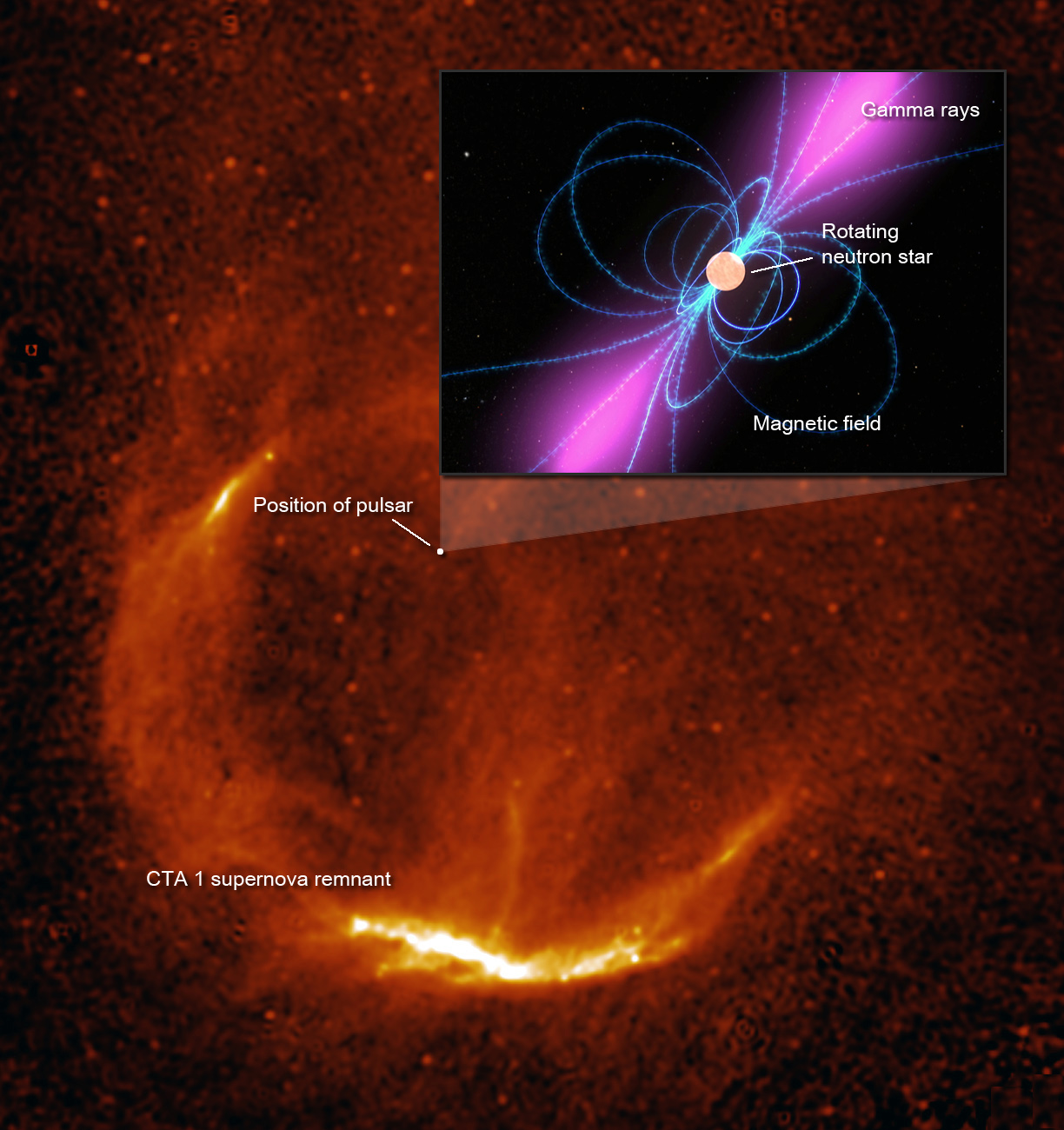
[/caption]
NASA’s Fermi Gamma-ray Space Telescope discovered the first pulsar that beams only in gamma rays. A pulsar is a rapidly spinning neutron star, the crushed core left behind when a massive sun explodes. Astronomers have cataloged nearly 1,800 pulsars. Although most were found through their pulses at radio wavelengths, some of these objects also beam energy in other forms, including visible light and X-rays. However, this new object only pulses at gamma-ray energies. “This is the first example of a new class of pulsars that will give us fundamental insights into how these collapsed stars work,” said Stanford University’s Peter Michelson, principal investigator for Fermi’s Large Area Telescope.
The gamma-ray-only pulsar lies within a supernova remnant known as CTA 1, which is located about 4,600 light-years away in the constellation Cepheus. Its lighthouse-like beam sweeps Earth’s way every 316.86 milliseconds. The pulsar, which formed about 10,000 years ago, emits 1,000 times the energy of our sun.
“We think the region that emits the pulsed gamma rays is broader than that responsible for pulses of lower-energy radiation,” explained team member Alice Harding at NASA’s Goddard Space Flight Center in Greenbelt, Md. “The radio beam probably never swings toward Earth, so we never see it. But the wider gamma-ray beam does sweep our way.”
Scientists think CTA 1 is only the first of a large population of similar objects.
“The Large Area Telescope provides us with a unique probe of the galaxy’s pulsar population, revealing objects we would not otherwise even know exist,” says Fermi project scientist Steve Ritz, also at Goddard.
Fermi’s Large Area Telescope scans the entire sky every three hours and detects photons with energies ranging from 20 million to more than 300 billion times the energy of visible light. The instrument sees about one gamma ray every minute from CTA 1, enough for scientists to piece together the neutron star’s pulsing behavior, its rotation period, and the rate at which it is slowing down.
The pulsar in CTA 1 is not located at the center of the remnant’s expanding gaseous shell. Supernova explosions can be asymmetrical, often imparting a “kick” that sends the neutron star careening through space. Based on the remnant’s age and the pulsar’s distance from its center, astronomers believe the neutron star is moving at about a million miles per hour — a typical speed.
Source: NASA
Interesting find. The more we watch, the more we see.
I’ve always wondered how come neutron stars have such extremely strong magnetic fields when they are (hypothetically) composed mostly of electrically neutral particles?
Yeah tha is a very interesting find. The Femmi telescope is doing very good work.
Fermi already making some very cool observations! Cant wait to see what else Fermi will discover.
Fermi is already paying off!!! Can’t wait until we get some of the higher quality xray spectrum pictures of everything it is up there to look at.
eer.. make that gamma ray. TGIF
A gamma-ray pulsar will evaporate very fast , much faster like other more common pulsars and therefore they will be a unique phenomenon in space, I think.
Hehehe, I’d like to see the Electric Cosmos Model explain this one.
“# Fenring Says:
October 17th, 2008 at 7:26 am
“I’ve always wondered how come neutron stars have such extremely strong magnetic fields when they are (hypothetically) composed mostly of electrically neutral particles?”
Neutron stars, though made up of mostly neutrons, still have a large number of charged particles floating around in them. Check the wikipedia article for a basic rundown…
Some good science there 🙂
this really isnt. its a magnetar, a form of pulsar where its decay of its magnetic field powers the EM radiation in the form of gamma rays or X-rays
The key point here is that Fermi is able to detect more pulsars than before since the gamma ray beacon is broader than the other em radiation they emit. If the poles of the pulsar are pointed away from Earth then we simply will miss a large number of pulsars out there. Fermi shouldf be able to capture some of these.
Perhaps someone could explain why the pulsar does not appear to be centered in the supernova remnant?
All this stuff just tickles me pink, before the silicon age I remember there was much speculation about ever being able to see deep into space with earth based telescopes! This new technology has been wonderful to see develop over this last half century! I salute the people who make it possible!
I guess magnetar is a good explanation for it.
“Perhaps someone could explain why the pulsar does not appear to be centered in the supernova remnant?”
The process that creates pulsars/neutron stars often gives them a bit of a kick in the pants in terms of momentum. It isn’t surprising at all to find that the star has moved from where it was when it went nova.
Neutrons only have a net charge that is neutral. All of the parts of the neutron are not neutral.
Secondly, AFAIK, it is the strange sea that produces the magnetic field and it is likely that strange quarks will be dominating in neutron star environments , resulting in very strong magnetic fields.
How come none of the other gamma ray satellites saw these before?
And how do we know this isn’t some kind of alien space weapon?
Or that their version of the LHC just went horribly, horribly wrong?
“Its lighthouse-like beam sweeps Earth’s way every 316.86 milliseconds. ”
and
Fermi “sees about one gamma ray every minute from CTA 1, enough for scientists to piece together the neutron star’s pulsing behavior, its rotation period, and the rate at which it is slowing down.”
One gamma a minute; how can that resolve such a rapid spin?
The paper announcing the discovery of the GR pulsar in CTA 1 is available at arXiv:0810.3562 (‘The Fermi Gamma Ray Space Telescope Discovers the Pulsar in the Young Supernova-Remnant CTA 1’) available at the arXiv astro-ph site for 10-21-08. Mention is made of the suspicion of the object known as 3EG J0010+7309 (from EGRET on GRO) & RXJ0007.0+7303 (from XMM-Newton & CXO observations) as likely being a gamma ray pulsar, but only observations from Fermi were able to confirm this. For JohnD, pages 8-9 describe how extended observations with Fermi (which has an internal clock accurate to 300ns) eventually collect enough GR photons for an accurate spin rate to be determined even with ‘a gamma ray photon per minute’ statistics. An earlier paper describing how GR pulsar observations would be feasible with Fermi is available at arXiv:0810.1637 submitted 10-8-08. Mention was made of the extremely high magnetic field deduced from Fermi observations( 1.1×10^13 Gauss ), probably making this GR pulsar also a magnetar candidate!