
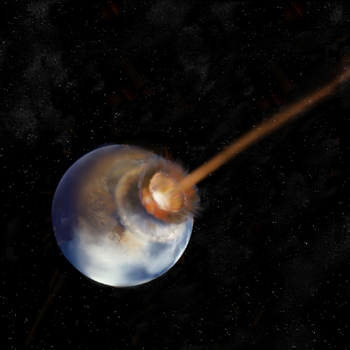
[/caption]We keep sending missions to Mars with the key objective to search for past or present life. But what if a huge impact early in the Red Planet’s history hindered any future possibility for life to thrive? Recent studies into the Martian “crustal dichotomy” indicate the planet was struck by a very large object, possibly a massive asteroid. Now researchers believe that this same impact may have scrubbed any chance for life on Mars, effectively making the planet sterile. This asteroid may have penetrated the Martian crust so deep that it damaged the internal structure irreparably, preventing a strong magnetic field from enveloping the planet. The lack of a Mars magnetosphere thereby ended any chance for a nurturing atmosphere…
Mars looks odd. Early astronomers noticed it, and today’s observatories see it every time they look at the red globe. Mars has two faces. One face (the northern hemisphere) is composed of barren plains and smooth sand dunes; the other face (the southern hemisphere) is a chaotic, jagged terrain of mountains and valleys. It would appear the crustal dichotomy formed after a massive impact early in the development of Mars, leaving the planet geologically scarred for eternity. But say if this impact went beyond pure aesthetics? What if this planet-wide impact zone represents something a lot deeper?
To understand what might have happened to Mars, we have to first look at the Earth. Our planet has a powerful magnetic field that is generated near the core. Molten iron convects, dragging free electrons with it, setting up a huge dynamo outputting the strong dipolar magnetic field. As the magnetic field threads through the planet, it projects from the surface and reaches thousands of miles into space, forming a vast bubble. This bubble is known as the magnetosphere, protecting us from the damaging solar wind and prevents our atmosphere from eroding into space. Life thrives on this blue planet because Earth has a powerful magnetic solar wind defence.
Although Mars is smaller than Earth, scientists have often been at a loss to explain why there is no Martian magnetosphere. But according to the growing armada of orbiting satellites, measurements suggest that Mars did have a global magnetic field in the past. It has been the general consensus for some time that Mars’ magnetic field disappeared when the smaller planet’s interior cooled quickly and lost its ability to keep its inner iron in a convective state. With no convection comes a loss of the dynamo effect and therefore the magnetic field (and any magnetosphere) is lost. This is often cited as the reason why Mars does not have a thick atmosphere; any atmospheric gases have been eroded into space by the solar wind.
However, there may be a better explanation as to why Mars lost its magnetism. “The evidence suggests that a giant impact early in the planet’s history could have disrupted the molten core, changing the circulation and affecting the magnetic field,” said Sabine Stanley, assistant professor of physics at the University of Toronto, one of the scientists involved in this research. “We know Mars had a magnetic field which disappeared about 4 billion years ago and that this happened around the same time that the crustal dichotomy appeared, which is a possible link to an asteroid impact.”
During Mars’ evolution before 4 billion years ago, things may have looked a lot more promising. With a strong magnetic field, Mars had a thick atmosphere, protected from the ravages of the solar wind within its own magnetosphere. But, in an instant, a huge asteroid impact could have changed the course of Martian history forever.
“Mars once had a much thicker atmosphere along with standing water and a magnetic field, so it would have been a very different place to the dry barren planet we see today.” – Monica Grady, professor of planetary and space sciences at the Open University.
Losing its magnetic field after the deep asteroid impact catastrophically damaged the internal workings of the planet, Mars quickly shed its atmosphere, thereby blocking its ability to sustain life in the 4 billion years since. What a sad story…
Original source: Times Online (UK)
In the long term, adding gases to the atmosphere is something humans are really good at, just look at all the greenhouse gases we’re emitting right now! Light gases will just float away from Mars, what if we output lots of heavy gases? The air doesn’t necessarily need to be breathable, but it’d be nice to have decent temperatures and a higher atmospheric pressure so you don’t get the bends if you need to step outside without a space suit on.
Very interesting read. Can you imagine if that event is responsible for preventing the evolution of life on Mars? ie. We would have neighbors on a habitable planet next door if that impact didn’t happen – an amazing thought.
…there can only be one 😀
Perhaps the impact on mars ejected a piece of rock that hit the earth and triggered the start of life 3.9 billion years ago.
If this event supposedly hit around 4 billion years ago, one can’t rule out that the earliest microbes supposed appeared on earth around 3.9 – 4.3 billion years ago depending on the estimates. Just some food for thought 🙂
wouldnt it be nice to go back in time and save mars from being hit, wouldnt it be great to have a neighbouring planet to visit, only problem is above above poster speculated we may not exist to appreicate it
the mind boggles
Perhaps one day we will have the means to re-start the molten core on Mars. Give it back a magnetosphere. Now thats what I would call terraforming. 🙂
T’is a shame ol’ Mars died off.
Twas taken from us too young.
On the subject of terraforming, it would be a really hard job.
Unlike Spore where you just point and click, this would require a LOT of energy.
Some ideas could be to create a massive mirror that sits on the dark side to reflect sun on the whole planet, 24/… uh wait, that phrase won’t work with Mars.. haha, but you know what i mean.
Then you would probably need to add lots of gas, specifically gases that retain heat, such as CO2. (anyone know of Jupiter has much of that? Or Saturn?)
Then you’d pretty much just need to wait for awhile to let nature take its course.
This is assuming that the core for Mars isn’t totally screwed up..
Also, this all assumes that we won’t somehow figure out some new way of producing energy in the next 3+ centuries.
What a sad story, but maybe this is why the planet we know as Mars has sent a message to brother Earth and requested our planet to send life forms to revive Mars. Maybe this messge is being sent to Earth from extra solar planets around the galaxy for similar help. Maybe this is the reason as to why we are here. Roger
martians we hardly knew ye
The possibilities for the apparent to this article are high. We need detailed geological research by the presence of manned missions there for more evidences
Great article, this makes me think that life in the universe may be a matter of luck as well as having the right conditions. Between the comets, asteroids and meteors alone it seems there are plenty of opportunities to extinguish nascent life. The several mass extinctions on our own planet show how perilously close Terran life came to be snuffed out in the past.
I don’t think its that hard to imagine mars, alive.
Its something we suspected (or rather, expected) up until the mariner probes showed otherwise.
I wonder if our space exploration history would have been different if there was a habitable world filled with animals nearby… or if we would have been the ones being explored by martians.
I think terraforming mars is still possible given what we know. If you believe in man made global warming (accidentally changing the climate) then you must admit that change through intentional efforts are not that far fetched.
The more difficult thing would be figuring out how to spin up a magnetic field, to make our changes permanent.
I always wonder though, was everything on earth just right and the conditions here are exactly what’s needed, or is it just the conditions life had to evolve in, and life will tend to find a way and quite different to what we know.
Also, the lack of a Martian magnetosphere, thats just due to the internal workings being static and the make up of the core. Isn’t it just a likely being a small planet further from the sun, it just all died out, not enough radioactive material?
If a huge impact killed the planet, it was obviously still geographically active for a very time after to cover it up, and to have supported water after. So why would that one aspect stop?
It all sounds way too vague for me this one. Could be true, but still just seems an idea.
Ummm, in regards to the posters of terraforming. It is almost impossible to terraform mars because of the lack of a magnetic field. Nothing to stop the solar win from swiping away the atmosphere
Great variation of commentary. With the timelines involved, I can’t help but speculate that our inner Solar system was perhaps influenced by the same event.
First Venus rotates on it’s axis in the opposite direction to the other planets, except Uranus, of Course. I have seen theories that Venus had a Massive Impact Event that essentially “flipped” the planet upsidedown.
Earth’s Moon was created when a massive object Collided with earth. Scientists consider the impact to be a Glancing Blow, similar to Billiards, when you “cut” the ball. The Theory says that after that blow, the resulting ejecta formed our moon. This explains how our Moon is actually Spiraling away from us, rather than orbiting.
So let’s say the Massive object then was sent on a collision course with Mars, where the Object ended its existence, and sealed the fate of Mars.
It is possible to tie in Uranus’s Rolling orbit, as the theory is that a collision with an Earth Sized Object of High Density is what tipped it on it’s side.
Also, new evidence supports Saturn’s rings were formed in the 4.2 Gyr range, so their creation is now explained.
What was this object, and where did it come from? The most logical place, due to the densities and mass required would be from a supernova. sends out a chunk of dense heavy metals, which cooled, and played some “snooker in the Solar System” (Feel free to use that as a future article title)
I don’t see why anyone takes seriously the idea that a magnetic field is important for preserving a thick atmosphere.
After all Venus has no magnetic field but as a much thicker atmosphere than earth, including a few times as much nitrogen as earth as well as the enormous amounts of CO2
…In addition to being closer to the Sun, where one would expect the solar wind to be yet more intense.
Thanks, Jim. That seeming contradiction’s bugged me for a long time, too….
If Mars had been at least as massive as Venus (with the Earth-like rotation it already has), I suspect things would’ve been rather different there today as well.
The asymmetry between the Martian hemispheres is somewhat reminiscent of the asymmetry between the near and far sides of the moon. In both cases major asteroid impacts have been postulated as the origin of this asymmetry. Significant mascons, evidenced from lunar gravimetric data, have been interpreted as evidence of the collision. If a large asteroid collision with mars was sufficiently catastrophic to disrupt the Martian core and prevent its reformation, then I would expect to see similar gravimetric evidence of mascons on mars. However, the very limited gravimetric data that I have seen to date does not seem to contain much evidence of Martian mascons. Has anyone seen such evidence?
How do you find remnants of 4 billion year old life?
How do you find remnants of 4 billion year old life?
You look for it.
I cannot believe anyone can come up with such a theory. They do everything to deny that there could have been intelligent life on Mars, even if they have to deny their own.
If this had been different, if Mars had supported life, then think of the consequences: There could have been millions of Sarah Palins living on the planet: “Look, I can see Earth from my house!”
Sleep well tonight, Sarah Palin and the Alaskan National Guard are awake…..:)
Earthly life will most likely become extinct because of the human tendency toward political excitement. (I couldn’t resist putting that in there — this is supposed to be a science blog, but somehow the politics get in there, thick as fleas on a wild dog in August, and I suppose I’m as guilty of that as anyone.
Anyway, I agree with Skip Ryan and others that we really can’t rule out life on *any* world until we have much better samples of it on whatever worlds we can get to . . . including the more forbidding parts of our own. We just don’t know enough about life to do so, as Mr. Ryan’s comments about how recent our (still superficial and nascent) understanding of the deep hot biosphere and the marine abysses of our own world really is. We’re still learning, just as we are still learning about the cosmos and everything in it, and will be forever. The magnificent science-fiction writer Olaf Stapledon wrote of life in the form of flames, rocks, and other media which current biological science won’t even look at as possible life-forms. He may turn out to have been a prophet — writers of his calibre often have, and will do so in the future (maybe even the cosmos of H. P. Lovecraft will turn out to conform to the reality of the universe we live in, may the Gods help us all! {G}). The one thing we can be sure of is that all life displays intentionality, i.e., in another word, will (the exercise of which with the intention of causing the universe to conform to one’s goals, according to the early biological information scientist, Aleister Crowley, is Magick; but that’s another story entirely, isn’t it), All life displays will, i.e., goal-oriented behavior, one way or another: plants striving to put roots down to acquire nutrients and put out chemicals to cause other plants to refrain from intruding on its territory, to put leaves and the like out to capture sunlight; animals display the “Four
F’s of biology” — Feeding, Fighting, Fleeing, and,. uh, Romantic Involvements; and fungi, protoctists, microbes, and other life-forms do their respective things as well, all in the name of survival and eventual reproduction or, at least, promotion of their genes’ survival through their siblings’ and cousins’ offspring. Corollary: If you see purposeful behavior in anything, it is in its way alive, no matter how weird it is, or else is an extension of some living things or groups of organisms, such as robots and computers (and who is to say *they* are not in their way alive? After all, scientifically speaking, telepathy is out of bounds, and since we won’t try to read their minds, we can’t know whether they have any intentions of their own or not). All we know about life or anything else is what we know *now*. The future may bring huge changes in that knowledge which, as Skip Ryan said, may in turn change all the basic assumptions behind one or another of our scientific disciplines. Maybe there is life on Mars after all, just in forms we don’t yet have a mind-set allowing us to see, or at least allow for the possibility of their existence. Similarly, there could be strange — to us — life on every world and worldlet and piece of sand in the Solar System, perhaps even plasmoid life in and on the Sun. There is no reason to assume our search for life in the universe at large is ended before it has even begun. So let’s go to Mars and start looking. 🙂
…We’re still looking for intelligent life on earth.
I don’t think there is consensus that life will always evolve to be smart if given enough time, or that intelligence is a permanent condition.
The dinosaurs bumbled along for millions of years on their own and (so far as we know) no civilization arose or survived that era.
Evolution does not dictate that animals become smarter than they need to be for basic survival. The human condition could be one of the most unusual things to ever occur in this universe.
To expect it twice in a row in the same planetary system is asking alot.
It seems probable that very soon after accretion, our Solar System may have had as many as five “temporarily” habitable planets (warm enough, liquid water on the surface); Venus, Earth, Mars, Europa and Titan (the last two heated by left over gravitational contraction energy of Jupiter and Saturn).
Don’t assume that just because a planet does not have a magnetic field, it will have a thin atmosphere. It may mean that the atmosphere is currently being replenished or is currently in decline (or both). Solar wind does indeed have an effect on the atmosphere. Temperature and molecular weights of the gasses have a large effect as well (think escape velocity). So planets with greater masses should have thicker atmospheres, right? What about Titan? Remember that Titan is very cold. It has different atmospheric gasses. It is also within Saturn’s magnetic field most of the time. Gas from geologic activity may also be contributing. We also have to think about the temperature and chemical profile of an atmosphere as well as how different wavelengths of light (ie: UV, visible, and longwave (IR)) interplay with different parts of the atmosphere and the surface. Chemical reactions and phase transitions (ie: liquid-gas) within the atmosphere also play a role. Atmospheres are complicated.
To be an extreme nitpicker- the use of the word “prematurely” in the article’s title just tweaks my interest. I know, but I have to write it. Else I couldn’t sleep and would have to write something even whinier about the earlier insipid “Sarah Palin” reference.
To return to releveance, by saying prematurely, that implies, at minimum, two things not necessarily set in, uh, stone.
The first being that there is a given point a any planet’s biospere whereby life has “matured”? If so, by who’s (or perhaps Who’s) mechanism? Certainly animals and plants do die off without the, shall we say, “assistance” of other, more pervasive organisms.
Perhaps there is a kind of “planned obsolence”, if you will, in some creatures. The endangered Desert Tortoise (found in California, USA’s Mojave desert) is dying off because its “fight or flight” response is to hunker down in its shell when threatened. As it lives IN THE DESERT, this animal subsequently tends to die of dehydration.
Whether there is an Almighty or not (different debate, yes?), if a creature’s response to a threat is to commit suicide, whichever c/Creation’s force it is, nature or God, is likely done here.
The second issue with the title-to belatedly return to the topic at hand- is that by proposing life was “prematurely” eliminated on Mars (intriguing theory), it implies that their is a timeline in place somewhere. Related to Nitpicky Observation 1, if so, who’s timeline might it be?
I think (no really) that even the most casual study of biology will lead one to see that if life can, it will. By that I mean that if the conditions for life to occur even remotely exist, odds are that their is *something* with a metabolism nearby.
Consider that if a marine biologist in the early 1970s staked his reputation on life existing at the deepest, darkest regions of our oceans, that person would have been laughed into a new career. Something involving the circus, most likely. Now, of course, people in that line of work are discovering new species practically everyday in areas where pressures and temperatures 40 years ago “precluded” life. Whatsmore, that life doesn’t even function as the “standard model” for this little planet of ours.
Prior to the discovery of the organisms at the oceans floor, it was understod that all life here was in some way based upon photosynthesis. That is, plants absorbed their energy from the sun, and something else either ate the plant or ate the animal that ate the plant.
Yes, that’s grotesquely over-simplified, but who wants to read a thesis here?
Now then, all this new life (but alas, no new civilizations as yet) in the ocean’s deep is WAY too deep to see the sun. In short, photosynthesis is right out. These creatures, flora and fauna, survive on chemosynthesis. That is, the building blocks for their energy needs are derived directly from the chemicals being dumped into the seabed (essentially) from the so-called smoker vents that this life clusters around.
Even better, the majority of the chemicals involved are toxic to photosynthetic-based life. How about that?
Since the discovery of the chemosynthetic life. other smart people started looking in the bottom of various deep chasms, shafts and all those places that spelunkers (cave divers) get all excited about. Turns out that “diversity” is more than just a buzz-word for the biologists. To be sure, much of what is being found in caves gives new meaning to the term “primitive”, but the point is that it’s there, whereas 50 years ago you would have failed Geology 101 for even suggesting the idea.
What we’re left with here on the Third Rock is either magnificent chance or the Benevolent Hand of Something Really Awesome, That’s For Sure. Consider that near as we can tell, everything in our solar system has been hit with something really, really big. Uranus has been knocked on its side. Something may have shattered Mar’s structure resulting in it losing its atmosphere, and something else has Venus with way too much of an atmosphere. We all saw Jupiter hit with a comet last year (whoopee). Earth has been hit at least 3 times, maybe twice that many by things large enough to wipe out almost everything, but still leaving a little something behind for the next go-round.
We ARE going to find life out there, somewhere. On the House-Bush arrogance scale, I rate a 7, (Rove-Clinton) but even at that high a level, it’s impossible for me to believe that we’re it. Besides for all the reasons stated above, the logic of a Universe as huge as this one (let’s not get Einstinian here), given how pernacious life appears to be, how could it be that we’re the luckly ones and there just isn’t anything else? To borrow an expression, it’s highly illogical.
Does that still mean that if there was nascent life on Mars (it is in the “zone”, after all), it was wiped out prematurely? No, not prematurely. If it was there, it was wiped out when it happened. It happened when it happened, and whatever may have been there was in the wrong place at the wrong time. The ultimate victims of cosmic injustice.
I wonder how much gas exists on a planet as a result of it’s internal mechanisms. Venus is exceedingly hot at the surface, hot enough that compounds on earth which exist in a solid or liquid state can exist there as gasses and even then only at certain points within the superdense atmosphere.
There must be a percentage of the Earth’s Atmosphere which is composed of gasses generated from within the planet it’s self I would think, so following that train of thought, Mars having no magnetosphere would be a contributing factor to the absence of an atmosphere but not the sole justification.
Beside this point, we have literally just scratched the surface of Mars, who knows what may be found at greater depths where gas pockets and internal temperatures may yet play some intriguing role in the formation of unusual compounds.
A giant rocky planet slams into another smaller rocky planet and create three seperate chunks which get flung into there own orbits.(Mars, Earth and the Moon.)
A magnetic field is not as important for Venus to maintain an atmosphere. On Mars, however, it is a different story because of the difference in gravity. Venus has .904 g at the equator (Earth having .99732 g at the equator) compared to Mars’ .376 g at the equator.
That change alone makes it easier for the solar wind to strip any atmosphere from Mars at a much faster rate than from Venus even though its closer to the Sun. And lighter elements or compounds can be stripped easier from both planets than the heavier elements and compounds. The other question that needs to be answered about the comparison is how fast is Venus losing its atmosphere?
If you want to speculate on possibilities, how about the possibility that if Venus had a moon throughout its history that it might have actually ended up more earth-like? The flexing of Venus’ crust from having a moon about the size of Earth’s might have helped form tectonic plates that would allow heat to escape from the core (assuming its actually still molten) and there by setting up convection currents in the core to create a magnetic field. That alone would create a completely different planet from the Venus we currently know.
’nuff said
Playing snooker with the Solar System reminds me of a passage in The Hitchhiker’s Guide To The Galaxy where Ford Prefect tells Arthur Dent that he’d heard of a planet ina higher dimension that had been potted ionto a black hole in an inter-dimensional game of billiards and only scored 10 points. Makes you wonder dunnit?
“This asteroid may have penetrated the Martian crust so deep that it damaged the internal structure irreparably, preventing a strong magnetic field from enveloping the planet.”
“the internal structure” What does that mean? I thought that the geomagnetic effect depends on the convection of molten inner layers or a molten core. What gigantic energy would be set free by the assumed impact being able to “penetrated the Martian crust so deep“? I guess that such an impact would not lower the temperature inside but increase it and thus contribute to the amount of molten. No cooling but heating up.
“a giant impact early in the planet’s history could have disrupted the molten core, changing the circulation”
What do “disrupted the molten core” and “changing the circulation” mean? Decelerating the circulation to a complete halt? Why? It makes no sense to me.
Could that impact have broken a chunk off Mars and sent it our way? Is it possible that that chunk slammed into the Earth to create our Moon? Just a thought.
“We keep sending missions to Mars to look for life”…..really? How many times have we looked for microbes in the past 50 years – twice? And that was in the martian desert. Send some probes to the dark areas, where Sinton detected organics, Dollfus destected small opaque particles that seasonally change, and where dozens of astronomers observed seasonal shade change. The incredibly slanted depiction of Mars as a dead, frozen world must be corrected.
You might want to follow-up on observations of methane, too. I suppose, defenders of the status quo, that you have your reasons. I just don’t understand what they are.
I was wondering.
1. How do scientists estimate when an impact occurs on another planet or moon as referred to in this article?
2. Would it be possible to send a probe to drill or excavate down into Mars to geologically test/observe rocks to more closely date the changes in Mars magnetic field?
Putting science to one side, One can see from evidence from all the solar planets we have a moral duty to continue exploration and (for lack of a better word) colonization of our solar system. If, you say Earth was lucky , we should take our winnings and better the odds by continuing NEO research and teaching the next generation what we learned about space exploration since the 1950’s. We must not sit on our hands as we have done the past 30 years for we have lost a lot of talent.
Mars has a thin atmosphere not because the atmosphere is eroded by the solar wind due to lack of a magnetic field. Mars has lost its atmosphere because its mass is tool low to hold its atmophere. Mars has only one tenth of the mass of the Earth.
Shadowdancer is right with Venus. Venus has no magnetic field but a thick atmosphere, as the mass of Venus is about the same as the mass of Earth. Venus can hold its atmosphere, as does Earth.
A huge impact is always something very spectacular to imagine, but bodies do not penetrate each other deeply as they collide in space. Their collision speed usually is so high that the kinetic ernergy of the impactor melts and vaporizes the solid material in the area of contact. This produces a vast explosion which creates an impact crater, instead of driving the impactor body thousands of miles into the other. Therefore, an impact will not affect the core of a planet, causing its magnetic field to dwindle and decay.
I didn’t do it, honestly
¿como podemos declarar que no hay vida?, falta mucho por explorar y por experimentar. Debieron sembrar algunas semillas y aplicar un sistema de riego para analizar que surge de esto, inclusive bacteorologicamente. Debemos en todo caso generar vida en Marte
Ok Ok, maybe i did… but even I have to answer to someone. Just be thankful I spared the earth.
Face it folks. Mars is too tiny to have a dense atmosphere. It is just barely bigger than half the size of Earth’s diamerer (4200 miles as compared to 8000 miles).
It probably has microbiologic life organisms on it, but that won’t be determined until we have human missions reach the planet.
Titan can have a much thicker atmosphere because its gases can persist in a much lower temperature than Mars.
addressed to Mr. G. Bendt, who wrote:
“Mars has lost its atmosphere because its mass is tool low to hold its atmophere. Mars has only one tenth of the mass of the Earth. Shadowdancer is right with Venus. Venus has no magnetic field but a thick atmosphere, as the mass of Venus is about the same as the mass of Earth. Venus can hold its atmosphere, as does Earth.”
Dear Sir,
after receiving the above message of yours I hoisted my sails and set out my ship for the shores of our neighbours in the habitable zone, to Venus and Mars, and then also out for the coasts of Saturn. And there for a while my Googleyzer observed that nearby island all in clouds and mist which we call Titan. It took me some time to come full circle. But now I am back and this is what I can say about it.
Yes, Venus has nearly the mass of the earth (0.902) but the pressure at the planet’s surface is about 92 times that at Earth’s surface which is in no relation to the instance that Venus is not even as heavy as our Earth. On Titan I found a Surface pressure of 146.7 kPa. That means that the Titanian atmosphere is denser than Earth’s, with a surface pressure more than one and a half times that of our planet. But it has only 0.0225 of Earth’s mass! So Mars has 0.107 of the Earth mass. That is much more than Titan has. So why is the atmosphere on Mars not much denser than on Titan? You see that there is no easy correlation between the mass of a body and the atmosphere it is covered by. You see that field workers are more inevitable than ever!
Sincerely,
Dollhopf
Listen not to idols and false deities…
I did it. Why? Because I wanted to.
Sue me.
Thank’s for the article Ian!
If Mars ever had a molten core providing the planet with a magnetic field, we could surely tell this by looking to see if any geological activity at the time formed rocks that were magnetically aligned with its north and south pole.
A magnetic pole would only defend the planet’s life forms from Solar radiation, which is pretty deadly to most lifeforms we know of.
Mars (as said by others as well) doesn’t have the mass to hold on to a thick atmosphere.
I suspect at best it could make a research facility, pobbibly a small colony, but I can’t imagine anyone walking about the surface of Mars anytime soon.
Unless we genetically modify humans to become super-inteligent-pan-dimensional beings (another reference to Douglas Adams), we might be in for a bit of a shock.
What if we’re alone in the entire Universe! Eeek! Agraphobics run for the hills – er sorry run for the covers!
We might be able to fold space one day and travel billions on light years, only to find life in the form of a bunch of furry blobs. That would be embarrasing, as the eyes of the entire planet are watching and our intrepid traveller introduces himself to a blob that’s totally unaware of his presence. doh!
And God Says:
“I did it. Why? Because I wanted to.”
Yes, GOD! That is what a good First Sergeant is characterized by.
“Mars (as said by others as well) doesn’t have the mass to hold on to a thick atmosphere.”
Problematic!
Titan has much less mass than Mars but it’s atmosphere is denser than that of Earth. Where do we go from here?
Nice theory. Of course it is also theorized that the earth got a pretty good whack from a Mars-sized body, creating our moon, and we still have a magnetic field, so if that happened to Mars, it must already have been pretty crystaline.
Now, the Hellas Basin area must have been hit by something pretty big. Might also be a good place for future landing, as it probably has the thickest atmosphere. Possibly also water, from the looks of some of the side-canyons.
Notorious face-it-folks sayers! A little bit less arrogance and egocentricity could broaden you horizon.
Dear Marcellus,
you claim that the lower temperature on Titan allows a denser athmosphere. Why then does the much higher temperature on Venus allow a denser atmosphere, too? Your counterfactual reasoning is funny.
And don’t tell us that Venus has a dense atmosphere, because it has nearly the mass of the Earth. It has not even the mass of the Earth (0.857), but the atmospheric mass is 93 times that of Earth’s atmosphere! And that despite a much higher temperature. How come, when there is not “a much lower temperature than Mars“?
Compare mass and temperature of Earth, Venus, Mars and Titan! The facts don’t support your simple assumption that the density of the atmosphere is due to the mass.
Dear Igor,
your argumentation is just funny. LOL
“as said by others as well“.
Since when does parroting decide on the correctness of a statement? Use your own reason and to speak in your own person!
QUOTE: “I don’t think there is consensus that life will always evolve to be smart if given enough time, or that intelligence is a permanent condition.
The dinosaurs bumbled along for millions of years on their own and (so far as we know) no civilization arose or survived that era.
Evolution does not dictate that animals become smarter than they need to be for basic survival. The human condition could be one of the most unusual things to ever occur in this universe.”
END QUOTE
Or perhaps as soon as intelligent life arises, it will quickly become dominant. The hardest part in survival of intelligent life might be that the first evolutionary steps must survive long enough.
Sorry for the wrong values I used in the above comment.
Due to solarsystem.nasa.gov the mass of Venus is about 4,868,500,000,000,000,000,000,000 kg and m_earth = 5,973,700,000,000,000,000,000,000 kg.
So the mass of Venus would be about 0.81 times the mass of the Earth.
Still the atmosphere of Venus is more than 90 times denser than that of our planet. So it is obvious that the lower mass of Mars can no simply be used to explain the relatively very low density of its atmosphere.
Mars is a Hero,you agree or not. Mars has created the platform for primordial life forms on earth.You were not posting and commenting if mars was not there.It prevented many asteroid being hit directly to the earth.Some say we are martian.It would be great if we go there within a decade and make this thing clear that something was wrong four billion years ago.We are coming mars,this is what we are for brother.
The history of (life on) mars has been largely described by the various books of Zecharia Sitchin. The series hold an interesting theory, as several geological, astronomical, biological and simply historical events coalesce into one big story concerning:
* how were earth, moon and the solar system formed
* how did the humans come to earth
* who built the face on mars and who does it represent
* what did they do on mars
* who built the pyramids and what are they
* what happened on earth before the deluge
* who were adam, eve, noah and god?
Concerning Mars:
Mars has been a way station on the way to the home planet called Niburu (read: neighbour). It has had a population of several hundreds to control the space stations.
The entrance of the large planet of niburu into our solar system and a course close to mars & earth caused both the wipe-out of the atmosphere of mars and earth’s great flood (Eridu Genesis).
My point is: astronomists should become historicist, historicist should become readers of Sumerian and the rest of us should read Sitchin.