
[/caption]
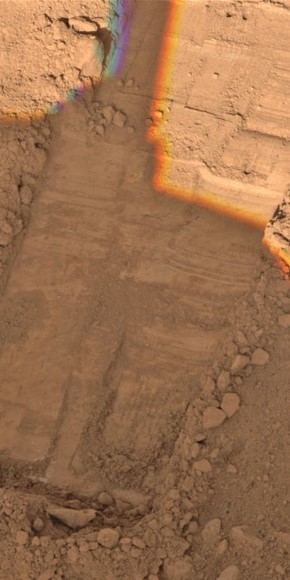
Scientists from the Phoenix lander are analyzing conflicting results from soil samples delivered to two science instruments on the Mars lander. Two different samples analyzed by the spacecraft’s Wet Chemistry Lab both suggested one of the soil constituents may be perchlorate, a highly oxidizing substance that is considered toxic. But results from the TEGA instrument, (Thermal and Evolved-Gas Analyzer) downloaded from the lander over the weekend indicated no evidence of perchlorate. These findings may may have prompted the reports of “provocative” science results recently. Today, Phoenix officials said any reports of the spacecraft finding life were unfounded, and over the weekend, the Phoenix spacecraft itself said, via Twitter, that reports of White House briefings were not true. NASA will hold a media teleconference on Tuesday, Aug. 5, at 2 p.m. EDT, to discuss the recent science activities. A press release from the Phoenix team today said, “Confirmation of the presence of perchlorate and supporting data is important prior to scientific peer review and subsequent public announcements.”
Scientists said that while the conflicting results are unexpected, they are working hard to understand the soil chemistry and mineralogy in the Mars northern arctic region.
“This is surprising since an earlier TEGA measurement of surface materials was consistent with but not conclusive of the presence of perchlorate,” said Peter Smith, Phoenix’s principal investigator at the University of Arizona, Tucson. “We are committed to following a rigorous scientific process. While we have not completed our process on these soil samples, we have very interesting intermediate results,” said Smith, “Initial MECA analyses suggested Earth-like soil. Further analysis has revealed un-Earthlike aspects of the soil chemistry.”
The team also is working to totally exonerate any possibility of the perchlorate readings being influenced by terrestrial sources which may have migrated from the spacecraft, either into samples or into the instrumentation. One type of perchlorate, ammonium perchlorate, is sometimes used as an oxidizer in rocket fuel.
“When surprising results are found, we want to review and assure our extensive pre-launch contamination control processes covered this potential,” said Barry Goldstein, Phoenix project manager at NASA’s Jet Propulsion Laboratory.
An article on AviationWeek.com reported August 1 that the US president had been briefed on findings from Phoenix, and NASA would be ready to reveal the findings in mid-August. An article on Universe Today was based on that report. Today, Aviation Week & Space Technology stands by its report, saying that “the new information involves the “potential for life” on Mars. That potential can either be positive or negative, and the new data indicate the new soil tests are at best inconclusive, according to the information being released on the soil chemistry experiment.”
Phoenix’s Wet Chemistry Lab is part of the Microscopy, Electrochemistry, and Conductivity Analyzer, or MECA instrument which studies soluble chemicals in the soil by mixing a soil sample with a water-based solution with several reagents brought from Earth. The inner surface of each cell’s beaker has 26 sensors that give information about the acidity or alkalinity and concentrations of elements such as chloride or perchlorate. The beaker also can detect concentrations of magnesium, calcium and potassium, which form salts that are soluble in water.
The TEGA instrument has tiny ovens that heat soil samples, and analyzers that “sniff” vapors released from substances in a sample.
Original News Source: Phoenix News
It sounds like an unavoidable issue of chemical confusion when you scoop where the lander just pooped.
Maybe someone with a better understanding of biochemistry can explain but, what would the presence of natural perchlorate mean in respect to the potential for life?
Ha. Huge let down.
Hmmm, just like getting pregnant, then finding your not.
surely any waterice soil in the vicinity of phoenix lander must have been heavily polluted by the exhaustng encines during landing
@Maxwell: Aren’t the Phoenix’s landing thrusters powered by hydrazine, and not a perchlorate-oxidizer/fuel mix?
Hey, we known since Viking that the chemisty of Mars is just very weird.
It will be interesting to see if the perchlorate could be a resource for a return trip.
In a smoke filled press room, 12 angry scientists clutched their sweat-stained spectrograph reports chanting, ” We want our perchlorate and we want it now.” Meanwhile, the two presidential candidates, moved to compassion, tearfully hugged each other and pledged their support. Choking back emotion, they emarked on the first-ever perchlorate world tour, joined by a chorus of aging folk singers.
Perchlorate is typically used in solid rocket fuel, and can be found in explosives like fireworks and other various pyrotechnics. It is a stretch, but possible there was some sort of contamination.
Phoenix thrusters used hydrazine to land on the planet, so “directly” it is unlikely a source. I’m not sure if there were some other pyrotechnic devices used on the craft or launch vehicle. Have to watch for an investigation.
Perchlorate is a highly oxidizing salt. In short, it means it would be difficult to grow plants an area containing it. Quite a different report from the initial findings, which found a great deal of non-reactive minerals. A fact which irritates many I bet.
So, like a mid-day soap opera. Tune in tomorrow for the latest in the saga of Phoenix on Mars.
I saw something on the scroller while watching Glenn Beck on Headline News last night that said there was a toxic chemical found in Mars’ soil and that it dims chances for finding life on Mars. Could that be the perchlorate we’re focused on now?
ahh its probably all another big government coverup!!!!!
Yep – notice how they were heading to talk to the Bush Science Advisory board over the weekend, and now, after they were supposed to have the conference …
“Nope, uhh, no conference here. No idea what any of you are talking about.”
Some might call me a “conspiracy theorist,” or something like that, which is fine. However, please keep in mind the Bush administration’s track record of restricting publication of / editing content of / denying evidence of climate science articles. They’ve forced the EPA’s hand on a few issues, as well.
Conspiracy theorist? I’d like to call myself a “rational alarmist.” 😛
I think I know exactly why there are cover-ups. Many many people have this deep rooted understanding of how “God created the Earth” and nothing else was supposed to have life – just another example of our amazing ego. If we were to find out that Mars is harboring life, people would flip out. Same thing goes for the possibility and almost certainty that aliens exist and have visited our planet. People will go absolutely hysterical and there will be chaos because they’ll feel like they’ve been lied to all their lives and that any aliens – and i do mean ANY – must have a personal vendetta to come here and destroy us. I want to know if we are not alone. I want to know because it will be the greatest discovery of our lives. Probably for all of our recorded history even. But we’ll probably never find out because governments across the globe know that if they make any and all knowledge of other living beings public, things will spiral down the toilet very quickly. We will not know until one of these UFOs touches down in front of NASA or at some event with heavy media coverage that would allow cameras to actually capture them. I’m not playing the role of a conspiracy theorist. I hate those people with a passion. It’s just common sense.
Eric – why do you hate conspiracy theorists? There are some real conspiracies, If there were no conspiracies, there wouldn’t need to be a crime called “conspiracy” At least one president was killed as a result of a conspiracy (Abraham Lincoln), and some other infamous crimes have been the result of conspiracy.
I dislike the poor conspiracies because they are a waste of time. Things like “we haven’t been to the moon” is a good example – because there is way too much evidence to the contrary, and way too many people would have to be involved, and it just makes no sense. But I still think it is reasonable to suspect a conspiracy where the other alternatives are equally implausible. Otherwise the conspirators always win.
There isn’t necessarily cover-ups for the sake of keeping things from everyone. However, there are things which are withheld in order to keep other countries from taking advantage of somthing you find before you get a chance to continue. This is somewhat common in the scientific community.
If you find “gold”, you don’t want everyone else to know about it, until you have a chance to prospect it.
So, don’t be alarmed if there isn’t more information which will come out at a later date.
I hope the scientists at NASA are not prone to mass generalizations (toxin here, means no life anywhere) about Mars based on the chemical properties of one tiny patch of Martian soil.
Just imagine of some alien probe came to Earth and landed next to a toxic volcanic lake…took a few samples and said damn must be no life here…time to give up. Of course that may explain why we haven’t met any yet.
My biggest problem with the search for life on Mars is one with no really good solution.
If there is life on Mars, then people will rejoice, (at least those searching for it) and the search will be over. There will be new science to pursuit but the big question will be answered.
This is not so much a problem, but it is an element of a greater problem.
If there is no life on Mars, there will never be a point where everyone can agree to stop searching and move on to other important questions.
How will we ever colonize Mars, or consider the possibility of terraforming or mining the planet if we always treat it with kid gloves, while we hold on to the hope that there might be life, or might have once, long long ago been life on Mars.
I think it was an error is speech to say that I hated conspiracy theorists, generally. I hate the ones that have nothing really backing up what their saying.
I have this on Mars and life:
Either something catastrophic happened to Mars that blew most of it’s atmosphere away or it never had much of an atmosphere to begin with that would help it retain heat. I tend to lean toward the first belief. There are too many features on that planet to have been shaped only by wind erosion, meteors and/or asteroids and volcanism. Volcanism has been dormant on Mars, as far as we can figure, for eons. So if the planet itself is brutally cold, has no habitable atmosphere, and doesn’t seem to have much going on beneath it’s surface, could it really be a place to go in the event that Earth becomes inhabitable?
I’ not a conspirationist either, and still -yes, this is indeed the proof they found “something”. “Huge” discovery to be announced and then next minute -wham- weird conflict appears. they even left a ray of hope – “it could be from Phoenix contamination”, and need further investgation. What further investgation? Is NASA that stupid to not fully test Phoenix on Earth in a “virtual Mars environment”, including the full set of landing and analyzing material. They could do just that to check their Phoenix on board gadgets and if they wouldn’t find anything wrong here then on Mars the accuracy of tests will be perfect. This kind of contamination could occur here on Earth as well. Even now is not to late to recreate in the lab the landing, on a sterile material like sand and than analyzing it to check for contamination from rockets/busters.
Sorry, just an ideea…
I hope we don’t “abruptly lose communication” with the lander anytime soon.. Then we will never hear the end of it! 🙂
I fail to see the political point on these “findings” and the delay to make them public. Io Tru02 is partially right.
Why doesn’t NASA publish all the photos taken? Why the mystery? What is really going on.
Why they adamantly refuse to answer all questions. We all are interested.
As for you in this forum, thank you for censoring my last comment.
…and the trickle became a drip drip drip again. The waffling is outstanding. This is becoming a grand insult to most peoples’ intelligence. What next more disappearing data, or another anomalous loss of control? Enough is already out from credentialed people that showcases our capabilities are well beyond this. Why not fess up and admit projects like Phoenix are nothing more than engineering exercises for the farm league and stop playing this out to everyone like this is the cutting edge.
Because these results are not from photos, they are from TEGA and MECA which are not imagers, they involve a lot of data that is not as simple as a picture.
They are scientists doing their job, they do not have to publish a realtime analysis of their findings, and doing so would be scientifically irresponsible.
The only reason people are acting like there is some kind of hype is because there is the possibility they could announce some findings regarding the habitability of a teaspoon sized spot on Mars. These findings are only a small part of the scientific bulk being unleashed by the very successful Phoenix mission and its scientists.
To diminish their success because you get in an uproar over the mass media’s sensationalist headlines is ridiculous and sad.
Also, for those complaining about the lack of communication which you seem to feel is their responsibility, here is the link to the most recent announcement by the Phoenix Team which should answer lots of your questions, but will no doubt leave you convinced that there is a great universal conspiracy against your ability to gain knowledge.
http://phoenix.lpl.arizona.edu/08_05_pr.php
I would also suggest that something be posted here in regard to the statement ‘conflicting results’. It appears that the MECA team does not believe their lack of detection of perchlorate contradicts the findings from TEGA.
I’m with John…. Let us see what happens. No reason to jump to conclusions.
Example: Up until a couple of days ago I thought the Huygens probe was pretty much a failure. It took a couple of pictures for a couple of seconds, but that was pretty much it… Now (after more than three years) we may be getting some data analysis from it…. So……………
I would advise everybody to listen to the media briefing the Phoenix team issued today (available here. It’s rather lengthy (1 hour) but clears up a lot of things, tries (unsuccessfully, I’m sure, but quite effectively as far as I’m concerned) to put the cork back in the speculation bottle, and the team says a thing or two very relevant to the whole life on mars issue.
In a nutshell, it’s not 100% certain that it was indeed perchorate that was found, they are still testing other possible explanations for the experimental results (as stated in this article here), but the case for perchlorate is strong. The journalists made a lot of questions about what perchlorate is, where it can be found in nature and what its impact might be for past or present martian life. The answers were pretty clear. I retained two things in particular: there’s still a whole lot to be learned about those molecules and their interaction with organic molecules in general and living organisms in particular, but they (or some perchlorates at least) can interact without causing much damage and even with the potential to be used as energy source. The fact that perchlorates are found on Earth’s Atacama Desert, where a thriving microbial community has its habitat, was mentioned several times.
The other thing that stood out for me was that, since percholates are ionic compounds, they dissolve very easily in water and therefore, under Earth conditions, are very efficiently washed away from the soil except in very dry climates. This means that once we find a way to have liquid water contacting with martian soil (inside labs, in pressurized modules, even in domes or whatever), the removal of these compounds from the soil would be pretty much an immediate consequence of adding water to it.
Whatever the result turns out to be on the perchlorate front, the bunch of surprises Phoenix dug up (literally) until now leads me to strengthen my opinion that we need many more robotic missions to Mars before even thinking to send people there. I don’t think we know nearly enough of how the planet works to prepare a crew for a stay of a couple of months in it. Perhaps a whole fleet of Spirit-like rovers in addition to missions like the MSL wouldn’t be such a bad idea. The cost of development would be zero and even if the outcome is smaller than that of the two pioneer rovers it’d probably be worth it.
Thanks go out to John for the link to the relevant Phoenix press release. I agree with him that at this very early stage of the analysis of instrumental results, no conflicts exist at this time between MECA & TEGA instruments. Detailed peer-reviewed analysis of measurements made by Phoenix may take months( or years ) and I see no reason for any rush to judgement or ‘conspiracy theories’ at this time. Proper scientific analysis takes time, so what’s the rush? Also, might detection of perchlorates only pertain to this particular site? Mars is a big place, so might it be possible this is only a local occurance? Why not give the scientific community some time to digest & analyze the data?
They also discussed the local or global presence of these substances in the briefing. The common assumption is that, given the fact that the planet is periodically engulfed by a global dust storm, whatever substances that are found in superficial sediments should be more or less the same around the globe. But this is only an assumption, of course. To be sure, more places should be studied.
‘…Much Ado about Nothing…’ Shakespeare