
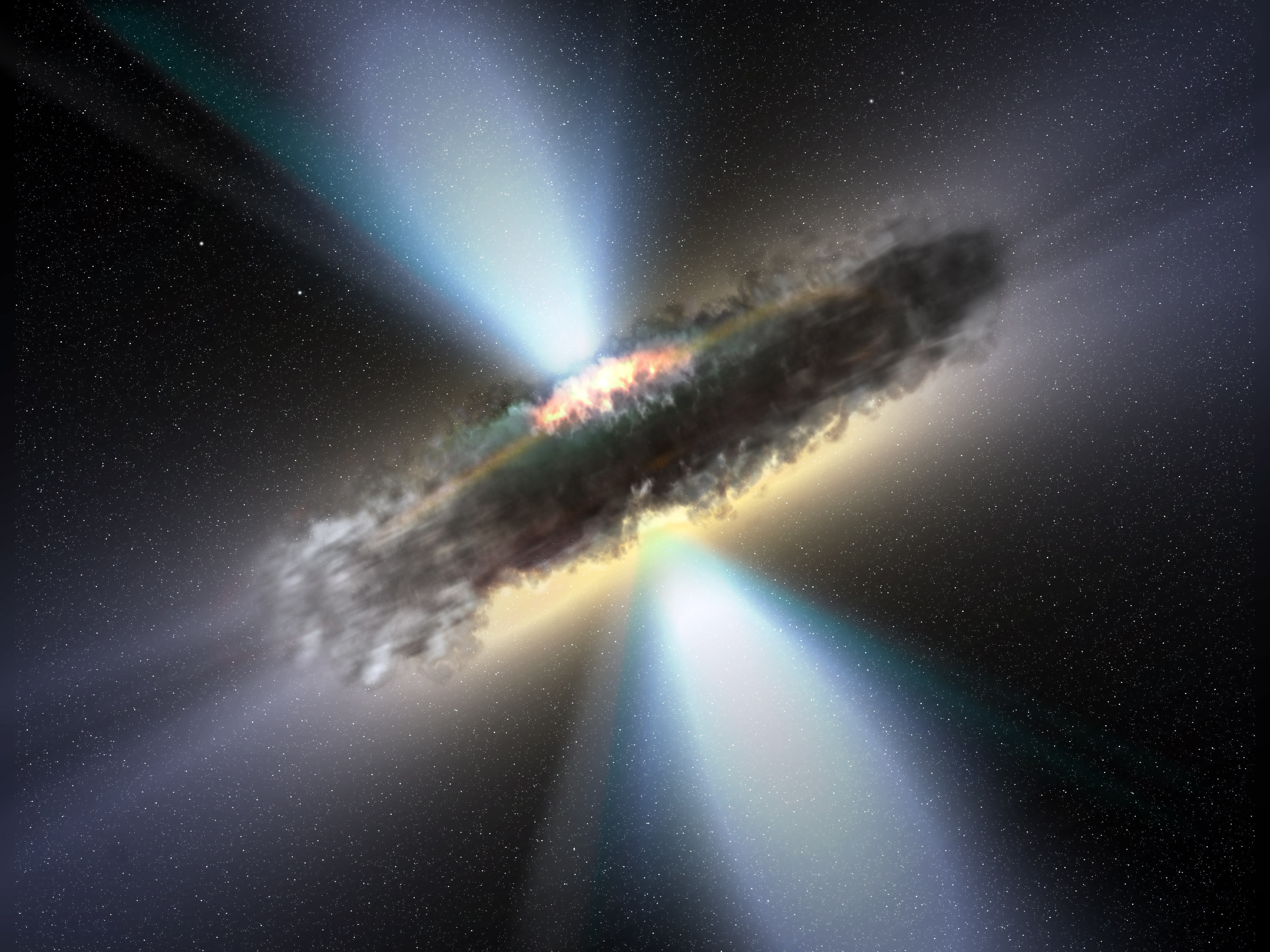
According to Einstein’s theory of general relativity, black holes are regions of space where gravity is so strong that not even light can escape. And in the 1970’s physicist Stephen Hawking asserted that any information sucked inside a black hole would be permanently lost. But now, researchers at Penn State have shown that information can be recovered from black holes.
A fundamental part of quantum physics is that information cannot be lost, so Hawking’s claim has been debated. His idea was generally accepted by physicists until the late 1990s, when many began to doubt the assertion. Even Hawking himself renounced the idea in 2004. Yet no one, until now, has been able to provide a plausible mechanism for how information might escape from a black hole. A team of physicists led by Abhay Ashtekar, say their findings expand space-time beyond its assumed size, providing room for information to reappear.
Ashtekar used an analogy from Alice in Wonderland: “When the Cheshire cat disappears, his grin remains,” he said. “We used to think it was the same way with black holes. Hawking’s analysis suggested that at the end of a black hole’s life, even after it has completely evaporated away, a singularity, or a final edge to space-time, is left behind, and this singularity serves as a sink for unrecoverable information.”
But the Penn State team suggest that singularities do not exist in the real world. “Information only appears to be lost because we have been looking at a restricted part of the true quantum-mechanical space-time,” said Ashtekar. “Once you consider quantum gravity, then space-time becomes much larger and there is room for information to reappear in the distant future on the other side of what was first thought to be the end of space-time.”
According to Ashtekar, space-time is not a continuum as physicists once believed. Instead, it is made up of individual building blocks, just as a piece of fabric, though it appears to be continuous, is made up of individual threads. “Once we realized that the notion of space-time as a continuum is only an approximation of reality, it became clear to us that singularities are merely artifacts of our insistence that space-time should be described as a continuum.”
To conduct their studies, the team used a two-dimensional model of black holes to investigate the quantum nature of real black holes, which exist in four dimensions. That’s because two-dimensional systems are simpler to study mathematically. But because of the close similarities between two-dimensional black holes and spherical four-dimensional black holes, the team believes that this approach is a general mechanism that can be applied in four dimensions. The group now is pursuing methods for directly studying four-dimensional black holes.
The team’s work will be published in the May 20, 2008 issue of the journal Physical Review Letters.
Original News Source: Penn State Press Release
I’ve always puzzled over the idea that information is ‘lost’ inside a black hole. To an outside observer (eg. the universe), no object ever actually appears to enter a black hole; time dilation effects cause any infalling object’s approach to the event horizon to become slower and its image to become more and more redshifted. So shouldn’t the object always be visible outside the horizon, simply very, very (add a mindboggling number of ‘very’s here) dim?
So, if one were to accidentally enter a black hole (and survive), s/he could travel far in to the future? But what is “the other side of what was first thought to be the end of space-time” ? It says it’s in the future, but it seems that it’s not purely continuous either.
Anyone that thinks Information can be retrieved from a Black Hole has apparently never worked for the Government.
A black Hole warps both Space and Time. Is time compressed by the same mechanism that space is compressed within a black hole?
Within the confines of a black hole does everything happen at once since the dimension of time doesn’t exist to separate it?
Do the X-Rays Emitted from a Black hole originate in what we consider the Present or are they vestiges of a time that has passed or perhaps have they been transported from a time some point in the future?
“Anyone that thinks Information can be retrieved from a Black Hole has apparently never worked for the Government. ”
Or worked on a PC running the Windows operating system.
Hi Silver Thread
Black holes don’t compress space or time, but within the event horizon space-time swap places and all paths end in the singularity – at least in a non-rotating Schwarzschild black hole. The singularity becomes “the future” and is as unavoidable as such.
If the hole is rotating an inner and outer horizon form and things get tricky. But the fall is as inexorable.
What is the definition of the term “information”, which is used in the context of Black Holes and of this article? What does “information” mean?
As long as I do not know, I don’t even get the glimpse of understanding of what this article is dealing with.
For example, when a body collides with and so falls into a Black Hole, it is obviously ripped apart previously to it’s disappearing beyond the Event Horizon. So, in analogy, what no one would ever see from Cheshire cat shortly before disappearing inside the Black Hole would be a grin, but a heap of hamburger meat.
So, is Abhay Ashtekar talking about the “memory” of that hamburger meat, when he is refering to “information”? Or is it our knowledge of how a photon, for example, or a proton or neutron, should be “normally”? Is it “information” about the features of the basic building blocks of the things on our side of the Event Horizon?
So, what is the definition of “information”?
So if this is true… why are there no black holes from the past spouting junk from then or randomly deposited crap coming out of nowhere? Just something we haven’t recorded yet?
sorry for the double post… i don’t know how to edit previous… anyways, I’m not a scientist… I don’t even have college degree yet… But what if everything was thrown into the same future, at the same place? Could this be said to be like the Big Bang all over again? Could it be an origin for it?
As I understand it, “Information” consists of the sum total of matter and energy, and all of the transitional states in between. The last bit is the most critical. Causality in physics requires that you be able to reconstruct what you had before using what you have now.
Hawking caused problems when he suggested that the gravity well around a black hole emitted “Hawking radiation”. As the radiation came from around the black hole, and not from the object itself, the information contained in the Hawking radiation has no connection with all of the stuff that fell into the black hole, breaking causality and causing information to be lost.
As the article says, Hawking eventually reversed he position on the paradox that he created for it. What the article does not say is how he chose to explain it. Hawking proposed that there must be infinte parallel realities. In some of them, the black hole exists and the information is lost. In others, the black hole does not develop and the information is not lost. So as long as there is a parallel relaity out there somewhere where a given bit of information does not fall into a black hole, causality is not broken, and physicists can sleep at night.
This is all very interesting information, but it’s not what I needed to know. If I’m falling into a Black Hole what do I do to escape. I’m on a schedule so I can’t wait for the end of the black hole’s life – I need out now
You’re screwed. One of your parallel reality selves might be lucky enough to not fall in though.
From the article: “A fundamental part of quantum physics is that information cannot be lost”. Unless, of course, your hard drive crashes.
Uh-huh, don’t worry. The tidal forces will kill you long before you actually fall into the black hole!
As to the X-Rays being emitted from a black hole, they aren’t actually coming from the black hole (as defined by the event horizon) but rather from the disk of dust gases and crud spiraling into it and heating up.
We don’t directly detect the black hole, just it’s effects on everything around it. (Even gravitationally, we just watch other things wobble, warp, or wiz by.)
Just because something exists and you know where it is does not necessarily mean that you can get it.
Besides, there is no evidence to suggest that a black hole has any unusual properties. It is only by assumption that all of the matter accumulated in bodies greater than the size of a star would be not only be luminescent but as luminescent. Rather than trapping light, isnt it more plausible that light simply isnt being produced?
APthebold Says:
May 16th, 2008 at 6:36 am
“…’Information’ consists of the sum total of matter and energy, and all of the transitional states in between. The last bit is the most critical. Causality in physics requires that you be able to reconstruct what you had before using what you have now.”
Okay, so till Ashtekar it was thought that if a Black Holes comes across our way, “causality” ( which equals information) is sucked into a realm which is forever strictly prohibited for human perception of cause and effect. So the method of falsification is not applicable any longer and that what is does enter a state of metaphysics.
Ashtekar now claims that information might “reappear in the distant future on the other side of what was first thought to be the end of space-time”.
Does this mean a time travel into the future for every piece of “information” (matter, energy) ever dunked into any Black Hole? Just to rise like a phoenix?
APthebold,
in other words: “information” means “knowledge”? Or, the possibility to know what had happened to matter and energy and why it has the current state. And this knowledge is not made impossible by a stay of the observed object inside of a Black Hole.
So maybe we already experience “information” that has been in a Black Hole and which now is already back to normal space-time.
I see some trouble in defining “information” here, but let me just ask how we define “lost.” My understanding of the word is that it simply means something exists where we cannot find it, making it “lost,” an obvious perspectival concept.
However, the word, in some context here, seems to be used to define the concept of no longer existing at all.
So my question would be, is “lost” defined as information of unknown whereabouts, or information that no longer exists?
In essence even something that is said to be “lost for good” still exists somewhere, ironically once something fits this old adage it is said to be lost so far as that it “no longer matters.”
I at least find that humorous.
So if Professor Mallett is correct, rotating black holes could send some circulating particles back in time as their speed accelerates beyond the speed of light due to rotating frames. How does this impact the “loss of information” conundrum? Perhaps some information is sent to the far future while other information is sent to the past (but not beyond the moment when the black hole formed.)
There seems to be some confusion whenever the word “Information” arises in a physics discussion. Perhaps this will help:
According to Wikipedia; “Information itself may be loosely defined as “that which can distinguish one thing from another”.
The information embodied by a thing can thus be said to be the identity of the particular thing itself, that is, all of its properties, all that makes it distinct from other (real or potential) things.”
Information can be defined by a physical principle called Landauer’s principle, which says that to erase 1 bit of information irreversibly at least k ln(2) entropy should be increased and at least kT ln(2) energy should be consumed, where k is the Boltzman’s constant and T is the temperature of a thermal bath. Thus any physical process could, at least in principle, be formulated in terms of its information content (in bits) just as it could be formulated in terms of its energy or entropy.
For physical systems we must distinguish between classical information and quantum information. Quantum information specifies the complete quantum state vector (or equivalently, wavefunction) of a system, whereas classical information, roughly speaking, only picks out a definite (pure) quantum state if we are already given a pre-specified set of distinguishable (orthogonal) quantum states to choose from; such a set forms a basis for the vector space of all the possible pure quantum states. (Quantum states can be statistically mixed, corresponding to an experiment involving a random change of the parameters. States obtained in this way are called mixed states, as opposed to pure states which cannot be described as a mixture of others.)
The usual view has been that a black hole takes a state described by a set of eigenvalues and coefficients, a large set of numbers, and transforms it into a state described by temperature, one number. All the other structure of the state was lost in the transformation.
Sceptic Tim, that is a lot of information on information.
I have a couple of questions, or points to make.
If “things” are identifiable by their embodied information being dissimilar from one “thing” to the next, then it almost seems as though information, in this context, is a conduit not to identification but to additional information which does not appear to be discernable by the aforementioned method.
More simply put. when information can be defined as that which distinguishes one thing from another, what is being said is that information can be defined as information which distinguishes a certain type of information from other types.
It would seem then that information itself, or the “thing” is not being directly observed but rather the things process of having its own information be discernable among other types.
Secondly a focus on the dissimilarities or “all that makes it distinct from other (real or potential) things” means that information is defined not by what it is, but by what it is not.
I am not saying we think of information in this way but it’s definition does.
I have a question I would like to ask. With regard to Landauers principle, by what method do we assert that information can be erased irreversibly, or how do we know this?
String theorists won’t like this – Loop Quantum Gravity scores.
Ry:
Landauers principle essentially relates energy and entropy in terms of ‘bits’ of information. Essentially, it is simply stating that entropy increases when energy is consumed in conformance with the second law of thermodynamics (entropy will always remain constant or increase). Landauer has simply quantitatively related this exchange to the amount of information in a system: he showed that the increase in entropy (eg. heating a snowflake until it turns into water vapor) is associated with the loss of information (the complex mathematical symmetries of that snowflake). The information remaining in the vapor is less than that in the snowflake; and we cannot reconstruct that snowflake from knowledge of the vapor produced from it.
Sceptic Tim,
What you are saying is very interesting, or rather Landauer’s discovery is very fascinating. I cannot disagree with the point you are relaying here as I understand what you are saying about the principle to be true in so much as it makes sense to me. However, at the same time I have to contend that sense with further curiosity in understanding why it is that a transformation from a solid into a liquid brings about the loss of information.
Currently I understand the transformation. I also understand the consequences of this transformation, and think that the theory makes sense, yet I do also feel a begging question of ‘why anyways’ in my head.
It seems that I have an issue with accepting the nature of things, in that I percieve the natural processes to make sense yet be limiting.
More simply put, I understand what happens, but think more so about the idea that it does not have to happen that way. At the same time I am not contending that I or anyone at this point knows another way to change those natural processes that the principle defines.
I feel forced to think of how that snowflake’s information may never be lost. Perhaps if we were to find that it’s information were stored in places other than where we currently know it to be we could have this happen. In this possibility the principle would apply only to the observations we currently have and have less presumption over the truth as we percieve it.
I cannot disagree with what we know, but what we do not know could drastically alter the implications of what we know, and perhaps significantly minimalize them.
Sceptic Tim.
This is only true if you see time as a linear entity. An outstander, not in our fixed interpretation of linear time, might look at the snowflake as ‘the top of a mountain’ and all other states (the vapor) as a way up to the top. Maybe all states will eventually lead to the snowflake, if you take away the ‘time’ limitation.
(sorry about my bad english…)
Those scientists are seeing it all wrong.
A black hole is an event you can compare to a wormhole, however at the other end is not a black hole but a sun. It works like a big afterburner, fuel gets sucked in, pressured and burns. Therefore our sun isn’t a planet (who has ever been behind the sun?).
Hey Mjollnir,
So u’re saying that all stars that we see are the other sides of black holes (aka, white hol3s)? hmmm… that’s something to think about. What about when a massive star dies and becomes a black hole? That means the star reverses its engines?
G’day from the land of ozzzzzzzzz
We have been told that aong many things nothing can escape Black holes. This may be true but for one property of plasma that allows it to form double layers and a Z-pinch within compacted matter core that can create electromagnetic fields ejecting matter via jets from the core itself. So! the BH creates the process and the drive to eject matter, no other process can produce enough power to do so.
Super massive black holes
This is the only conclusion to explain the fast moving objects near the centers of galaxies.
The two reasons are
1. There is not much visible light at the center of galaxies.
2. The speed of objects orbiting near the center of galaxies appears to be very high.
The red and blue shifts of rotating objects and gas clouds on either side of the center would produce
the standard rotation curves. From which it is observed that there is very high red shifts and therefore
very high velocities near the center.
But if there is a massive black hole, should not there be an additional red shift near black hole,
superimposed on the velocity red and blue shifts which would make the rotation curves appear
lop sided? May be the deduced high velocities are wrong.
According to my work, singularities are impossible because I derive the limits on gravity and inertia
See cosmicdarkmatter.com for a partial hint.
You are thinking in one direction, time space is an illusion that follows a set of laws.
just like a video game
just press reset the game was saved
try a different way
and im not saying we are in a simulation
Spirituality+science=truth
Brain…..hurts……thinking about this.
My boyfriend has been trying to explain this crap to me for years. I find it to be fascinating. Hopefully our children will get his brain and my looks/sense of humor.
So, can someone explain in the simplest terms what they mean by information/quantum information? I understand if the Hubble traveled too close to a black hole it would cease to exist, and obviously data could not be transmitted back to us after that. So, when they mean information, do they mean the inability to retrieve information post event horizon? How would we really know that information could not escape? Could it just be distorted, misplaced somewhere like to an inhabitant living in NGC 5078?
Ry Says:
May 18th, 2008 at 10:15 pm
Back to the phenomenologist philosophy eh! .. To those a physical world does not exist… everything is a perceptual phenomenon. Needless to say I am not one of those followers. I work in a physical world that I can “touch” and “sense” …. some call it reality or down to earth.
i just want to know ithat when i die there will be a way to find me alive agan i dont care about how you go about finding a way to make that happion i just want to know that its posably . thats why im looking up black hole ‘s like skirt’s at a dance hall tonight.