
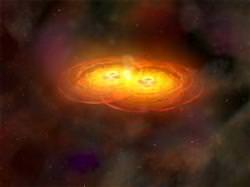
As galaxies merge together, you might be wondering what happens with the supermassive black holes that lurk at their centres. Just imagine the forces unleashed as two black holes with hundreds of millions of times the mass of the Sun come together. The answer will surprise you. Fortunately, it’s an event that we should be able to detect from here on Earth, if we know what we’re looking for.
Most, if not all, galaxies in the Universe seem to contain supermassive blackholes. Some of the biggest can contain hundreds of millions, or even billions of times the mass of our own Sun. And the environments around them can only be called “extreme”. Researchers think that many could be spinning at the maximum rates predicted by Einstein’s theories of relativity – a significant fraction of the speed of light.
As two galaxies merge, their supermassive black holes have to eventually interact. Either through a direct collision, or by spiraling inward until they eventually merge as well.
And that’s when things get interesting.
According to simulations made by G.A. Shields from the University of Texas, Austin, and E.W. Bonning, from Yale University, the result is often a powerful recoil. Instead of coming together nicely, the forces are so extreme that one black holes is kicked away at a tremendous velocity.
The maximum kick happens with the two black holes are spinning in opposite directions, but they’re on the same orbital plane – imagine two spinning tops coming together. In a fraction of a second, one black hole is given enough of a kick to send it right out of the newly merged galaxy, never to return.
As one black hole is given a kick, the other receives a tremendous amount of energy, injected into the disk of gas and dust surrounding it. The accretion disk will blaze with a soft X-ray flare that should last thousands of years.
So even though mergers between supermassive black holes are extremely rare events, the afterglow lasts long enough that we should be able to detect a large number out there in space right now. The researchers estimate that there could be as many as 100 of these recent recoil events happening within 5 billion light-years of the Earth.
Their recently updated journal article, entitled Powerful Flares from Recoiling Black Holes in Quasars will be published in an upcoming issue of the Astrophysics Journal.
Original Source: Arxiv
That would be so cool to expereince.
Could it be the black holes hold anti matter and not regular matter or maybe regular matter turns into anti matter when it is in a black hole? The reason I ask is this galaxy collision black hole thing sounds a lot like an atom when electricity passes from one to the next. Maybe the non black hole part of the galaxy is like the electrons and black hole is like the nucleas and much like atoms pass electrons along, galaxies pass matter along. I suspect the same is true at the universe level as well. Seems like same theme on different scales.
Hummm, so… Lets say that the black hole “kicked out” is sent flying at a very very high speed, and pulls a few stars along with it, and maybe the light from the glow of material around the kicked out black hole then would appear a lot more red-shifted than the nearby galaxy . . . And since this would occur in interacting colliding galaxies, they would, in the telescope, appear “peculiar” would then not? So there might be quasi-stellar objects, ejected from peculiar galaxies with discordant red-shifts perhaps??? Someone call Mr. Arp!
I reckon that the gravity that drives towards the black hole centre will be weaken by the other, causing the black holes to reduce their hold on their matter and energy. One might exploded.
Is this a “Small Bang”
Dave,
Are you suggesting the universe red shift doesnt mean it’s expanding? Please elaborate on your red shift comment. Thanks.
So through this, 2 super-massive black holes can never merge into 1 ? In a galaxy merger the two will always interact in this manner? Cool!
Hmm . . . the merging of two black holes, including the accretion disks, could be a relatively silent unspectacular event. The reason could be as simple as absorbtion of one hole of another regardless of spin direction or mass. Assuming black hole theory is correct, nothing can escape a black hole. Why then would there necessarily have to be fireworks? Why would the merging black holes have to give up energy?
Thank guys. More “simulations” and no observations!
Fusion is when two nuclei of particles merge together giving off tremendous amount of energy. Aren’t black holes void of electrons, protons, etc. Why wouldn’t two black hole be theoretically the same as fusion two nuclei but on an inconceivable scale?????
Perhaps gravitational waves would act to repel two black holes from merging.
Can’t wait til they find an example…
Blak holes donot have matter ,pro and anti.
If one black hole gets kicked out of the galaxy, I wonder why the other doesn’t fly out in the opposite direction…..
“# Dave Says:
February 29th, 2008 at 4:01 pm
Hummm, so… Lets say that the black hole “kicked out” is sent flying at a very very high speed, and pulls a few stars along with it, and maybe the light from the glow of material around the kicked out black hole then would appear a lot more red-shifted than the nearby galaxy . . . And since this would occur in interacting colliding galaxies, they would, in the telescope, appear “peculiar” would then not? So there might be quasi-stellar objects, ejected from peculiar galaxies with discordant red-shifts perhaps??? Someone call Mr. Arp!”
Except for the fact that the variability of QSO sources, the features of their emission spectrums (both broad and detailed) etc. etc. are not stellar in any way shape or form…
“# Chuck Lam Says:
March 1st, 2008 at 3:54 pm
Hmm . . . the merging of two black holes, including the accretion disks, could be a relatively silent unspectacular event. The reason could be as simple as absorbtion of one hole of another regardless of spin direction or mass. Assuming black hole theory is correct, nothing can escape a black hole. Why then would there necessarily have to be fireworks? Why would the merging black holes have to give up energy?”
Two black holes in the middle of nowhere could be seen to merge without ‘fireworks’, though there would be other indicators such as (most probably) gravitational waves. In reality though, all black holes would likely be surrounded by material which would be excited greatly by a merger event. It is this emission that would be able to be detected. It is pretty much inconceivable that a merger could take place without at least some degree of accretion disk emission.
So this must be the explanation for the quasar/galacy mistery of GQ6 NGC_4319
Astrofriend is probably correct concerning emissions. Good thinking!
Astrofriend makes sense for what we know, which may not be much. “Assuming black hole theory is correct, nothing can escape a black hole”. Yes for what theory says but that doesn’t quite hold up when you start applying it to the “Big Bang”. We are all still in nursery school when it comes to what is really going on.
Not sure if anyone is still following this but I was asked to elaborate.
Mr. Arp’s research showed that QSO’s had a remarkable, and statistically amazing, tendancy to be located in the area near “peculiar” galaxies, which we are aware today are often two or more galaxies in the process of collision and integration. QSO’s with high red-shifts are assumed to be tremedously distant objects, and thus could not be physically associated with the nearby galaxies that Apr’s research showed them to be located near on photographic plates that he studied, at least that is the predominent thinking. Since the QSO red shift, and consequent calculation of the Hubble constant, all fit neatly into the idea of universal expansion, the great majority of Arps contemporaries (and still today) did not want to have the universal expansion bubble burst by Arps “silly” ideas Arp’s idea was that, given a nearly impossible to be cooincedence statistical correlation of QSO’s and peculiar galaxies in terms of location, and in in terms of what appear to be visible streams of stars connecting them, then at least some QSO’s were NOT at tremendous distances at all and that there was some other possible explanation for the red-shifts. Arp has been roundly labeled a lunatic by modern physicists, and his ideas summarily dismissed. As for the spectral analysis of QSO’s “the features of their emission spectrums (both broad and detailed) etc. etc. are not stellar in any way shape or form..” Correct me here if I am wrong but if one explanation for Arp’s QSO’s is that they may be highly accelerated ejected black holes, I would think their spectrum might be expected to by rather non-stellar appearing would it not?
well i have an idea….mabey if two supermassive black holes were to at least try to collide then mabey they would because if one is spinning one way and the other is spinnig the other way then mabey they would but no one can say they wouldnt because no one really knows !!!!!!!
hehehehe anyone up for some black hole spinning top fights?
both massive black hole will dissepired… acording 2 pysic law.. the volcano and dinemite… just the matter…
A merger of 2 supermasive black holes at the center of a galaxy would increase gravitational field of the new black hole and have a significant impact on the rest of the galaxy.
So if this happens would there be a bunch of black holes out there just floating around in space capturing anything between the galaxies that gets near it?? We would never see it coming!
My thoughts ,if they say you went into the outer portion of a black hole you would be accelerated forward in time and if you were able to come back out you would see that you have gone into the future without aging as much as your surroundings . That means for an observer that watched you go into the future you just popped out of existence because you left to go into the future . So thinking on that note if two black holes merge there should be only the slightest ghost of the happening the intruding black hole went into the future by going into a black hole ! if its gone there then so has most of its gravitational forces . Now look at this from a distance and see that there were two high gravity objects thats two forces now join them and one force disappears ! This will produce a missing gravity wave if all theory is correct. Or if the thing should fly apart and still make two again there should be some very small black holes produced between them that should have such a small mass as to not be able to maintain the black hole effect thus bringing matter back into normal existence (an EXPLOSION OF NEW MATTER BETWEEN two black holes going in opposite directions ) . And possibly the mini black holes that can still exist as black holes ,could these be small enough to allow light to be in orbit around them and showing flashes whenever an object gets sucked into them while hitting this orbiting light shell ? Is there a shell of light orbiting at a precise distance from all black holes that is similar to a laser in that it gets stronger and actually aligns itself to the point of lasing emissions sporadically or when an object hits its orbit disturbing its orbit ? I think we really don’t have an understanding of what black holes are yet ! We need to watch these constantly to see what is happening . Are black holes really ghosts of matter going into the future and we are only seeing the glimpse of them passing by ? Including their gravity . Wouldn’t this produce a very different kind of gravity than we expect ? Where there is giant explosions of matter like in a new star is there two black holes flying away from it making trails through the merging galaxies as they add to their mass ? What if the two black holes met so violently that they went into an expansion that ended their life as black holes then all of the matter would suddenly appear as in a big bang ?
I do have some great dreams !
If two supermassive galactic black holes “collide” such that one is flung away, do the contents of the black holes get close enough that their event horizons merge or make contact?
It is interesting that David Gronczniak and I independently arrived at one possible product of two massive “high spin” black holes colliding – that being black holes formed from initial masses much smaller than could be created through the normal stellar processes. With such massive forces at play, perhaps a small object, say the mass of earth, could be “compressed” right down to a singularity. What size would the accretion disk be? The size of a marble? Smaller? What if one of these flung itself into our solar system – what effects would it have? Would it orbit? What if it collided with a planet like earth? How long would it take for it to absorb another planet? What if it was flung out at such a velocity that it screamed through our solar system at a high fraction of the speed of light? Would it pass through a planet like earth and keep on going? If so, how much matter would it suck in as it passed through our planet? What effects would it have on our planet as it passed through? What if this neo-black hole was created from a mass as small as 1/1000 earths mass – how small would its accretion disk be? Can this be calculated? The size of a bacterium? A molecule? What if that hit the earth at a high fraction of the speed of light? Any ideas?
Thinking about Bob Kapli’s idea , neutrinos sort of act like mini black holes and they seem to pass right through planets ! If they were really little black holes then any thing they would hit would instantly be absorbed . This absorption process would tend to actually speed up the total particles mass , so here it is the particle that exists here and now that on a sub atomic level gets absorbed into an on coming black hole both attract each other and accelerate towards this combining action then upon joining the hit particle gets placed into the future and being no longer here tends not to slow down the original mini black hole it sort of explains how a black hole is not impeded by a planet in its way . However some deflection in its original path would probably occur as the absorb process would very likely be off center thus the in and out path might not (match or line up )make sense in the detectors they use for finding neutrinos . They look for neutrinos with large tanks of a chemical as the detector ,in the bottom of mine shafts deep in the earth as no other particle (except for a black hole) can penetrate that far. If they could examine the entry and exit hole of the detector tank they might find out something new ! This is becoming possible with our newest technology . The new particle accelerator in Geneva might get these results . I think that a black hole traveling at a very high speed near the speed of light would be really strange ,this is matter that is already traveling into the future even if standing still but add the speed and get an even faster launch into the future ,nullifying the effects of becoming more massive as the approach of light speed is almost reached. This is really hard to imagine ,what would it appear to be ?
when two black holes of near equal size collide a big bang will happen .If one is larger than the other , the smaller will be absorbed. therefore many “big bang” might be possible. This I have thought for many years.
A little thing about black holes is how there can be any differences in their sizes? This is what should be happening if the science is correct , mass reaches a concentration of sufficient amounts to cause the collapse of the spacing between atoms and shrinks in physical size it takes up visually . Now this still has all its mass but in a smaller more concentrated package . Now its coined as being a black hole as its gravity is such that light cannot escape and all the definitions of a black hole are officially in play. I don’t believe this to be true because of the idea that going into a close orbit of a black hole would bring you into the future as you are feeling the effects of its high gravity. If this were true then the stuff in the black hole has already gone into the future along with its gravity !
So the black hole is now almost a ghost of itself with less apparent gravity as most of or all of its mass has gone into or in the process of going into the future at an accelerated rate ! So if this is whats happening then why should the physical gravity or appearance of a black hole be able to be changed by the addition of more mass ? Any more mass merely gets transported into the future upon entering its core . It could not just be simply be added to its mass as its mass is traveling into the future already !
So the idea for me is there is theoretically only one actual size for all black holes to appear to us in our present way that time occurs for us in this universe or dimension . Now that they are saying that there is different sizes for black holes actually proves they don’t really have a good definition at all of what they are ! Possibly i think these are really like giant capacitors or rechargeable batteries that in our view look like black holes but are really not what they seem to be they have no emitting radiations of anything but gravity but might be the entrances to other existences and be emitting their energies there. This might account for different apparent sizes for black holes they are possibly the entrance hole of different sizes to the other dimensions , and the flow between is at different rates . This would tend to cause sort of a traffic jam and make them appear larger and have more gravity . I think there are black holes of very small size and having very localized effects that are extremely fast accelerators of matter into the future .
It would look like an implosion point where things just disappear and actually not look like an actual physical object of any type or size. As soon as matter enters its area it is absorbed and the noticed effect would be the ripple in the matter that surrounded the object that disappeared in a flash.
There is also the possibility that it doesn’t go in a flash but gets absorbed slowly like being sucked through a pin hole leak into another area or time.
In some areas there might be planets or even stars that are being swiss cheesed ( cores of matter eaten by a black hole ) while the gravity of it is causing it to be trapped in a line type of orbit that is or is not perfect . If perfect the object will be fairly stable for a small amount of time as the mini black hole goes bouncing back and forth through the same hole until it all falls into itself . On the other hand if its off a little it would tend to eat the object up much faster taking new fresh bites till there is not enough mass to keep the black hole captured.
Its last bite would probably tend to slow down its movement in space and it would be less than noticeable to us at this time in our science knowledge. As the black hole was absorbing its meal there is less for it to eat and this would tend to put the brakes on it thus slowing down its travels to outer space into new areas . This would make me feel a little safer in our world . This might explain why these black holes are not traveling like crazy through space eating everything in its path ,they would appear to travel along with its host matter that is around it ,that helped it to form in the first place . This might explain why they say that black holes are feeding and not feeding . They feed when an object falls within its gravity and this upsets its movement in space then when it has mostly absorbed its matter just acquired it slows the upset and becomes stable again . This happens over and over as this eating process makes gravity waves that upsets the objects nearest to itself , causing more objects to get out of wack .
If black holes were moving through space at great speeds and numbers there would be evidence of missing material in gaseous nebulae ,They would look like dark straight lines of missing gas . The lines with time added would look like dashes in a swirling system . Do we see this anywhere in space , not yet ,i don’t think but someone should be looking for this effect.
And another thing about mass and speed of its travel ,the faster it travels the more massive it becomes thats why matter to travel at near the speed of light would be nearly impossible . So matter traveling into a black hole approaching the speed of light would look more massive than it was originally ,this would tend to mean that just the small amount of matter in the vacuum of space is enough to generate the effect of a black hole as its just very small amounts of matter accelerating to near speed of light and appearing to be massive. How this all fits i think nobody knows !
But its here for us to figure out ! I haven’t begun to even think about this on any great scale YET !
I would be interested in making an animation of these ideas and it might actually make more sense even to me. If i saw a movie of these ideas i might be able to see a new understanding of it all together or spark someone else to fitting it all together is a more likely thing to happen.
I would love to write sifi but with it pointing toward reality ,thats freaky enough !
It might be that a black hole that has just gained enough mass to be created is going to be the same size all over the universe ,no matter where it was formed . And i think that its effects of matter going into the future would be at its least amount and because of this look like a giant (or the largest ones in existence)and would have the slowest acceleration of matter entering its realm . However a black hole that has gathered more material (mass) is going to accelerate matter faster to its interior and appear smaller because the material has gone into the future faster and now it appears to us as to have vanished !
Looking at this from the stand point that particles in motion tend to stay in motion would explain why even the mass of the original black hole would get bombarded by incoming mass and forced into the future at an accelerated rate than it was when first formed and everything was at equilibrium . Now as this thing gets more mass that is going into the future faster and faster as it feeds ,i think its visual appearance and gravitational effects will appear to be smaller . The actual diameter of its influence to us viewing will physically be smaller and this is because it has lost mass to the future but still must remain as a black hole here its real gravitational strength will be there but only after entering its influence will you feel it . The sphere of its influence can be very small ,possibly if all matter enters from our universe then it might bounce back into a big bang ! If the only thing that was here is in one black hole then whats left to happen ? All that mass traveling into the future trying to fight the forces of an empty universe with no time or with all time ? I think this would result in the big bang and all start over again ,and the sporadic pulses of the gathering of all that has existed will be again restored and include some of the pulses and information of the un-evenness of its origin will also be there and somewhat restored . This will happen in cycles like it has probably happened before . Please excuse my repetitiveness in my explanation but you see why i almost flunked English ! My science ideas were what i really wanted to concentrate on while i thought they were trying to fill my mind with useless Hog Wash in high school !
When i asked the sister in catholic grade school weather i was looking back in time when i looked into a telescope she slapped me for having such devilish thoughts and right there began my revolt of the school system ! I HATED ! School ! Till i went to public high school and found a real Science class ! Wow ! I became great friends with all the science teachers and had some fun (I was a science NERD or GEEK !).
Is it possible that one of the black holes will miss and go way of?If so were will it might go?
I wonder if 1 of the black holes is tooooooooooo big!What would happen…..
OK! so i read this and i want to know, if light CANNOT escape the black hole, then that means there is something faster then the speed of light. and if the 2 black holes are colliding, then wouldent the bigger of the 2 still suck the smaller one up??? because, the way i see it, that the force is soooo powerfull, it would take more force to get away then just 2 be sucked in, so in other words the massive black holes would be the same, just one is the luckier of the 2??? please someone that is really smart, plese answer a few of my questions thank you lotts
About the black hole being too big. If the black hole is very large it is probably a very young one as i see it .Here is my thoughts ,something massive enough to form a black hole would probably actually be (more) weak in gravitational effects and appear larger than one that has more mass that tends to compact its visable size (sort of the effect of collapsing in on itself).
And for faster than the speed of light that is only correct from our point of view ,as you speed up entering the black hole you go into another dimension ,or the future! And the observed universe looks to you to slow down. Light would do the same. There are many problems with this idea as any material that speeds up to the speed of light is also looking like it is becoming more massive (as the great minds say ) so is it just a gateway to the future and we are just seeing this effect in a very small area in space ? We need to do some more work by years of observations to figure this out . I think the answer might be more rapidly learned by seeing an actual collision of something into a black hole. Or find one that has traveled through a galaxy of early forming stars so a path of destruction can be looked at and also observe the explosions that would have occured.
I think that two gateways (black holes) that combine might have a minimal effect except for one transfering some motion to the more massive one ,and see if it gets bigger or smaller in appearance . We have not seen this yet or it might still not be viewable with todays technology.
I do think that there is evidence out there that we havent pointed our equipment at yet and will be found soon ! Look for curved and straight lines through gaseous formations and find a black hole at one end ,these lines might be dark or light but will have some gaps etc. from it gathering other materials in its path. This will give great insight to what these things are. Personally i think that the gravity that exists on a observed black holes area where it meets space is very localized and becomes almost infinate in a fraction of an inch as observable to us , this is not to say that there is little gravity at some greater distance from its surface (observable division) blackness. I do think there is great gravity around it ,after all it deflects stars orbits ! But i think just the matter of space that enters its observed blackness becomes so massive that thats the varying gravity we see not whats under that layer as that is gone into the future along with its effects. Shoot me for my spelling errors ! Sorry i guess i was concentrating on the black hole instead of HOMEWORK ! If i were good at spelling and grammar i would be working somewhere and not thinking of this universe’s mysteries ! HOW BORING !
cool….. DUH